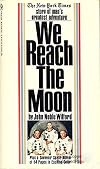
We Reach The Moon: The New York Times Story of Man's Greatest Adventure
by John Noble Wilford
On This Page
Tags
Recommendations





























Member Reviews
“The Eagle has landed.” So begins the events that culminate with those immortal words by Neil Armstrong, “That’s one small step for man, one giant leap for mankind.” In We reach the moon, written in 1969 soon after the first lunar landing by John Noble Wilford, a space reporter for the New York Times, we find out how this all came to be and why we were glued to the TV set that day in July. Drawing on the vast resources of the Times, Wilford tells the story of the race for the moon for the average reader starting with Sputnik in 1957, the Kennedy pledge to put a man on the moon by the end of the 1960s, John Glenn’s flight, the Apollo 1 disaster and more, ending with splashdown of the Apollo 11 mission. Weaving the story of show more the men who made it happen, scientists, engineers, contractors and astronauts with the plans for rockets, capsules, lunar modules and scientific experiments makes for compelling and exciting reading, even when knowing the end result.
Wilford has included a 64 color insert with photographs of astronauts, spacecraft and the real scene-stealers, the earth and the moon from outer space. Unfortunately the black-and-white photos of the Apollo11 mission are grainy and hard to see, due to the rush to get this book in print. There is a chart with all the manned missions in space up to the publication date, both Russian and American, along with a list of all Apollo/Saturn contractors, a selection of radio transmissions as published by the Times, an excellent index and a short bibliography containing classics of the space age. The book has numerous simple drawings of equipment to explain engineering concepts and basic rocket design.
For those who want more up to date material, there is a marvelous series, The NASA mission reports published by Apogee Books, covering most of the NASA pioneering flights. Each title includes at least 1 CD-ROM with movies, images and extra textual material. The one covering Apollo 11 is a three volume set.
It is hard to image that we got to the moon with the primitive technology of the 60s. Their state-of-the-art computers look like toys with little power. The technology for rockets, space suits and other accoutrements has progressed beyond anything dreamed of in 1969. Yet we haven’t come much farther. A man on Mars, a goal for the end of the century, hasn’t happened. We don’t have colonies on the moon. Yet that moon walk defined a generation and led to such promise of peace and progress. Space indeed is “the final frontier” and that first step was taken 43 years ago. show less
Wilford has included a 64 color insert with photographs of astronauts, spacecraft and the real scene-stealers, the earth and the moon from outer space. Unfortunately the black-and-white photos of the Apollo11 mission are grainy and hard to see, due to the rush to get this book in print. There is a chart with all the manned missions in space up to the publication date, both Russian and American, along with a list of all Apollo/Saturn contractors, a selection of radio transmissions as published by the Times, an excellent index and a short bibliography containing classics of the space age. The book has numerous simple drawings of equipment to explain engineering concepts and basic rocket design.
For those who want more up to date material, there is a marvelous series, The NASA mission reports published by Apogee Books, covering most of the NASA pioneering flights. Each title includes at least 1 CD-ROM with movies, images and extra textual material. The one covering Apollo 11 is a three volume set.
It is hard to image that we got to the moon with the primitive technology of the 60s. Their state-of-the-art computers look like toys with little power. The technology for rockets, space suits and other accoutrements has progressed beyond anything dreamed of in 1969. Yet we haven’t come much farther. A man on Mars, a goal for the end of the century, hasn’t happened. We don’t have colonies on the moon. Yet that moon walk defined a generation and led to such promise of peace and progress. Space indeed is “the final frontier” and that first step was taken 43 years ago. show less
Ratings
Members
- Recently Added By
Author Information

22+ Works 1,684 Members
John Noble Wilford, winner of two Pulitzer Prizes, has reported on science for the New York Times since 1965
Work Relationships
Has the adaptation
Common Knowledge
- Canonical title
- We Reach The Moon: The New York Times Story of Man's Greatest Adventure
- Original title
- We Reach the Moon
- Original publication date
- 1969-07
- People/Characters
- Buzz Aldrin; Neil Armstrong; Michael Collins, astronaut
- Important places
- The Moon
- Important events
- Apollo program (1961 | 1975)
- Original language
- English US
Classifications
- Genres
- Nonfiction, History, Science & Nature, Technology
- DDC/MDS
- 629.45 — Applied Science & Technology Engineering Transportation Vehicles Spacecraft & Vehicles Manned space flight
- LCC
- TL799 .M6 .W5 — Technology Motor vehicles. Aeronautics. Astronautics Motor vehicles. Aeronautics. Astronautics Astronautics. Space travel
Statistics
- Members
- 229
- Popularity
- 141,700
- Reviews
- 2
- Rating
- (3.72)
- Languages
- English, German, Italian
- Media
- Paper
- ISBNs
- 3
- UPCs
- 1
- ASINs
- 8