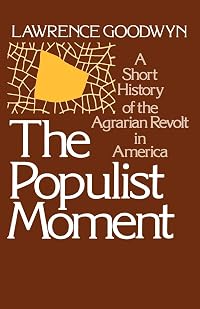
The Populist moment : a short history of the agrarian revolt in America
by Lawrence Goodwyn
On This Page
Description
This condensed version of Lawrence Goodwyn's Democratic Promise, the highly-acclaimed study on American Populism which the Civil Liberties Review called "a brilliant, comprehensive study," offers new political language designed to provide a fresh means of assessing both democracy andauthoritarianism today.Tags
Recommendations






Member Reviews
In spite of what you may think, the nation’s most successful movement against the forces that came to dominate post-Civil War America arose not from the cities or radical intellectuals but from southern and southwestern farmers. In the last quarter of the 19th century, farmers were painfully aware of how the rules of the Gilded Age economy were rigged for the benefit of Eastern banks and local merchants.
In ‘The Populist Moment,’ Lawrence Goodwyn details how a tight money supply demanded by Wall Street and creditors devalued the price of crops and land and bought the nation’s farming class to its knees. America’s farmers responded to the forces arrayed against them by promoting buying and marketing cooperatives, launching show more lecturers to spearhead their movement, and (when their organizing proved insufficient) by building their own political party. Goodwyn strength as a writer lies on how he depicts people usually consigned to the dustbin of history as individuals with goals, aspirations, a strategy and a vision the nation’s rulers found too subversive. Although we may seem light years removed from the world of a Texan or Kansan farmer of the late 19th century their predicament still holds important lessons for us. Goodwyn describes how exceedingly difficult it is for a social movement to push for economic reforms and the pitfalls laid before anyone who wishes to form an independent political party. show less
In ‘The Populist Moment,’ Lawrence Goodwyn details how a tight money supply demanded by Wall Street and creditors devalued the price of crops and land and bought the nation’s farming class to its knees. America’s farmers responded to the forces arrayed against them by promoting buying and marketing cooperatives, launching show more lecturers to spearhead their movement, and (when their organizing proved insufficient) by building their own political party. Goodwyn strength as a writer lies on how he depicts people usually consigned to the dustbin of history as individuals with goals, aspirations, a strategy and a vision the nation’s rulers found too subversive. Although we may seem light years removed from the world of a Texan or Kansan farmer of the late 19th century their predicament still holds important lessons for us. Goodwyn describes how exceedingly difficult it is for a social movement to push for economic reforms and the pitfalls laid before anyone who wishes to form an independent political party. show less
The populist "moment", as Lawrence Goodwyn describes it, was a point at which farmers in the southern US banded together to take control of their destinies. Goodwyn attributes the populist movement to several factors. First, the return to the gold standard meant a shrinking money supply. This was exacerbated by a credit system that was stacked against the farmer in favor of the supply merchant, who would take a lien against future harvest. The result was that it was very difficult for farmers to break even.
The first response was forming Alliance cooperatives, but the hostility of suppliers and bankers meant that credit was nearly impossible to obtain. This made the alliance turn from economics to politics as the only way to protect the show more interests of its members. Several lists of demands were made across the country for financial reform culminating in the formation of the Populist Party, which nominated William Jennings Bryan for president in 1896, As Bryan was already the Democratic candidate, this effectively submerged the populist movement under party priorities. show less
The first response was forming Alliance cooperatives, but the hostility of suppliers and bankers meant that credit was nearly impossible to obtain. This made the alliance turn from economics to politics as the only way to protect the show more interests of its members. Several lists of demands were made across the country for financial reform culminating in the formation of the Populist Party, which nominated William Jennings Bryan for president in 1896, As Bryan was already the Democratic candidate, this effectively submerged the populist movement under party priorities. show less
Journal entry for October 11, 1993
Since I am running out of time, this will be a highly sketchy consideration of Goodwyn, to which I must later return and fill in details. It strikes me that Livingston is right to question that if Lawrence Goodwyn is right (about Populism being the last truly democratic movement in American history), how can we talk about the 20th Century? For Goodwyn, as Livingston observes, the Populists are more than just the "liberals' Lost Cause." The failure of Populism is the end of American democracy and the story of the 20th century must be written as "the unheroic residue of tragedy."*
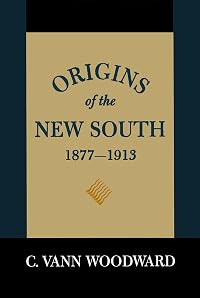
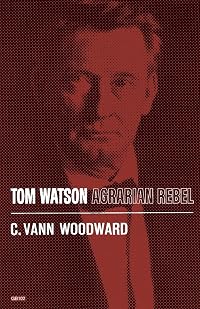
Building on C. Vann Woodward, Goodwyn's Populists come out of the New South, especially Texas. Understanding the development of show more the "movement culture" of the Farmers' Alliance is the key to understanding Southern and thus national Populism. The cooperative vision and program of the Alliance's lecturers formed the core of this cultural vision. By educating the masses in economic democracy, the Alliance politicized the masses. Yielding to silverism and to the shadow movement of William Jennings Bryan, Populism yielded on its most fundamental premise, the economic democracy of the sub treasury system. The failure of Populism, as the result of silverism, meant the triumph of the corporatist state and the end of any hope of true democracy.
Goodwyn's history of the 20th century is the exact opposite of Hofstadter's. For Goodwyn, the New Deal "unconsciously reflected the shrunken vistas that remained culturally permissible" (313). Hofstadter's New Deal is free from ideology. Goodwyn's New Deal is a mere shadow of the grand social vision of the Populist moment. One could quite easily see the Hostadtlerian vision as typical of the 1950s and Goodwyn's as typical of the 1960s, but where does that put us now? In the 1990s we are still debating the place of the Populists. We still haven't decided where we will take our stand, or have we?
And here is where class discussion should begin ...
*Walter Nugent underestimates the consequences of accepting Goodwyn's interpretation of the Populists. See his review of Promise; The Populist Movement in America by Lawrence Goodwyn, In Journal of American History 64 (September 1977): .464-5. Like many other reviews in ~-this one is rather bland. With such a controversial book as this, one would expect more. show less
Since I am running out of time, this will be a highly sketchy consideration of Goodwyn, to which I must later return and fill in details. It strikes me that Livingston is right to question that if Lawrence Goodwyn is right (about Populism being the last truly democratic movement in American history), how can we talk about the 20th Century? For Goodwyn, as Livingston observes, the Populists are more than just the "liberals' Lost Cause." The failure of Populism is the end of American democracy and the story of the 20th century must be written as "the unheroic residue of tragedy."*
Building on C. Vann Woodward, Goodwyn's Populists come out of the New South, especially Texas. Understanding the development of show more the "movement culture" of the Farmers' Alliance is the key to understanding Southern and thus national Populism. The cooperative vision and program of the Alliance's lecturers formed the core of this cultural vision. By educating the masses in economic democracy, the Alliance politicized the masses. Yielding to silverism and to the shadow movement of William Jennings Bryan, Populism yielded on its most fundamental premise, the economic democracy of the sub treasury system. The failure of Populism, as the result of silverism, meant the triumph of the corporatist state and the end of any hope of true democracy.
Goodwyn's history of the 20th century is the exact opposite of Hofstadter's. For Goodwyn, the New Deal "unconsciously reflected the shrunken vistas that remained culturally permissible" (313). Hofstadter's New Deal is free from ideology. Goodwyn's New Deal is a mere shadow of the grand social vision of the Populist moment. One could quite easily see the Hostadtlerian vision as typical of the 1950s and Goodwyn's as typical of the 1960s, but where does that put us now? In the 1990s we are still debating the place of the Populists. We still haven't decided where we will take our stand, or have we?
And here is where class discussion should begin ...
*Walter Nugent underestimates the consequences of accepting Goodwyn's interpretation of the Populists. See his review of Promise; The Populist Movement in America by Lawrence Goodwyn, In Journal of American History 64 (September 1977): .464-5. Like many other reviews in ~-this one is rather bland. With such a controversial book as this, one would expect more. show less
FOR REFERENCE:
Contents:
Introduction
I. Creating a Democratic Politics
1. Prelude to Populism: Discovering the Limits of American Politics
2. The Alliance Develops a Movement Culture
3. The Cooperative Vision: Building a Democratic Economy
II. The People's Movement Encounters the Received Culture
4. The National Alliance: Organizing Northern Farmers, Southern Blacks, and Urban Workers
5. Reform and Its Shadow: The Core Cultural Struggle
6. Reform Politicians, Reform Editors, and Plain People: The Language of American Populism
III. The Triumph of the Corporate State
7. The Shadow Movement Acquires a Purpose
8. The Last Agrarian Crusade: The Movement in the Silver Lobby
9. The Irony of Populism
Afterword
A Critical Essay on Authorities
Index
Contents:
Introduction
I. Creating a Democratic Politics
1. Prelude to Populism: Discovering the Limits of American Politics
2. The Alliance Develops a Movement Culture
3. The Cooperative Vision: Building a Democratic Economy
II. The People's Movement Encounters the Received Culture
4. The National Alliance: Organizing Northern Farmers, Southern Blacks, and Urban Workers
5. Reform and Its Shadow: The Core Cultural Struggle
6. Reform Politicians, Reform Editors, and Plain People: The Language of American Populism
III. The Triumph of the Corporate State
7. The Shadow Movement Acquires a Purpose
8. The Last Agrarian Crusade: The Movement in the Silver Lobby
9. The Irony of Populism
Afterword
A Critical Essay on Authorities
Index
Ratings
Members
- Recently Added By
Lists

2024-2025 Ezra Klein Guest Recommendations
213 works; 6 members

In Our Time books
4,934 works; 2 members
Author Information
5 Works 410 Members
Work Relationships
Is an abridged version of
Common Knowledge
- Canonical title
- The Populist moment : a short history of the agrarian revolt in America
- Original publication date
- 1978-11-30
- People/Characters
- William Jennings Bryan; Charles Macune; Jeremiah Simpson; Tom Watson
- Important places
- USA
- Epigraph
- I hope we shall crush in its birth the aristocracy of our monied corporations which dare already to challenge our government to a trial of strength, and bid defiance to the laws of our country. - Thomas Jefferson, 1816
He was the largest landholder . . . in one county and Justice of the Peace in the next and election commissioner in both, and hence the fountainhead if not of law at least of advice and suggestion . . . He was a farmer, a usu... (show all)rer, a veterinarian; Judge Benbow of Jefferson once said of him that a milder-mannered man never bled a mule or stuffed a ballot box. He owned most of the good land in the country and held mortgages on most of the rest. He owned the store and the cotton gin and the combined grist mill and blacksmith shop in the village proper and it was considered, to put it mildly, bad luck for a man of the neighborhood to do his trading or gin his cotton or grind his meal or shoe his stock anywhere else.
- The furnishing merchant in The Hamlet, by William Faulkner - Dedication
- To Nell
- First words
- This book is about the flowering of the largest democratic mass movement in American history. [Introduction]
- Last words
- (Click to show. Warning: May contain spoilers.)It was the corporate state that the People's Party attempted to bring under democratic control.
- Blurbers
- Coles, Robert; Nugent, Walter; Rosenstone, Robert A.; Woodward, C. Vann
- Original language
- English
Classifications
- Genres
- Nonfiction, History, General Nonfiction, Politics and Government
- DDC/MDS
- 329.88009 — Society, government, & culture Political science [Formerly: Political Parties and conventions] Minor parties
- LCC
- E661 .G672 — History of the United States United States Late nineteenth century, 1865-1900 Diplomatic history. Foreign and general
- BISAC
Statistics
- Members
- 305
- Popularity
- 105,519
- Reviews
- 5
- Rating
- (3.80)
- Languages
- English
- Media
- Paper, Ebook
- ISBNs
- 2
- ASINs
- 2