On This Page
Description
After a brief introduction, the complex genealogies of the gods lead him from the begettings of the Titans and from Aphrodite under all her titles and aspects, to Apollo, Hermes and the reign of Zeus, touching upon the Affairs of Pan, nymphs, satyrs, cosmogonies and the birth of mankind, until he reaches the ineffable mystery of Dionysos. The lively and highly readable narrative is complemented by an appendix of detailed references to all the original texts and a fine selection of show more illustrations taken from vase paintings. show lessTags
Recommendations


































Member Reviews
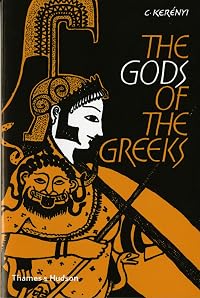
67. The Gods of the Greeks by Karl Kerényi
translation: from German by Norman Cameron
published: 1951
format: 286 page paperback (1994 reprint of 1979 edition)
acquired: March
read: Nov 5-12
rating: 4
wikipedia tells me Kerényi was a classical philologist and that he was a Hungarian who spent a year in Switzerland and then never left. Hungry had swung Nazi right. It also tells me that his "scientific interpretation of the figures of Greek mythology as archetypes of the human soul was in line with the approach of the Swiss psychologist Carl Gustav Jung." This curiosity is not in display here, except for a brief comment in the introduction where he says that Greek mythology of interest for the study of human beings and that in the contemporary show more world that meant "of course, an interest in psychology."
Instead the [The Gods of the Greeks] is a straight-forward summary of everything the classical sources have to say about the Greek Gods. He cites only about 200 sources and they are all classical. He calls it a mythology of the Greek for adults. It is however, anything but straightforward. The mythology of Greeks is nowhere near as simple as [[Edith Hamilton]], or anyone else presented it. There is simply no consistency, but numerous and endless variations. And presented in this form, in the way Kerényi does, it is a bit overwhelming, a constant barrage of uncondensable information.
"The archaic forms of so many tales have been lost that the whole body of what has reached us and can be presented has become exceedingly compact. This compactness should not be artificially loosened. Already in Ovid we find the archaic spirit has been spoilt in a process of dilution. The author has decided against trying to provide any relief of this kind. The reader's best plan, therefore, is to not absorb too much of this solid fare at a sitting, but to read only a few pages at a time—and preferably more than once, as he would read an ancient poem."
I quickly learned to follow his advice. Somewhere around ten pages at a sitting my eyes would start to cross and pressing any further, I could feel my brain actively shrinking.
What comes out of this is no one single thing. It's something of a massive compilation of information, in a very pure form. It's also striking not only how unstructured all this was, but how one thing was many things and how associations and combinations means that many of these characters whom we see as distinct - Gaia and Ouranos, Cronos & Rhea & Demeter and Persephone, Zeus & Hera, Aphrodite & Adonis, Ares, Athena, Apollo, Hermes, and Dyonisos... Prometheus, Io, Fates, Furies, Typhon etc are merely variations on the same theme - the same god or goddess concept could come in many variations then get recombined and forced apart by divine lineages. Flexibility and openness seems to have been one rule - perhaps variation from many forms of communal isolation and connection might have been another.
Certainly recommended to anyone who wants to know enough about mythology that they can finally rest assured they still really know nothing.
2016
https://www.librarything.com/topic/226898#5796816 show less
translation: from German by Norman Cameron
published: 1951
format: 286 page paperback (1994 reprint of 1979 edition)
acquired: March
read: Nov 5-12
rating: 4
wikipedia tells me Kerényi was a classical philologist and that he was a Hungarian who spent a year in Switzerland and then never left. Hungry had swung Nazi right. It also tells me that his "scientific interpretation of the figures of Greek mythology as archetypes of the human soul was in line with the approach of the Swiss psychologist Carl Gustav Jung." This curiosity is not in display here, except for a brief comment in the introduction where he says that Greek mythology of interest for the study of human beings and that in the contemporary show more world that meant "of course, an interest in psychology."
Instead the [The Gods of the Greeks] is a straight-forward summary of everything the classical sources have to say about the Greek Gods. He cites only about 200 sources and they are all classical. He calls it a mythology of the Greek for adults. It is however, anything but straightforward. The mythology of Greeks is nowhere near as simple as [[Edith Hamilton]], or anyone else presented it. There is simply no consistency, but numerous and endless variations. And presented in this form, in the way Kerényi does, it is a bit overwhelming, a constant barrage of uncondensable information.
"The archaic forms of so many tales have been lost that the whole body of what has reached us and can be presented has become exceedingly compact. This compactness should not be artificially loosened. Already in Ovid we find the archaic spirit has been spoilt in a process of dilution. The author has decided against trying to provide any relief of this kind. The reader's best plan, therefore, is to not absorb too much of this solid fare at a sitting, but to read only a few pages at a time—and preferably more than once, as he would read an ancient poem."
I quickly learned to follow his advice. Somewhere around ten pages at a sitting my eyes would start to cross and pressing any further, I could feel my brain actively shrinking.
What comes out of this is no one single thing. It's something of a massive compilation of information, in a very pure form. It's also striking not only how unstructured all this was, but how one thing was many things and how associations and combinations means that many of these characters whom we see as distinct - Gaia and Ouranos, Cronos & Rhea & Demeter and Persephone, Zeus & Hera, Aphrodite & Adonis, Ares, Athena, Apollo, Hermes, and Dyonisos... Prometheus, Io, Fates, Furies, Typhon etc are merely variations on the same theme - the same god or goddess concept could come in many variations then get recombined and forced apart by divine lineages. Flexibility and openness seems to have been one rule - perhaps variation from many forms of communal isolation and connection might have been another.
Certainly recommended to anyone who wants to know enough about mythology that they can finally rest assured they still really know nothing.
2016
https://www.librarything.com/topic/226898#5796816 show less
~ Kerenyi has often been tarred with a Jungian brush, but in this early and independent work, he admirably displays his intimate knowledge of the language, art and traditions of the Greek peoples. He also consistently delves to the most ancient known source of a myth for its telling, to the benefit of all layman scholars.
Due palle...
Ratings
Members
- Recently Added By
Author Information

122+ Works 2,911 Members
Those interested in Jungian psychology and ancient religions should look carefully at the work of Karoly (or Karl) Kerenyi. Kerenyi was a friend of, and coauthor with, Carl Jung, a cofounder of the Jung Institute in Zurich, and a regular participant in the Eranos conferences in Ascona, Switzerland. His work is not, however, Jungian in the show more strictest sense of the word. Trained as a classical philologist, Kerenyi attempted to transcend the limits of historical study and to reveal the "theological" or contemporary significance of ancient myths. In doing so, he relied not solely on literary and archaeological documentation but also invoked a relationship of sympathy between the scholar and the evidence. Among an incredible number of publications, Kerenyi pursued this agenda in a series of volumes devoted to the mythologies of individual Greek gods and goddesses. Throughout, his writing is accessible to the general reader. (Bowker Author Biography) show less
Some Editions
Series

Belongs to Publisher Series
Work Relationships
Is contained in
Common Knowledge
- Canonical title
- The Gods of the Greeks
- Original title
- Die Mythologie der Griechen - Band 1: Die Götter- und Menschheitsgeschichten; Die Mythologie der Griechen
- Original publication date
- 1951 (UNITED KINDOM) (UNITED KINDOM); 1980 (USA) (USA)
- Epigraph*
- Mi ricordo di questa idea che risaliva a non so quale piacere sensuale e insieme spirituale: come il cervo inseguito cerca l'acqua in cui precipitarsi, così bramavo di vivere in questi corpi nudi, lucidi, in queste figure di... (show all) Narciso e di Proteo, di Perseo e Atteone: desideravo scomparire in essi ed esprimermi con le loro parole.
Hugo von Hofmannsthal - Dedication*
- A mia moglie Dildil
- Original language
- German
- Disambiguation notice
- Gods of the Greeks is the first part of The Mythology of the Greeks. Please, do not combine with the second part or with the complete work, thanks.
*Some information comes from Common Knowledge in other languages. Click "Edit" for more information.
Classifications
- Genres
- Nonfiction, Religion & Spirituality, History, General Nonfiction
- DDC/MDS
- 292.13 — Religion Other religions Greek & Roman Mythology Religious mythology, general classes of religion, interreligious relations and attitudes, social theology Mythology and mythological foundations
- LCC
- BL781 .K363 — Philosophy, Psychology and Religion Religions. Mythology. Rationalism Religions. Mythology. Rationalism History and principles of religions European. Occidental Classical (Etruscan, Greek, Roman)
- BISAC
Statistics
- Members
- 580
- Popularity
- 50,991
- Reviews
- 3
- Rating
- (3.99)
- Languages
- 7 — Dutch, English, German, Italian, Polish, Portuguese, Spanish
- Media
- Paper, Ebook
- ISBNs
- 15
- ASINs
- 11