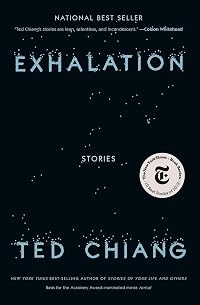
Exhalation
by Ted Chiang
On This Page
Description
This much-anticipated second collection of stories is signature Ted Chiang, full of revelatory ideas and deeply sympathetic characters. In "The Merchant and the Alchemist's Gate," a portal through time forces a fabric seller in ancient Baghdad to grapple with past mistakes and the temptation of second chances. In the epistolary "Exhalation," an alien scientist makes a shocking discovery with ramifications not just for his own people, but for all of reality. And in "The Lifecycle of Software show more Objects," a woman cares for an artificial intelligence over twenty years, elevating a faddish digital pet into what might be a true living being. Also included are two brand-new stories: "Omphalos" and "Anxiety Is the Dizziness of Freedom." In this fantastical and elegant collection, Ted Chiang wrestles with the oldest questions on earth--What is the nature of the universe? What does it mean to be human?--and ones that no one else has even imagined. And, each in its own way, the stories prove that complex and thoughtful science fiction can rise to new heights of beauty, meaning, and compassion. show lessTags
Recommendations










Member Recommendations

by anonymous user
Member Reviews
Other than Arrival and "Story of Your Life," this was my first exposure to Ted Chiang's work. At his best, Chiang hits that doubling effect of science fiction I love so much: he build other worlds based on scientific ideas, and his ideas serve as metaphors about our world. Chiang tends toward the hard sf end of the spectrum, which is to say that his ideas are put forth in great detail. I don't know if the science is real but it feels real, and Chiang keeps explaining it interesting, usually by paralleling it with the human impact of the technology.
Stories that really worked in this way including "The Truth of Fact, the Truth of Feeling," about how writing reshaped our cognition, and about how memory retrieval is likely to do so again; I show more really liked his point that memory technologies will do for individual people what writing did on a societal scale. (As I was reading the story, I thought, "someone knows his Walter Ong," and then I got to "story notes"... and yes he does!) I also really liked "Anxiety Is the Dizziness of Freedom," about branching timelines. It's clearly a grounded, realistic take on the idea, and in being so, does some really interesting stuff that I've never seen before in sf.
The more middling stories don't quite thread this needle. I thought "The Merchant and the Alchemists' Gate" (a take on how a time machine would "actually" work) was intellectually interesting, but it didn't have the emotional impact of Chiang at his best; similar thoughts were spurred by "Omphalos."
Chiang seems to be at his weakest when in short-short mode; all the stories I liked least were ones that explored an idea but didn't really support it with character or thematic work. Thus you lose the doubling effect of the best sf: I liked the weird other worlds, but I want to see the connection to our world. I felt the title story fell into this trap, as did "What's Expected of Us" (I didn't even remember what this one was about until I flipped back through it to write this review) and "Dacey's Patent Automatic Nanny" (about a Victorian who makes a mechanical child-rearer, it's told in the form of a museum guidebook, which keeps you rather distant from the actual events, and as a Victorianist, I didn't think the period details rang true; it felt like someone's stereotypes of the era). I think Chiang actually did pull off the form in "The Great Silence," a cute story about the parrots who live near the Arecibo Observatory.
My favorite story in the book was "The Lifecycle of Software Objects," about a group of people "raising" AIs in a computer environment. I really appreciated its accurate depiction of AI; ever since I read Gödel, Escher, Bach, it's seemed unlikely to me that AI would spring into the world fully sapient. Any truly emergent system would have to be taught just like human have to be taught. It's a really neat look at how that process might go, and how difficult it might be, and how external factors might influence it-- and it's also a really moving depiction of the difficulties of parenting and figuring out when to let someone be autonomous. An incredible piece of sf writing that does what only sf can do at its best. show less
Stories that really worked in this way including "The Truth of Fact, the Truth of Feeling," about how writing reshaped our cognition, and about how memory retrieval is likely to do so again; I show more really liked his point that memory technologies will do for individual people what writing did on a societal scale. (As I was reading the story, I thought, "someone knows his Walter Ong," and then I got to "story notes"... and yes he does!) I also really liked "Anxiety Is the Dizziness of Freedom," about branching timelines. It's clearly a grounded, realistic take on the idea, and in being so, does some really interesting stuff that I've never seen before in sf.
The more middling stories don't quite thread this needle. I thought "The Merchant and the Alchemists' Gate" (a take on how a time machine would "actually" work) was intellectually interesting, but it didn't have the emotional impact of Chiang at his best; similar thoughts were spurred by "Omphalos."
Chiang seems to be at his weakest when in short-short mode; all the stories I liked least were ones that explored an idea but didn't really support it with character or thematic work. Thus you lose the doubling effect of the best sf: I liked the weird other worlds, but I want to see the connection to our world. I felt the title story fell into this trap, as did "What's Expected of Us" (I didn't even remember what this one was about until I flipped back through it to write this review) and "Dacey's Patent Automatic Nanny" (about a Victorian who makes a mechanical child-rearer, it's told in the form of a museum guidebook, which keeps you rather distant from the actual events, and as a Victorianist, I didn't think the period details rang true; it felt like someone's stereotypes of the era). I think Chiang actually did pull off the form in "The Great Silence," a cute story about the parrots who live near the Arecibo Observatory.
My favorite story in the book was "The Lifecycle of Software Objects," about a group of people "raising" AIs in a computer environment. I really appreciated its accurate depiction of AI; ever since I read Gödel, Escher, Bach, it's seemed unlikely to me that AI would spring into the world fully sapient. Any truly emergent system would have to be taught just like human have to be taught. It's a really neat look at how that process might go, and how difficult it might be, and how external factors might influence it-- and it's also a really moving depiction of the difficulties of parenting and figuring out when to let someone be autonomous. An incredible piece of sf writing that does what only sf can do at its best. show less
The Merchant and the Alchemist's Gate: In a story-within-a-story, a merchant meets an alchemist who invented a gate through which a traveler can access the future or past. The alchemist tells him an additional layer of stories, and the merchant decides to go to the past and change things.
This story is fine, but not spectacular. It contains some time travel tropes that I enjoy, while also feeling very Arabian Nights. Perhaps a little derivative of it.
Exhalation {short story}: The narrator describes their life a bit, and then their discovery that the environment is deteriorating and their species will go extinct in a few hundred years.
A nice little story with a good twist -the people are robots . It felt kind of halfway between Ray show more Bradbury and H.G. Wells. It's a little bit of a metaphor about climate change, except it falls apart when there's nothing society can do about it. (Solar power would fix their problem but they live inside a titanium dome .) I enjoyed it a lot.
What's Expected of Us: A very short letter from the future explains the invention of a button that lights up one second before you press it, and the effect it had on society.
This story is only 4 pages but it packs a lot. A good lesson - it doesn't matter if we have free will or not, but we have to act like we do.
The Lifecycle of Software Objects: Ana and Derek both work for a company that creates Digients, cute digital pets with a genetics-mimicking algorithm that allows them to grow and change based on how they're raised in their digital world. They love their work, bond with the Digients they've created and raised, and create a community with other Digient owners. The market for these pets is vibrant, with several companies in gentle competition over who has the best algorithm or the cutest interface. Over the next few years, however, the market declines and eventually the company closes. Ana and Derek get jobs elsewhere, but continue to find joy in raising their Digients in their free time. As the tech world continues to move on to shiny new things, the digital world the Digients live in is no longer supported and is in danger of shutting down. The Digients could be ported into a more modern space, but it would cost far more than the dwindling Digient-raising community could ever afford on their own. They are approached by a company with a proposal: sell copies of their hand-raised Digients to be used as sexual companions, and guarantee their survival.
This truly remarkable story has been sitting with me since I first read it 5 years ago. I think about it constantly. It's hard to explain in a plot synopsis but Ana's bond with her Digient feels so true, and the way she feels about losing them is the way I imagine I would feel if, say, LibraryThing shut down tomorrow. The story is about what it's like to form a bond with an internet community, but it's also about what it means to be a sentient being. An adult. To consent. The Digients are in favor of selling copies as sexual companions because for them, like humans who have turned to sex work since time immemorial, it's about an existential threat. To the owners it is unconscionable, because they don't think the pets they've been raising for the last 18 years are capable of consent. Really thought-provoking stuff.
The only bad part of this novella is the relationship between Ana and Derek. The story is told equally from their points of view, but Derek's sections are full of romantic thoughts about Ana. At first he is married but wants to be with Ana, then he gets divorced but Ana is in a relationship and Derek thinks all the time about whether/how he can drive a wedge between them. Ana, on the other hand, never thinks about him romantically in any direction and is apparently unaware of his obsession. It's a gross dynamic that treats an otherwise well-written woman like an object. The point of it in the end is thatDerek "sacrifices" his "chance" of a relationship with Ana by selling a copy of one of his Digients so that she doesn't have to take a possibly abusive job to pay for the port. It's not that she's terribly disgusted with him for doing so (after he explains that he let the Digient choose), but that her boyfriend did not want her to take the abusive job and so by preventing that Derek pushed them together. It left a bad taste in my mouth to end a story about consent on that note.
Despite that fairly big flaw, I do highly recommend this story. I think the good parts will stick with you.
Dacey's Patent Automatic Nanny: An eccentric inventor in 1901 creates a mechanical nanny that will help raise children, after being unhappy with how he saw real nannies treat his son. It doesn't catch on, but later the inventor's son revives the mechanical nanny, and has it raise his own son.
A nice little story with a steampunk vibe. I liked that both of the inventors are well-meaning (the original inventor thinks that nannies should be nicer), and that nothing really bad happens to the young child, he's justemotionally bonded to robots, which is totally fine after he gets a few accommodations . I especially liked that the whole story is presented as the description of an item in a museum catalog.
The Truth of Fact, the Truth of Feeling: Two alternating narratives - a first-person story from a future in which everyone's life is awkwardly recorded on video and the introduction of a new algorithm which analyzes and organizes the videos to anticipate which ones the user might want to revisit, and an historical account from the introduction of written language to a fictional pre-literate African society.
I didn't love this one. I think it goes on too long, especially compared to other stories in this collection which are so concise. The point is that new technology, whether it's written language or a video-analyzing algorithm, will radically change society but society will adapt and move on and everything will be fine. But it takes too long to get there.
The Great Silence: A parrot laments in the first-person that humans spend all their time and energy trying to communicate with aliens beyond earth, when they could be communicating with parrots right here on earth.
I don't think this one really clicked for me, but it's short and sweet.
Omphalos: A world that is mostly the same as ours, except there is substantial tangible proof that all of life was created at once several thousand years ago. The narrator, an archaeologist who specializes in uncovering artifacts proving the creation of life, investigates a black market which leads to an astronomer who has discovered life on another planet which seems to be more favored by God than Earth. A crisis of faith ensues.
This story was fine. The faith vs. proof aspect didn't speak to me but I really liked thinking about how this world differs from ours. I liked the methodology for realizing that life was created (by examining ancient preserved wood they can see the point at which tree trunk rings begin, same with ancient shellfish shells) and how their Earth never discovered how genetics works because there is no evolution.
Anxiety Is the Dizziness of Freedom: A device is invented which causes a single change at the quantum level, branching the timeline into two, and also allows communication between the timelines. The technology is originally used for research, but as it gets less expensive regular people start using the device (called a "prism") to talk to their alternate timeline selves. Some find it comforting, but others become addicted and spend all their time thinking about how their life could be if it was slightly different. Nat works in a shop where people can rent prisms, and on the side she and her coworker hustle prism users out of money whenever they can. Dana is a therapist who sees patients and also runs a support group for prism addicts, which Nat starts attending as part of a scam.
I really loved this story. It's the only story in this collection in which any character has actual bad intentions, and it also provides lots to think about. It's about free will and determinism. If for every action you take there is an alternate timeline in which you make a different choice, does any choice matter? Or, if you consistently act a particular way does that become an inherent part of you that is rarely changeable? I really loved the story's ending.
Overall this is an excellent collection. The stories are varied but still themed - free will, the introduction of new technology, seeing the future. There was a bit more first-person narration than I like, but I really enjoyed that all of the stories are gentle and everyone is well-meaning. Highly recommended, and I’m definitely going to check out the author’s other collection. show less
This story is fine, but not spectacular. It contains some time travel tropes that I enjoy, while also feeling very Arabian Nights. Perhaps a little derivative of it.
Exhalation {short story}: The narrator describes their life a bit, and then their discovery that the environment is deteriorating and their species will go extinct in a few hundred years.
A nice little story with a good twist -
What's Expected of Us: A very short letter from the future explains the invention of a button that lights up one second before you press it, and the effect it had on society.
This story is only 4 pages but it packs a lot. A good lesson - it doesn't matter if we have free will or not, but we have to act like we do.
The Lifecycle of Software Objects: Ana and Derek both work for a company that creates Digients, cute digital pets with a genetics-mimicking algorithm that allows them to grow and change based on how they're raised in their digital world. They love their work, bond with the Digients they've created and raised, and create a community with other Digient owners. The market for these pets is vibrant, with several companies in gentle competition over who has the best algorithm or the cutest interface. Over the next few years, however, the market declines and eventually the company closes. Ana and Derek get jobs elsewhere, but continue to find joy in raising their Digients in their free time. As the tech world continues to move on to shiny new things, the digital world the Digients live in is no longer supported and is in danger of shutting down. The Digients could be ported into a more modern space, but it would cost far more than the dwindling Digient-raising community could ever afford on their own. They are approached by a company with a proposal: sell copies of their hand-raised Digients to be used as sexual companions, and guarantee their survival.
This truly remarkable story has been sitting with me since I first read it 5 years ago. I think about it constantly. It's hard to explain in a plot synopsis but Ana's bond with her Digient feels so true, and the way she feels about losing them is the way I imagine I would feel if, say, LibraryThing shut down tomorrow. The story is about what it's like to form a bond with an internet community, but it's also about what it means to be a sentient being. An adult. To consent. The Digients are in favor of selling copies as sexual companions because for them, like humans who have turned to sex work since time immemorial, it's about an existential threat. To the owners it is unconscionable, because they don't think the pets they've been raising for the last 18 years are capable of consent. Really thought-provoking stuff.
The only bad part of this novella is the relationship between Ana and Derek. The story is told equally from their points of view, but Derek's sections are full of romantic thoughts about Ana. At first he is married but wants to be with Ana, then he gets divorced but Ana is in a relationship and Derek thinks all the time about whether/how he can drive a wedge between them. Ana, on the other hand, never thinks about him romantically in any direction and is apparently unaware of his obsession. It's a gross dynamic that treats an otherwise well-written woman like an object. The point of it in the end is that
Despite that fairly big flaw, I do highly recommend this story. I think the good parts will stick with you.
Dacey's Patent Automatic Nanny: An eccentric inventor in 1901 creates a mechanical nanny that will help raise children, after being unhappy with how he saw real nannies treat his son. It doesn't catch on, but later the inventor's son revives the mechanical nanny, and has it raise his own son.
A nice little story with a steampunk vibe. I liked that both of the inventors are well-meaning (the original inventor thinks that nannies should be nicer), and that nothing really bad happens to the young child, he's just
The Truth of Fact, the Truth of Feeling: Two alternating narratives - a first-person story from a future in which everyone's life is awkwardly recorded on video and the introduction of a new algorithm which analyzes and organizes the videos to anticipate which ones the user might want to revisit, and an historical account from the introduction of written language to a fictional pre-literate African society.
I didn't love this one. I think it goes on too long, especially compared to other stories in this collection which are so concise. The point is that new technology, whether it's written language or a video-analyzing algorithm, will radically change society but society will adapt and move on and everything will be fine. But it takes too long to get there.
The Great Silence: A parrot laments in the first-person that humans spend all their time and energy trying to communicate with aliens beyond earth, when they could be communicating with parrots right here on earth.
I don't think this one really clicked for me, but it's short and sweet.
Omphalos: A world that is mostly the same as ours, except there is substantial tangible proof that all of life was created at once several thousand years ago. The narrator, an archaeologist who specializes in uncovering artifacts proving the creation of life, investigates a black market which leads to an astronomer who has discovered life on another planet which seems to be more favored by God than Earth. A crisis of faith ensues.
This story was fine. The faith vs. proof aspect didn't speak to me but I really liked thinking about how this world differs from ours. I liked the methodology for realizing that life was created (by examining ancient preserved wood they can see the point at which tree trunk rings begin, same with ancient shellfish shells) and how their Earth never discovered how genetics works because there is no evolution.
Anxiety Is the Dizziness of Freedom: A device is invented which causes a single change at the quantum level, branching the timeline into two, and also allows communication between the timelines. The technology is originally used for research, but as it gets less expensive regular people start using the device (called a "prism") to talk to their alternate timeline selves. Some find it comforting, but others become addicted and spend all their time thinking about how their life could be if it was slightly different. Nat works in a shop where people can rent prisms, and on the side she and her coworker hustle prism users out of money whenever they can. Dana is a therapist who sees patients and also runs a support group for prism addicts, which Nat starts attending as part of a scam.
I really loved this story. It's the only story in this collection in which any character has actual bad intentions, and it also provides lots to think about. It's about free will and determinism. If for every action you take there is an alternate timeline in which you make a different choice, does any choice matter? Or, if you consistently act a particular way does that become an inherent part of you that is rarely changeable? I really loved the story's ending.
Overall this is an excellent collection. The stories are varied but still themed - free will, the introduction of new technology, seeing the future. There was a bit more first-person narration than I like, but I really enjoyed that all of the stories are gentle and everyone is well-meaning. Highly recommended, and I’m definitely going to check out the author’s other collection. show less
Chiang's stories walk a thin line between fiction and thought experiment. As prompters for speculation about free will, consciousness, the multiverse etc. they're excellent. I especially liked the title story, set in a pneumatically-powered universe where the equalization of air pressure is a metaphor for entropy in ours, and featuring an extended scene of self-conducted brain dissection. What this story has in common with Chiang's best is that it sticks the emotional landing: The Merchant and the Alchemist's Gate, a time-traveling Arabian Nights-style frame story does this too, and is impossibly clever to boot.
I was less taken with the Hugo-winning novella The Lifecycle of Software Objects, which relates the ups and downs of a group of show more (mostly) VR-dwelling self-learning AI's, designed and marketed as virtual pets, and their human owners in loco parentis. Unfortunately the "digients" never get past toddler-speak, so the dialogue is somewhat infuriating, although it has its moments, like when they get upset because their owners won't legally incorporate them:
I was less taken with the Hugo-winning novella The Lifecycle of Software Objects, which relates the ups and downs of a group of show more (mostly) VR-dwelling self-learning AI's, designed and marketed as virtual pets, and their human owners in loco parentis. Unfortunately the "digients" never get past toddler-speak, so the dialogue is somewhat infuriating, although it has its moments, like when they get upset because their owners won't legally incorporate them:
"People say being corporation great," says Marco. "Can do whatever want."A wry moment in a too-long tale. But I can't really fault Chiang for writing brain-twizzling conceptual science fiction tales; God knows the general direction of the genre seems to favour the waving of hands and the baring of souls. Three or four of these — shout-out to closer Anxiety is the Dizziness of Freedom — reach the empyrean heights of Story of Your Life, and you can't ask for more than that. show less
A number of human adolescents have complained that Voyl has more rights than they do; obviously the digients have seen their comments. "Well, you're not incorporated, and you definitely cannot do anything you want."
"We sorry," says Marco, suddenly appreciating the trouble he's in. "Just want be corporations."
Chiang writes the most amazing short sf stories. They’re about the nature of consciousness, free will, and moral duty/desert, whether they’re about nonhuman intelligences in the form of parrots, AI, God, or otherwise. My favorite here was The Lifecycle of Software Objects, in which “digients”—intelligent, childlike artificial entities—start out as commercial products, then become obsolete and still beloved by a few, who struggle with how to treat them (as children, pets, corporate entities with their own decisionmaking capability, something else) and how to deal with technical obsolescence. When a chance to port the digients to a more modern environment arrives, but only if the company at issue can make some of the digients show more into sexual companions, the ethical challenges get even more severe. Can a digient consent to having its reward pathways changed so that it “genuinely wants” to have virtual sex with a human being? If that’s the only way to get the money to give the digients access to the rest of the virtual world, is that ok? How different is that from one of the humans involved, who is considering taking a designer drug that will make her love her employment so that she can get a chance to convince her employer to port the digients without the sexual aspect? Chiang’s characters are serious people trying to do well, but they aren’t perfect, just thoughtful. Another great story imagines being a scientist in a world with clear evidence of recent creation: tree cores that have a uniform radius five thousand years back; mummies with no navels; ancient deer bones with no growth marks because they were created as adults. But what happens to faith when science shows that the Earth isn’t the center of the universe and, crucially, that some other planet is? See also his almost-story op-ed in the NYT, It’s 2059, and the Rich Kids Are Still Winning https://www.nytimes.com/2019/05/27/opinion/ted-chiang-future-genetic-engineering.... show less
I liked this one a lot. Chiang walks down the aisle between sf and philosophy and pulls in both sides for each story—so "What's Expected of Us" looks at the conundrum of free will through a sf/tech lens, and "The Lifecycle of Software Objects" is a take on AI and tech obsolescence that turns it into a philosophical/moral issue, bringing in not just the expected Uncanny Valley musings but also thoughts about agency, animal rights, parenthood, and consent. The collection reminded me of reading sf as an early teen, when the good thoughtful stuff (hello, [Dangerous Visions]) was new and sparked all sorts of deep thoughts... none of Chang's plots is particularly radical, but he approaches them in novel ways and writes well.
Every time I show more said I was reading this, people would tell me that his last collection, [Stories of Your Life and Others], was the real killer, so I'll probably be librarying that one up soon. show less
Every time I show more said I was reading this, people would tell me that his last collection, [Stories of Your Life and Others], was the real killer, so I'll probably be librarying that one up soon. show less
Ted Chiang is one of the most remarkable voices in science fiction. Above all else, he is a living symbol that science fiction is a literature of ideas. He writes at a bonsai pace, perhaps 20 short works over as many years, but each of them is a masterpiece.
In Exhalation, Chiang wrestles with the paradoxes of predestination and growth. The Merchant and the Alchemist's Gate is a time travel story set in the medieval Arab world, where various characters encounter a wormhole through time, and discover that fate is exactly as Allah wills it, no more and no less. This is a theme returned to in What's Expected of Us, where a machine that blinks one second before you push the button causes mass hysteria, and more generously in Anxiety is the show more Dizziness of Freedom, concerning a world with common communication with nearby quantum neighbors, and the psychological effects of being able to communicate with your paraselves.
The other major tentpole of the book is forms of childhood, particular through The Lifecycle of Software Objects which focuses on the growth of intelligent if not terribly bright AI pets in a virtual world, and the bonds they form with their humans as they reach a tentative adulthood.
But my favorite stories were Omphalos and Exhalation, relentlessly rigorous extrapolations of a single high concept that showcase a brilliant alternative takes on Young Earth Creationism and the Third Law of Thermodynamics. show less
In Exhalation, Chiang wrestles with the paradoxes of predestination and growth. The Merchant and the Alchemist's Gate is a time travel story set in the medieval Arab world, where various characters encounter a wormhole through time, and discover that fate is exactly as Allah wills it, no more and no less. This is a theme returned to in What's Expected of Us, where a machine that blinks one second before you push the button causes mass hysteria, and more generously in Anxiety is the show more Dizziness of Freedom, concerning a world with common communication with nearby quantum neighbors, and the psychological effects of being able to communicate with your paraselves.
The other major tentpole of the book is forms of childhood, particular through The Lifecycle of Software Objects which focuses on the growth of intelligent if not terribly bright AI pets in a virtual world, and the bonds they form with their humans as they reach a tentative adulthood.
But my favorite stories were Omphalos and Exhalation, relentlessly rigorous extrapolations of a single high concept that showcase a brilliant alternative takes on Young Earth Creationism and the Third Law of Thermodynamics. show less
Ted Chiang is becoming a do-not-miss writer for me. I don’t have a lot of them.
This is his second collection of short stories, and these are much like the first (Stories of Your Life). They have the same somewhat abstract and experimental feel to them.
Chiang is a writer who is inspired by ideas more than by characters. Many of his stories are experiments in possible realities or possible futures that reveal something about human nature in the here and now.
What if we had infallible memory, so that we could instantly replay the video and audio of events and conversations? No one could misremember or reinterpret the past. Do we actually depend on our ability to transform our memories to conform to who we think we are in some way, or to show more who we hope to become? Do we need to have uncertainty about what has happened in our relations with others in order to even get along with one another? Is misremembering or reinterpreting the past healthy?
What if time travel were really possible? How would it work? What would we do? What would we not do? How could we take advantage of being able to visit and influence our future selves? How would it change how we live in the present?
What if science and religion worked hand in hand, such that scientists really did discover evidence of God’s creation (e.g., trees whose growth rings were blank before the time of creation)? What would happen if we then discovered something that after all contradicted science’s affirmation of religious beliefs?
The final story, Anxiety is the Dizziness of Freedom, is a great example of Chiang’s experimental approach. What if the many worlds interpretation of quantum physics were true, and that we could actually intentionally spawn and then communicate between possible realities? What would we do? How would it transform our lives?
Chiang is categorized as a science fiction writer, but I think that’s a little misleading. Some so-called science fiction writers, like Ray Bradbury, Theodore Sturgeon, or Philip K. Dick, go broader than any narrow conception of science fiction. If Chiang is like any of those, it would be Dick, I think. Experimental realities, possible futures. What does placing ourselves in alternative realities and futures reveal?
If I have a general criticism, it is that Chiang’s writing does have an abstract feel. There are exceptions. The longest story in this collection, The Lifecycle of Software Objects, is one of those, in which the characters do develop, and the story takes on a more human, even warm feel, as Chiang explores the relationships that develop between humans and “digients” — artificial characters created by humans, cared for by humans, but with lives of their own.
But I think his uniqueness, his “genius” if we call it that, is tied to that abstract feel of his stories. He has ideas. And he plays his ideas out in his stories. The stories are as clever as the ideas, and that’s pretty clever.
The characters may not feel as real or have the apparent autonomy as those of some very different writers (Jesmyn Ward comes to mind). For those writers, it’s as if they create the characters first, place them in a context, and then let them loose, facilitating but don’t controlling what they do. They may even be surprised themselves at where their characters take things.
Chiang just isn’t that kind of writer. He’s in a different business. And his characters play closer to script, to play out the idea behind the story.
I don’t want to be over-critical. As I said, Chiang’s stories, in the end, reveal something about ourselves, viewed through a lens placed at a skew angle to reality. show less
This is his second collection of short stories, and these are much like the first (Stories of Your Life). They have the same somewhat abstract and experimental feel to them.
Chiang is a writer who is inspired by ideas more than by characters. Many of his stories are experiments in possible realities or possible futures that reveal something about human nature in the here and now.
What if we had infallible memory, so that we could instantly replay the video and audio of events and conversations? No one could misremember or reinterpret the past. Do we actually depend on our ability to transform our memories to conform to who we think we are in some way, or to show more who we hope to become? Do we need to have uncertainty about what has happened in our relations with others in order to even get along with one another? Is misremembering or reinterpreting the past healthy?
What if time travel were really possible? How would it work? What would we do? What would we not do? How could we take advantage of being able to visit and influence our future selves? How would it change how we live in the present?
What if science and religion worked hand in hand, such that scientists really did discover evidence of God’s creation (e.g., trees whose growth rings were blank before the time of creation)? What would happen if we then discovered something that after all contradicted science’s affirmation of religious beliefs?
The final story, Anxiety is the Dizziness of Freedom, is a great example of Chiang’s experimental approach. What if the many worlds interpretation of quantum physics were true, and that we could actually intentionally spawn and then communicate between possible realities? What would we do? How would it transform our lives?
Chiang is categorized as a science fiction writer, but I think that’s a little misleading. Some so-called science fiction writers, like Ray Bradbury, Theodore Sturgeon, or Philip K. Dick, go broader than any narrow conception of science fiction. If Chiang is like any of those, it would be Dick, I think. Experimental realities, possible futures. What does placing ourselves in alternative realities and futures reveal?
If I have a general criticism, it is that Chiang’s writing does have an abstract feel. There are exceptions. The longest story in this collection, The Lifecycle of Software Objects, is one of those, in which the characters do develop, and the story takes on a more human, even warm feel, as Chiang explores the relationships that develop between humans and “digients” — artificial characters created by humans, cared for by humans, but with lives of their own.
But I think his uniqueness, his “genius” if we call it that, is tied to that abstract feel of his stories. He has ideas. And he plays his ideas out in his stories. The stories are as clever as the ideas, and that’s pretty clever.
The characters may not feel as real or have the apparent autonomy as those of some very different writers (Jesmyn Ward comes to mind). For those writers, it’s as if they create the characters first, place them in a context, and then let them loose, facilitating but don’t controlling what they do. They may even be surprised themselves at where their characters take things.
Chiang just isn’t that kind of writer. He’s in a different business. And his characters play closer to script, to play out the idea behind the story.
I don’t want to be over-critical. As I said, Chiang’s stories, in the end, reveal something about ourselves, viewed through a lens placed at a skew angle to reality. show less
Members
- Recently Added By
Published Reviews
ThingScore 95
Exhalation’s nine stories are … fine. A couple are excellent, most are good, a couple don’t really work. It feels like damning the book with faint praise to say so, but isn’t that exactly how short-story collections generally work?
added by ScattershotSteph
I can’t think of another modern genre writer like him, myself: his tales make me think of the same sort of impact a Bradbury or a Heinlein story had in the Golden Age, where readers would read something just because it is written by the author.
added by ScattershotSteph
In the hands of a truly fatalistic writer, the premises and conceits in Exhalation would frogmarch us down the tired path to dystopia. But Chiang takes the constraints on our freedom as a starting point from which we have to decide what it means to act as if our decisions still matter.
added by ScattershotSteph
Lists

NPR Summer 2021: 50 Favorite Sci-Fi And Fantasy Books Of The Past Decade
50 works; 8 members

Best 21st Century Books (So Far)
670 works; 86 members

2020 Hugo Eligible Novellas
36 works; 7 members

Favorite Short Fiction
228 works; 99 members

Top Five Books of 2020
982 works; 350 members

Recommended Speculative Fiction by Women and People of Color
298 works; 45 members

Top Five Books of 2021
604 works; 181 members

Must read
30 works; 2 members

Speculative Fiction to Read
706 works; 32 members
Totally Biased List of Tookie’s Favorite Books: Sublime Books
18 works; 1 member

Favorite Science Fiction
456 works; 218 members

Books in the Bibliography of Humans: A Monstrous History by Surekha Davies
346 works; 1 member

Favourite Books
1,819 works; 316 members

Top Five Books of 2024
795 works; 264 members

Books recommended by Barack Obama
295 works; 28 members

Barack Obama's Summer Reading List 2019
10 works; 2 members

Books Read in 2023
5,547 works; 145 members

Top Five Books of 2023
767 works; 317 members

Asian American Literature
46 works; 6 members

Books Read in 2021
5,361 works; 114 members

Books Read in 2020
4,379 works; 124 members

Finished in 2026
9 works; 1 member
Author Information

35+ Works 12,346 Members
Some Editions
Awards and Honors
Series
Belongs to Publisher Series
Gallimard, Folio SF (702)
Work Relationships
Contains
Common Knowledge
- Canonical title*
- Expiration
- Original title
- Exhalation
- Original publication date
- 2019
- Dedication
- To Marcia
- First words
- The Merchant and the Alchemist's Gate
O might caliph and commander of the faithful, I am humbled to be in the splendor of your presence; a man can hope for no greater blessing as long as he lives. - Quotations
- Nothing erases the past. There is repentance, there is atonement, and there is forgiveness. That is all, but that is enough.
--"The Merchant and the Alchemist's Gate"
My message to you is this: Pretend that you have free will. It's essential that you behave as if your decisions matter, even though you know they don't. The reality isn't important; what's important is your belief, and believ... (show all)ing the lie is the only way to avoid a waking coma. Civilization now depends on self-deception. Perhaps it always has.
--"What's Expected of Us"
But I and my fellow parrots are right here. Why aren't they interested in listening to our voices?
We're a nonhuman species capable of communicating with them. Aren't we exactly what humans are looking for?
--"T... (show all)he Great Silence"
Experience is algorithmically incompressible.
--"Exhalation" - Last words*
- (Click to show. Warning: May contain spoilers.)C'est tout, mais c'est bien assez. (Le Marchand et la Porte de l'alchimiste)
(Click to show. Warning: May contain spoilers.)Je crois avoir le droit de vous dire cela car, en gravant ces mots, c'est ce que je fais moi aussi. (Expiration)
(Click to show. Warning: May contain spoilers.)Parce que je n'avais pas le choix. (Ce qu'on attend de nous)
(Click to show. Warning: May contain spoilers.)C'est l'heure de faire tes devoirs. (Le Cycle de vie des objets logiciels)
(Click to show. Warning: May contain spoilers.)Le musée national de Psychologie remercie le Dr Lambshead pour le don de cet artefact unique. (La Nurse automatique brevetée de Dacey)
(Click to show. Warning: May contain spoilers.)Je veux savoir. (La Vérité du fait, la Vérité de l'émotion)
(Click to show. Warning: May contain spoilers.)Je t'aime. (Le Grand Silence)
(Click to show. Warning: May contain spoilers.)Amen. (Omphalos)
(Click to show. Warning: May contain spoilers.)Ça avait dû coûter une fortune. (L'angoisse est le vertige de la liberté) - Publisher's editor
- O'Connell, Tim
- Blurbers
- Whitehead, Colson; Russell, Karen; Crouch, Blake; Khong, Rachel; Brockmeier, Kevin; Gabel, Aja (show all 8); Obama, Barack; Moore, Alan
- Original language
- English
- Canonical DDC/MDS
- 813.6
- Canonical LCC
- PS3603.H53; PS3603.H53A6 2019
- Disambiguation notice
- This is the collection that includes the title story. Please do not combine with the individual story.
*Some information comes from Common Knowledge in other languages. Click "Edit" for more information.
Classifications
Statistics
- Members
- 4,152
- Popularity
- 3,705
- Reviews
- 168
- Rating
- (4.19)
- Languages
- 16 — Chinese, Czech, English, French, German, Greek, Hungarian, Italian, Japanese, Korean, Polish, Romanian, Spanish, Swedish, Turkish, Portuguese (Portugal)
- Media
- Paper, Audiobook, Ebook
- ISBNs
- 41
- ASINs
- 11