On This Page
Description
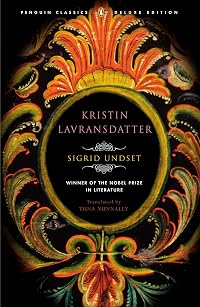
Panorama of Norwegian life in the first half of the 14th century and the tumultous life of a woman, traces Kristin's life from childhood to death.Tags
Recommendations











Member Recommendations
by jhowell

by anonymous user
susanbooks They take place centuries apart, but both are about young women's intense relationships with their fathers' and take place in similar, rural communities
Member Reviews
I. DID. IT.
Oh, this book, which lurked for almost a year on my nightstand - a brick that taunted me every time I dared to pick up another book that was lighter, smaller, less intense and tedious. I was determined to finish it, but it was tough.
A review in four parts:
Book 1: The Wreath (4 stars)
I really did enjoy the beginning of the story, when innocent but headstrong Kristin was discovering the world and her place in it. When she was old enough to be thinking about the opposite sex, she developed an exciting and rebellious romance with the dashing bad-boy Erland, which led her to reject her betrothal to good-guy Simon (and go against the wishes of her beloved father). A little racy, a little dangerous. You go girl.
Book 2: The Wife (2 show more stars)
Having gotten exactly what she wanted, Kristin spent the next 15 years (and 400 pages) whining about it and resenting Erland. Granted, Erland is frivolous and oblivious, but she knew that before they got married, and that was what drew her to him in the first place. Getting through this part was like pulling teeth. I asked myself for months on end if I was willing to devote hours of my life to this torture, and the answer was usually "no." If you find yourself stuck here, as I did, take comfort in knowing that it does get better. If you can't take it, know that they have seven sons, Erland gets involved in a treasonous venture and loses all his property, and is once again generally a disappointment to Kristin, and move on to Book 3.
Book 3: The Cross (3 stars)
So, here they are in reduced circumstances, and tensions are still high between Kristin and Erland. Simon, her former fiance, still loves her even though he has since married her little sister. Everyone knows this except Kristin; fallouts ensue. Her sons are growing up and are just as stubborn as their parents, which causes great sorrow to the whiny Kristin. Both Simon and Erland die. Kristin becomes a nun. Then she dies. Finally, her travails and mine are over. In all honesty, the last 50 pages or so go a long way towards redeeming the last 2/3 of the book, but is it worth reading all of that to come to he following conclusion...?
Overall (3 stars)
This book is essentially about Kristin's struggles with her own perceived shortcomings as a Christian. For many people, I know this book is a poignant story about the trials and insecurities we all face, and the reality of God's love at the end of the day.
For me... was it worth the pain she put herself through her entire life? Was the regret she felt about defying her father and burning resentment towards her own husband worth the trouble because she felt that she'd sinned? I just can't relate. I found her refusal to live her life to the fullest tedious. She hurt everyone she touched because she was brooding that her own soul wasn't up to par. On one hand, I get it. On the other, get over yourself.
Finally, a purely modern critique: these people could have benefited with some classes in communication. Perhaps talking to each other might be more productive than sulking and holding grudges for YEARS? show less
Oh, this book, which lurked for almost a year on my nightstand - a brick that taunted me every time I dared to pick up another book that was lighter, smaller, less intense and tedious. I was determined to finish it, but it was tough.
A review in four parts:
Book 1: The Wreath (4 stars)
I really did enjoy the beginning of the story, when innocent but headstrong Kristin was discovering the world and her place in it. When she was old enough to be thinking about the opposite sex, she developed an exciting and rebellious romance with the dashing bad-boy Erland, which led her to reject her betrothal to good-guy Simon (and go against the wishes of her beloved father). A little racy, a little dangerous. You go girl.
Book 2: The Wife (2 show more stars)
Having gotten exactly what she wanted, Kristin spent the next 15 years (and 400 pages) whining about it and resenting Erland. Granted, Erland is frivolous and oblivious, but she knew that before they got married, and that was what drew her to him in the first place. Getting through this part was like pulling teeth. I asked myself for months on end if I was willing to devote hours of my life to this torture, and the answer was usually "no." If you find yourself stuck here, as I did, take comfort in knowing that it does get better. If you can't take it, know that they have seven sons, Erland gets involved in a treasonous venture and loses all his property, and is once again generally a disappointment to Kristin, and move on to Book 3.
Book 3: The Cross (3 stars)
So, here they are in reduced circumstances, and tensions are still high between Kristin and Erland. Simon, her former fiance, still loves her even though he has since married her little sister. Everyone knows this except Kristin; fallouts ensue. Her sons are growing up and are just as stubborn as their parents, which causes great sorrow to the whiny Kristin. Both Simon and Erland die. Kristin becomes a nun. Then she dies. Finally, her travails and mine are over. In all honesty, the last 50 pages or so go a long way towards redeeming the last 2/3 of the book, but is it worth reading all of that to come to he following conclusion...?
Overall (3 stars)
This book is essentially about Kristin's struggles with her own perceived shortcomings as a Christian. For many people, I know this book is a poignant story about the trials and insecurities we all face, and the reality of God's love at the end of the day.
For me... was it worth the pain she put herself through her entire life? Was the regret she felt about defying her father and burning resentment towards her own husband worth the trouble because she felt that she'd sinned? I just can't relate. I found her refusal to live her life to the fullest tedious. She hurt everyone she touched because she was brooding that her own soul wasn't up to par. On one hand, I get it. On the other, get over yourself.
Finally, a purely modern critique: these people could have benefited with some classes in communication. Perhaps talking to each other might be more productive than sulking and holding grudges for YEARS? show less
First, a note on the translation: I started reading this trilogy using the first English translation from the 1920s, but switched midway through to Tiina Nunnally's translation, and if you have the choice, I highly recommend this version. The prose is much more lively and readable, which Nunnally notes is more accurate and faithful to the original text. And Nunally has restored passages that were censored or omitted from earlier editions.
With that out of the way: this is a wonderful book, another of those I found myself amazed that I hadn't read long before now. I lingered over the last third or so just to keep reading it. It's got complicated politics, beautiful descriptions of the natural world, deep musings on spirituality and inner show more lives, and Undset's research into everyday life in medieval Norway is obvious but lightly worn. At its heart, though, this is the story of a human life, with all the ups and downs and ins and outs that entails. A lovely, lovely book, and one which I suspect I'll come back to often. show less
With that out of the way: this is a wonderful book, another of those I found myself amazed that I hadn't read long before now. I lingered over the last third or so just to keep reading it. It's got complicated politics, beautiful descriptions of the natural world, deep musings on spirituality and inner show more lives, and Undset's research into everyday life in medieval Norway is obvious but lightly worn. At its heart, though, this is the story of a human life, with all the ups and downs and ins and outs that entails. A lovely, lovely book, and one which I suspect I'll come back to often. show less
I have so many thoughts about this most wonderful of all epics that I don't know where to start and I am certain that no matter what I write, will it do Kristin Lavransdatter enough justice. I'll write what I can and you decide for yourself whether you want to enter or, should I say, let the world of 14th century Norway enter your life. Sigrid Undset cetainly wrote about the country and the time, and the people in a way that will never let me forget this diamond of a novel.
There really isn't much I can do about it but mostly it's feelings and emotions that come to my mind when thinking of this masterpiece. There's no need to bother my head with proper character development, exceptional historical detail, the flow of the plot, etc. It's show more all there, yes, all in proper condition as even the most demanding would seek, but that's not what you pay attention to when reading about Kristin, about wild Erlend, about noble, goodhearted Simon, about the beautiful Norway with traditions and culture long gone (although hopefully not forgotten). You, instead, focus on the life itself, its trials and tribulations, tragedies and sadness, intermingled with happiness, joy and miracles it brings.
Kristin Lavransdatter is the ultimate coming-of-age story following the young girl from the days of her sweet, innocent childhood all through the end of her life ravished with sorrows, misfortunes, but also blessed with many good things that were not given to others. Even Kristin herself ruminates later in her life on how she lost sight of all the good things she'd been granted in life, because she could only think about the next tragedy to come along as a result of her wantonness.
If you're looking for the novel of motherhood, look no more. If you want a romance, this is a story that aces all other romances. and finally, if it's historical fiction you're after, you'll find Kristin Lavransdatter to be the one all other HF novels will be judged upon.
Kristin Lavransdatter is the masterpiece of literature. It's sublime. Just the thought that I've already finished it tightens my throat and almost makes me cry (I kid you not). I miss it, I'm nostalgic and I want to go back to it.
A word on translation: Tiina Nunnally is fantastic and she did a beautiful job, showing the full extent of Sigrid Undset's writing genius. For more in depth information, I'm directing you to the article about Nunnally's translation of Kristin Lavransdatter on Norway, the Official Site in the United States: http://www.norway.org/ARCHIVE/culture/literature/nunnally/.
P.S.
Try to look for it at library sales or other used book's sales sites. Chances are you won't find it. At least I couldn't. And I visit tons of sales. That's because most people who've read Kristin Lavransdatter, do not want to part with it. Ever. show less
There really isn't much I can do about it but mostly it's feelings and emotions that come to my mind when thinking of this masterpiece. There's no need to bother my head with proper character development, exceptional historical detail, the flow of the plot, etc. It's show more all there, yes, all in proper condition as even the most demanding would seek, but that's not what you pay attention to when reading about Kristin, about wild Erlend, about noble, goodhearted Simon, about the beautiful Norway with traditions and culture long gone (although hopefully not forgotten). You, instead, focus on the life itself, its trials and tribulations, tragedies and sadness, intermingled with happiness, joy and miracles it brings.
Kristin Lavransdatter is the ultimate coming-of-age story following the young girl from the days of her sweet, innocent childhood all through the end of her life ravished with sorrows, misfortunes, but also blessed with many good things that were not given to others. Even Kristin herself ruminates later in her life on how she lost sight of all the good things she'd been granted in life, because she could only think about the next tragedy to come along as a result of her wantonness.
If you're looking for the novel of motherhood, look no more. If you want a romance, this is a story that aces all other romances. and finally, if it's historical fiction you're after, you'll find Kristin Lavransdatter to be the one all other HF novels will be judged upon.
Kristin Lavransdatter is the masterpiece of literature. It's sublime. Just the thought that I've already finished it tightens my throat and almost makes me cry (I kid you not). I miss it, I'm nostalgic and I want to go back to it.
A word on translation: Tiina Nunnally is fantastic and she did a beautiful job, showing the full extent of Sigrid Undset's writing genius. For more in depth information, I'm directing you to the article about Nunnally's translation of Kristin Lavransdatter on Norway, the Official Site in the United States: http://www.norway.org/ARCHIVE/culture/literature/nunnally/.
P.S.
Try to look for it at library sales or other used book's sales sites. Chances are you won't find it. At least I couldn't. And I visit tons of sales. That's because most people who've read Kristin Lavransdatter, do not want to part with it. Ever. show less
I started this book a couple of times as an audio book… but stopped after the having a hard time recognizing places and names. But then I had an AHA moment!!! I embraced this 44 hour 59 minute exquisite listen... and fell in love. (the book version is 1168 pages!) This well researched, and well written description of a young medieval Norwegian girls life, from girlhood to death is enthralling and fascinating. It is humanity at its best. One must love, live, procreate, feel guilt, grieve, love some more and then carry on. It is the story of the human condition that has not changed in probably thousands of years. This novel has EVERYTHING.
I must admit that I did have to tune out the severe religiosity in the story at times, but hey, show more that’s what it was like during these times. I can let that go. I loved the authors description of the physical details of the Nordic scenery, just beautiful. I can breathe the cold, fresh air from her vivid descriptions and see the glorious colors of the Nordic landscape, not to mention the Aurora Borealis. I would like to mention that the narrator did a fantastic job. She made every character stand out as an important individual, and I never got lost - there are many characters to be sure after such a momentous life as Kristin’s.
I’m amazed what this writer has created in her relatively short life, (age 67). Imagine what she could have created if she’d lived longer. I recommend this book for fans of Historical Fiction, human drama and the human experience. Very highly recommended, and please, to those of you who might feel impatient for a quick story, stick with it. It’s long but worth it. show less
I must admit that I did have to tune out the severe religiosity in the story at times, but hey, show more that’s what it was like during these times. I can let that go. I loved the authors description of the physical details of the Nordic scenery, just beautiful. I can breathe the cold, fresh air from her vivid descriptions and see the glorious colors of the Nordic landscape, not to mention the Aurora Borealis. I would like to mention that the narrator did a fantastic job. She made every character stand out as an important individual, and I never got lost - there are many characters to be sure after such a momentous life as Kristin’s.
I’m amazed what this writer has created in her relatively short life, (age 67). Imagine what she could have created if she’d lived longer. I recommend this book for fans of Historical Fiction, human drama and the human experience. Very highly recommended, and please, to those of you who might feel impatient for a quick story, stick with it. It’s long but worth it. show less
What an amazing epic story. This book resonates on so many levels.
Despite being set in a faraway place at a faraway time, the characters and their trials and joys seem very real. The people are real because they are all flawed in some way - even the saintly monks reveal their temptations and failings.
Kristin is a character you keep hoping will finally find happiness. Even as you know her decisions are foolish, you know she had no real choice but to make them. Then she tortures herself ever after about having done so. Wonderful cast, fascinating history, lyrical descriptions of a harsh but beautiful country and a riveting tale.
Despite being set in a faraway place at a faraway time, the characters and their trials and joys seem very real. The people are real because they are all flawed in some way - even the saintly monks reveal their temptations and failings.
Kristin is a character you keep hoping will finally find happiness. Even as you know her decisions are foolish, you know she had no real choice but to make them. Then she tortures herself ever after about having done so. Wonderful cast, fascinating history, lyrical descriptions of a harsh but beautiful country and a riveting tale.
But she couldn’t help it; it was her nature to love with great toil and care.
When I read, I seek the marrow of things. Details and description of lands I shall never see and times I shall never know are all very well, but I am a human being, and it is human beings I am concerned with. It is easier for me with some books than others due to commonalities of sex and race and culture, but more often than not that is a surface tension appeal, a reliance on shared references that both author and I indulge in. What matters is when the author dives deep into both thought and feeling, wrestling in such a knowledgeable yet empathetic way that it matters not that they were born in the 19th century and I was not, that they were religious and I am show more not, that they were holistically passionate about Norway in the Middle Ages and I am not. The fact that we share a gender helps, but considering how this work won the author a Nobel Prize for Literature and how beloved it is today, I'd say it's more than that.
But the most extreme and oppressive fears seized her whenever she thought of Simon—the way he had picked her up and carried her off and spoken for her at home and acted as if she were his property. Her father and mother had yielded to him as if she already belonged more to him than to them.
God only knew she didn’t consider herself more than a simple woman; she would have preferred to avoid taking responsibility for anything but her own children and her household duties. And yet she had been forced to deal with so many things that seemed to her more appropriate concerns for a man to handle. But Erlend had thought it quite reasonable to let them rest on her shoulders. So it didn’t suit him to act so overbearing and to rebuff her when she wanted to know about things that he had undertaken on his own that would affect the welfare of them all.
The woman who takes a path different from what has been ordained is a popular topic in the classics, but it is a rare piece of literature that so thoroughly and humanely follows that "fallen" life to its end. Rare is the work that brings forth a woman who, while willing and able to follow the mores of the world she has been brought up in, does not accept the assumption that she will submit to them entirely. Sewing, yes, marriage, yes, but also the consideration of her self as a subject with her own aesthetics and moral grounds, her own lusts and commitment to others. Her faith is one which critically evaluates the differences between what she has been taught and how she has been treated, and were she a man she would have had a vaster field upon which to experiment, possess, take responsibility for what she has done and not for what has been done to her. However, she is a woman, and that is an epic all in itself.
“And yet you cannot proceed with a change in the law before it has been enacted without exerting excessive force against the people—and from ancient times the people have had difficulty in accepting excessive force from their kings.”
How in fiery Hell was a man to rule his wife if he couldn’t beat her because of her high birth and his own sense of honor.
The person who recommended this to me called it a Norwegian [Middlemarch], and now that I have finished, I say it is a true statement for all intents and purposes. There are, however, some sizable differences, ones that I myself enjoyed but may not be as favorable to others. Where Middlemarch spreads across a web of plots comparable in length, this work is most concerned with its titular character, dipping masterfully into the heads of surrounding others when needed but only just, embellishing the sociopolitical concerns in a fully realized world of an intellectually restricted woman. Where Middlemarch dwells on several years of serious social turnovers, its sleepy Victorianisms are melodramatic hyperspeed in comparison to the Middle Ages of honor and pagans and the Black Plague. Where Middlemarch plucks and bends but more often than not turns towards the realistic happy ending, [Kristin Lavransdatter] triggers the fall, follows them down, and watches these human beings wrest their own measure of self-worth from a narrative that in any other work would have ended with the finality of death. Middlemarch has both depth and breadth, but it does not send its heroine through the ravages of death and time and all the social redemption they bring long after they would have done any good. It does not send its heroine into a gorgeous world of unjust human beings and wrestle it with her to the very end.
“Ah, young child, you probably think there's nothing else that entices in the world save sensual pleasure and wealth and power. I must tell you that these are small things that are found along the side of the road—but I, I have loved the roads themselves.”
Now she realized that her mother’s heart had been deeply etched with memories of her daughter, memories of her thoughts about the child from before she was born and from all the years the child could not remember, memories of fears and hopes and dreams that children would never know had been dreamed on their behalf, before it was their own turn to fear and hope and dream in secret.
There is a beauty from refusing to cut off a story at the "happily ever after" point, for none of us have the benefit of that. There is a beauty in forgoing the finality of a tragic death and setting the character forth to persist on their own terms, seeming flaws and shamefulness paling beside the very fact that they are still alive. While it is advisable that the reader seek out the latest translation of this and all its accompanying end notes, there is a story here that will ring true with any who have struggled with law and with other, even more so with those have wrestled in the dead of the night with their regretful past and unknown future. I will not claim that everyone will empathize with the lengthy bouts between one person and Christianity in the Middle Ages, but I can say with certainty that this is not a story that aims to convert. It is a story of a human being in a part of the world during a time of great religious focus, and never is the strength of any individual in the face of death and growth and transitioning faith taken for granted.
But the drifting blue shadows on the hillsides, the fair-weather clouds billowing up over the mountain ridges and melting into the blue summer sky, the glitter of the Laag's water beyond the trees, the white glint of sunlight on all the leaves—these things she noticed more as silent sounds, audible only to her inner ear, rather than as visible images. With her wimple pulled forward over her brow, Kristin sat and listened to the play of light and shadow across the valley.
It is a great work of humanity, this.
Now, whenever she took the old path home past the site of the smithy—and by now it was almost overgrown, with tufts of yellow bedstraw, bluebells, and sweet peas spilling over the borders of the lush meadow—it seemed almost as if she were looking at a picture of her own life:” the weather-beaten, soot-covered old hearth that would never again be lit by a fire. The ground was strewn with bits of coal, but thin, short, gleaming tendrils of grass were springing up all over the abandoned site. And in the cracks of the old hearth blossomed fireweed, which sows its seeds everywhere, with its exquisite, long red tassels.show less
This is very long, there is a big focus on religion and I spent a good part of the book wanting to tell Kristin to snap out of it. But even so, you don't read books set in medieval Norway every day, the relationships were complex and I was invested in knowing how lives would play out. Good for a long winter read.
Members
- Recently Added By
Lists

1001 Books You Must Read Before You Die
1,448 works; 1,134 members

Classics you know you should have read but probably haven't
421 works; 408 members

Best Historical Fiction
620 works; 261 members

Favorite Long Books
330 works; 42 members

Favourite Books
1,819 works; 316 members

Female Author
1,234 works; 64 members
Female Protagonist
1,056 works; 57 members
Best Family Stories
241 works; 22 members

The Top Ten: Writers Pick Their Favorite Books
240 works; 31 members

20th Century Literature
1,161 works; 55 members

In and About the 1920s
181 works; 31 members

Books That Made Me Cry
199 works; 105 members

Canon de la narrativa universal del siglo XX
254 works; 6 members

Best family sagas
244 works; 34 members

Nobel Price Winners
222 works; 20 members

Best Love Stories
107 works; 14 members

Winter Books
127 works; 17 members

Western World's Greatest Books - Project Gutenberg
295 works; 15 members
500 Great Books by Women
507 works; 60 members
1920s
141 works; 6 members

A Novel Cure
742 works; 23 members

History novels (not too romancey)
37 works; 5 members
Lamont's Hundred Best Novels (1947)
100 works; 4 members

Set in the Middle Ages
42 works; 9 members

Favorite Books in Translation
320 works; 133 members
Reading LIst
648 works; 1 member
Canon de la narrativa universal del s. XX (cicutadry)
499 works; 3 members

Recommended Reading : 600 Classics Reviewed, Editors of Salem Press, 2015
634 works; 6 members

Juggernauts (fiction)
21 works; 3 members

Trinity College Booklist (1951): Class Nine, Foreign Literatures
161 works; 3 members

Women and the Family, European Fiction, 1900-1934
68 works; 1 member
Books with a Character's Name as the Title
129 works; 9 members

Best Books of 1926-1935
403 works; 10 members

For Further Reading: A List of 160 Novels from 15 Literatures
160 works; 4 members
Harold Bloom - The Western Canon: D. The Chaotic Age
833 works; 24 members

Allie's Wishlist
217 works; 2 members

Biggest Disappointments
606 works; 163 members

Favorite Childhood Books
1,646 works; 518 members
.
396 works; 1 member
Talk Discussions
Past Discussions
Group read: Kristin Lavransdatter in 2018 Category Challenge (June 2018)
Author Information

165+ Works 12,101 Members
Sigrid Undset was the daughter of archeologist Ingvald Undset. Cultural, autobiographical, and religious topics constitute a large and interesting portion of her fiction, which in Norway is categorized according to the time of action: medieval or modern. Jenny (1911), an idealistic and tragic love story, is one of the latter novels. Undset's show more comprehensive knowledge of medieval Scandinavian culture has its literary monuments in Kristin Lavransdatter (1920--22) and The Master of Hestviken (1925--27), historical novels that depict life in the Norwegian Middle Ages. She was awarded the Nobel Prize for Literature in 1928. Norwegian criticism of Sigrid Undset's writing centers on her religiosity (she became a conservative, almost reactionary Catholic in Lutheran Norway in the 1920s; she possesses an intensity of belief that is rather naturally expressed in the medieval novels. Yet while she has written religious polemics, the medieval novels are not tendentious. In fact, the central motifs are eroticism, marriage, and family life, in short, the full life of a medieval woman who sees herself in the light of contemporary Christian beliefs. These novels are great, realistic delineations of medieval personalities. During World War II she escaped the German occupation of Norway and fled to America, where she wrote her autobiographical Happy Times in Norway (1942). (Bowker Author Biography) show less
Some Editions
Awards and Honors
Awards
Notable Lists
Series

Belongs to Publisher Series
Work Relationships
Common Knowledge
- Canonical title
- Kristin Lavransdatter
- Original title
- Kristin Lavransdatter
- Alternate titles*
- Kransen; Husfrue; Korset
- Original publication date
- 1922; 1927 (English: Archer & Scott) (English: Archer & Scott)
- People/Characters
- Kristin Lavransdatter; Aasmund Bjørgulfsson; Lavrans Bjørgulfson; Simon Darre; Sira Eiliv; Sira Eirik (show all 24); Aashild Gautesdatter of Dovre; Ivar Gjesling; Gyrid; Inga; Ragnfrid Ivarsdatter; Ramborg Lavransdatter; Ulvhild Lavransdatter; Erlend Nikulausson; Bentein Prestesønn; Gaute Erlendsson; Arne Gyrdson; Trond Ivarsson; Magnhild; Margreth; Baard Munanson; Orm; Eline Ormsdatter; Sira Solmund
- Important places
- Sel in Gudbrandsdalen; Jørundgaard; Oslo, Norway; Trondheim, Norway; Husaby
- Related movies
- Kristin Lavransdatter (1995 | IMDb)
- First words
- When the earthly goods of Ivar Gjesling the Younger of Sundbu were divided up in the year 1306, his property at Sil was given to his daughter Ragnfrid and her husband Lavrans Bjorgulfson.
- Last words
- (Click to show. Warning: May contain spoilers.)Without thinking, they both walked as lightly and carefully as they could in the new snow.
- Original language
- Norwegian
- Disambiguation notice
- This record is for the trilogy complete set. Please do not add individual books of the trilogy to this record. Thank you!
*Some information comes from Common Knowledge in other languages. Click "Edit" for more information.
Classifications
- Genres
- Fiction and Literature, General Fiction, Historical Fiction
- DDC/MDS
- 839.82372 — Literature & rhetoric German & related literatures Other Germanic literatures Danish and Norwegian literatures Norwegian literature Norwegian Bokmål fiction 1900–2000 Early 20th century 1900–1945
- LCC
- PT8950 .U5 .K713 — Language and Literature German, Dutch and Scandinavian literatures Norwegian literature Individual authors or works 1900-1960
- BISAC
Statistics
- Members
- 3,439
- Popularity
- 4,861
- Reviews
- 79
- Rating
- (4.22)
- Languages
- 15 — Danish, Dutch, English, French, German, Italian, Latvian, Lithuanian, Norwegian (Bokmål), Norwegian, Polish, Russian, Slovenian, Spanish, Swedish
- Media
- Paper, Audiobook, Ebook
- ISBNs
- 67
- ASINs
- 120