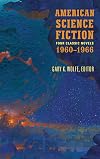
American Science Fiction: Four Classic Novels 1960–1966
by Gary K. Wolfe (Editor)
On This Page
Description
"This volume, the first of a two-volume set gathering the best American science fiction from the tumultuous 1960s, opens with Poul Anderson's immensely popular The High Crusade, in which aliens planning to conquer Earth land in Lincolnshire during the Hundred Years' War. In Clifford Simak's Hugo Award-winning Way Station, Enoch Wallace is a spry 124-year-old Civil War veteran whose lifelong job monitoring the intergalactic pit stop inside his home is largely uneventful--until a CIA agent show more shows up and Cold War hostilities threaten the peaceful harmony of the Galactic confederation. Daniel Keyes's beloved Flowers for Algernon, winner of the Nebula Award and adapted as the Academy Award-winning movie Charly, is told through the journal entries of Charlie Gordon, a young man with severe learning disabilities who is the test subject for surgery to improve his intelligence. And in the postapocalyptic earthscape of Roger Zelazny's Hugo Award-winning . . . And Call Me Conrad (also published as This Immortal) Conrad Nomikos reluctantly accepts the responsibility of showing the planet to the governing extraterrestrials' representative and protecting him from rebellious remnants of the human race. Using early manuscripts and original setting copy, this Library of America volume restores the novel to a version that most closely approximates Zelazny's original text."--Provided by publisher. show lessTags
Recommendations








Member Reviews
Poul Anderson, The High Crusade (1960)
Poul Anderson isn't an author I have much experience with, but I did love his time travel fantasy There Will Be Time (1972), which I read many times as a kid. But on the other hand, my copy was part of a Signet double with The Dancer from Atlantis (1971), which I never even got through the first chapter of despite several attempts! LibraryThing tells me I own many anthologies with his stories in them, but most of the time I don't mention his contributions in my reviews, so I must not have found them notably good or bad. Thus, I was very curious how I would take this book.
It turns out that I took it very well! The High Crusade opens in medieval England, where an alien spaceship lands in a country show more village, ready to frighten the locals. However, guile, brutality, and sheer luck lead to an upset when the villagers manage to slaughter all of the aliens bar one and take over the ship. The local baron loads most of his village's population onto the massive ship. He intends to fly the ship to the Holy Land and "liberate" it, but the surviving alien tricks him and engages the autopilot, taking the ship back to the alien colony from whence it came, with no reference coordinates to enable a return to Earth.
It's hilarious and charming. The humans are outclassed and outgunned, but keep going anyway. The baron doesn't even know how to use a napkin, but manages to outwit aliens who have hand-held nuclear weapons through superior strategy and a propensity to bluff outrageously. The novel is narrated by a monk named Brother Parvus. Would the novel's plausibility hold up to strict scrutiny? Perhaps not, but it's such a joy to read that you won't want to hold it up to strict scrutiny. It zips along (only 140 pages long in this edition) and doesn't outwear its welcome, as it continuously escalates. Soon the baron is organizing an interstellar alliance against the invading aliens and converting other aliens to Christianity! Jo Walton has a great tribute to the novel here, and says it better than I can.
It is a bit funny that this lost the Hugo Award for Best Novel to A Canticle for Leibowitz, also a science fiction novel about a Catholic monk (or monks) recording information for posterity. Must have been something in the air in 1960! I think it would be pretty difficult to argue that Canticle wasn't the right choice—it's certainly the one of the finalists I would have voted for—but this is a worthy finalist for sure, and well worth reading, and I'm glad editor Gary K. Wolfe included it in this Library of America anthology of 1960s sf. Poul Anderson was a finalist for Best Novel seven times, but never won; he did win many times in the various short fiction categories, however: twice in Best Novella, thrice in Best Novelette, and twice in Best Short Story.
Clifford D. Simak, Way Station (1963)
In 1964, the Hugo Award for Best Novel was given to Clifford Simak's Way Station. Simak is an author I haven't read much of; last year, I read his 1967 novel Why Call Them Back from Heaven?, but other than that it's just pieces of scattered short fiction in anthologies like The Science Fiction Hall of Fame. (I do remember liking his story "Immigrant" in Galactic Empires, Volume I.)
Way Station is an odd book: after the American Civil War, a Union soldier named Enoch returns home to Wisconsin and is recruited to operate a "way station" for Galactic Central, a place where aliens can materialize and rest on their way to destinations further out in the spiral arm. For this, he is essentially granted immortality. At the time the book takes place (much of it is told in flashback), four things converge: the CIA discovers and takes an interest in this immortal man, a political faction in Galactic Central wants to close the way station on Earth by any means necessary, Enoch takes a woman into his home when she's abused by her father, causing the locals to end their longstanding policy of ignoring him, and an important peace conference is breaking down, meaning the Cold War may be about to turn hot.
Like Fritz Lieber's The Big Time (1958), also a Hugo winner from this era, it has big ideas, but takes a subdued, personal, perhaps even slow approach to them. That said, many like to point to Simak's style as "pastoral sf." (Searching "pastoral, science fiction" as a tagmash on LibraryThing brings up sixty-nine works, though only the top dozen would really seem to count. Simak is its top practitioner with his 1965 novel All Flesh Is Grass, and Way Station itself comes in sixth.) It's a defense I buy: I imagine that even in 1963, this felt like a story from another era. Simak's style captures the emotions Enoch must feel as a man out of his own time and the tone really communicates his isolation without slipping into being maudlin. The flashbacks we go into about Enoch's life over the years, encounters he's had with various aliens especially, are effective and Simak manages to evoke a world that is beyond Enoch's comprehension (and ours) but tantalizing and promising. Probably one of the most admirable parts of the novel is the way Simak communicates Enoch's orientation toward the universe, one of wonder and hope.
Given that even good contemporary sf often seems to want to emulate streaming television programs rather than play to the strengths of prose, I appreciated how different this book was. (Oddly, a Netflix film adaptation of this book was announced in 2019, though nothing has been heard since.) That said, I occasionally found myself wanting to skim—the pacing is a bit too languid from time to time!
There is, in the end, a lot going on here, and at the novel's conclusion, all those things kind of collide. Simak handles this very effectively, as elements of different plots and strands cross with one another in unexpected ways. But there's not just a unity of plot but also one of theme. People these days like to talk about "hopepunk" (thanks, I hate it), but sf has always provided us with hope. In Way Station, hope comes from caring: Enoch cares of course, but so does the woman Enoch rescues, and so do many of the various aliens Enoch meets, and so does Enoch's postman, and even the CIA agent assigned to shadow Enoch does, and without all of these people caring about things, the ending would have gone much differently. Near the end, Enoch thinks this:
A million years ago there had been no river here and in a million years to come there might be no river—but in a million years from now there would be, if not Man, at least a caring thing. And that was the secret of the universe, Enoch told himself—a thing that went on caring.
It's a sentiment worth awarding.
Daniel Keyes, Flowers for Algernon (1966)
"Flowers for Algernon" was originally a short story, which I have read at least twice before and remember really enjoying; it won the Hugo Award for Best Short Story in 1960. Keyes later expanded it into a novel. The novel was a finalist for Best Novel in 1967, but lost out to Heinlein's The Moon is a Harsh Mistress. (It did tie with Delany's Babel-17 for the Nebula, however. The notes in this LOA edition mistakenly state the two tied for the Hugo.)
I am sure there are lots of people who complain the novel loses the elegant simplicity and thus the power of the short story. It has been over fifteen years since I read the short story, so it's hard for me to do a direct comparison. But even without that, I am sure they are right; it's hard for me to imagine it could be otherwise. A good short story is a thing of power, and the premise of "Flowers for Algernon" is perfectly calibrated to make it a great one.
And yet, I don't think that invalidates the novel. The novel doesn't replace the short story, after all, but exists alongside it. Based on my vague memories of the short story, I think what the novel adds is the material about Charlie's family, his "escape" from the experiment, and his different encounters with women. Though like a lot of 1960s sf, it comes at sex from an angle a bit disconcerting to a modern reader (we are more prudish now, I think), I otherwise found a lot of this material highly effective, particularly the stuff about his family. The flashbacks to his family trying to—not very well—deal with their low-IQ child was very interesting. The climax of this subplot, where Charlie goes to see his father (who doesn't recognize him) and his mother (who does but ultimately rejects him) were great, tough scenes.
The last twenty pages or so of the novel are some of the most emotionally charged writing I've ever read. Keyes very expertly shows you the disintegration of Charlie's intelligence in a way that only prose can manage. Because the first-person perspective puts you in the mind of Charlie, you experience the backslide of his intelligence firsthand—you lose your intelligence. My eyes got misty reading it.
If there's one thing that doesn't work for me, it's that Keyes seems to be pushing some kind of idea of intelligence and empathy, that intelligence makes it harder to have empathy. We see this with the various scientists working on Charlie, who treat him as an object not a person, and also with Charlie himself. I'm not totally convinced; the novel tries to make you think that the suspicion of other people Charlies acquires is some kind of tragedy... but people were awful to him. It's totally justified! Something I'd like to chew on at more length if I ever give the book another read.
There's a lot to like here. I'll be curious to see next year if The Moon is a Harsh Mistress really does exceed it for me.
Roger Zelazny, ...And Call Me Conrad [This Immortal] (1965)
In 1966, the Hugo Award for Best Novel was won by Frank Herbert's Dune, still a staggering titan of the genre that has cast a long shadow over science fiction. According to the voters of the 1966 Worldcon, however, there was another novel that was every bit as good as Dune: ...And Call Me Conrad, the debut novel of Roger Zelazny. Though Zelazny is an acclaimed writer, ...And Call Me Conrad is mostly remembered now as the novel that somewhat inexplicably tied with Dune.
(The novel was originally serialized in F&SF, cut down a little for length; it was later republished in full under the title of This Immortal as a standalone novel. This Library of America edition reprints the full text, but reinstates the title of the serial, which Zelazny preferred. I do think the editor of the novel was right. While I don't think "This Immortal" is any great shakes, "...And Call Me Conrad" works as a title for a magazine story, but it's impossible for me to imagine a reader seeing it emblazoned on the cover of a novel and thinking it sounds intriguing. I might have gone with Zelazny's proposed subtitle, "The Reluctant Immortal." It was the serial publication that won the Hugo, technically.)
I'm reading it as part of my project to read winners of the Hugo Award for Best Novel I haven't already read—and I read Dune twenty years ago, back in high school, so I'll be skipping that. (I probably really ought to reread Dune, because I don't think I appreciated it at the time, but I must press on, no going back!) Despite that, it's hard not to wonder what the voters of 1966 were thinking, and hard not to compare it to Dune.
The thing about Dune that made it impactful and influential is its total immersion in an alien (future) way of life—it's lead to a style of sfnal storytelling we now totally take for granted. ...And Call Me Conrad is set in a future world, but on Earth. It's not quite as disorienting as Dune, but it's still light on exposition in its early stages; the reader isn't given a lot to go on from the beginning. The editor of F&SF made Zelazny add a page of exposition, which this Library of America edition includes in an end note; I read it where it was supposed to fit into the narrative but found it didn't really clarify anything at all! But it's not immersive in the way Dune is immersive; it didn't reinvent science fiction.
The novel has an interesting set-up; the Earth has become subjugated by the alien Vegans, not through militaristic conquest, but through economic domination. Most humans have emigrated to Vegan planets, Earth itself is owned by the Vegans, and Earth is largely dependent on Vegan tourism. There are some humans, however, who are resentful of Vegan control, and want humanity to return to its home. A book about forms of empire and domination and cultural imperialism and native uprisings and violent resistant to hegemonic power. So while it may not be told in the way Dune was told, it was very much interested in the same kinds of ideas as Dune. Something in the air in 1965! (This was the same year Kwame Nkrumah published his book Neo-Colonialism: The Last Stage of Imperialism.) In some ways, though, Call Me Conrad does something more interesting, in making Earth the "Africa" of its colonial allegory—it very much is in the War of the Worlds vein of "what if aliens did to Earth what the West is always doing to other countries?" (Jo Walton has an interesting take over on Tor.com, of course, but I particularly liked this comment by @relogical.)
It resonates with other novels I've read as part of this project. In its contemplative tone, it reminds me a lot of what Clifford D. Simak was doing in books like City (1944-73) and Way Station (1963). Indeed, like both of those novels its focuses on an emotionally isolated immortal! The somewhat pulpy depiction of the Vegans reminded me a lot of what Philip K. Dick was doing in novels like Now Wait for Last Year (1966), using old-school tropes to quickly sketch in a background of cosmic war but then telling the kinds of stories that went in much more interesting directions.
I would say that overall, I liked it but did not love it. Very well written, neat backstory, lots of keen moments of observation and insight. My favorite moment was probably the argument over what was being done to the Great Pyramid in Egypt, some excellent thoughtful satire there. But I never felt a strong interest in its protagonist; the idea of the world-weary immortal has probably been done better elsewhere. I've read some of his short fiction before, but this was my first novel by Roger Zelazny; I look forward to reading Lord of Light for the 1968 awards, which most people seem to consider his best work. show less
Poul Anderson isn't an author I have much experience with, but I did love his time travel fantasy There Will Be Time (1972), which I read many times as a kid. But on the other hand, my copy was part of a Signet double with The Dancer from Atlantis (1971), which I never even got through the first chapter of despite several attempts! LibraryThing tells me I own many anthologies with his stories in them, but most of the time I don't mention his contributions in my reviews, so I must not have found them notably good or bad. Thus, I was very curious how I would take this book.
It turns out that I took it very well! The High Crusade opens in medieval England, where an alien spaceship lands in a country show more village, ready to frighten the locals. However, guile, brutality, and sheer luck lead to an upset when the villagers manage to slaughter all of the aliens bar one and take over the ship. The local baron loads most of his village's population onto the massive ship. He intends to fly the ship to the Holy Land and "liberate" it, but the surviving alien tricks him and engages the autopilot, taking the ship back to the alien colony from whence it came, with no reference coordinates to enable a return to Earth.
It's hilarious and charming. The humans are outclassed and outgunned, but keep going anyway. The baron doesn't even know how to use a napkin, but manages to outwit aliens who have hand-held nuclear weapons through superior strategy and a propensity to bluff outrageously. The novel is narrated by a monk named Brother Parvus. Would the novel's plausibility hold up to strict scrutiny? Perhaps not, but it's such a joy to read that you won't want to hold it up to strict scrutiny. It zips along (only 140 pages long in this edition) and doesn't outwear its welcome, as it continuously escalates. Soon the baron is organizing an interstellar alliance against the invading aliens and converting other aliens to Christianity! Jo Walton has a great tribute to the novel here, and says it better than I can.
It is a bit funny that this lost the Hugo Award for Best Novel to A Canticle for Leibowitz, also a science fiction novel about a Catholic monk (or monks) recording information for posterity. Must have been something in the air in 1960! I think it would be pretty difficult to argue that Canticle wasn't the right choice—it's certainly the one of the finalists I would have voted for—but this is a worthy finalist for sure, and well worth reading, and I'm glad editor Gary K. Wolfe included it in this Library of America anthology of 1960s sf. Poul Anderson was a finalist for Best Novel seven times, but never won; he did win many times in the various short fiction categories, however: twice in Best Novella, thrice in Best Novelette, and twice in Best Short Story.
Clifford D. Simak, Way Station (1963)
In 1964, the Hugo Award for Best Novel was given to Clifford Simak's Way Station. Simak is an author I haven't read much of; last year, I read his 1967 novel Why Call Them Back from Heaven?, but other than that it's just pieces of scattered short fiction in anthologies like The Science Fiction Hall of Fame. (I do remember liking his story "Immigrant" in Galactic Empires, Volume I.)
Way Station is an odd book: after the American Civil War, a Union soldier named Enoch returns home to Wisconsin and is recruited to operate a "way station" for Galactic Central, a place where aliens can materialize and rest on their way to destinations further out in the spiral arm. For this, he is essentially granted immortality. At the time the book takes place (much of it is told in flashback), four things converge: the CIA discovers and takes an interest in this immortal man, a political faction in Galactic Central wants to close the way station on Earth by any means necessary, Enoch takes a woman into his home when she's abused by her father, causing the locals to end their longstanding policy of ignoring him, and an important peace conference is breaking down, meaning the Cold War may be about to turn hot.
Like Fritz Lieber's The Big Time (1958), also a Hugo winner from this era, it has big ideas, but takes a subdued, personal, perhaps even slow approach to them. That said, many like to point to Simak's style as "pastoral sf." (Searching "pastoral, science fiction" as a tagmash on LibraryThing brings up sixty-nine works, though only the top dozen would really seem to count. Simak is its top practitioner with his 1965 novel All Flesh Is Grass, and Way Station itself comes in sixth.) It's a defense I buy: I imagine that even in 1963, this felt like a story from another era. Simak's style captures the emotions Enoch must feel as a man out of his own time and the tone really communicates his isolation without slipping into being maudlin. The flashbacks we go into about Enoch's life over the years, encounters he's had with various aliens especially, are effective and Simak manages to evoke a world that is beyond Enoch's comprehension (and ours) but tantalizing and promising. Probably one of the most admirable parts of the novel is the way Simak communicates Enoch's orientation toward the universe, one of wonder and hope.
Given that even good contemporary sf often seems to want to emulate streaming television programs rather than play to the strengths of prose, I appreciated how different this book was. (Oddly, a Netflix film adaptation of this book was announced in 2019, though nothing has been heard since.) That said, I occasionally found myself wanting to skim—the pacing is a bit too languid from time to time!
There is, in the end, a lot going on here, and at the novel's conclusion, all those things kind of collide. Simak handles this very effectively, as elements of different plots and strands cross with one another in unexpected ways. But there's not just a unity of plot but also one of theme. People these days like to talk about "hopepunk" (thanks, I hate it), but sf has always provided us with hope. In Way Station, hope comes from caring: Enoch cares of course, but so does the woman Enoch rescues, and so do many of the various aliens Enoch meets, and so does Enoch's postman, and even the CIA agent assigned to shadow Enoch does, and without all of these people caring about things, the ending would have gone much differently. Near the end, Enoch thinks this:
A million years ago there had been no river here and in a million years to come there might be no river—but in a million years from now there would be, if not Man, at least a caring thing. And that was the secret of the universe, Enoch told himself—a thing that went on caring.
It's a sentiment worth awarding.
Daniel Keyes, Flowers for Algernon (1966)
"Flowers for Algernon" was originally a short story, which I have read at least twice before and remember really enjoying; it won the Hugo Award for Best Short Story in 1960. Keyes later expanded it into a novel. The novel was a finalist for Best Novel in 1967, but lost out to Heinlein's The Moon is a Harsh Mistress. (It did tie with Delany's Babel-17 for the Nebula, however. The notes in this LOA edition mistakenly state the two tied for the Hugo.)
I am sure there are lots of people who complain the novel loses the elegant simplicity and thus the power of the short story. It has been over fifteen years since I read the short story, so it's hard for me to do a direct comparison. But even without that, I am sure they are right; it's hard for me to imagine it could be otherwise. A good short story is a thing of power, and the premise of "Flowers for Algernon" is perfectly calibrated to make it a great one.
And yet, I don't think that invalidates the novel. The novel doesn't replace the short story, after all, but exists alongside it. Based on my vague memories of the short story, I think what the novel adds is the material about Charlie's family, his "escape" from the experiment, and his different encounters with women. Though like a lot of 1960s sf, it comes at sex from an angle a bit disconcerting to a modern reader (we are more prudish now, I think), I otherwise found a lot of this material highly effective, particularly the stuff about his family. The flashbacks to his family trying to—not very well—deal with their low-IQ child was very interesting. The climax of this subplot, where Charlie goes to see his father (who doesn't recognize him) and his mother (who does but ultimately rejects him) were great, tough scenes.
The last twenty pages or so of the novel are some of the most emotionally charged writing I've ever read. Keyes very expertly shows you the disintegration of Charlie's intelligence in a way that only prose can manage. Because the first-person perspective puts you in the mind of Charlie, you experience the backslide of his intelligence firsthand—you lose your intelligence. My eyes got misty reading it.
If there's one thing that doesn't work for me, it's that Keyes seems to be pushing some kind of idea of intelligence and empathy, that intelligence makes it harder to have empathy. We see this with the various scientists working on Charlie, who treat him as an object not a person, and also with Charlie himself. I'm not totally convinced; the novel tries to make you think that the suspicion of other people Charlies acquires is some kind of tragedy... but people were awful to him. It's totally justified! Something I'd like to chew on at more length if I ever give the book another read.
There's a lot to like here. I'll be curious to see next year if The Moon is a Harsh Mistress really does exceed it for me.
Roger Zelazny, ...And Call Me Conrad [This Immortal] (1965)
In 1966, the Hugo Award for Best Novel was won by Frank Herbert's Dune, still a staggering titan of the genre that has cast a long shadow over science fiction. According to the voters of the 1966 Worldcon, however, there was another novel that was every bit as good as Dune: ...And Call Me Conrad, the debut novel of Roger Zelazny. Though Zelazny is an acclaimed writer, ...And Call Me Conrad is mostly remembered now as the novel that somewhat inexplicably tied with Dune.
(The novel was originally serialized in F&SF, cut down a little for length; it was later republished in full under the title of This Immortal as a standalone novel. This Library of America edition reprints the full text, but reinstates the title of the serial, which Zelazny preferred. I do think the editor of the novel was right. While I don't think "This Immortal" is any great shakes, "...And Call Me Conrad" works as a title for a magazine story, but it's impossible for me to imagine a reader seeing it emblazoned on the cover of a novel and thinking it sounds intriguing. I might have gone with Zelazny's proposed subtitle, "The Reluctant Immortal." It was the serial publication that won the Hugo, technically.)
I'm reading it as part of my project to read winners of the Hugo Award for Best Novel I haven't already read—and I read Dune twenty years ago, back in high school, so I'll be skipping that. (I probably really ought to reread Dune, because I don't think I appreciated it at the time, but I must press on, no going back!) Despite that, it's hard not to wonder what the voters of 1966 were thinking, and hard not to compare it to Dune.
The thing about Dune that made it impactful and influential is its total immersion in an alien (future) way of life—it's lead to a style of sfnal storytelling we now totally take for granted. ...And Call Me Conrad is set in a future world, but on Earth. It's not quite as disorienting as Dune, but it's still light on exposition in its early stages; the reader isn't given a lot to go on from the beginning. The editor of F&SF made Zelazny add a page of exposition, which this Library of America edition includes in an end note; I read it where it was supposed to fit into the narrative but found it didn't really clarify anything at all! But it's not immersive in the way Dune is immersive; it didn't reinvent science fiction.
The novel has an interesting set-up; the Earth has become subjugated by the alien Vegans, not through militaristic conquest, but through economic domination. Most humans have emigrated to Vegan planets, Earth itself is owned by the Vegans, and Earth is largely dependent on Vegan tourism. There are some humans, however, who are resentful of Vegan control, and want humanity to return to its home. A book about forms of empire and domination and cultural imperialism and native uprisings and violent resistant to hegemonic power. So while it may not be told in the way Dune was told, it was very much interested in the same kinds of ideas as Dune. Something in the air in 1965! (This was the same year Kwame Nkrumah published his book Neo-Colonialism: The Last Stage of Imperialism.) In some ways, though, Call Me Conrad does something more interesting, in making Earth the "Africa" of its colonial allegory—it very much is in the War of the Worlds vein of "what if aliens did to Earth what the West is always doing to other countries?" (Jo Walton has an interesting take over on Tor.com, of course, but I particularly liked this comment by @relogical.)
It resonates with other novels I've read as part of this project. In its contemplative tone, it reminds me a lot of what Clifford D. Simak was doing in books like City (1944-73) and Way Station (1963). Indeed, like both of those novels its focuses on an emotionally isolated immortal! The somewhat pulpy depiction of the Vegans reminded me a lot of what Philip K. Dick was doing in novels like Now Wait for Last Year (1966), using old-school tropes to quickly sketch in a background of cosmic war but then telling the kinds of stories that went in much more interesting directions.
I would say that overall, I liked it but did not love it. Very well written, neat backstory, lots of keen moments of observation and insight. My favorite moment was probably the argument over what was being done to the Great Pyramid in Egypt, some excellent thoughtful satire there. But I never felt a strong interest in its protagonist; the idea of the world-weary immortal has probably been done better elsewhere. I've read some of his short fiction before, but this was my first novel by Roger Zelazny; I look forward to reading Lord of Light for the 1968 awards, which most people seem to consider his best work. show less
Ratings
Members
- Recently Added By
Author Information

All Editions
Series
Belongs to Publisher Series
Library of America (321)
Work Relationships
Common Knowledge
- Canonical title
- American Science Fiction: Four Classic Novels 1960–1966
- First words
- Archbishop William, a most learned and holy prelate, having commanded me to put into English writing those great events to which I was a humble witness, I take up my quill in the name of the Lord and my patron saint: trusting... (show all) that they will aid my feeble powers of narrative for the sake of future generations who may with profit study the account of Sir Roger de Tourneville's campaign and learn thereby fervently to reverence the great God by whom all things are brought to pass.
- Last words
- (Click to show. Warning: May contain spoilers.)Which is a nice place to end a story, sic: .
Classifications
- Genres
- Fiction and Literature, Science Fiction
- DDC/MDS
- 813.0876208 — Literature & rhetoric American literature in English American fiction in English By type Genre fiction Adventure fiction Speculative fiction Science fiction Collections and anthologies Anthologies
- LCC
- PS648 .S3 .A5155 — Language and Literature American literature American literature Collections of American literature Prose (General)
- BISAC
Statistics
- Members
- 130
- Popularity
- 251,214
- Reviews
- 1
- Rating
- (4.80)
- Languages
- English
- Media
- Paper, Ebook
- ISBNs
- 2
- ASINs
- 1