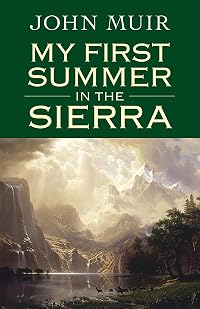
My First Summer in the Sierra
by John Muir 
On This Page
Description
In the summer of 1869, John Muir, a young Scottish immigrant, joined a crew of shepherds in the foothills of California's Sierra Nevada Mountains. The diary he kept while tending sheep formed the heart of this book, which was first published in 1911 and which eventually lured thousands of Americans to visit Yosemite country. My First Summer in the Sierra incorporates the lyrical accounts and sketches Muir produced during his four-month stay in the Yosemite River Valley and the High Sierra. show more His daily records track his memorable experiences, describing in picturesque terms the majestic vistas, flora and fauna, and other breathtaking natural wonders of the area. Today, Muir is recognized as one of the most important and influential naturalists and nature writers in America. This book, the most popular of the author's works, will delight environmentalists and nature lovers with its exuberant observations. show lessTags
Recommendations













Member Recommendations
by anonymous user

Member Reviews
My First Summer in the Sierra comprises John Muir's journal entries that document his journey, in the company of a herd of sheep, a shepherd, and a dog, to California's Sierra Nevada mountains during the summer of 1869. Muir records his daily experiences moving through spectacular wilderness areas that would later become Yosemite National Park. Muir presents the Sierra as a pristine ecosystem, depicts wildlife in their habitats, and observes the destructive impact of sheep grazing. He encounters several indigenous tribes and describes their ways of life.
The prose alternates between detailed scientific observation and rapturous descriptions of the landscape. He mentions practical concerns about animals, weather, and terrain. He also show more muses on humanity's relationship with nature. This region is not far from where I live so I had a personal interest in this memoir. I have visited the John Muir house in Martinez, California, and the Muir Woods in Marin County. It will appeal to fans of lyrical nature writing. I enjoyed it as a historic record written by an early proponent of conservationist thought. show less
The prose alternates between detailed scientific observation and rapturous descriptions of the landscape. He mentions practical concerns about animals, weather, and terrain. He also show more muses on humanity's relationship with nature. This region is not far from where I live so I had a personal interest in this memoir. I have visited the John Muir house in Martinez, California, and the Muir Woods in Marin County. It will appeal to fans of lyrical nature writing. I enjoyed it as a historic record written by an early proponent of conservationist thought. show less
So! Many! Superlatives! That's what the bulk of this book consists of. As rich and rewarding as Muir's prose is, I believe it might best be enjoyed in small doses rather than all in one go.
[Audiobook note: The reader was okay, but suffers greatly in comparison with the Scottish-accented actor that Ken Burns used as Muir's voice in his National Parks documentary. This reader just somehow failed to bring across the deeply spiritual tone that Muir's words call for.]
[Audiobook note: The reader was okay, but suffers greatly in comparison with the Scottish-accented actor that Ken Burns used as Muir's voice in his National Parks documentary. This reader just somehow failed to bring across the deeply spiritual tone that Muir's words call for.]
I think some of the people who quote his "When we try to pick out anything by itself, we find it hitched to everything else in the universe" phrase would be surprised to see it in the context of the rest of the paragraph (p87). He relates a lot of what he sees to God's presence. At times I felt his gushing enthusiastic words were a bit over the top, and wondered that he could have so much boundless enthusiasm day after day--but my reaction is doubtless a result of our comparative ages. There were sections where his imagery was strongly appealing, e.g. "some [raindrops]sift spray through the shining needles, whispering peace and good cheer to each one of them." (p 69)
He does animate nature; I thought it was refreshing the way he would show more identify plants etc as people, in a manner we are used to only hearing from Native Americans. I wonder how much of our innate attraction to specific landscapes has to do with some genetic predisposition: he comes from a Scots family which I assume lived for centuries in highlands.
I wonder what reference books he might have had with him. For example, in the beginning he wonders at the bird that walks under water in the streams but by the end he names it ouzel in his observations. show less
He does animate nature; I thought it was refreshing the way he would show more identify plants etc as people, in a manner we are used to only hearing from Native Americans. I wonder how much of our innate attraction to specific landscapes has to do with some genetic predisposition: he comes from a Scots family which I assume lived for centuries in highlands.
I wonder what reference books he might have had with him. For example, in the beginning he wonders at the bird that walks under water in the streams but by the end he names it ouzel in his observations. show less
This is not my usual style of book. It is a diary, with no real story, and with long and detailed descriptions of plants. It takes a while to get into the book, and took me almost nine months to finish it. Yet there is a progression to the diary. Particularly once Muir gets to higher elevations, then still higher, his delight becomes infectious, and the story moves quickly. Although the prose can be terribly purple, Muir back it up and justifies it with a fine eye for detail. I regretted getting to the end of the Sierra summer.
Unreadable.
Poetical and ponderous sermons on nature; eyerollingly irritating to the modern eye.
I realize it was written in 1869... and was likely intentionally... poetic and quasi-religious in tone. I love the journal descriptions of camp life and daily observations had they not been cut far too short by his purple ponderings. This is not to say, as a man, that he wasn't profoundly important and influential... just that this piece doesn't transport us to the Sierras as much as it hijacks us into sitting through church.
Poetical and ponderous sermons on nature; eyerollingly irritating to the modern eye.
I realize it was written in 1869... and was likely intentionally... poetic and quasi-religious in tone. I love the journal descriptions of camp life and daily observations had they not been cut far too short by his purple ponderings. This is not to say, as a man, that he wasn't profoundly important and influential... just that this piece doesn't transport us to the Sierras as much as it hijacks us into sitting through church.
Muir's prose is ecstatic: but it is also aware, accurate, and detailed. Page after page records observations of botany, geology, the climate. And while Muir is alone much of the time his notes on the personalities he meets — Portuguese, Indian, tourists; and also squirrels, houseflies, bear, not to mention the tedious sheep — enliven the book and bring his ecstasy back to earth.
http://cshere.blogspot.com/2008/12/why-do-i-read.html
http://cshere.blogspot.com/2008/12/why-do-i-read.html
“We are now in the mountains and they are in us, kindling enthusiasm, making every nerve quiver, filling every pore and cell of us. Our flesh-and bone tabernacle seems transparent as glass to the beauty about us, as if truly an inseparable part of it, thrilling with the air and trees, streams and rocks, in the waves of the sun, - a part of all nature, neither old nor young, sick nor well, but immortal.” p.20
A record of Muir’s activities, discoveries, and philosophic musings with unusual insight into the beauties of nature and life. 12 plates reproduced from photographs by Herbert W. Gleason and 21 textual illustrations from sketches made by the author in 1869. Octavo, original dark green cloth with gilt and light green stamped show more picture of forest scene with mountains in background. "Muir was 72 years old when he began to prepare the journal of his first summer in the Sierra for publication. With the skillful editing of his mature years, he retains the refreshing spontaneity and enthusiasm of his youthful experiences." (Kimes bibliography) show less
A record of Muir’s activities, discoveries, and philosophic musings with unusual insight into the beauties of nature and life. 12 plates reproduced from photographs by Herbert W. Gleason and 21 textual illustrations from sketches made by the author in 1869. Octavo, original dark green cloth with gilt and light green stamped show more picture of forest scene with mountains in background. "Muir was 72 years old when he began to prepare the journal of his first summer in the Sierra for publication. With the skillful editing of his mature years, he retains the refreshing spontaneity and enthusiasm of his youthful experiences." (Kimes bibliography) show less
Members
- Recently Added By
Lists

Recommended Nature Writing
346 works; 180 members

Mustich's 1000 Books to Read Before You Die: A Life Changing List
1,001 works; 20 members

The Complete Rory Gilmore Reading List
506 works; 5 members

Ry's Uncover Challenge Window Shopping
14 works; 1 member
Author Information

153+ Works 7,927 Members
The naturalist John Muir was born in Dunbar, Scotland. When he was 11 years old, he moved to the United States with his family and lived on a Wisconsin farm, where he had to work hard for long hours. He would rise as early as one o'clock in the morning in order to have time to study. At the urging of friends, he took some inventions he had made to show more a fair in Madison, Wisconsin. This trip resulted in his attending the University of Wisconsin. After four years in school, he began the travels that eventually took him around the world. Muir's inventing career came to an abrupt end in 1867, when he lost an eye in an accident while working on one of his mechanical inventions. Thereafter, he focused his attention on natural history, exploring the American West, especially the Yosemite region of California. Muir traveled primarily on foot carrying only a minimum amount of food and a bedroll. In 1880 Muir married Louie Strentzel, the daughter of an Austrian who began the fruit and wine industry in California. One of the first explorers to postulate the role of glaciers in forming the Yosemite Valley, Muir also discovered a glacier in Alaska that later was named for him. His lively descriptions of many of the natural areas of the United States contributed to the founding of Yosemite National Park in 1890. His urge to preserve these areas for posterity led to his founding of the Sierra Club in 1892. (Bowker Author Biography) show less
John Muir has a Legacy Library. Legacy libraries are the personal libraries of famous readers, entered by LibraryThing members from the Legacy Libraries group.
Some Editions
Awards and Honors
Awards
Series
Belongs to Publisher Series
Work Relationships
Is contained in
Is abridged in
Common Knowledge
- Canonical title
- My First Summer in the Sierra
- Original publication date
- 1911
- People/Characters
- John Muir, naturalist
- Important places
- USA; California, USA; Sierra Nevada Mountains
- First words
- In the great Central Valley of California there are only two seasons, -- spring and summer.
- Quotations
- When we try to pick out anything by itself, we find it hitched to everything else in the universe. (p 87)
...we are reminded that everything is flowing--going somewhere, animals and so-called lifeless rocks as well as water. Thus the snow flows fast or slow in grand beauty-making glaciers and avalanches; the air in majestic floo... (show all)ds carrying minerals, plant leaves, seeds, spores, with streams of music and fragrance; water streams carrying rocks both in solution and in the form of mud particles, sand, pebbles, and boulders. Rocks flow from volcanoes like water from springs, and animals flock together and flow in currents modified by stepping, leaping, gliding, flying, swimming, etc. While the stars go streaming through space pulsed on and on forever like blood globules in Nature's warm heart. (p 130)
We never know where we must go nor what guides we are to get--men, storms, guardian angels, or sheep. Perhaps almost everybody in the least natural is guided more than he is ever aware of. All the wilderness seems to be ful... (show all)l of tricks and plans to drive and draw us up into God's Light. (p 136) - Last words
- (Click to show. Warning: May contain spoilers.)I gladly, gratefully, hopefully pray I may see it again.
- Original language
- English
Classifications
Statistics
- Members
- 1,118
- Popularity
- 22,783
- Reviews
- 13
- Rating
- (4.05)
- Languages
- 7 — Chinese, Czech, English, Finnish, French, Italian, Spanish
- Media
- Paper, Audiobook, Ebook
- ISBNs
- 87
- UPCs
- 2
- ASINs
- 29