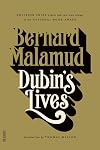
Dubin's Lives
by Bernard Malamud
On This Page
Description
With a new introduction by Thomas Mallon "Dubin's Lives" (1979) is a compassionate and wry commedia, a book praised by Christopher Lehmann-Haupt in "The New York Times" as Malamud's "best novel since "The Assistant," Possibly, it is the best he has written of all." Its protagonist is one of Malamud's finest characters; prize-winning biographer William Dubin, who learns from lives, or thinks he does: those he writes, those he shares, the life he lives. Now in his later middle age, he seeks show more his own secret self, and the obsession of biography is supplanted by the obsession of love--love for a woman half is age, who has sought an understanding of her life through his books. "Dubin's Lives" is a rich, subtle book, as well as a moving tale of love and marriage. show lessTags
Recommendations






















Member Reviews
William Dubin, biographer, marries late in life: after receiving a letter from a desperate pregnant widow, he decides Kitty is the one. They raise 2 children, and the marriage succeeds because they do care about each other. But after a number of years, Dubin feels he needs more and engages in brief affairs. After meeting young Fanny Bick William Dubin is smitten and hopes for another affair but Fanny eludes his efforts. Dubin struggles with writing the biography of DH Lawrence, suffers depression, analyzes his life, sees it lacking. He is a product of a difficult childhood: his father was an umambitious waiter, and his mother a homemaker hidden at home after her emotional breakdown when her younger son drowns.
Dubin believes he has show more gotten over Fanny but when she shows up again and describes her life, he is pulled in once again. Fanny becomes his mistress, and William is ecstatic, his writing improves as well as his marriage but eventually the demands of his career, a wife and a mistress cause severe stress. William fantasizes different potential scenarios: Fanny abandons him, life improves, or he divorces Kitty, marries Fanny and they have children. But William realizes he loves both his life with Kitty and their children, and his life with Fanny.
Is William trying to live Lawrence's life? Is he compensating for his childhood? All possibilities. I personally have difficulty reading about infidelity but the depth of writing and the beautiful descriptions kept me going. show less
Dubin believes he has show more gotten over Fanny but when she shows up again and describes her life, he is pulled in once again. Fanny becomes his mistress, and William is ecstatic, his writing improves as well as his marriage but eventually the demands of his career, a wife and a mistress cause severe stress. William fantasizes different potential scenarios: Fanny abandons him, life improves, or he divorces Kitty, marries Fanny and they have children. But William realizes he loves both his life with Kitty and their children, and his life with Fanny.
Is William trying to live Lawrence's life? Is he compensating for his childhood? All possibilities. I personally have difficulty reading about infidelity but the depth of writing and the beautiful descriptions kept me going. show less
I know who I am (p.358)
William Dubin, the main protagonist in Malamud's novel Dubin's Lives is a writer, particularly a biographer. The largest part of the novel is about Dubin's life, especially his sexual escapades with Fanny Bick, who made her first advances when she came to his home as a house-cleaner. Throughout the novel there is no doubt that Dubin and his wife Kitty are in a long, happy and loving marriage, and Dubin often struggles with guilt about his sexual affair with Fanny. Although he is hiding his affair and his sexual adventures with Fanny, the game is brought home to him, so to speak, as Fanny seems intend on replacing Kitty. From a visit to Venice, to visiting her in New York, later on Fanny starts visiting Dubin at show more home, at first having sex with him in his studio in the garden and later in the home, in his the bedroom. Dubin's relation with Fanny has all the characteristics of a relation sprung up around a mid-life crisis, from early wonder and joy that such a young women would show so much interest in a man of his age, to a completely promiscuous and illicit extra-martital affair right under his wife's nose. Dubin's impotence while with his wife, and his attempts to hide his affair with Fanny add a great deal to the fun of the book.
Throughout the book, Dubin is working on a biography of D.H. Lawrence, at times wondering whether he has "given up life to write lives." As he is stuck in his biography about Lawrence, he likewise seems to have got stuck in his life. In Lawrence he reads: "We ought to dance with rapture that we should be alive and in the flesh and part of the living incarnate cosmos." (p.338) Besides working on Lawrence, Dubin finds time to read Saint Augustine. The novel begins with two quotations: What demon possessed me that I behaved so well? from Thoreau, about whom Dubin has written a biography, and Give me continence and chastity, but not yet. by Saint Augustine. While worried whether his adulterous affair may hurt his wife, Dubin feels that he needs more in life, and that Fanny can give him that.
Du bist Dubin (p.358). Although the root of confusion about the self lies in Dubin's name, Ich bin, Du bist Dubin's concludes that he knows who he is, at least "well enough the take the next necessary step." (ibid), n.l. to act his age. The final part of the book is revealing, as the basic theme of the book is expanded to the other characters in the book. The existentialist dilemma of how to live your life, create and use the freedom to be alive, and shape your life to it's ultimate fullfilment is worked out, showing that each and everyone has to deal with these questions, and that there is an infinite variety of possibilities. show less
William Dubin, the main protagonist in Malamud's novel Dubin's Lives is a writer, particularly a biographer. The largest part of the novel is about Dubin's life, especially his sexual escapades with Fanny Bick, who made her first advances when she came to his home as a house-cleaner. Throughout the novel there is no doubt that Dubin and his wife Kitty are in a long, happy and loving marriage, and Dubin often struggles with guilt about his sexual affair with Fanny. Although he is hiding his affair and his sexual adventures with Fanny, the game is brought home to him, so to speak, as Fanny seems intend on replacing Kitty. From a visit to Venice, to visiting her in New York, later on Fanny starts visiting Dubin at show more home, at first having sex with him in his studio in the garden and later in the home, in his the bedroom. Dubin's relation with Fanny has all the characteristics of a relation sprung up around a mid-life crisis, from early wonder and joy that such a young women would show so much interest in a man of his age, to a completely promiscuous and illicit extra-martital affair right under his wife's nose. Dubin's impotence while with his wife, and his attempts to hide his affair with Fanny add a great deal to the fun of the book.
Throughout the book, Dubin is working on a biography of D.H. Lawrence, at times wondering whether he has "given up life to write lives." As he is stuck in his biography about Lawrence, he likewise seems to have got stuck in his life. In Lawrence he reads: "We ought to dance with rapture that we should be alive and in the flesh and part of the living incarnate cosmos." (p.338) Besides working on Lawrence, Dubin finds time to read Saint Augustine. The novel begins with two quotations: What demon possessed me that I behaved so well? from Thoreau, about whom Dubin has written a biography, and Give me continence and chastity, but not yet. by Saint Augustine. While worried whether his adulterous affair may hurt his wife, Dubin feels that he needs more in life, and that Fanny can give him that.
Du bist Dubin (p.358). Although the root of confusion about the self lies in Dubin's name, Ich bin, Du bist Dubin's concludes that he knows who he is, at least "well enough the take the next necessary step." (ibid), n.l. to act his age. The final part of the book is revealing, as the basic theme of the book is expanded to the other characters in the book. The existentialist dilemma of how to live your life, create and use the freedom to be alive, and shape your life to it's ultimate fullfilment is worked out, showing that each and everyone has to deal with these questions, and that there is an infinite variety of possibilities. show less
Mooie roman! Een verslag van het ouder worden; het aftakelingsproces. William Dubin, een biograaf, woont alleen met zijn vrouw en werkt. Hij schrijft een biografie over D.H. Lawrence. Hij kan zich echter moeilijk inwerken vanwege zo een ingewikkeld individu als Lawrence. Bovendien is de levenswandel van Lawrence wel zeer verschillend van Dubin's eigen levenswandel. Totdat Fanny Bick haar intrede doet in het leven van de biograaf. Hij krijgt een intensieve verhouding met haar, waardoor nogal wat van zijn zekerheden wankelen. Een mooi verhaal met een min of meer open einde. Met name de wisseling der seizoenen wordt prachtig beschreven, gelijk met de wisselingen van levensstemmingen. William Dubin, een ambitieus iemand die zichzelf hoge show more eisen stelt. show less
Jun 29, 2012Dutch
1
זכור לי שממש לא השתגעתי מהספר
Sep 13, 2013Hebrew
Ratings
Members
- Recently Added By
Lists

Anthony Burgess 99 Post War Novels
99 works; 7 members
Author Information

98+ Works 11,790 Members
Bernard Malamud was born in 1914 in New York City and later received his B. A. from City College of New York and his M. A. from Columbia University. All of Malamud's works are highly respected, including "Armistice" (his first), "The Magic Barrel," which won the National Book Award, "The Fixer," which received a Pulitzer Prize. "The Assistant," show more "The Natural," "The Fixer," and "The Angel Levine," which were all adapted as films. Bernard Malamud died in 1986. (Bowker Author Biography) show less
Awards and Honors
Distinctions
Notable Lists
Series
Belongs to Publisher Series
Common Knowledge
- Canonical title
- Dubin's Lives
- Original title
- Dubin's Lives
- Original publication date
- 1979
- People/Characters
- William Dubin
- Epigraph
- What demon possessed me that I behaved so well.
—Thoreau
Give me continence and chastity, but not yet.
—Augustine - Dedication
- Max and Bertha
my father and mother
And for
Anna Fidelman - First words
- They sometimes met on country roads when there were flowers or snow.
- Last words
- (Click to show. Warning: May contain spoilers.)Roger Foster waited in the shadow of a long-boughed two-trunked silver maple as Dubin ran up the moonlit road, holding his half-stiffened phallus in his hand, for his wife with love.
Classifications
Statistics
- Members
- 572
- Popularity
- 51,907
- Reviews
- 4
- Rating
- (3.60)
- Languages
- 10 — Dutch, English, Finnish, French, German, Hebrew, Italian, Norwegian (Bokmål), Spanish, Swedish
- Media
- Paper, Audiobook, Ebook
- ISBNs
- 24
- ASINs
- 21