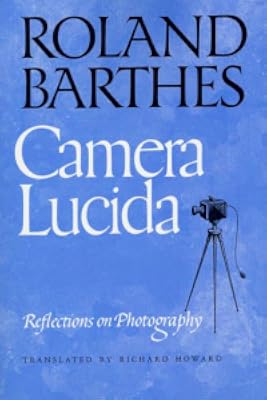
Camera Lucida: Reflections on Photography
by Roland Barthes
On This Page
Description
A graceful, contemplative volume, Camera Lucida was first published in 1979. Commenting on artists such as Avedon, Clifford, Mapplethorpe, and Nadar, Roland Barthes presents photography as being outside the codes of language or culture, acting on the body as much as on the mind, and rendering death and loss more acutely than any other medium. This groundbreaking approach established Camera Lucida as one of the most important books of theory on the subject, along with Susan Sontags On show more Photography. show lessTags
Recommendations






Member Recommendations
greuh Le livre de Barthes est évoqué à de nombreuses reprises dans le livre de Tisseron, qui critique la démarche de Barthes. Une lecture du livre de Barthes devrait donc enrichir, je pense, le lecteur du livre de Tisseron. Même si je ne l'ai pas fait...
Nox by Anne Carson
emydid Both are explorations of loss, death, and essence by way of triangulation through a third object (a Catullus poem in the case of Carson; photographs in the case of Barthes).
anonymous user Guibert knew Barthes and his book was written as a response to Barthes’ book.
Member Reviews
Meu lance com Barthes vai além da minha profunda paixão por Semiótica, mais do que sobre o que ele escreve, meu prazer em sua leitura está no como ele escreve.
Exalando cultura, Barthes é um dos mais deliciosos teóricos da palavra justamente por saber usá-la com maestria e estou dando cinco estrelas para este livro em que ele destrincha a arte fotográfica de forma afetiva, não porque concordo inteiramente com ele, longe disso, mas porque é um deleite absorver cada frase.
Exalando cultura, Barthes é um dos mais deliciosos teóricos da palavra justamente por saber usá-la com maestria e estou dando cinco estrelas para este livro em que ele destrincha a arte fotográfica de forma afetiva, não porque concordo inteiramente com ele, longe disso, mas porque é um deleite absorver cada frase.
Based on 48 fragments of philosophical insights about photography, this short book is at its core about love and grief, written after the loss of Barthes’ mother in 1977 with whom he had lived most of his life. He starts looking for her among old photographs and time and again the face he finds is not hers, even if she looks like herself. He ends up discovering her true likeness, the "air" that he remembers, in a picture of his mother at five years old taken by a provincial photographer in a winter garden in 1898.
I would have to reread this book several times to retain much of it; as it was, I merely enjoyed it as a philosophical journey, an intellectual inquiry on which I was allowed to spy. It was fascinating, often revealing truths about my own relationship to photographs, while raising further questions about photography, depiction, and art.
this is a great work of essay and introspection but it doesn't really interest me as theory. the argument is too scattered, overlapping and backtracking, to form a coherent (to me) way of thinking about Looking at photos. also i find it interesting/frustrating that barthes is basically incapable of thinking beyond photographs of people (portraits or otherwise). but parts of this are deeply moving and with stunning turns of phrase, so, i liked it, just not for the reasons i assumed i might.
Recommended by a prof when I described a series of family photos I'm working with.
The writing is, at first, a bit convoluted and challenging. However, I found that with patience I was able to hear Barthes in the context of my own experience with photography and the Photograph.
I came away with several pages of scribbled quotes in my journal. These for consideration as I work with two different image/photo-based projects: my Feminist Family Tree and The Body Catalog.
The writing is, at first, a bit convoluted and challenging. However, I found that with patience I was able to hear Barthes in the context of my own experience with photography and the Photograph.
I came away with several pages of scribbled quotes in my journal. These for consideration as I work with two different image/photo-based projects: my Feminist Family Tree and The Body Catalog.
Personally, I found this book to be of uneven quality. It has flashes where it is very good indeed, and then there are sections where I thought that he was meandering.
It is not an easy book, and I did read it slowly. I may well read it again. The overall tone is sombre, and the parts that I like are when he discusses a photograph, because this made me a lot more sensitive to what is in the photo, and what the story could possibly be. This is the singular most achievement of this set of writings.
I am not sure about that section on his mother, but the pain of her loss, and his love for her shine through. This part is deeply personal, and I must admire him for being able to share this.
It is not an easy book, and I did read it slowly. I may well read it again. The overall tone is sombre, and the parts that I like are when he discusses a photograph, because this made me a lot more sensitive to what is in the photo, and what the story could possibly be. This is the singular most achievement of this set of writings.
I am not sure about that section on his mother, but the pain of her loss, and his love for her shine through. This part is deeply personal, and I must admire him for being able to share this.
"Margaret Cameron’s claim that photography qualifies as an art because, like painting, it seeks the beautiful was succeeded by Henry Peach Robinson’s Wildean claim that photography is an art because it can lie. " — Sontag, "On Photography"
On the Productive Use of Useless Categories
Some people treat a book like it's a gun in a car. ("A [text] that's really very [cool] can sometimes get into a privileged position and do [great collateral damage.]" (e.g. certain works by of Baudrillard, Derrida, Chomsky).) I'm not (concealed) carrying Sontag's On Photography on me now, (Those who do are also a menace to society,) but when I get to my copy you'll be sorry. This is what I'm thinking when I recognize that, frankly, it's kind of show more abhorrent how Barthes manages to be so prolix in the space of little more than a hundred pages — nota bene -> never rule out the possibility that the author will be talking about his relationship with his mother for the rest of the essay.
A missive (missile) from Sontag is perhaps not yet necessary for an investigation of Barthes's "Studium / Punctum," which already appears to be an unstable pairing. Barthes's Studium is, "that very wide field of unconcerned desire, of various interest, of inconsequential taste: I like / I don't like,"(12) which, in its use throughout the text, appears to describe a quality of 'technical competence' in (mostly) bad photography. Punctum is, "that [accidental detail] which pricks me [...] which attracts or distresses me,"(27) which, upon further elaboration, describes merely a matter of taste: 'I like / I don't like.' Of course, Studium is already a negative category (dark room), designed to set Punctum in relief (exposure). Corollary: among the twenty photographs included in the the text, none is a demonstration of 'mere' Studium — nor would it be easy to produce one, given absence-of-a-Punctum is not a stable category. Is a Punctum then just a detail in a photograph (Barthes's examples appear to privilege intimate male figures, though not exclusively), that 'I like' because 'it affects me in some type of way?'
Sontag's engagement with notions of falsification in photography would appear to further destabilize this category: "In the mid-1840s, a German photographer invented the first technique for retouching the negative. His two versions of the same portrait—one retouched, the other not—astounded crowds at the Exposition Universelle held in Paris in 1855. The news that the camera could lie made getting photographed much more popular,"(On Photography, 61) We are already thinking of the advent of digital alteration (and DSLR all-digital photography), which might give the lie to any captured image — that hand-on-thigh Punctum might be the product of prurient processing-in-post.
We are unnerved by the notion that the strongest Punctum can be turned back into Studium by a (dumb) refusal (e.g. that moment in Bernhard's Old Masters in which a stranger tells our chief character that he has the exact same one-of-a-kind painting also mounted above his own bed — a direct Punctum and an invitation to do Plot, which our narrator simply neglects to pursue.)
We can further conceive of an all-Punctum-no-Studium photograph (i.e. the all black/gray image which is the absence of all technical competence but which pierces the viewer when he receives the explanation that it's the recording of the background radiation permeating the cosmos) — a Punctum that is always lying dead in all photographs. One wouldn't do badly to think that, further troubled by this reality, "Punctum" would give up the ghost.
Yet "Punctum" somehow persists — though not much more refined than the truism, 'I like what I like.' Yet there's still an opportunity to put "Punctum" to limited use by juxtaposing Barthes's neologism with that [apocryphal] phrase of Beauvoir's: "The weak have never overcome the strong." This phrase, ostensibly false, presents an opening for an interesting synchronic analysis when we take for examination an 'exception' to the rule and then assert the rule again simultaneously. A so-called 'weaker' force routs a 'stronger' foe — therefore it was the stronger force in that moment, (perhaps due to the topography of that landscape, the flash of sunlight, the forced march). Rephrasing Barthes, we might say "Bad photographs never prick (puncture) me." This might, at least, turn a double take into a look at the photograph that's a little deeper.
The trick is to turn a positive value-phrase into 'the negative of a negative' - with "never" in the middle of the phrase:
-e.g. A complicated field of forces determines strength at any given moment --> "The weak have never overcome the strong." -e.g. The touching detail is the component of a photograph that determines its value (to me) as art --> "Bad photographs never prick me." -e.g. We are at least getting a little something out of a good book --> "Bad books never have to be read."
"if you’re going two ways / all you need / is one light / to move." — Eileen Mylesshow less
Members
- Recently Added By
Lists

Deathreads
78 works; 2 members

1980 great books
63 works; 1 member
Author Information

196+ Works 22,392 Members
Roland Barthes (1915-1980), a French critic and intellectual, was a seminal figure in late twentieth-century literary criticism. Barthes's primary theory is that language is not simply words, but a series of indicators of a given society's assumptions. He derived his critical method from structuralism, which studies the rules behind language, and show more semiotics, which analyzes culture through signs and holds that meaning results from social conventions. Barthes believed that such techniques permit the reader to participate in the work of art under study, rather than merely react to it. Barthes's first books, Writing Degree Zero (1953), and Mythologies (1957), introduced his ideas to a European audience. During the 1960s his work began to appear in the United States in translation and became a strong influence on a generation of American literary critics and theorists. Other important works by Barthes are Elements of Semiology (1968), Critical Essays (1972), The Pleasure of the Text (1973), and The Empire of Signs (1982). The Barthes Reader (1983), edited by Susan Sontag, contains a wide selection of the critic's work in English translation. (Bowker Author Biography) show less
Some Editions
Series
Belongs to Publisher Series
Common Knowledge
- Canonical title*
- La chambre claire: Note sur la photographie
- Original title
- La chambre claire: Note sur la photographie
- Original publication date
- 1980
- Epigraph*
- En hommage à L'imaginaire de Sartre.
- First words*
- Un jour, il y a bien longtemps, je tombai sur une photographie du dernier frère de Napoléon, Jérôme (1852).
- Last words*
- (Click to show. Warning: May contain spoilers.)A moi de choisir, de soumettre son spectacle au code civilisé des illusions parfaites, ou d'affronter en elle le réveil de l'intraitable réalité.
- Original language
- French
*Some information comes from Common Knowledge in other languages. Click "Edit" for more information.
Classifications
Statistics
- Members
- 2,943
- Popularity
- 6,116
- Reviews
- 22
- Rating
- (4.03)
- Languages
- 21 — Catalan, Czech, Danish, Dutch, English, Estonian, Finnish, French, German, Hungarian, Italian, Japanese, Latvian, Norwegian (Bokmål), Polish, Romanian, Russian, Spanish, Swedish, Turkish, Portuguese (Portugal)
- Media
- Paper, Audiobook, Ebook
- ISBNs
- 61
- ASINs
- 16