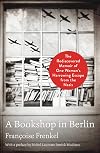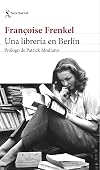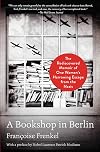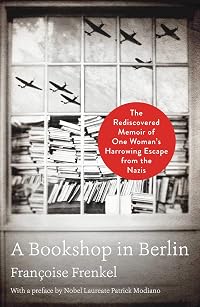
A Bookshop in Berlin: The Rediscovered Memoir of One Woman's Harrowing Escape from the Nazis
by Françoise Frenkel
On This Page
Description
In 1921, Françoise Frenkel--a Jewish woman from Poland--fulfills a dream. She opens La Maison du Livre, Berlin's first French bookshop, attracting artists and diplomats, celebrities and poets. The shop becomes a haven for intellectual exchange as Nazi ideology begins to poison the culturally rich city. In 1935, the scene continues to darken. First come the new bureaucratic hurdles, followed by frequent police visits and book confiscations. Françoise's dream finally shatters on show more Kristallnacht in November 1938, as hundreds of Jewish shops and businesses are destroyed. La Maison du Livre is miraculously spared, but fear of persecution eventually forces Françoise on a desperate, lonely flight to Paris. When the city is bombed, she seeks refuge across southern France, witnessing countless horrors: children torn from their parents, mothers throwing themselves under buses. Secreted away from one safe house to the next, Françoise survives at the heroic hands of strangers risking their lives to protect her. show lessTags
Recommendations
































Member Reviews
Writing: 4.0; Theme: 5.0; Content: 5.0; Language: 5.0; Overall: 4.0
This an amazing story of a Jewish woman- Francoise Frenkel- who fulfills her dream of opening up a book store in France. As Nazi ideology passes through Europe, police visits and confiscations begin to increase at Frenkel's place of business. Her book store is soon destroyed, as well as many other Jewish-owned businesses experienced, during the destruction of the evil of German tyranny. This book was actually published in 1945 and left in an attic until somewhat recently. Recommend.
***March 10, 2023***
This an amazing story of a Jewish woman- Francoise Frenkel- who fulfills her dream of opening up a book store in France. As Nazi ideology passes through Europe, police visits and confiscations begin to increase at Frenkel's place of business. Her book store is soon destroyed, as well as many other Jewish-owned businesses experienced, during the destruction of the evil of German tyranny. This book was actually published in 1945 and left in an attic until somewhat recently. Recommend.
***March 10, 2023***
Digital audiobook narrated by Jilly Bond
4****
Subtitle: The Rediscovered Memoir of One Woman’s Harrowing Escape From the Nazis
In 1921 Frankel – a Jewish woman from Poland – opened La Maison du Livre, Berlin’s first French bookshop. It was popular with artists and diplomats, celebrities and poets. But by 1935 the city was in the grip of the Nazis – first came bureaucratic hurdles, then police inspections and book confiscations. In November 1938 came Kristallnacht, when hundreds of Jewish shops and businesses were destroyed. Frankel fled to Paris. But she was hardly safe for long.
Originally titled No Place To Lay One’s Head this has been re-issued with the popular “bookshop” title – certainly a marketing strategy. show more There’s virtually nothing in the memoir about the bookshop, and little about Berlin.
This is not to say that Frankel’s memoir isn’t worth reading. I was engaged, interested and riveted by her tale. The many near misses and constant uncertainty would break many. I marveled at her tenacity, determination and sheer will to survive.
Jilly Bond does an excellent job of narrating the audiobook. She sets a good pace and has very clear diction. I don’t speak French, so am not certain, but her French pronunciation sounds authentic to me.
The text version includes numerous notes at the end, including copies of correspondence and a review of Frankel’s original memoir. I was surprised to learn from these appendices that she was married; her husband is never mentioned in the book. show less
4****
Subtitle: The Rediscovered Memoir of One Woman’s Harrowing Escape From the Nazis
In 1921 Frankel – a Jewish woman from Poland – opened La Maison du Livre, Berlin’s first French bookshop. It was popular with artists and diplomats, celebrities and poets. But by 1935 the city was in the grip of the Nazis – first came bureaucratic hurdles, then police inspections and book confiscations. In November 1938 came Kristallnacht, when hundreds of Jewish shops and businesses were destroyed. Frankel fled to Paris. But she was hardly safe for long.
Originally titled No Place To Lay One’s Head this has been re-issued with the popular “bookshop” title – certainly a marketing strategy. show more There’s virtually nothing in the memoir about the bookshop, and little about Berlin.
This is not to say that Frankel’s memoir isn’t worth reading. I was engaged, interested and riveted by her tale. The many near misses and constant uncertainty would break many. I marveled at her tenacity, determination and sheer will to survive.
Jilly Bond does an excellent job of narrating the audiobook. She sets a good pace and has very clear diction. I don’t speak French, so am not certain, but her French pronunciation sounds authentic to me.
The text version includes numerous notes at the end, including copies of correspondence and a review of Frankel’s original memoir. I was surprised to learn from these appendices that she was married; her husband is never mentioned in the book. show less
This memoir, written by a virtually unknown woman, was first published in 1945 under a different title and with little acclaim. Rediscovered in 2010, it has resonated with readers today. Because divisive politics, fear of minorities, and hateful rhetoric have reemerged, Frenkel’s recollections serve as stark reminders that the consequences of such circumstances can be quite devastating.
Frenkel’s aim was to show what it was like for those trapped in France during the brutal Nazi occupation. Her story demonstrates not only what is best in the human spirit— courage, empathy, and determination—but also the evils of indifference and outright cruelty. Shortages were prevalent; draconian regulations were enforced by unkind bureaucrats show more and soldiers; Jews and other minorities were harassed, arrested, and deported to death camps.
Frenkel relates her story linearly in the first person. She was born to Jewish parents in Poland in the late 19th century. She grew up in Paris where she studied literature at the Sorbonne. Her love of books led her to open a successful Berlin bookstore, La Maison du Livre, in 1921. She closed it 18 years later when the Nazi’s rose to power in Germany. Frenkel fled to Paris but left for Avignon when the Nazis arrived. Later she moved further south to Nice where she constantly feared arrest by the Nazis. A French couple (the Marius) provided her with safety and assistance. Narrow escapes, false papers, some luck and multiple examples of good faith by the locals characterized this time. Arrests and detention followed two failed attempts to enter Switzerland illegally. Frenkel finally succeeded in 1943. She returned to Nice following the war, where she resided until her death in the 1970s.
The memoir is filled with anecdotes that graphically capture the times. Children were separated from their parents often with dire consequences. Some locals hid her for money and rare supplies, only to betray her when word spread of her presence in their homes. She witnessed a trial wherein a man murdered his wife at her request following their arrest. Although most of the memoir is quite dark, there were some lighter moments. Of particular note was the story of a French octogenarian who agreed to provide Frenkel with a marriage of convenience only to backed out when he mistakenly thought that she was old and deformed. He was outlandishly undeterred when reminded that this was a marriage in name only.
Frenkel writes in a simple journalistic style devoid of value judgements yet conveying insight and sympathy. Regrettably, her voice often seems too distant and measured to convey the sense of suspense and urgency the events truly deserve. show less
Frenkel’s aim was to show what it was like for those trapped in France during the brutal Nazi occupation. Her story demonstrates not only what is best in the human spirit— courage, empathy, and determination—but also the evils of indifference and outright cruelty. Shortages were prevalent; draconian regulations were enforced by unkind bureaucrats show more and soldiers; Jews and other minorities were harassed, arrested, and deported to death camps.
Frenkel relates her story linearly in the first person. She was born to Jewish parents in Poland in the late 19th century. She grew up in Paris where she studied literature at the Sorbonne. Her love of books led her to open a successful Berlin bookstore, La Maison du Livre, in 1921. She closed it 18 years later when the Nazi’s rose to power in Germany. Frenkel fled to Paris but left for Avignon when the Nazis arrived. Later she moved further south to Nice where she constantly feared arrest by the Nazis. A French couple (the Marius) provided her with safety and assistance. Narrow escapes, false papers, some luck and multiple examples of good faith by the locals characterized this time. Arrests and detention followed two failed attempts to enter Switzerland illegally. Frenkel finally succeeded in 1943. She returned to Nice following the war, where she resided until her death in the 1970s.
The memoir is filled with anecdotes that graphically capture the times. Children were separated from their parents often with dire consequences. Some locals hid her for money and rare supplies, only to betray her when word spread of her presence in their homes. She witnessed a trial wherein a man murdered his wife at her request following their arrest. Although most of the memoir is quite dark, there were some lighter moments. Of particular note was the story of a French octogenarian who agreed to provide Frenkel with a marriage of convenience only to backed out when he mistakenly thought that she was old and deformed. He was outlandishly undeterred when reminded that this was a marriage in name only.
Frenkel writes in a simple journalistic style devoid of value judgements yet conveying insight and sympathy. Regrettably, her voice often seems too distant and measured to convey the sense of suspense and urgency the events truly deserve. show less
This is an amazing and gripping recently rediscovered memoir about a Jewish polish woman who owned a French bookstore in Berlin in the years when the nazi party came into power.
Having eventually to flee Germany she founds herself in France where she has to bounce around from one hiding place to the next while she makes multiple attempts to cross into Switzerland.
The writing is immaculate and keeps you wanting to read on. I could not put this one down.
I highly recommend this one to anyone if if you're not into memoirs or the holocaust!
Having eventually to flee Germany she founds herself in France where she has to bounce around from one hiding place to the next while she makes multiple attempts to cross into Switzerland.
The writing is immaculate and keeps you wanting to read on. I could not put this one down.
I highly recommend this one to anyone if if you're not into memoirs or the holocaust!
This is a well-done memoir from Frenkel and, amazingly, this memoir was found after so much time. She provides a really interesting point of view and in this book, you get to see such a devesting journey for Frenkel, from losing her bookstore she spent so long creating to her time running away from the Nazis.
Bookshop in Berlin: The Rediscovered Memoir of One Woman's Harrowing Escape from the Nazis, Francois Frenkel, author; Patrick Moidano, preface; Jilly Bond, narrator
This book is a rediscovered memoir of Francoise Frenkel. It is written in a beautiful, lyrical, and expressive prose with a vocabulary that is free from the crudeness existing in many books today. It is read by a wonderful narrator who used tone and emphasis at just the right time. In Frenkel’s voice, the reader is taken through a detailed description of the decline of life in Europe as it falls under Hitler’s control.
Alternating between moments that seem idyllic and peaceful, as she, a lover of books, operates her French book shop in Berlin and interacts with her show more favorite customers, there are moments of terror and danger, violence and brutality. She is a foreigner, of Polish heritage, and a Jew, in a country that reveres Aryans and finds Jews reprehensible. The book cracks a window on how her life changed under the Nazis influence, how people reacted to her, and how the draconian rules altered the worldview of those in her immediate environment.
Frenkel was lucky to have good friends, influential friends, the funds to help herself, and the personal courage to face the perils that awaited her on her journey to her ultimate freedom. Not everyone in her situation would be as fortunate. No one could have imagined the horrors that Hitler planned. In some ways the memoir oversimplified the most tragic event of the 20th century. The population simply seemed largely naïve and incredulous as race laws were drafted and implemented and Jews and others were arrested with abandon and unnecessary violence. There seemed to be very little active resistance to Hitler in Germany. Rather he had full and loyal support.
I found the absence of some kind of deep emotional response and/or anger, overall, by most of the people with whom she interacted, to be completely disheartening. Since I know that there was an underground and there were many unsung heroes that gave their lives to stand in Hitler’s way, my own knowledge somewhat mitigated my disappointment. The idea that the need to “simply do their job” was the overriding principle coupled with a general feeling of disbelief by the citizenry about what was happening was disturbing. France had fallen, other countries were falling. What were those who acquiesced to Hitler thinking?
As a foreigner in Germany, as the new laws were written, Francoise couldn’t obtain work or travel papers. She was also Jewish. The description of the history of events, her own personal effort to flee, her eventual capture and imprisonment, coupled with the stories of the abuse and the cruelty the prisoners faced, was informative, but no new light was shed on the reasons the Holocaust even came to pass or on how to prevent another.
Just because of a series of lucky coincidences and lucky encounters, Francoise was able to survive and eventually travel to America. Others were not so lucky. Although she thought she lived through the worst moments anyone could, and they were traumatic for her, no doubt about it, far worse was yet to come for others who were captured, sent to prison and than herded off to Concentration Camps. She was lucky to have the wherewithal to support and defend herself financially, the relatives and influential friends who could help her, and the strength to face whatever came before her. show less
This book is a rediscovered memoir of Francoise Frenkel. It is written in a beautiful, lyrical, and expressive prose with a vocabulary that is free from the crudeness existing in many books today. It is read by a wonderful narrator who used tone and emphasis at just the right time. In Frenkel’s voice, the reader is taken through a detailed description of the decline of life in Europe as it falls under Hitler’s control.
Alternating between moments that seem idyllic and peaceful, as she, a lover of books, operates her French book shop in Berlin and interacts with her show more favorite customers, there are moments of terror and danger, violence and brutality. She is a foreigner, of Polish heritage, and a Jew, in a country that reveres Aryans and finds Jews reprehensible. The book cracks a window on how her life changed under the Nazis influence, how people reacted to her, and how the draconian rules altered the worldview of those in her immediate environment.
Frenkel was lucky to have good friends, influential friends, the funds to help herself, and the personal courage to face the perils that awaited her on her journey to her ultimate freedom. Not everyone in her situation would be as fortunate. No one could have imagined the horrors that Hitler planned. In some ways the memoir oversimplified the most tragic event of the 20th century. The population simply seemed largely naïve and incredulous as race laws were drafted and implemented and Jews and others were arrested with abandon and unnecessary violence. There seemed to be very little active resistance to Hitler in Germany. Rather he had full and loyal support.
I found the absence of some kind of deep emotional response and/or anger, overall, by most of the people with whom she interacted, to be completely disheartening. Since I know that there was an underground and there were many unsung heroes that gave their lives to stand in Hitler’s way, my own knowledge somewhat mitigated my disappointment. The idea that the need to “simply do their job” was the overriding principle coupled with a general feeling of disbelief by the citizenry about what was happening was disturbing. France had fallen, other countries were falling. What were those who acquiesced to Hitler thinking?
As a foreigner in Germany, as the new laws were written, Francoise couldn’t obtain work or travel papers. She was also Jewish. The description of the history of events, her own personal effort to flee, her eventual capture and imprisonment, coupled with the stories of the abuse and the cruelty the prisoners faced, was informative, but no new light was shed on the reasons the Holocaust even came to pass or on how to prevent another.
Just because of a series of lucky coincidences and lucky encounters, Francoise was able to survive and eventually travel to America. Others were not so lucky. Although she thought she lived through the worst moments anyone could, and they were traumatic for her, no doubt about it, far worse was yet to come for others who were captured, sent to prison and than herded off to Concentration Camps. She was lucky to have the wherewithal to support and defend herself financially, the relatives and influential friends who could help her, and the strength to face whatever came before her. show less
Francoise Frenkel's memoir, first published in French in 1945, was recently rediscovered and translated into English. In it, she recounts how she started the first French literature bookstore in Berlin, but then had to flee after Kristallnacht. Her bookshop is not destroyed, but because of her Polish Jewish heritage, she knows her life is in danger and she returns to France as a refugee.
The French title of this book translates to "No place to lay one's head", which is a more accurate representation of the contents than the English title. Only chapter 1 really told you about the bookshop, which was Frenkel's dream, and which she ran from 1921 to her leaving in 1938. The rest is about her life in France from 1939 and through the German show more occupation, showing how her life grows more and more restricted. Though the threat of deportation is always present, her day-to-day life is at times rather boring. And yet, she manages to convey a generally positive attitude and love for French people and literature, despite the way she's treated as a refugee by the government and some of the townspeople. In fact, she's much more forgiving of their human foibles than I would be. Many books have been written about the awful events in World War 2, but it's still powerful to read a memoir about it, especially one written so close to her experiences. show less
The French title of this book translates to "No place to lay one's head", which is a more accurate representation of the contents than the English title. Only chapter 1 really told you about the bookshop, which was Frenkel's dream, and which she ran from 1921 to her leaving in 1938. The rest is about her life in France from 1939 and through the German show more occupation, showing how her life grows more and more restricted. Though the threat of deportation is always present, her day-to-day life is at times rather boring. And yet, she manages to convey a generally positive attitude and love for French people and literature, despite the way she's treated as a refugee by the government and some of the townspeople. In fact, she's much more forgiving of their human foibles than I would be. Many books have been written about the awful events in World War 2, but it's still powerful to read a memoir about it, especially one written so close to her experiences. show less
Members
- Recently Added By
Lists

History: Holocaust
106 works; 1 member
Author Information
Some Editions
Awards and Honors
Awards
Series
Belongs to Publisher Series
Common Knowledge
- Canonical title*
- Rien où poser sa tête
- Original title
- Rien où poser sa tête
- Original publication date
- 1945-09 (1e édition orriginale suisse, Jeheber, Genève) (1e é | dition orriginale suisse, Jeheber, Genè | ve); 2015-10-15 (Nouvelle édition compilée et complétée, L'arbalète, Gallimard) (Nouvelle é | dition compilé | e et complé | té | e, L'arbalè | te, Gallimard)
- Important places
- Berlin
- First words*
- Préface (Patrick Modiano / Edition Gallimard 2015)
L'exemplaire de Rien où poser sa tête dont on m'a dit qu'il avait été trouvé récemment à Nice dans un déballage des compagnons d'Emmaüs m'a cau... (show all)sé une curieuse impression. [...]
Avant-propos
Il est du devoir des survivants de rendre témoignage afin que les morts ne soient pas oubliés, ni méconnus les obscurs dévouements.
[...]
I
Au service de la pensée française en Allemagne
Je ne sais à quel âge remonte, en réalité, ma vocation de libraire. Toute petite, je pouvais passer des heures à feuilleter un livre d'images ou ... (show all)un grand volume illustré.
[...] - Original language
- French
*Some information comes from Common Knowledge in other languages. Click "Edit" for more information.
Classifications
- Genres
- Biography & Memoir, Nonfiction, History, General Nonfiction
- DDC/MDS
- 940.5318092 — History & geography History of Europe History of Europe 1918- World War II, 1939-1945 Social, political, economic history; Holocaust Holocaust Standard subdivisions History, geographic treatment, biography Biography
- LCC
- D811.5 .F7313 — History of Europe, Asia, Africa and Oceania History (General) World War II (1939-1945)
- BISAC
Statistics
- Members
- 586
- Popularity
- 50,145
- Reviews
- 30
- Rating
- (3.75)
- Languages
- 10 — Catalan, Dutch, English, French, German, Italian, Portuguese (Portugal), Romanian, Spanish, Swedish
- Media
- Paper, Audiobook, Ebook
- ISBNs
- 33
- ASINs
- 7