The End of the Bronze Age
by Robert Drews
On This Page
Description
This text attempts to account for the destruction of key cities in the Mediterranean at the end of the Bronze Age, circa the 12th century BC. The author proposes a military explanation for the destruction of four important kingdoms at this time.Tags
Recommendations

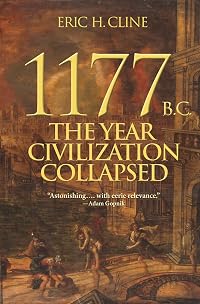



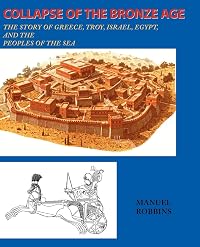
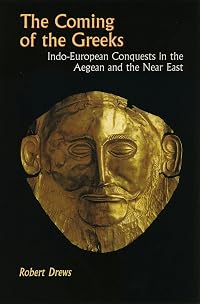



















Member Recommendations
Member Reviews
One of the mysteries of early human history is the near-complete collapse of Bronze Age civilisation in the West around 1200BC. The Mycenaean and Hittite Empires collapsed, the Canaanite and Syrian cities were plundered, Egypt was severely threatened by hordes from the Libyan West and only Assyria survived intact.
This would be like some upheaval destroying civilisation in Europe and Russia and forcing all world trade centres out of business, leaving only China standing and a weakened US. What caused this has been a puzzle for generations of archaeologists.
Robert Drews, writing a quarter of a century ago, came up with a very plausible solution in this book, taking account of one simple problem - we cannot know very much about this era. show more In the end, his solutions seems the most plausible largely because all other solutions are less so.
He takes us through all those formerly plausible scenarios that do not quite stand up to scrutiny - tectonic shifts causing devastating earthquakes, mass migrations of peoples (caused perhaps by, say, over-population), the arrival of ironworking, climatic change and general systems collapse.
His solution is more brutally simple - changes in basic military technology which triggered a change in the relative power of 'primitives' in the hinterland, used to doing imperial dirty work or hungry for the goodies that the empires and cities held, to 'civilisation'.
There is no point on over-simplifying his argument. The slim evidential base is nevertheless handled with skill to place a great deal of emphasis on the arrival of the slashing sword invented to the North and which gave tribes throughout the region a new edge against chariot warfare.
His argument provides a plausible narrative in which mercenaries are hired and then become factors (as in Rome many centuries later) in disturbing the balance of power on which empires depend. Unlike the later barbarians, these 'primitives' were happy just to plunder and not to learn.
Drew calls these events the Catastrophe but points out that it was these plundering tribes who eventually learned to cohere in the Iron Age into 'nations' that were the founding twin poles of later Western civilisation, Greece and Israel.
There is much to ponder here (if one is so minded) on what may cause the collapse of civilisations. Eco-causes are fashionable on the left and migration pressures on the right but it may be that both are allowing ideology and prejudice to get in the way.
Even new technology, the current favourite for renewed torment amongst the terminal pessimists, may not be the probable cause that we are told. Perhaps it is just going to be about the transfer of very specific tools to the 'damned of the earth', a simple shift in power relations.
In 1200BC, the slashing sword and a few other highly specific innovations and new motivations in the hands of masses of men seem to have overcome the capital-intensive military technologies of the day - the chariot army and its logistics - surprisingly quickly and brutally.
The masses of men were outsiders who had been brought into the system to act as mercenaries and seem to have learned of the weaknesses of their employers and enemies. Drews give some emphasis to the role of an attempted mass assault on Egypt by the Libyans as central to the learning process.
I cannot quite see a modern analogy but we might be interested in looking for it. Who are the masses of persons today who are allowed to taste the system but not to own it? What tools are to hand that would give them the edge over the finely honed 'educated' and wealthier 'owners'?
Perhaps then it was a struggle over brute force - the ability to thrust aside the other and plunder. Perhaps today civilisation is vulnerable not to such thuggery but to a simple withdrawal of an acceptance of elite legitimacy enabled by some new and forthcoming single techno-innovation.
The pessimists always think that the collapse of civilisation is due at any time. They are usually wrong. However, Chinese and Western history have shown periodic periods of collapse and restoration. It is probably worth thinking about what could cause the next collapse if it ever came. show less
This would be like some upheaval destroying civilisation in Europe and Russia and forcing all world trade centres out of business, leaving only China standing and a weakened US. What caused this has been a puzzle for generations of archaeologists.
Robert Drews, writing a quarter of a century ago, came up with a very plausible solution in this book, taking account of one simple problem - we cannot know very much about this era. show more In the end, his solutions seems the most plausible largely because all other solutions are less so.
He takes us through all those formerly plausible scenarios that do not quite stand up to scrutiny - tectonic shifts causing devastating earthquakes, mass migrations of peoples (caused perhaps by, say, over-population), the arrival of ironworking, climatic change and general systems collapse.
His solution is more brutally simple - changes in basic military technology which triggered a change in the relative power of 'primitives' in the hinterland, used to doing imperial dirty work or hungry for the goodies that the empires and cities held, to 'civilisation'.
There is no point on over-simplifying his argument. The slim evidential base is nevertheless handled with skill to place a great deal of emphasis on the arrival of the slashing sword invented to the North and which gave tribes throughout the region a new edge against chariot warfare.
His argument provides a plausible narrative in which mercenaries are hired and then become factors (as in Rome many centuries later) in disturbing the balance of power on which empires depend. Unlike the later barbarians, these 'primitives' were happy just to plunder and not to learn.
Drew calls these events the Catastrophe but points out that it was these plundering tribes who eventually learned to cohere in the Iron Age into 'nations' that were the founding twin poles of later Western civilisation, Greece and Israel.
There is much to ponder here (if one is so minded) on what may cause the collapse of civilisations. Eco-causes are fashionable on the left and migration pressures on the right but it may be that both are allowing ideology and prejudice to get in the way.
Even new technology, the current favourite for renewed torment amongst the terminal pessimists, may not be the probable cause that we are told. Perhaps it is just going to be about the transfer of very specific tools to the 'damned of the earth', a simple shift in power relations.
In 1200BC, the slashing sword and a few other highly specific innovations and new motivations in the hands of masses of men seem to have overcome the capital-intensive military technologies of the day - the chariot army and its logistics - surprisingly quickly and brutally.
The masses of men were outsiders who had been brought into the system to act as mercenaries and seem to have learned of the weaknesses of their employers and enemies. Drews give some emphasis to the role of an attempted mass assault on Egypt by the Libyans as central to the learning process.
I cannot quite see a modern analogy but we might be interested in looking for it. Who are the masses of persons today who are allowed to taste the system but not to own it? What tools are to hand that would give them the edge over the finely honed 'educated' and wealthier 'owners'?
Perhaps then it was a struggle over brute force - the ability to thrust aside the other and plunder. Perhaps today civilisation is vulnerable not to such thuggery but to a simple withdrawal of an acceptance of elite legitimacy enabled by some new and forthcoming single techno-innovation.
The pessimists always think that the collapse of civilisation is due at any time. They are usually wrong. However, Chinese and Western history have shown periodic periods of collapse and restoration. It is probably worth thinking about what could cause the next collapse if it ever came. show less
A fascinating look at the history of the Bronze Age collapse, one of the least-known but most pivotal periods in history. Even though the invasions of the Sea Peoples were so devastating that there aren't even records of their proper name, and despite the passage of over thirty centuries and the disappearance of most of the historical record, Drews reviews the greater part of the known evidence of the battles that the eastern Mediterranean civilizations fought against them and comes up with fairly convincing theories to explain how so many nations vanished so suddenly during the 12th century BC, how the Egyptians eventually managed to stop them, and what the consequences were for military tactics and Western civilization as a whole.
He show more begins briskly, with a review of the known evidence. Archaeologists have discovered that around the end of the 12th century BC, many parts of the eastern Mediterranean experienced sudden population decline and epidemics of cities burned to the ground: Turkey, Cyprus, the entire coast of the Levant, Greece and the Aegean islands, Crete, and even parts of Mesopotamia up to the boundary of the Assyrian empire. The only region that appears to have escaped relatively unscathed is what's now Egypt, but whatever happened was so catastrophic that it marks the end of the Bronze Age and the beginning of a long dark age lasting at least half a millennium in most of the area. Prior to the calamity, powerful empires like the Hittites controlled large centralized states with strong, mobile militaries, and afterwards there was basically nothing left of virtually every culture anywhere near the Mediterranean coast: "Altogether the end of the Bronze Age was arguably the worst disaster in ancient history, even more calamitous than the collapse of the western Roman Empire."
Many theories have been proposed to explain this mass collapse - Drews covers theories of earthquakes, large-scale migrations, the introduction of iron weapons and armor, widespread drought, an increase in barbarian raids, and the all-encompassing "general systems collapse". Each is somewhat plausible, and Drews' contention is that the true answer is essentially a combination of most of the above, with a primary emphasis on changes in military tactics. Much like the Mongols' use of heavy cavalry was so revolutionary as to render them nearly unstoppable for many decades across most of Eurasia, the Sea Peoples' use of heavy infantry caught almost every Mediterranean empire completely off guard. At the time, infantry were used only for fighting small, disorganized bands of barbarians; the chariot, driven by a charioteer accompanied by an archer with a composite bow, was the unit of choice for serious wars between powerful states. In ancient battles like Megiddo and Kadesh, they seem to have fulfilled a role vaguely similar to that of tanks in the North African front of World War 2 as fast-moving tactical shock units (it's funny how after thousands of years warfare in that part of the world can be so similar). Unlike in the classical era, where groups of heavy infantry like hoplites/phalanxes/legionaries were the decisive unit in state-to-state warfare, in the Bronze Age most societies organized their foot soldiers primarily into light infantry, and used them mostly against weaker barbarian tribes, in areas unsuitable for chariot warfare, or as auxiliaries and support in chariot warfare.
That particular structure of forces says a lot, not only about what warfare was like, but also the limits of technology and the social structures of Bronze Age civilizations. By the middle of the Iron Age chariots had essentially disappeared from the battlefield, mounted cavalry being a more efficient use of horse but also seemingly more effective in the supporting role so familiar from the infantry-focused wars of the Romans and Greeks. In between was the Bronze Age collapse, and though hard evidence is frustratingly scanty, Drews is convinced that the invasions of the Sea Peoples, with their more advanced armor, javelins, and swords, were the catalyst for the disappearance of the chariot as a viable unit of warfare. Without chariots, most states were essentially helpless before their assaults, and even the "lucky" Egyptians relied on some decisive naval victories to escape most of the damage. While he's weirdly attached to the theory that the Sea Peoples were originally from Sardinia (given the behavior of later civilizations, it seems like the western Mediterranean would be a more pleasant place to pillage than the eastern), his theory that most of the established cultures just couldn't withstand the Sea People's superior way of war seems solid. Again, much like the Mongols were able to completely obliterate much larger and richer empires by virtue of better military prowess, it seems reasonable to think that the same thing could have happened in the same area in the Bronze Age (although the Egyptians managed to fight off the Mongols that time).
The book is written in a dry, scholarly tone, but there's a chill behind its descriptions of sacks, ruins, and conflict: were it not for Egypt's resistance to the Sea Peoples, what, if anything, would have eventually limited their depredations? Unlike the Vikings or the Mongols, they didn't settle in most of the territories they came across, they just destroyed everything they touched. If they had proceeded unchecked until they ran out of steam, we might never have known about them, and the long interregnum of civilization at the end of the Bronze Age might have been gone on for much longer. I would have liked for him to have spent more time on the theory that the stories of the Trojan War are based in part on the Bronze Age collapse, and to have bothered to translate some primary source quotes from the original Italian, Ancient Greek, etc., but otherwise this was an intriguing look at an irritatingly enigmatic period in world history. show less
He show more begins briskly, with a review of the known evidence. Archaeologists have discovered that around the end of the 12th century BC, many parts of the eastern Mediterranean experienced sudden population decline and epidemics of cities burned to the ground: Turkey, Cyprus, the entire coast of the Levant, Greece and the Aegean islands, Crete, and even parts of Mesopotamia up to the boundary of the Assyrian empire. The only region that appears to have escaped relatively unscathed is what's now Egypt, but whatever happened was so catastrophic that it marks the end of the Bronze Age and the beginning of a long dark age lasting at least half a millennium in most of the area. Prior to the calamity, powerful empires like the Hittites controlled large centralized states with strong, mobile militaries, and afterwards there was basically nothing left of virtually every culture anywhere near the Mediterranean coast: "Altogether the end of the Bronze Age was arguably the worst disaster in ancient history, even more calamitous than the collapse of the western Roman Empire."
Many theories have been proposed to explain this mass collapse - Drews covers theories of earthquakes, large-scale migrations, the introduction of iron weapons and armor, widespread drought, an increase in barbarian raids, and the all-encompassing "general systems collapse". Each is somewhat plausible, and Drews' contention is that the true answer is essentially a combination of most of the above, with a primary emphasis on changes in military tactics. Much like the Mongols' use of heavy cavalry was so revolutionary as to render them nearly unstoppable for many decades across most of Eurasia, the Sea Peoples' use of heavy infantry caught almost every Mediterranean empire completely off guard. At the time, infantry were used only for fighting small, disorganized bands of barbarians; the chariot, driven by a charioteer accompanied by an archer with a composite bow, was the unit of choice for serious wars between powerful states. In ancient battles like Megiddo and Kadesh, they seem to have fulfilled a role vaguely similar to that of tanks in the North African front of World War 2 as fast-moving tactical shock units (it's funny how after thousands of years warfare in that part of the world can be so similar). Unlike in the classical era, where groups of heavy infantry like hoplites/phalanxes/legionaries were the decisive unit in state-to-state warfare, in the Bronze Age most societies organized their foot soldiers primarily into light infantry, and used them mostly against weaker barbarian tribes, in areas unsuitable for chariot warfare, or as auxiliaries and support in chariot warfare.
That particular structure of forces says a lot, not only about what warfare was like, but also the limits of technology and the social structures of Bronze Age civilizations. By the middle of the Iron Age chariots had essentially disappeared from the battlefield, mounted cavalry being a more efficient use of horse but also seemingly more effective in the supporting role so familiar from the infantry-focused wars of the Romans and Greeks. In between was the Bronze Age collapse, and though hard evidence is frustratingly scanty, Drews is convinced that the invasions of the Sea Peoples, with their more advanced armor, javelins, and swords, were the catalyst for the disappearance of the chariot as a viable unit of warfare. Without chariots, most states were essentially helpless before their assaults, and even the "lucky" Egyptians relied on some decisive naval victories to escape most of the damage. While he's weirdly attached to the theory that the Sea Peoples were originally from Sardinia (given the behavior of later civilizations, it seems like the western Mediterranean would be a more pleasant place to pillage than the eastern), his theory that most of the established cultures just couldn't withstand the Sea People's superior way of war seems solid. Again, much like the Mongols were able to completely obliterate much larger and richer empires by virtue of better military prowess, it seems reasonable to think that the same thing could have happened in the same area in the Bronze Age (although the Egyptians managed to fight off the Mongols that time).
The book is written in a dry, scholarly tone, but there's a chill behind its descriptions of sacks, ruins, and conflict: were it not for Egypt's resistance to the Sea Peoples, what, if anything, would have eventually limited their depredations? Unlike the Vikings or the Mongols, they didn't settle in most of the territories they came across, they just destroyed everything they touched. If they had proceeded unchecked until they ran out of steam, we might never have known about them, and the long interregnum of civilization at the end of the Bronze Age might have been gone on for much longer. I would have liked for him to have spent more time on the theory that the stories of the Trojan War are based in part on the Bronze Age collapse, and to have bothered to translate some primary source quotes from the original Italian, Ancient Greek, etc., but otherwise this was an intriguing look at an irritatingly enigmatic period in world history. show less
Around the eastern Mediterranean, the end of the Bronze Age was quite dramatic: within the span of just a few decades, the Mycenaean kingdoms and the Hittite empire collapse, as does the Egyptian dominion in the southern Levant, while Egypt itself suffers barbarian invasions from both Libya and Palestine. Many urban centres are burnt, and in Greece and Anatolia societal collapse is such that writing disappears for centuries, and even Egypt enters a period of few inscriptions.
Drews reviews and dismisses a number of previously suggested explanations for this collapse before advancing his own. He finds no evidence for a geological (eg. earthquakes) or climatological (eg. crop failures due to drought) cause acting across the entire region, show more and dismisses mass migrations by Dorians, Phrygians, or "Sea Peoples" as misreadings of the sources compounded with the 19C tendency to explain much of everything with Völkerwanderungen. His own explanation, then, is that light infantry with swords and javelins, such as had long been used in a subsidiary role in the chariot-based armies of the civilized states, were discovered by marginal groups, probably in northern Greece (outside the Mycenean Greece proper), to be able, used en masse, to defeat chariot forces by themselves. Once this "secret" was out, every barbarian chieftain worth his salt gathered an army of followers armed like this and attempted to sack the nearest civilized city, frequently successfully.
Unfortunately, I find Drews's criticisms of others' hypotheses far more convincing than his own suggestion. If one, as Drews does, accepts that the bronze age chariot was essentially an archery platform, it's hard to see why it should be radically more vulnerable to infantry javelins that later ages' horse archers were. And if it for some reason were, it beggars belief that discovering this should have lagged the introduction of chariotry by centuries.
Nevertheless, I'm happy to have read the book. While I am not convinced by his conclusions, Drews presents lots of interesting data. Whether vulnerable to javelins or not, it's an archaeological fact that chariots virtually disappear from Greece at this time, and become less prominent elsewhere, and new types of weapons, notably new types of swords, are introduced. Clearly, something happened on the military front during the bronze age collapse. Whether one accepts his particular answer he's calling our attention to a question needing one. show less
Drews reviews and dismisses a number of previously suggested explanations for this collapse before advancing his own. He finds no evidence for a geological (eg. earthquakes) or climatological (eg. crop failures due to drought) cause acting across the entire region, show more and dismisses mass migrations by Dorians, Phrygians, or "Sea Peoples" as misreadings of the sources compounded with the 19C tendency to explain much of everything with Völkerwanderungen. His own explanation, then, is that light infantry with swords and javelins, such as had long been used in a subsidiary role in the chariot-based armies of the civilized states, were discovered by marginal groups, probably in northern Greece (outside the Mycenean Greece proper), to be able, used en masse, to defeat chariot forces by themselves. Once this "secret" was out, every barbarian chieftain worth his salt gathered an army of followers armed like this and attempted to sack the nearest civilized city, frequently successfully.
Unfortunately, I find Drews's criticisms of others' hypotheses far more convincing than his own suggestion. If one, as Drews does, accepts that the bronze age chariot was essentially an archery platform, it's hard to see why it should be radically more vulnerable to infantry javelins that later ages' horse archers were. And if it for some reason were, it beggars belief that discovering this should have lagged the introduction of chariotry by centuries.
Nevertheless, I'm happy to have read the book. While I am not convinced by his conclusions, Drews presents lots of interesting data. Whether vulnerable to javelins or not, it's an archaeological fact that chariots virtually disappear from Greece at this time, and become less prominent elsewhere, and new types of weapons, notably new types of swords, are introduced. Clearly, something happened on the military front during the bronze age collapse. Whether one accepts his particular answer he's calling our attention to a question needing one. show less
The End of the Bronze Age, by Robert Drews, is a good introduction to the catastrophe of the bronze age. The book provides a summary of the events, a map showing the sites, and a critique of the various possible explanations of the cause. Drews also speculates that the cause was a change in tactics and weaponry (an improved sword).
Although the book was written in the mid 1990s, it is still current. The same debate still exists about the cause, with the same possible explanations.
Although the book was written in the mid 1990s, it is still current. The same debate still exists about the cause, with the same possible explanations.
Ratings
Members
- Recently Added By
Lists

Bronze age catastrophe
30 works; 2 members

Books Read in 2013
1,630 works; 51 members

r/AskHistorians' Recommended Books
1,068 works; 19 members
Author Information

8+ Works 495 Members
Common Knowledge
- Original publication date
- 1993
Classifications
- Genres
- Anthropology, History, Nonfiction, General Nonfiction
- DDC/MDS
- 930.09822 — History & geography History of ancient world (to ca. 499) Ancient History: China, Egypt, Rome, Greece Sea people
- LCC
- GN778.3 .A1 .D74 — Geography, Anthropology and Recreation Anthropology Anthropology Prehistoric archaeology
- BISAC
Statistics
- Members
- 292
- Popularity
- 110,218
- Reviews
- 4
- Rating
- (3.89)
- Languages
- English
- Media
- Paper, Ebook
- ISBNs
- 3
- ASINs
- 1