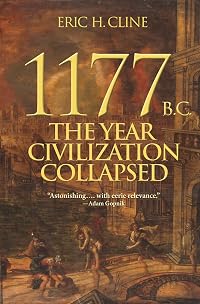
1177 B.C. : The Year Civilization Collapsed
by Eric H. Cline
On This Page
Description
"In 1177 B.C., marauding groups known only as the "Sea Peoples" invaded Egypt. The pharaoh's army and navy managed to defeat them, but the victory so weakened Egypt that it soon slid into decline, as did most of the surrounding civilizations. After centuries of brilliance, the civilized world of the Bronze Age came to an abrupt and cataclysmic end. Kingdoms fell like dominoes over the course of just a few decades. No more Minoans or Mycenaeans. No more Trojans, Hittites, or Babylonians. The show more thriving economy and cultures of the late second millennium B.C., which had stretched from Greece to Egypt and Mesopotamia, suddenly ceased to exist, along with writing systems, technology, and monumental architecture. But the Sea Peoples alone could not have caused such widespread breakdown. How did it happen? In this major new account of the causes of this "First Dark Ages," Eric Cline tells the gripping story of how the end was brought about by multiple interconnected failures, ranging from invasion and revolt to earthquakes, drought, and the cutting of international trade routes. Bringing to life the vibrant multicultural world of these great civilizations, he draws a sweeping panorama of the empires and globalized peoples of the Late Bronze Age and shows that it was their very interdependence that hastened their dramatic collapse and ushered in a dark age that lasted centuries. A compelling combination of narrative and the latest scholarship, 1177 B.C. sheds new light on the complex ties that gave rise to, and ultimately destroyed, the flourishing civilizations of the Late Bronze Age-and that set the stage for the emergence of classical Greece"-- show lessTags
Recommendations








Member Recommendations


Member Reviews
Overproduction, vast inequalities, endemic war, exhaustion of resources, climate shifts - what I learned was that the earliest "global civilization" sounds much like the latest. No single cause brings down complex human systems, but when these factors conjoin, at some point, they fall. The process unfolds over decades, and frenzied activity - construction, diplomacy, trade, commerce - continues right up to the last, so that it is only clear in retrospect that some order which may have lasted for centuries is gone for good.
I would have liked to hear more speculation about what happens to common people in these situations - their lives are not recorded, so it's difficult. But when city after city was burned to the ground, what became of show more the people in them? I suppose we could look at contemporary examples like Syria to get some sense.
Humans make pretty things, but our history isn't pretty. It's beyond disturbing - it seems a complete concession to entropy and waste, for our species and for our planetary ecosystem. Now more than ever, works like this make me wonder if what we call civilization is the best we'll ever do. show less
I would have liked to hear more speculation about what happens to common people in these situations - their lives are not recorded, so it's difficult. But when city after city was burned to the ground, what became of show more the people in them? I suppose we could look at contemporary examples like Syria to get some sense.
Humans make pretty things, but our history isn't pretty. It's beyond disturbing - it seems a complete concession to entropy and waste, for our species and for our planetary ecosystem. Now more than ever, works like this make me wonder if what we call civilization is the best we'll ever do. show less
One of the great mysteries of history is the Sea People. They arrived from somewhere in the 12th century BC, sacked the palaces of the literate civilizations of the Eastern Mediterranean, caused the collapse of the intricate society of the Late Bronze Age, and vanished.
Cline aims to explain what happened, but archeology is as much art as science, and despite ample ruins and inscriptions, including diplomatic correspondence, we simply don't know. There were webs of trade and communication, and then they stopped, cities burned, and people stopped writing anything for centuries. It's frustrating, because along with the mystery of the Sea People, two great epics of Western civilization are set in the Late Bronze Age, and extra-textual show more evidence for both the Iliad and Exodus is scanty at best.
Cline points at a multitude of causes: earthquake, drought, disease, and invasion. He draws labored comparisons to our own integrated and global world. One key factor was that bronze requires tin, which at the time only came from a region that is now Afghanistan. This single tenuous land link was an obvious vulnerability, though not one that is much discussed. It's a long way from Mycenae to Afghanistan. What was traded for tin?
I found Graeber's Debt a much more interesting exploration of the period. show less
Cline aims to explain what happened, but archeology is as much art as science, and despite ample ruins and inscriptions, including diplomatic correspondence, we simply don't know. There were webs of trade and communication, and then they stopped, cities burned, and people stopped writing anything for centuries. It's frustrating, because along with the mystery of the Sea People, two great epics of Western civilization are set in the Late Bronze Age, and extra-textual show more evidence for both the Iliad and Exodus is scanty at best.
Cline points at a multitude of causes: earthquake, drought, disease, and invasion. He draws labored comparisons to our own integrated and global world. One key factor was that bronze requires tin, which at the time only came from a region that is now Afghanistan. This single tenuous land link was an obvious vulnerability, though not one that is much discussed. It's a long way from Mycenae to Afghanistan. What was traded for tin?
I found Graeber's Debt a much more interesting exploration of the period. show less
On the whole I rather liked this work, however, I do have to agree with those who think that less was delivered than the title seems to suggest, as Cline spends more time on dismantling past arguments for the collapse of Bronze Age culture in the Mediterranean than he does in terms of providing an explanation. In as much as Cline offers an analysis it is to suggest that it was a series of unfortunate events that kicked out the supports of a system that was too interdependent and complicated for its own good, leading to failure.
Two thoughts come to my mind. One, while this system was convoluted, it probably was not very redundant, being more in the nature of a dozen or so single points of failure. Two, the shadowy war between the show more Hittites and the Mycenaean Greeks over predominance in western Anatolia of this period, which provoked the Hittite emperor to impose a trade embargo, may had even more of a systemic impact if this much-touted system was already in a rather ramshackle state. After natural disaster, drought, famine, and the like, maybe it only took bad political decisions by the major players to drive the machine into the ditch. This is particularly if the enigmatic "Sea Peoples," who seem to have had a predominant base of folks from the Aegean islands, really were left out in the cold by this war, and decided to play their own hand. But this is just my stab at offering a hypothesis on the basis of what Cline thinks that we can reasonably say. show less
Two thoughts come to my mind. One, while this system was convoluted, it probably was not very redundant, being more in the nature of a dozen or so single points of failure. Two, the shadowy war between the show more Hittites and the Mycenaean Greeks over predominance in western Anatolia of this period, which provoked the Hittite emperor to impose a trade embargo, may had even more of a systemic impact if this much-touted system was already in a rather ramshackle state. After natural disaster, drought, famine, and the like, maybe it only took bad political decisions by the major players to drive the machine into the ditch. This is particularly if the enigmatic "Sea Peoples," who seem to have had a predominant base of folks from the Aegean islands, really were left out in the cold by this war, and decided to play their own hand. But this is just my stab at offering a hypothesis on the basis of what Cline thinks that we can reasonably say. show less
The Late Bronze Age Collapse is uncomfortable to read about, at least for me. Over the span of a few decades, civilizations around the whole Eastern Mediterranean, one of the most pleasant locations on earth, disintegrated in fire and bloodshed, and no one really knows why. The destruction was so total in many places that even the memories of these disasters are faded, because no one was left alive to write about them, save for in a few places like Egypt which somehow escaped. That's the last time, to the best of our understanding, when a large cluster of civilizations collapsed to leave barely ruins behind, and though I've read competing theories about exactly how the entire eastern Mediterranean transformed into ghosts - most notably, show more Robert Drews' theory of warfare shifts in The End of the Bronze Age - Cline's synthesis of what's known about that time period combines archeology, demography, analysis of trade routes, recent translations, and some good old-fashioned speculation to offer about as good an overview of the mysterious Sea Peoples and their role in what was essentially the end of the world as you're likely to find. show less
I originally gave this three stars, but after a bit more thinking I think I was being unduly harsh. I'd just finished reading Isabel Wilkerson's masterful [b:The Warmth of Other Suns: The Epic Story of America's Great Migration|8171378|The Warmth of Other Suns The Epic Story of America's Great Migration|Isabel Wilkerson|https://d.gr-assets.com/books/1433354252s/8171378.jpg|13341052] and Andy Weir's marvelous space-castaway adventure [b:The Martian|18007564|The Martian|Andy Weir|https://d.gr-assets.com/books/1413706054s/18007564.jpg|21825181], so what is a solid, well-researched book seemed a bit paler than it would under the light of less luminous peers.
Cline does a great job of sifting though not just the complicated and show more difficult-to-understand archaeological evidence, but its numerous and frequently contradictory interpretations.
Contrary to what at least one other reviewer said, he does not engage in wild speculation. In fact, he does quite the opposite: he debunks a lot of theories. In particular, the simplistic one-cause ones. In his view, and it is presented convincingly to my ear (audiobook), no one cause--the Sea Peoples, earthquakes, famine, climate change--is enough to explain the collapse of the Eastern Mediterranean Near East world.
More likely it was a sort of perfect storm of several of these that brought on the dark ages at the end of the Bronze Age. (You'll have to read/listen to find out which one's he favors.)
In short, an excellent piece of scholarship that is accessibly written and, in the case of the audiobook, well-narrated. If you're into archaeology or ancient history, pick this up! show less
Cline does a great job of sifting though not just the complicated and show more difficult-to-understand archaeological evidence, but its numerous and frequently contradictory interpretations.
Contrary to what at least one other reviewer said, he does not engage in wild speculation. In fact, he does quite the opposite: he debunks a lot of theories. In particular, the simplistic one-cause ones. In his view, and it is presented convincingly to my ear (audiobook), no one cause--the Sea Peoples, earthquakes, famine, climate change--is enough to explain the collapse of the Eastern Mediterranean Near East world.
More likely it was a sort of perfect storm of several of these that brought on the dark ages at the end of the Bronze Age. (You'll have to read/listen to find out which one's he favors.)
In short, an excellent piece of scholarship that is accessibly written and, in the case of the audiobook, well-narrated. If you're into archaeology or ancient history, pick this up! show less
Buena muestra de como una obra puede ser didáctica sin dejar de ser rigurosa. Cline enumera las distintas hipótesis que pudieron llevar al colapso de las civilizaciones de la Edad del Bronce tardía argumentándolas según los últimos hallazgos e investigaciones (textuales, arqueológicos, geológicos, biológicos,…) pero sin aseverar nada que no esté lo suficientemente comprobado. Aún así, arriesga y ofrece posibles nuevas vías de investigación y enfoques novedosos con la honestidad de señalar siempre quienes han sido los primeros en formularlos. El hecho de buscar paralelismos, sea sólo como referencia y sin profundizar en ello pues sería tema de otra obra, con la época actual, lejos de trivializar los hechos anima a la show more reflexión y a ponderar como pudieron sentirlos y valorarlos las personas que los vivieron. Al fin y a la postre “la historia no consiste en pensar en gente que murió hace tiempo sino en gente que vivió hace tiempo”(“Hijos de Homero”. Bernardo Souvirón. Alianza Editorial 2006, pág 246). show less
Recommended by a history professor from Lyon College and did not disappoint in its telling of fairly significant trade and diplomatic relations among the ancient peoples spanning Eurasia to Africa. Book read a bit like a Dan Carlin "Hardcore History" podcast in its focus on connections and what other people were doing at the same time. The book also had my favorite benefit of forcing me to another book to look something up. In this case, The Sea People, who apparently are in need of additional focused research and a few books of their own as they remain a mystery.
Members
- Recently Added By
Published Reviews
This book by Eric Cline is the first in the series Turning Points in Ancient History edited by Barry Strauss. In the words of Strauss, this series “looks at a crucial event or key moment in the ancient world”, and the series seems targeted—judging from this first book—at a broad audience of both students and experts in the field. Cline’s book takes as its crucial event the battle show more between Ramses III of Egypt and the so-called Sea Peoples in 1177 B.C., a point in history that marked the end of the Late Bronze Age in the Eastern Mediterranean. Cline is careful not to suggest that this battle alone was responsible for the wave of destructions dated to the beginning of the twelfth-century; rather, he treats this battle as a point of departure for addressing a variety of calamities—both natural and anthropogenic—that affected much of the Eastern Mediterranean and brought an end to the Late Bronze Age. show less
added by cinaedus
Lists

Non-Fiction Worth Reading
1,016 works; 262 members

Bronze age catastrophe
30 works; 2 members

Books I Would Like to Acquire
20 works; 1 member

Books Read in 2015
3,299 works; 129 members

Books Read in 2021
5,361 works; 114 members

Books Read in 2023
5,638 works; 147 members

Books Read in 2024
4,727 works; 128 members

Ancient/Classical World
34 works; 1 member

What A Year: Books titled with a particular year
147 works; 2 members

TBR of Books I Don't Own
132 works; 1 member

In Our Time books
4,934 works; 2 members
Author Information

33+ Works 4,144 Members
Eric H. Cline is professor of classics and anthropology and director of the Capitol Archaeological Institute George Washington University.
Some Editions
Awards and Honors
Series
Belongs to Publisher Series
Work Relationships
Has the adaptation
Common Knowledge
- Canonical title
- 1177 B.C. : The Year Civilization Collapsed
- Original title
- 1177 B.C. : The Year Civilization Collapsed
- Original publication date
- 2014
- Important places
- Ancient Egypt; Troy; Crete; Mycenae; Ugarit; Elam (show all 8); Babylon; Hittite Empire
- Important events
- Late Bronze Age collapse
- Dedication
- Dedicated to James D. Muhly,
who has been debating these issues, and introducing them to his students, for nearly half a century - First words
- The warriors entered the world scene and moved rapidly, leaving death and destruction in their wake.
- Last words
- (Click to show. Warning: May contain spoilers.)Sometimes it takes a large-scale wildfire to help renew the ecosystem of an old-growth forest and allow it to thrive afresh.
- Blurbers
- Gopnik, Adam
- Canonical DDC/MDS
- 930
- Canonical LCC
- GN778.25 .C55 2014; DE73.2.S4 C55 2021
Classifications
Statistics
- Members
- 2,083
- Popularity
- 9,934
- Reviews
- 61
- Rating
- (3.72)
- Languages
- 11 — Chinese, Czech, Dutch, English, French, German, Italian, Polish, Portuguese, Spanish, Turkish
- Media
- Paper, Audiobook, Ebook
- ISBNs
- 34
- UPCs
- 1
- ASINs
- 17