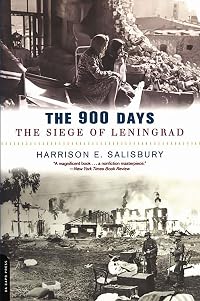
The 900 Days: The Siege of Leningrad
by Harrison E. Salisbury
On This Page
Description
The Nazi siege of Leningrad from 1941 to 1943, during which time the city was cut off from the rest of the world, was one of the most gruesome episodes of World War II. In scale, the tragedy of Leningrad dwarfs even the Warsaw ghetto or Hiroshima. Nearly three million people endured it; just under half of them died, starving or freezing to death, most in the six months from October 1941 to April 1942 when the temperature often stayed at 30 degrees below zero. For twenty-five years the show more distinguished journalist and historian Harrison Salisbury has assembled material for this story. He has interviewed survivors, sifted through the Russian archives, and drawn on his vast experience as a correspondent in the Soviet Union. What he has discovered and imparted in The 900 Days is an epic narrative of villainy and survival, in which the city had as much to fear from Stalin as from Hitler. He concludes his story with the culminating disaster of the Leningrad Affair, a plot hatched by Stalin three years after the war had ended. Almost every official who had been instrumental in the city's survival was implicated, convicted, and executed. Harrison Salisbury has told this overwhelming story boldly, unforgettably, and definitively. Harrison E. Salisbury is the author of American in Russia, Moscow Journal, and other books. show lessTags
Recommendations























Member Recommendations




Member Reviews
Harrison Salisbury tells the gripping story of the siege of Leningrad in the broader context of Germany’s invasion of the Soviet Union in Operation Barbarosso. He uses the memoirs and diaries of inhabitants of Leningrad, journalists and key military figures as source material. The personal recollections fill in the day-to-day horrors of war. He examines the Soviet government’s, and in particular Stalin’s, unwillingness to recognize that the German invasion was imminent despite the huge amount of intelligence to the contrary. The horrors of the invasion and the siege bring home the tragedy of the current war in Ukraine, where the two largest of the former Soviet Socialist Republics are fighting each other 80 years after World War show more II.
The first part of the book, entitled The Night Without End, consists of sixteen chapters focusing on the background to the invasion and the events taking place on Saturday, June 21, and Sunday, June 22, beautiful sunny days in Leningrad under the “White Night” of the summer solstice. The failure of the Soviet government and much of its military to prepare for invasion despite all the warning signals comes to a head Saturday night and early Sunday morning, when the invasion begins at 3 AM. Salisbury covers in detail the massive intelligence that was provided to Stalin before the invasion, including intelligence predicting the exact time and date. He also examines Stalin’s refusal to believe that any invasion was imminent, given his faith that Hitler would abide by the German-Soviet Pact, his belief that preparations for a successful invasion could not be completed until 1942 at the earliest and his suspicions that rumors of war were a plot by Churchill to create discord between the Soviet Union and Germany. Even as the invasion was beginning, the official position of Moscow was that the Russian military should not do anything that the Germans could view as provocative. Fortunately, Admiral Kuznetsov had been able to take some steps to prepare the Navy, including the Baltic Fleet. Stalin was in such a shock that he was inactive for several days.
Hitler’s plan was to capture Leningrad before turning south towards the ultimate objective, Moscow. On the first day of the invasion, Army Group Nord had great success in crossing the Neman River into Lithuania and moving against Kaunas. The Soviet armies in the district were unprepared. In Leningrad, the Military Council met on Sunday to discuss plans for the defense of Leningrad. It realized that most of Leningrad’s existing fortifications were to the north, to protect against an attack from Finland. There were very few fortifications to the west. The Council decided its priority was to develop as quickly as possible lines of fortifications facing the West. According to Salisbury, this decision was key to Leningrad’s survival. In another chapter, he discusses the general condition of the Soviet military, pointing out that the purges of 1937 to 1938 had severely weakened it.
The people of Leningrad generally learned about war on Sunday from a radio speech by Molotov. Salisbury introduces Leningrad with a capsule history since its founding as St. Petersburg by Peter the Great through the Russian Revolution and replacement by Moscow as capital of the Soviet Union. In the final chapter of this part Iosef Orbeli, the director of the Hermitage Museum, decides to evacuate the paintings and other artworks from the Hermitage even though he has been unsuccessful in getting any guidance from Moscow. This part of the book ends with a pre-sentiment of hope for final victory:
Suddenly [Orbeli] looked at the calendar. It still showed Saturday’s date. Mechanically, he tore off the Saturday sheet. The new date, Sunday, June 22, appeared. Orbeli looked up. A thought had come to him: “Napoleon, if I’m not mistaken, attacked Russia also in June -- was it 24 June?” The thought of Napoleon changed Orbeli’s mood. He smiled, looking a bit like Mephistopheles when he did so. Napoleon and now Hitler. Not a bad precedent to bear in mind.
Part Two, the Summer War, recounts the German invasion until the end of August 1941 when the Germans cut all railroad communications between Leningrad and the rest of the Soviet Union. Salisbury begins with background on the Soviet pact with Germany. It was Stalin’s decision to collaborate with the Germans, but Salisbury argues that Andrei Zhdanov, the leader of Leningrad and at one time heir apparent of Stalin, was a driving force behind the questionable strategy of alignment with Nazi Germany which ultimately backfired when the Soviets were unprepared for the German invasion. Zhdanov was sure that Germany would never fight on two fronts given the experience of World War I, and distrusted Britain and France as possible allies. Salisbury declares that Stalin and Zhdanov are primarily responsible for the catastrophe of the war with Germany.
While Zhdanov was in Sochi (where he had gone on vacation on June 21), an initial Military Council was held in Leningrad where the key decision was made to build fortifications protecting the approach to Leningrad from the west, in particular along the Luga River. While there were extensive fortifications to the north to protect against invasion from Finland, Leningrad had very little protection from invasion from the West. Civilians from Leningrad were recruited to build fortifications. Because of the lack of troops, large numbers of volunteers were also raised to man the fortifications. Salisbury believes that this quick decision to build fortifications helped save Leningrad because it slowed down the German advance, even though it could not stop it.
Meanwhile, sunny weather continued in Leningrad. The people had mixed feelings of fear and optimism: optimism, based on Soviet propaganda, that the Germans would quickly be rolled back and fear of bombing. On July 2, Orbeli succeeded in getting a first shipment of half a million precious artworks from the Hermitage shipped out by the railroad. The secret police arrested innocent people suspected of favoring the enemy.
The German military was making rapid progress through the Baltic states, knocking off the Russian defenders and keeping to Hitler’s schedule. Moscow made unrealistic demands for counterattacks, which the Soviets made but often ended in disaster. Meanwhile, a Finnish attack from the north broke through the new border established by Soviet successes during the recent Winter War, and the Soviets were forced to retreat to the defensive works at the old border, closer to Leningrad. Fortunately for Leningrad, despite one golden opportunity, the Finns did not break through to reach Leningrad itself. Orbeli got a second shipment of Hermitage treasures sent to the east by rail.
By the middle of July, the Germans had reached the Luga Line but were held up in this area for about a month, until Novgorod fell on August 13. Despite the weakness of Russian defenses at this point in the war, the Germans had also begun to suffer and needed reinforcements. On August 21, Hitler directed that Leningrad be taken and that Army Group Nord link with the Finns before going on to Moscow.
As the German army moved through the Baltic states, the Russian fleet in Tallinn, Estonia was threatened. At the last minute, on August 28, the fleet evacuated Tallinn to return to Leningrad. The retreat was a horrific disaster as German mines, bombs and shells imposed huge losses. Only one out of 26 transports made it back to Leningrad. Naturally leaders in Moscow began to second-guess the decisions of the commanders. Salisbury sums up as follows:
Looking back at the Tallinn tragedy from the perspective of 25 years, the Soviet naval historian, Captain V. Achkasov, was convinced that its cause lay in the reluctance of any of the commanders -- of either the Baltic Fleet, the Leningrad Command or the High Command in Moscow -- to order preparations for evacuating the fleet. The reason for this reluctance, he felt, was a well-founded knowledge on the part of all that commanders of encircled units had repeatedly been subjected to the gravest of charges of cowardice and panic, often with fatal consequences. Rather than risk a firing squad, the commanders withheld any recommendations for withdrawal until the tragic outcome became inescapable. (p. 242).
As the Germans continued to advance, the Soviet authorities were concerned that many civilians were ignoring orders to evacuate Leningrad. On August 30, the Germans captured a small train junction, Mga, which cut the railroad connection between Moscow and Leningrad and thus achieved the effective encirclement of Leningrad. Orbeli’s third and final shipment of art works was blocked.
Georgi Malenkov and Vyacheslav Molotov, members of the Politburo, came to Leningrad to review the situation with Zhdanov and Marshall Kliment Voroshilov, the general in charge of Leningrad defense. Salisbury believes that Stalin and other leaders in Moscow were inclined to abandon Leningrad altogether but that Zhdanov successfully resisted this and in the end a compromise was made under which Marshall Georgi Zhukov replaced Voroshilov as the commanding general in Leningrad. Stalin suggested to Admiral Kuznetsov that the Baltic fleet should be scuttled, but, because of centralized control in Moscow, the Admiral was not authorized to sign the order, and no one else was found to do so, Stalin himself evading doing this. Stalin threatened that Leningrad would not be given too much time to save itself. At this point Salisbury notes that, despite his mistakes before the war, and his absence on the initial days, Zhdanov became more popular in Leningrad and became the symbol of its resistance. His portrait spread throughout Leningrad, while it was difficult to find portraits of Stalin.
Part Three, Leningrad in Blockade, begins with the Soviets losing the battle for control of the key railroad junction of Mga. Frustrated in their attempt to attack Leningrad head on opposite the Izhorsk Factory, the German Panzers began to move east along the south bank of the river Neva and quickly reached and captured Schlissberg on Lake Ladoga. Surprisingly, they made no effort to cross the river Neva at a time when the Soviets could only lightly defend the north bank. Fortunately, the military engineer Colonel Bychevsky had blown up the only bridge crossing the Neva before the Panzers reached it. In addition, the Germans did not capture the fortress of Oreshek in the estuary of the river Neva on Lake Ladoga. This medieval fortress still had two ancient cannons. Some sailors on the island began firing at the Germans and the Soviets rushed additional artillery and men to the fortress, which held out for the entire siege of Leningrad.
The German general, Field Marshall von Leeb, continued to focus his main attack on Leningrad from the southwest. Marshall Zhukov arrived to replace Voroshilov. He threatened the Russian generals with execution if they retreated, and also insisted they make counterattacks. The situation was desperate, but Hitler’s timetable to shift the panzers to the attack on Moscow was decisive. On September 26, Panzer divisions withdrew from the Leningrad front to move south east towards Moscow. While German infantry continued the attack, their forces were significantly weaker. The defenders of Leningrad breathed a sigh of relief when the Germans began to dig trenches for the winter. Explosives had been set to destroy any infrastructure in the city that could be of use to the Germans including factories, bridges and the Baltic Fleet. Fortunately, orders to set off the explosives were never issued. Stalin called Zhukov back to Moscow, and his deputy Lieutenant General Fedyuninsky took command in Leningrad.
However, holding the Germans at the outskirts of Leningrad was not a full reprieve. German aircraft bombing and shelling of Leningrad was at its heaviest during the fall of 1941. The Germans sought to destroy the Baltic fleet by bombing but were not successful. The food crisis began to force rationing in September. Deaths from starvation became common in November. Supplies could be brought by boat over Lake Ladoga but the amount of food being brought into the city could not match the amount being consumed each day. Ration cards had been issued, and the worsening situation caused Dimitri Pavlov to continually reduce the ration of bread. Soldiers and workers received the highest ration so they could continue to be active; dependents and children were the most at risk for inadequate nourishment. Teenagers began to succumb to starvation before the elders, and men before women. Rumors of human flesh in sausages and other combinations developed. Pavlov kept redefining bread to include questionable substances including cottonseed cake. Meanwhile, in November the first snowflakes arrived, the harbinger of a combination of cold and hunger that would be deadly. Dimitri Shostakovich was repeatedly asked to leave the city but he refused. He continued to work on his Leningrad Symphony and to perform his duty in the fire service to protect against bombs. Finally, in early October after finishing the third movement he reluctantly agreed to be evacuated with his family. Anna Akhmatova, the ”muse” of Leningrad, gave a speech over the radio, expressing her belief that the Germans would not conquer Leningrad. She was also evacuated, reluctantly, in October.
In Part Four, the Longest Winter, Salisbury narrates the most horrible part of the siege. At first, residents of Leningrad expected the blockade to be ended quickly: however, efforts to bypass the German lines by taking Peteroff on the Baltic Coast and to break the blockade at the Neva River were not successful. On the contrary, the Germans continued to move east to cut railroad connections from which supplies could reach Leningrad across Lake Ladoga. The Germans captured one key railroad junction but a month later, in one of the first successful efforts by the Soviets to push back the German invasion, general Meretskov succeeded in retaking the junction.
Meanwhile the situation in Leningrad worsened every day. Rations kept being cut. Only front-line soldiers had the strength to be active. Efforts were made to prepare when the winter ice on Lake Ladoga would permit the passage of horse drawn sledges and ultimately trucks. One of the greatest achievements of the Leningrad spirit was to make the Lake Ladoga supply line work. Unfortunately, the level of supplies could not keep up with the needs of the people of Leningrad. Finally, on December 23, 1942, Zhdanov thought the calculus was changing enough that he could start raising the ration slightly. For one thing, the horrendous death toll had significantly reduced the number of people in the city requiring food. Unfortunately, even this optimism was misplaced as the initial rollback of the Germans did not continue. Leningrad was soon down to two days of food supplies.
[To Be Completed] show less
The first part of the book, entitled The Night Without End, consists of sixteen chapters focusing on the background to the invasion and the events taking place on Saturday, June 21, and Sunday, June 22, beautiful sunny days in Leningrad under the “White Night” of the summer solstice. The failure of the Soviet government and much of its military to prepare for invasion despite all the warning signals comes to a head Saturday night and early Sunday morning, when the invasion begins at 3 AM. Salisbury covers in detail the massive intelligence that was provided to Stalin before the invasion, including intelligence predicting the exact time and date. He also examines Stalin’s refusal to believe that any invasion was imminent, given his faith that Hitler would abide by the German-Soviet Pact, his belief that preparations for a successful invasion could not be completed until 1942 at the earliest and his suspicions that rumors of war were a plot by Churchill to create discord between the Soviet Union and Germany. Even as the invasion was beginning, the official position of Moscow was that the Russian military should not do anything that the Germans could view as provocative. Fortunately, Admiral Kuznetsov had been able to take some steps to prepare the Navy, including the Baltic Fleet. Stalin was in such a shock that he was inactive for several days.
Hitler’s plan was to capture Leningrad before turning south towards the ultimate objective, Moscow. On the first day of the invasion, Army Group Nord had great success in crossing the Neman River into Lithuania and moving against Kaunas. The Soviet armies in the district were unprepared. In Leningrad, the Military Council met on Sunday to discuss plans for the defense of Leningrad. It realized that most of Leningrad’s existing fortifications were to the north, to protect against an attack from Finland. There were very few fortifications to the west. The Council decided its priority was to develop as quickly as possible lines of fortifications facing the West. According to Salisbury, this decision was key to Leningrad’s survival. In another chapter, he discusses the general condition of the Soviet military, pointing out that the purges of 1937 to 1938 had severely weakened it.
The people of Leningrad generally learned about war on Sunday from a radio speech by Molotov. Salisbury introduces Leningrad with a capsule history since its founding as St. Petersburg by Peter the Great through the Russian Revolution and replacement by Moscow as capital of the Soviet Union. In the final chapter of this part Iosef Orbeli, the director of the Hermitage Museum, decides to evacuate the paintings and other artworks from the Hermitage even though he has been unsuccessful in getting any guidance from Moscow. This part of the book ends with a pre-sentiment of hope for final victory:
Suddenly [Orbeli] looked at the calendar. It still showed Saturday’s date. Mechanically, he tore off the Saturday sheet. The new date, Sunday, June 22, appeared. Orbeli looked up. A thought had come to him: “Napoleon, if I’m not mistaken, attacked Russia also in June -- was it 24 June?” The thought of Napoleon changed Orbeli’s mood. He smiled, looking a bit like Mephistopheles when he did so. Napoleon and now Hitler. Not a bad precedent to bear in mind.
Part Two, the Summer War, recounts the German invasion until the end of August 1941 when the Germans cut all railroad communications between Leningrad and the rest of the Soviet Union. Salisbury begins with background on the Soviet pact with Germany. It was Stalin’s decision to collaborate with the Germans, but Salisbury argues that Andrei Zhdanov, the leader of Leningrad and at one time heir apparent of Stalin, was a driving force behind the questionable strategy of alignment with Nazi Germany which ultimately backfired when the Soviets were unprepared for the German invasion. Zhdanov was sure that Germany would never fight on two fronts given the experience of World War I, and distrusted Britain and France as possible allies. Salisbury declares that Stalin and Zhdanov are primarily responsible for the catastrophe of the war with Germany.
While Zhdanov was in Sochi (where he had gone on vacation on June 21), an initial Military Council was held in Leningrad where the key decision was made to build fortifications protecting the approach to Leningrad from the west, in particular along the Luga River. While there were extensive fortifications to the north to protect against invasion from Finland, Leningrad had very little protection from invasion from the West. Civilians from Leningrad were recruited to build fortifications. Because of the lack of troops, large numbers of volunteers were also raised to man the fortifications. Salisbury believes that this quick decision to build fortifications helped save Leningrad because it slowed down the German advance, even though it could not stop it.
Meanwhile, sunny weather continued in Leningrad. The people had mixed feelings of fear and optimism: optimism, based on Soviet propaganda, that the Germans would quickly be rolled back and fear of bombing. On July 2, Orbeli succeeded in getting a first shipment of half a million precious artworks from the Hermitage shipped out by the railroad. The secret police arrested innocent people suspected of favoring the enemy.
The German military was making rapid progress through the Baltic states, knocking off the Russian defenders and keeping to Hitler’s schedule. Moscow made unrealistic demands for counterattacks, which the Soviets made but often ended in disaster. Meanwhile, a Finnish attack from the north broke through the new border established by Soviet successes during the recent Winter War, and the Soviets were forced to retreat to the defensive works at the old border, closer to Leningrad. Fortunately for Leningrad, despite one golden opportunity, the Finns did not break through to reach Leningrad itself. Orbeli got a second shipment of Hermitage treasures sent to the east by rail.
By the middle of July, the Germans had reached the Luga Line but were held up in this area for about a month, until Novgorod fell on August 13. Despite the weakness of Russian defenses at this point in the war, the Germans had also begun to suffer and needed reinforcements. On August 21, Hitler directed that Leningrad be taken and that Army Group Nord link with the Finns before going on to Moscow.
As the German army moved through the Baltic states, the Russian fleet in Tallinn, Estonia was threatened. At the last minute, on August 28, the fleet evacuated Tallinn to return to Leningrad. The retreat was a horrific disaster as German mines, bombs and shells imposed huge losses. Only one out of 26 transports made it back to Leningrad. Naturally leaders in Moscow began to second-guess the decisions of the commanders. Salisbury sums up as follows:
Looking back at the Tallinn tragedy from the perspective of 25 years, the Soviet naval historian, Captain V. Achkasov, was convinced that its cause lay in the reluctance of any of the commanders -- of either the Baltic Fleet, the Leningrad Command or the High Command in Moscow -- to order preparations for evacuating the fleet. The reason for this reluctance, he felt, was a well-founded knowledge on the part of all that commanders of encircled units had repeatedly been subjected to the gravest of charges of cowardice and panic, often with fatal consequences. Rather than risk a firing squad, the commanders withheld any recommendations for withdrawal until the tragic outcome became inescapable. (p. 242).
As the Germans continued to advance, the Soviet authorities were concerned that many civilians were ignoring orders to evacuate Leningrad. On August 30, the Germans captured a small train junction, Mga, which cut the railroad connection between Moscow and Leningrad and thus achieved the effective encirclement of Leningrad. Orbeli’s third and final shipment of art works was blocked.
Georgi Malenkov and Vyacheslav Molotov, members of the Politburo, came to Leningrad to review the situation with Zhdanov and Marshall Kliment Voroshilov, the general in charge of Leningrad defense. Salisbury believes that Stalin and other leaders in Moscow were inclined to abandon Leningrad altogether but that Zhdanov successfully resisted this and in the end a compromise was made under which Marshall Georgi Zhukov replaced Voroshilov as the commanding general in Leningrad. Stalin suggested to Admiral Kuznetsov that the Baltic fleet should be scuttled, but, because of centralized control in Moscow, the Admiral was not authorized to sign the order, and no one else was found to do so, Stalin himself evading doing this. Stalin threatened that Leningrad would not be given too much time to save itself. At this point Salisbury notes that, despite his mistakes before the war, and his absence on the initial days, Zhdanov became more popular in Leningrad and became the symbol of its resistance. His portrait spread throughout Leningrad, while it was difficult to find portraits of Stalin.
Part Three, Leningrad in Blockade, begins with the Soviets losing the battle for control of the key railroad junction of Mga. Frustrated in their attempt to attack Leningrad head on opposite the Izhorsk Factory, the German Panzers began to move east along the south bank of the river Neva and quickly reached and captured Schlissberg on Lake Ladoga. Surprisingly, they made no effort to cross the river Neva at a time when the Soviets could only lightly defend the north bank. Fortunately, the military engineer Colonel Bychevsky had blown up the only bridge crossing the Neva before the Panzers reached it. In addition, the Germans did not capture the fortress of Oreshek in the estuary of the river Neva on Lake Ladoga. This medieval fortress still had two ancient cannons. Some sailors on the island began firing at the Germans and the Soviets rushed additional artillery and men to the fortress, which held out for the entire siege of Leningrad.
The German general, Field Marshall von Leeb, continued to focus his main attack on Leningrad from the southwest. Marshall Zhukov arrived to replace Voroshilov. He threatened the Russian generals with execution if they retreated, and also insisted they make counterattacks. The situation was desperate, but Hitler’s timetable to shift the panzers to the attack on Moscow was decisive. On September 26, Panzer divisions withdrew from the Leningrad front to move south east towards Moscow. While German infantry continued the attack, their forces were significantly weaker. The defenders of Leningrad breathed a sigh of relief when the Germans began to dig trenches for the winter. Explosives had been set to destroy any infrastructure in the city that could be of use to the Germans including factories, bridges and the Baltic Fleet. Fortunately, orders to set off the explosives were never issued. Stalin called Zhukov back to Moscow, and his deputy Lieutenant General Fedyuninsky took command in Leningrad.
However, holding the Germans at the outskirts of Leningrad was not a full reprieve. German aircraft bombing and shelling of Leningrad was at its heaviest during the fall of 1941. The Germans sought to destroy the Baltic fleet by bombing but were not successful. The food crisis began to force rationing in September. Deaths from starvation became common in November. Supplies could be brought by boat over Lake Ladoga but the amount of food being brought into the city could not match the amount being consumed each day. Ration cards had been issued, and the worsening situation caused Dimitri Pavlov to continually reduce the ration of bread. Soldiers and workers received the highest ration so they could continue to be active; dependents and children were the most at risk for inadequate nourishment. Teenagers began to succumb to starvation before the elders, and men before women. Rumors of human flesh in sausages and other combinations developed. Pavlov kept redefining bread to include questionable substances including cottonseed cake. Meanwhile, in November the first snowflakes arrived, the harbinger of a combination of cold and hunger that would be deadly. Dimitri Shostakovich was repeatedly asked to leave the city but he refused. He continued to work on his Leningrad Symphony and to perform his duty in the fire service to protect against bombs. Finally, in early October after finishing the third movement he reluctantly agreed to be evacuated with his family. Anna Akhmatova, the ”muse” of Leningrad, gave a speech over the radio, expressing her belief that the Germans would not conquer Leningrad. She was also evacuated, reluctantly, in October.
In Part Four, the Longest Winter, Salisbury narrates the most horrible part of the siege. At first, residents of Leningrad expected the blockade to be ended quickly: however, efforts to bypass the German lines by taking Peteroff on the Baltic Coast and to break the blockade at the Neva River were not successful. On the contrary, the Germans continued to move east to cut railroad connections from which supplies could reach Leningrad across Lake Ladoga. The Germans captured one key railroad junction but a month later, in one of the first successful efforts by the Soviets to push back the German invasion, general Meretskov succeeded in retaking the junction.
Meanwhile the situation in Leningrad worsened every day. Rations kept being cut. Only front-line soldiers had the strength to be active. Efforts were made to prepare when the winter ice on Lake Ladoga would permit the passage of horse drawn sledges and ultimately trucks. One of the greatest achievements of the Leningrad spirit was to make the Lake Ladoga supply line work. Unfortunately, the level of supplies could not keep up with the needs of the people of Leningrad. Finally, on December 23, 1942, Zhdanov thought the calculus was changing enough that he could start raising the ration slightly. For one thing, the horrendous death toll had significantly reduced the number of people in the city requiring food. Unfortunately, even this optimism was misplaced as the initial rollback of the Germans did not continue. Leningrad was soon down to two days of food supplies.
[To Be Completed] show less
In the spring of 1944, the Museum of the Defense of Leningrad opened to the public with hundreds of exhibits and thousands of artifacts that sought to preserve the memory of the terrible ordeal that the city had endured for over two years. For the first several thousand visitors to the museum, who had survived the nightmare of the blockade, no reminder was needed, but they still were gratified to see an official and formal recognition of their sacrifice, and to be assured that future generations would be taught what they had done to keep Leningrad alive for them.
But as Harrison Salisbury writes in his epilogue to "The 900 Days", Stalin's paranoid jealousy of the city named for Lenin, and his resentment of the praise heaped on its show more heroic defenders, as reflected in "the Leningrad Affair" of the late 1940's, meant that the museum was closed in 1949, and that the books, plays and poems dedicated to the story of Leningrad under siege were not published or performed, at least not as of 1969, when Salisbury's "900 Days" was published.
So it fell to an American journalist to tell the epic story of besieged Leningrad, and he tells it well. Of the 900 days of the blockade (actually about 880 days), Salisbury devotes most of the book to the first 200 days and even earlier. The first several chapters dwell on the eve of the Nazi invasion of the Soviet Union and Stalin's failures, first to respond to abundant intelligence about Hitler's intention to break their non-aggression pact, and then, after the shooting began, to react to the emergency on his borders.
Despite the disasters of the summer of 1941, the Red Army began to rally by the autumn and to slow down and finally stop the Nazi advance. The Baltic Fleet managed to retreat to its bases at Kronstadt and Leningrad. Salisbury then describes the desperate fight to hold the invaders at the gates of Leningrad in the winter of 1941-42. That was the worst winter any major city has suffered in modern history. As many as a million Leningraders starved to death. Nearly all those who survived were reduced to emaciated shells by the draconian rationing regime.
Eventually, life in the besieged city got "better". An ice road was built across frozen Lake Ladoga in the winter months to establish a tenuous connection to the "mainland". A Red Army offensive in January 1943 opened up one rail line to the outside, the "Corridor of Death", under constant German shelling. Not until a year later, the winter of 1944, were the Nazis and their Axis partners finally driven away from the approaches to the city.
Salisbury ably covers the political and military conflicts of wartime Leningrad, and related affairs in the Kremlin. But "900 Days" is most moving in its harrowing accounts of the poets, scientists, factory workers and mothers who struggled to stay alive and to keep their humanity intact under the worst of conditions. This book is a tribute to them. show less
But as Harrison Salisbury writes in his epilogue to "The 900 Days", Stalin's paranoid jealousy of the city named for Lenin, and his resentment of the praise heaped on its show more heroic defenders, as reflected in "the Leningrad Affair" of the late 1940's, meant that the museum was closed in 1949, and that the books, plays and poems dedicated to the story of Leningrad under siege were not published or performed, at least not as of 1969, when Salisbury's "900 Days" was published.
So it fell to an American journalist to tell the epic story of besieged Leningrad, and he tells it well. Of the 900 days of the blockade (actually about 880 days), Salisbury devotes most of the book to the first 200 days and even earlier. The first several chapters dwell on the eve of the Nazi invasion of the Soviet Union and Stalin's failures, first to respond to abundant intelligence about Hitler's intention to break their non-aggression pact, and then, after the shooting began, to react to the emergency on his borders.
Despite the disasters of the summer of 1941, the Red Army began to rally by the autumn and to slow down and finally stop the Nazi advance. The Baltic Fleet managed to retreat to its bases at Kronstadt and Leningrad. Salisbury then describes the desperate fight to hold the invaders at the gates of Leningrad in the winter of 1941-42. That was the worst winter any major city has suffered in modern history. As many as a million Leningraders starved to death. Nearly all those who survived were reduced to emaciated shells by the draconian rationing regime.
Eventually, life in the besieged city got "better". An ice road was built across frozen Lake Ladoga in the winter months to establish a tenuous connection to the "mainland". A Red Army offensive in January 1943 opened up one rail line to the outside, the "Corridor of Death", under constant German shelling. Not until a year later, the winter of 1944, were the Nazis and their Axis partners finally driven away from the approaches to the city.
Salisbury ably covers the political and military conflicts of wartime Leningrad, and related affairs in the Kremlin. But "900 Days" is most moving in its harrowing accounts of the poets, scientists, factory workers and mothers who struggled to stay alive and to keep their humanity intact under the worst of conditions. This book is a tribute to them. show less
A thoroughly absorbing account of the privations suffered during this momentous part of WWII. It's remarkable that the author was able to gather so many accounts from ordinary people, given that it was written in the late 1960s when Brezhnev was reversing the moves towards openness introduced under Khrushchev. The book was officially criticised in the USSR as giving insufficient coverage to the role of the Communist Party in leading the besieged citizens' struggle. The only slight point of mild criticism of this great book might be the imbalance in coverage of the 900 days: the emphasis is almost all on the first winter of the siege when so many died of starvation, with the following two years covered very scantily.
Had this book in my library for years and finally got around to reading it. When I began the book, I wondered how 900 days could be covered in 583 pages, and it isn't. I was, in a way, disappointed by the book because it follows the first 300 days or so in great detail and then the last 600 days are over in about 50 or 60 pages. If you want to know how the poets and literati of Leningrad made it thru the first 300 days, this is your book. There is a rather superficial treatment of the military events in the first 300 days. Plenty of stuff on communist back-stabbing and executions for "failure" or on the other hand for exile for being right when the boss said the other thing and you disagreed. I am going to move on to David Glantz Battle show more for Leningrad. show less
The book was well written and the stories conveyed were properly cited. The details of what went on in Leningrad were still disturbing, although I was aware of some snippets of them.
It is a sad story that the Soviet government refused to allow so many of the details to come out, and it took the crumbling of that empire to get many details out. It is an incredible story of death and survival, along with the maniacal actions of Stalin and his followers. Sadly, so many Americans were wholehearted supporters of Stalin over the years and remained so until revelations of what he really did finally came out.
Despite being quite detailed, the writing style allowed for fairly easy reading, if you can stand to continue without having to take show more fairly frequent breaks. Having read many books about WW II, and being a historical non-fiction fan, I was able to get through it in about 2 weeks while on vacation in the Caribbean.
The one big disappointment, so to speak, I had in reading it was that it was short on details of the military side of the siege. That may have been a misdirected expectation on my part, but when I picked up the soft-cover version at a library book sale, nowhere did the cover indicate that 98% was about the residents' struggles, not the military activity. for that reason, I gave it 4 stars rather than 5. show less
It is a sad story that the Soviet government refused to allow so many of the details to come out, and it took the crumbling of that empire to get many details out. It is an incredible story of death and survival, along with the maniacal actions of Stalin and his followers. Sadly, so many Americans were wholehearted supporters of Stalin over the years and remained so until revelations of what he really did finally came out.
Despite being quite detailed, the writing style allowed for fairly easy reading, if you can stand to continue without having to take show more fairly frequent breaks. Having read many books about WW II, and being a historical non-fiction fan, I was able to get through it in about 2 weeks while on vacation in the Caribbean.
The one big disappointment, so to speak, I had in reading it was that it was short on details of the military side of the siege. That may have been a misdirected expectation on my part, but when I picked up the soft-cover version at a library book sale, nowhere did the cover indicate that 98% was about the residents' struggles, not the military activity. for that reason, I gave it 4 stars rather than 5. show less
“The 900 Days: The Siege of Leningrad” by Harrison E. Salisbury…SUCKS! This book really, really sucks, and is a terrible, terrible book.
The title of the book is extremely misleading; indeed, only slightly more than half the total number of pages (54%) in the book actually have anything to do with the siege of Leningrad. It is not until page 307 — that’s right, THREE-HUNDRED SEVEN — that the siege of Leningrad even starts!
What’s the first 307 pages about, you ask? Good question. The first 307 pages of the book offer very little besides anti-Stalin and anti-Soviet claims juxtaposed with some poetic and colourful descriptions of Leningrad (St. Petersburg). Most of Salisbury’s anti-Stalin and anti-Soviet claims are frankly show more absurd, outrageous, and completely ahistorical.
Page after page, for example, Salisbury criticizes Stalin and Soviet bureaucracy for lack of preparedness for the Nazi offensive; but when the Soviet’s did take actions to defend Leningrad, Salisbury criticizes those actions as being “extraordinary dictatorial”?! What does Salisbury expect?! Is there some kind of military-style democracy I am unaware of in the armed forces of other states? Did the U.S. or British militaries have some kind of secret ballot referendum about WWII that I have somehow missed?! Were the Japanese in Canada consulted before being stripped of all their assets and thrown in concentration camps?!
Salisbury’s outrageous, sometimes contradictory, and almost always uncited, accusations don’t end there. Like all anti-Soviet writers, Salisbury loves to describe Stalin as paranoid. He criticizes Stalin’s “suspiciousness” and refusal to heed the warnings of a possible Nazi invasion by the British (p. 77), as if Stalin’s suspicions of the British weren’t historically justified. Salisbury seems totally unaware of the fact of British involvement in the Allied intervention in the Soviet Union (1918-25), British policy of appeasement with Hitler throughout the 1930s and the willingness of the British to sacrifice Czechoslovakia at Munich, and the desire of leading British statement for war between the Soviet Union and Nazi Germany, the essence of which was captured by Prime Minister Stanley Baldwin’s comments in 1936: “We all know the German desire, and he has come out with it in his book [i.e., Hitler’s Mein Kampf], to move east, and if he should move East I should not break my heart…There is one danger, of course, which has probably been in all your minds — supposing the Russians and Germans got fighting and the French went in as allies of Russia owing to that appalling pact they made, you would not feel you were obliged to go and help France, would you? If there is any fighting in Europe to be done, I should like to see the Bolshies and the Nazis doing it” (p. 33 of “1939: The Alliance that Never Was and the Coming of World War II” by Michael Jabara Carley). Other outrageous and uncited accusations Salisbury makes include Stalin’s alleged pathological disdain for Leningrad and Leningraders (p. 126-29), Stalin’s willingness to execute someone “because he wore a funny hat” (p. 171), the execution of those whom “meticulously carried out” Stalin’s own orders (p. 182), etc.
Probably the worst book of 2021 so far. Yuck! show less
The title of the book is extremely misleading; indeed, only slightly more than half the total number of pages (54%) in the book actually have anything to do with the siege of Leningrad. It is not until page 307 — that’s right, THREE-HUNDRED SEVEN — that the siege of Leningrad even starts!
What’s the first 307 pages about, you ask? Good question. The first 307 pages of the book offer very little besides anti-Stalin and anti-Soviet claims juxtaposed with some poetic and colourful descriptions of Leningrad (St. Petersburg). Most of Salisbury’s anti-Stalin and anti-Soviet claims are frankly show more absurd, outrageous, and completely ahistorical.
Page after page, for example, Salisbury criticizes Stalin and Soviet bureaucracy for lack of preparedness for the Nazi offensive; but when the Soviet’s did take actions to defend Leningrad, Salisbury criticizes those actions as being “extraordinary dictatorial”?! What does Salisbury expect?! Is there some kind of military-style democracy I am unaware of in the armed forces of other states? Did the U.S. or British militaries have some kind of secret ballot referendum about WWII that I have somehow missed?! Were the Japanese in Canada consulted before being stripped of all their assets and thrown in concentration camps?!
Salisbury’s outrageous, sometimes contradictory, and almost always uncited, accusations don’t end there. Like all anti-Soviet writers, Salisbury loves to describe Stalin as paranoid. He criticizes Stalin’s “suspiciousness” and refusal to heed the warnings of a possible Nazi invasion by the British (p. 77), as if Stalin’s suspicions of the British weren’t historically justified. Salisbury seems totally unaware of the fact of British involvement in the Allied intervention in the Soviet Union (1918-25), British policy of appeasement with Hitler throughout the 1930s and the willingness of the British to sacrifice Czechoslovakia at Munich, and the desire of leading British statement for war between the Soviet Union and Nazi Germany, the essence of which was captured by Prime Minister Stanley Baldwin’s comments in 1936: “We all know the German desire, and he has come out with it in his book [i.e., Hitler’s Mein Kampf], to move east, and if he should move East I should not break my heart…There is one danger, of course, which has probably been in all your minds — supposing the Russians and Germans got fighting and the French went in as allies of Russia owing to that appalling pact they made, you would not feel you were obliged to go and help France, would you? If there is any fighting in Europe to be done, I should like to see the Bolshies and the Nazis doing it” (p. 33 of “1939: The Alliance that Never Was and the Coming of World War II” by Michael Jabara Carley). Other outrageous and uncited accusations Salisbury makes include Stalin’s alleged pathological disdain for Leningrad and Leningraders (p. 126-29), Stalin’s willingness to execute someone “because he wore a funny hat” (p. 171), the execution of those whom “meticulously carried out” Stalin’s own orders (p. 182), etc.
Probably the worst book of 2021 so far. Yuck! show less
There were times when I was reading this book that it almost brought me to tears. The chapters involving the starvation and the cannibalism were simply horrifying. The author did a very good job of telling the story from the individual's point of view. That made it hit home a bit more than if it was a view from 10,000 feet up. What gave me a hard time while reading this book was keeping track of all the different names and their associated units. While there were 3 maps included in this book, I could have used a few more. Having said that, I was still able to follow along for the most part.
I never realized the death and destruction involved in the Leningrad siege before reading this book. It seems as if most historians focus on show more Stalingrad or Moscow. I do wish, as another reviewer pointed out, that more time was spent on the second and third years. Perhaps there was not as much to tell since the food supply was increased and a good number of people in the city had been evacuated. show less
I never realized the death and destruction involved in the Leningrad siege before reading this book. It seems as if most historians focus on show more Stalingrad or Moscow. I do wish, as another reviewer pointed out, that more time was spent on the second and third years. Perhaps there was not as much to tell since the food supply was increased and a good number of people in the city had been evacuated. show less
Members
- Recently Added By
Lists

Top Five Books of 2016
795 works; 228 members

r/History Recommended Reading List
603 works; 12 members

r/AskHistorians' Recommended Books
1,068 works; 19 members
Author Information

62+ Works 2,808 Members
Foreign correspondent par excellence, Harrison Salisbury reported on World War II, Russia under Joseph Stalin and Khrushchev, Vietnam during the war, China, and numerous other hot spots around the world. He also covered the U.S. civil rights movement in the 1960s and inaugurated the op-ed page of The New York Times, a paper he was associated with show more for much of his career. Born into an intellectual family in Minneapolis, Salisbury got an early start in his career. After graduating from high school two years early, he worked intermittently as a reporter for the Minneapolis Journal while attending the University of Minnesota. When he was expelled from the university because of his crusading journalism, he joined United Press, and by 1934 was working in its Washington, D.C., bureau. During World War II, he reported from England, North Africa, and the Middle East, as well as Russia. In 1949, Salisbury went to work for The New York Times as the paper's Moscow correspondent. For the next six years, he got to know Russia and in 1955 wrote a series of articles on it that won him the Pulitzer Prize for international reporting. Salisbury joined the Times board in 1962 and became assistant managing editor in 1964. Still he continued to make his journalistic forays abroad. From December 12, 1966, to January 7, 1967, he reported from Hanoi, North Vietnam, the first American journalist to gain entrance to that country during the Vietnam War. His dispatches earned him several awards, including the Overseas Press Club's Asian Award, although the idea of an American reporting from enemy territory upset many people in Washington and elsewhere. The dispatches were soon turned into a book, Behind the Lines---Hanoi (1967). Salisbury retired from the Times in 1973. He produced 23 books, several of them dealing with social and political life in Russia under communism. He also wrote two novels and two autobiographical books. (Bowker Author Biography) show less
Some Editions
Awards and Honors
Distinctions
Work Relationships
Contains
Common Knowledge
- Canonical title
- The 900 Days: The Siege of Leningrad
- Original title
- The 900 days, the siege of Leningrad
- Original publication date
- 1969; 1969 (1e édition originale américaine) (1e édition originale américaine); 1970 (1e traduction et édition française, Albin Michel) (1e traduction et édition française, Albin Michel)
- Important places
- Leningrad, USSR; USSR
- Important events
- World War II (1939 | 1945); World War II, Eastern Front (1941-06-22 | 1945-05-05); Operation Barbarossa (1941-06-22 | 1941-12-05); Siege of Leningrad (1941-09-08 | 1944-01-27)
- Original language*
- Anglais (Etats-Unis) (Etats-Unis)
*Some information comes from Common Knowledge in other languages. Click "Edit" for more information.
Classifications
- Genres
- History, Nonfiction, General Nonfiction
- DDC/MDS
- 940.542 — History & geography History of Europe History of Europe 1918- Military history of World War II Campaigns and battles by theatre
- LCC
- D764.3 .L4 .S2 — History of Europe, Asia, Africa and Oceania History (General) World War II (1939-1945)
- BISAC
Statistics
- Members
- 1,006
- Popularity
- 25,944
- Reviews
- 12
- Rating
- (4.01)
- Languages
- 9 — Dutch, English, Finnish, French, German, Italian, Norwegian (Bokmål), Russian, Swedish
- Media
- Paper, Audiobook, Ebook
- ISBNs
- 20
- ASINs
- 35