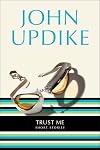
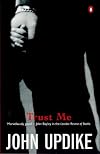
Trust Me: Short Stories
by John Updike
On This Page
Description
A collection of 22 short stories which share the theme of trust, mostly betrayed, but sometimes fulfilled.Tags
Recommendations




















Member Reviews
Suburbia is boring.
Well, at least, in John Updike’s hands it is boring.
What we have within Trust Me is a collection of upper-middle-class people (I think that is the correct classification) who have nothing to complain about, yet find ways to complain. And that complaining is generally reflected in their choices – choices that show a disinterest in their own lives. (Which raises the question, if they are not interested, why should I be?) Multiple marriages, affairs, divorces, bratty children, boring children – yawn, life goes on for the poor, downtrodden happy-lifers.
I would like to argue that this disconnect is a function of how time has taken its toll on the effectiveness of these stories. But a quick glance at the publication show more date shows that many of these stories are set in the 80s, yet they all feel as if they are set in the 60’s and 70’. The content and themes become a rehashing of old concepts that really don’t matter anymore.
Let me note that I am a fan of Updike’s. The Rabbit novels, as one example, are excellent. However, this collection…not so much. It is a collection of stories about people I just don’t care about. They are boring, they are tedious, they are narcissistic, they are just not worth my time. In different stories, in different hands, maybe I could have cared. But Updike’s style leaves no impression but their underserved ennui.
It may not be popular to pick on a writer of Updike’s stature, and maybe I am missing something, or maybe this is not representative of his best, but it is not worth my time to be bored by boring people. show less
Well, at least, in John Updike’s hands it is boring.
What we have within Trust Me is a collection of upper-middle-class people (I think that is the correct classification) who have nothing to complain about, yet find ways to complain. And that complaining is generally reflected in their choices – choices that show a disinterest in their own lives. (Which raises the question, if they are not interested, why should I be?) Multiple marriages, affairs, divorces, bratty children, boring children – yawn, life goes on for the poor, downtrodden happy-lifers.
I would like to argue that this disconnect is a function of how time has taken its toll on the effectiveness of these stories. But a quick glance at the publication show more date shows that many of these stories are set in the 80s, yet they all feel as if they are set in the 60’s and 70’. The content and themes become a rehashing of old concepts that really don’t matter anymore.
Let me note that I am a fan of Updike’s. The Rabbit novels, as one example, are excellent. However, this collection…not so much. It is a collection of stories about people I just don’t care about. They are boring, they are tedious, they are narcissistic, they are just not worth my time. In different stories, in different hands, maybe I could have cared. But Updike’s style leaves no impression but their underserved ennui.
It may not be popular to pick on a writer of Updike’s stature, and maybe I am missing something, or maybe this is not representative of his best, but it is not worth my time to be bored by boring people. show less
Many of these stories may be acutely observed and well-worded assessments of life. Countless reviews tell me so, and on the whole I would agree. Other reviewers will tell you that this short story collection is tedious and samey, re-treading and re-treading and re-treading the same middle-aged, mid-western, white upper-middle-class preoccupations of adultery, divorce, and possibly ageing. I'm in full agreement with that sentiment, too. Unfortunately, the latter wins out.
Some of these stories are really, really good, and would have earned a high rating, either on their own or in a more varied bundle of stories. But I can't stand another one of Updike's obsessive musings about failing relationships. I've given him a fair shake, but I show more will never read anything by him again. show less
Some of these stories are really, really good, and would have earned a high rating, either on their own or in a more varied bundle of stories. But I can't stand another one of Updike's obsessive musings about failing relationships. I've given him a fair shake, but I show more will never read anything by him again. show less
Incisive, honest stories about the failures and foibles of human relationships. The subjects are not endearing, but the prose is masterful. There are also very funny bits.
Ratings
Members
- Recently Added By
Author Information

343+ Works 53,923 Members
American novelist, poet, and critic John Updike was born in Reading, Pennsylvania on March 18, 1932. He received an A.B. degree from Harvard University, which he attended on a scholarship, in 1954. After graduation, he accepted a one-year fellowship to study painting at the Ruskin School of Drawing and Fine Art in Oxford, England. After returning show more from England in 1955, he worked for two years on the staff of The New Yorker. This marked the beginning of a long relationship with the magazine, during which he has contributed numerous short stories, poems, and book reviews. Although Updike's first published book was a collection of verse, The Carpentered Hen and Other Tame Creatures (1958), his renown as a writer is based on his fiction, beginning with The Poorhouse Fair (1959). During his lifetime, he wrote more than 50 books and primarily focused on middle-class America and their major concerns---marriage, divorce, religion, materialism, and sex. Among his best-known works are the Rabbit tetrology---Rabbit, Run (1960), Rabbit Redux (1971), Rabbit Is Rich (1981), and Rabbit at Rest (1988). Rabbit, Run introduces Harry "Rabbit" Angstrom as a 26-year-old salesman of dime-store gadgets trapped in an unhappy marriage in a dismal Pennsylvania town, looking back wistfully on his days as a high school basketball star. Rabbit Redux takes up the story 10 years later, and Rabbit's relationship with representative figures of the 1960s enables Updike to provide social commentary in a story marked by mellow wisdom and compassion in spite of some shocking jolts. In Rabbit Is Rich, Harry is comfortably middle-aged and complacent, and much of the book seems to satirize the country-club set and the swinging sexual/social life of Rabbit and his friends. Finally, in Rabbit at Rest, Harry arrives at the age where he must confront his mortality. Updike won the Pulitzer Prize for both Rabbit Is Rich and Rabbit at Rest. Updike's other novels range widely in subject and locale, from The Poorhouse Fair, about a home for the aged that seems to be a microcosm for society as a whole, through The Court (1978), about a revolution in Africa, to The Witches of Eastwick (1984), in which Updike tries to write from inside the sensibilities of three witches in contemporary New England. The Centaur (1963) is a subtle, complicated allegorical novel that won Updike the National Book Award in 1964. In addition to his novels, Updike also has written short stories, poems, critical essays, and reviews. Self-Consciousness (1989) is a memoir of his early life, his thoughts on issues such as the Vietnam War, and his attitude toward religion. He was elected to the American Academy of Arts and Letters in 1977. He died of lung cancer on January 27, 2009 at the age of 76. (Bowker Author Biography) John Updike was born in 1932, in Shillington, Pennsylvania. Since 1957 he has lived in Massachusetts. His novels have won the Pulitzer Prize, the National Book Award, the National Book Critics Circle Award, & the Howells Medal. (Publisher Provided) John Updike was born in 1932 and attended Harvard College and the Ruskin School of Drawing and Fine Art in Oxford, England. Form 1955 to 1957 he was a staff member of The New Yorker, which he contributed numerous writings. Updike's art criticism has appeared in publications including Arts and Antiques, The New Republic, The New York Times Book Review, and Realites, among many others. He is the author of such best-selling novels as Rabbit Run and Rabbit is Rich. His many works of fiction, poetry and criticism have been awarded the Pulitzer Prize, the National Book Award, the American Book Award, and the National Book Critics Circle Award. For the past 40 years he has lived in Massachusetts. (Publisher Provided) John Updike is the author of some 50 books, including collections of short stories, poems, & criticism. His novels have won the Pulitzer Prize, the National Book Award, the National Book Critics Circle Award, & the Howells Medal. Born in Shillington, Pennsylvania, in 1932, he has lived in Massachusetts since 1957. (Publisher Provided) show less
Common Knowledge
- Canonical title
- Trust Me: Short Stories
- Original publication date
- 1987
- Dedication
- To John, Jason, and Ted, trusting and trustworthy.
- First words
- When Harold was three or four, his father and mother took him to a swimming pool. ("Trust Me")
- Last words
- (Click to show. Warning: May contain spoilers.)Or that -- and this fit best, as Ed heard his name called and stood to go in to his punishment -- that she was in her embrace acknowledging their closeness that night when, in an exultant, trembling moment, he had held her, too, in his hands? ("The Other Woman")
Classifications
Statistics
- Members
- 622
- Popularity
- 47,121
- Reviews
- 3
- Rating
- (3.66)
- Languages
- Dutch, English, German, Spanish
- Media
- Paper, Audiobook, Ebook
- ISBNs
- 16
- UPCs
- 1
- ASINs
- 15