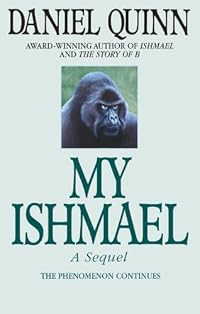
On This Page
Description
An extraordinary and startlingly original sequel to Ishmael“Enthralling, shocking, hope-filled, and utterly fearless, Daniel Quinn leads us deeper and deeper into the human heart, history, and spirit. In My Ishmael, Quinn strikes out into entirely new territory, posing questions that will rock you on your heels, and providing tantalizing possibilities for a truly new world vision.”—Susan Chernak McElroy, author of Animals as Teachers & Healers
When Ishmael places an show more advertisement for pupils with “an earnest desire to save the world,” he does not expect a child to answer him. But twelve-year-old Julie Gerchak is undaunted by Ishmael’s reluctance to teach someone so young, and convinces him to take her on as his next student. Ishmael knows he can't apply the same strategies with Julie that he used with his first pupil, Alan Lomax—nor can he hope for the same outcome. But young Julie proves that she is ready to forge her own spiritual path and arrive at her own destination. And when the time comes to choose a pupil to carry out his greatest mission yet, Ishmael makes a daring decision—a choice that just might change the world.
Explore Daniel Quinn’s spiritual Ishmael trilogy:
ISHMAEL • MY ISHMAEL • THE STORY OF B. show less
Tags
Recommendations










Member Recommendations
teelgee Sequel, every bit as good.
Member Reviews
This is supposedly a novel about a young girl learning about human culture from a telepathic gorilla, but it barely qualifies as a novel. The gorilla, Ishmael, is really just a mouthpiece for Daniel Quinn's views, and the girl (Julie) does little more than say "Uh-huh" to Ishmael's two-chapter-long parables about life on alien planets.
Quinn's argument is that schooling in modern society is not about education, but actually entirely about helping business out in two ways. 1) It keeps people out of the work force until they are at least eighteen, solving the problems that would result from massive unemployment that would ensue if they were in it. 2) Because kids are not working, they have access to their parents' funds (a lot more than show more they would probably have if they were on their own) and thus can spend lots of money on teen-marketed stuff. He idealizes a tribal form of education, where everyone learns from the community what they need to survive. In tribal society, he says, kids passed into adulthood when they hit puberty because at that point they had learned how to survive, whereas in our society, even when people graduate after twelve years of schooling, "their survival value is virtually zero. If the rest of the community were to vanish overnight and they were left entirely to their own resources, they'd be very lucky to survive at all" (133).
Because the purpose of education is to merely keep people in a holding pattern for twelve years, Quinn says, "real school falls [far short] from the ideal of 'young minds being awakened'" (131). One of things that teachers discourage in their effort to move through the curriculum is questions from students, because it is a distraction.* This is in direct opposition to a different reading from the same class, from Cris Tovani's I Read It, but I Don't Get It: Comprehension Strategies for Adolescent Readers, which was all about getting students to ask questions. (Now I think a lot of Tovani is ridiculous, but it's her methods I usually disagree with, not her goals.) Our professor asked us to look at the two viewpoints and compare them.
What I think it comes down to is Quinn's cynicism. He says our lifestyle (by this I mean the human society that has existed since mankind began farming in the Fertile Crescent) is predicated on the fact that everything, from the code of Hammurabi to the constitution of the United States of America, only works "if people were better.... All this would work beautifully... if people would just be better than people have ever been" (121). He argues that the reason the tribal way worked so well for the three million years prior to our society is that it "didn't depend on people being better. It worked for people the way they are-- unimproved, unenlightened, troublesome, disruptive, selfish, mean, cruel, greedy, and violent" (121). The tribal system doesn't assume that laws can stop a man from committing adultery, it assumes that it will happen, and so it "prescribes steps that minimize the damage done by this act of infidelity" (108). According to Quinn, people aren't perfect (something I think no one will disagree with), but they will never be able to improve (something that, especially as a humanist, I fundamentally disagree with).
So Quinn does see school as something, that to an extent at least, could work. Ideally, questions would be asked by student and answered by students; it's just that the way the system actually works (thanks to imperfect human nature) is not like that, by and large. I think Quinn and Tovani would agree on that point, but it's their solutions that differ. Tovani seems to have a fundamentally idealistic viewpoint-- the system can work if we just do it right-- whereas Quinn's is fundamentally cynical-- the system will never work, so logically we must dismantle it. (Note that I think that Quinn would disagree with my assessment of him; I suspect he would consider himself a realist, not a cynic, but I consider him a cynic since I believe humanity is fundamentally capable of self-improvement.) Tovani gives methods for creating questioning in the classroom, but Quinn starts from the assumption that it will simply never happen.
I haven't yet gotten to where Quinn explains what he thinks should be done instead of the human society he criticizes so much, it is obvious he think the ultimate goal of education is survival. Not just survival in society, but the sort of primitive survival a member of a tribal society would have to pull off. This is what really bothers me about My Ishmael. Is survival all humankind has to look forward to? An ability to go beyond survival is what sets us apart from animals. All an animal wants to do is survive, but a human being has so much more. It reminds me of a late-night conversation I had in high school with some friends where they opined that everyone should be dropped into a forest and forced to fight their way out or something to prove their worth to continue existing in society. At the time, this really irritated me, but I later realized what ticked me off. As human beings, what sets us apart is that we help those who would die otherwise. Civilization is about creating an environment where Quinn's primitive survival is not needed. If all that mattered was survival, we wouldn't have art or iPods or philosophy or Doctor Who or books or anything that didn't relate to eating and keeping warm. This is what makes humanity superior to animals; in fact, it's what makes our society superior to the tribal ones Quinn admires.
There's one very important thing we also wouldn't have. And that is a book called My Ishmael. What did this book contribute to my survival? Nothing. I read it because I was required to, technically speaking, but in a general way, I read it simply to be more educated. Education outside of one's immediate field and interests can most definitely be a good thing; though I may complain when I take the classes, I am a proponent of liberal arts programs. But learning about musical theater and orogeny has not set me up for survival at all-- much like My Ishmael.
But the kicker is that in the sort of tribal society Quinn idealizes, My Ishmael couldn't have been written. Time and again, he traces the shift from tribal society to what he calls "Taker society" to the development of agriculture. More specifically, it's when people began to specialize: instead of everyone focusing on providing food, certain people began to produce more than they needed and give that to others in exchange for things they wanted. This sort of specialization is what makes modern society possible, of course. (Quinn also dislikes specialization, see page 174.) Because someone is making more food than he needs, other people can acquire this food in exchange for things they are good at making. But Quinn doesn't see this as an advancement:
"But you're also saying that the real innovation of our revolution wasn't growing the food, it was locking it up."
"Yes, that was certainly the key. Your revolution would have ground to a halt without that feature. It would grind to halt today without that feature." (61)
Again and again throughout the book, "locking up the food" is cited as a reason for the ills of Taker society. But how does Daniel Quinn eat? He doesn't grow his own food**; rather he writes a book, gets paid for it, heads down to the grocery store, and hands over his money to the people who locked up the food. If no one locked up food, he wouldn't be writing My Ishmael; he'd be in the forest spearing a deer or digging up roots. Rather than the downfall of human society, "locking up the food" is fundamental to it, its greatest triumph. Without this division of labor that leads to food-growers locking it up (because, after all, the want to get something in return for the food prior to handing it over), we would still be a sustenance society, not a society that had produced William Shakespeare, the Mona Lisa, the Taj Mahal.
And yes, we'd be a society without My Ishmael to tell us where we'd gone wrong by just existing. (originally written December 2005)
* His example of a discouraged question, however, is asking in a lesson on tidal forces about whether or not it's true people go crazy on the full moon. I don't care how open a teacher is, he is going to find that question pretty dang irrelevant
** Okay, I suppose he could. But I'm pretty sure he doesn't. show less
Quinn's argument is that schooling in modern society is not about education, but actually entirely about helping business out in two ways. 1) It keeps people out of the work force until they are at least eighteen, solving the problems that would result from massive unemployment that would ensue if they were in it. 2) Because kids are not working, they have access to their parents' funds (a lot more than show more they would probably have if they were on their own) and thus can spend lots of money on teen-marketed stuff. He idealizes a tribal form of education, where everyone learns from the community what they need to survive. In tribal society, he says, kids passed into adulthood when they hit puberty because at that point they had learned how to survive, whereas in our society, even when people graduate after twelve years of schooling, "their survival value is virtually zero. If the rest of the community were to vanish overnight and they were left entirely to their own resources, they'd be very lucky to survive at all" (133).
Because the purpose of education is to merely keep people in a holding pattern for twelve years, Quinn says, "real school falls [far short] from the ideal of 'young minds being awakened'" (131). One of things that teachers discourage in their effort to move through the curriculum is questions from students, because it is a distraction.* This is in direct opposition to a different reading from the same class, from Cris Tovani's I Read It, but I Don't Get It: Comprehension Strategies for Adolescent Readers, which was all about getting students to ask questions. (Now I think a lot of Tovani is ridiculous, but it's her methods I usually disagree with, not her goals.) Our professor asked us to look at the two viewpoints and compare them.
What I think it comes down to is Quinn's cynicism. He says our lifestyle (by this I mean the human society that has existed since mankind began farming in the Fertile Crescent) is predicated on the fact that everything, from the code of Hammurabi to the constitution of the United States of America, only works "if people were better.... All this would work beautifully... if people would just be better than people have ever been" (121). He argues that the reason the tribal way worked so well for the three million years prior to our society is that it "didn't depend on people being better. It worked for people the way they are-- unimproved, unenlightened, troublesome, disruptive, selfish, mean, cruel, greedy, and violent" (121). The tribal system doesn't assume that laws can stop a man from committing adultery, it assumes that it will happen, and so it "prescribes steps that minimize the damage done by this act of infidelity" (108). According to Quinn, people aren't perfect (something I think no one will disagree with), but they will never be able to improve (something that, especially as a humanist, I fundamentally disagree with).
So Quinn does see school as something, that to an extent at least, could work. Ideally, questions would be asked by student and answered by students; it's just that the way the system actually works (thanks to imperfect human nature) is not like that, by and large. I think Quinn and Tovani would agree on that point, but it's their solutions that differ. Tovani seems to have a fundamentally idealistic viewpoint-- the system can work if we just do it right-- whereas Quinn's is fundamentally cynical-- the system will never work, so logically we must dismantle it. (Note that I think that Quinn would disagree with my assessment of him; I suspect he would consider himself a realist, not a cynic, but I consider him a cynic since I believe humanity is fundamentally capable of self-improvement.) Tovani gives methods for creating questioning in the classroom, but Quinn starts from the assumption that it will simply never happen.
I haven't yet gotten to where Quinn explains what he thinks should be done instead of the human society he criticizes so much, it is obvious he think the ultimate goal of education is survival. Not just survival in society, but the sort of primitive survival a member of a tribal society would have to pull off. This is what really bothers me about My Ishmael. Is survival all humankind has to look forward to? An ability to go beyond survival is what sets us apart from animals. All an animal wants to do is survive, but a human being has so much more. It reminds me of a late-night conversation I had in high school with some friends where they opined that everyone should be dropped into a forest and forced to fight their way out or something to prove their worth to continue existing in society. At the time, this really irritated me, but I later realized what ticked me off. As human beings, what sets us apart is that we help those who would die otherwise. Civilization is about creating an environment where Quinn's primitive survival is not needed. If all that mattered was survival, we wouldn't have art or iPods or philosophy or Doctor Who or books or anything that didn't relate to eating and keeping warm. This is what makes humanity superior to animals; in fact, it's what makes our society superior to the tribal ones Quinn admires.
There's one very important thing we also wouldn't have. And that is a book called My Ishmael. What did this book contribute to my survival? Nothing. I read it because I was required to, technically speaking, but in a general way, I read it simply to be more educated. Education outside of one's immediate field and interests can most definitely be a good thing; though I may complain when I take the classes, I am a proponent of liberal arts programs. But learning about musical theater and orogeny has not set me up for survival at all-- much like My Ishmael.
But the kicker is that in the sort of tribal society Quinn idealizes, My Ishmael couldn't have been written. Time and again, he traces the shift from tribal society to what he calls "Taker society" to the development of agriculture. More specifically, it's when people began to specialize: instead of everyone focusing on providing food, certain people began to produce more than they needed and give that to others in exchange for things they wanted. This sort of specialization is what makes modern society possible, of course. (Quinn also dislikes specialization, see page 174.) Because someone is making more food than he needs, other people can acquire this food in exchange for things they are good at making. But Quinn doesn't see this as an advancement:
"But you're also saying that the real innovation of our revolution wasn't growing the food, it was locking it up."
"Yes, that was certainly the key. Your revolution would have ground to a halt without that feature. It would grind to halt today without that feature." (61)
Again and again throughout the book, "locking up the food" is cited as a reason for the ills of Taker society. But how does Daniel Quinn eat? He doesn't grow his own food**; rather he writes a book, gets paid for it, heads down to the grocery store, and hands over his money to the people who locked up the food. If no one locked up food, he wouldn't be writing My Ishmael; he'd be in the forest spearing a deer or digging up roots. Rather than the downfall of human society, "locking up the food" is fundamental to it, its greatest triumph. Without this division of labor that leads to food-growers locking it up (because, after all, the want to get something in return for the food prior to handing it over), we would still be a sustenance society, not a society that had produced William Shakespeare, the Mona Lisa, the Taj Mahal.
And yes, we'd be a society without My Ishmael to tell us where we'd gone wrong by just existing. (originally written December 2005)
* His example of a discouraged question, however, is asking in a lesson on tidal forces about whether or not it's true people go crazy on the full moon. I don't care how open a teacher is, he is going to find that question pretty dang irrelevant
** Okay, I suppose he could. But I'm pretty sure he doesn't. show less
Daniel Quinn gives a lot of food-for-thought in this sequel to Ishmael. In My Ishmael, again, there's a talking philosopher gorilla (the title's namesake) who takes on a student to try to educate (in this case) on what's needed to save humanity from society.
I thought Quinn presented many valid points through his gorilla stand-in, but I also think it's all just a dream. I don't have much faith in society ever righting its problems and I have a feeling the proclamation that "the meek will inherit the earth" will actually be spot-on. But the meek will end up taking things full-circle with simple organisms being there in the end.
Interesting, thought-provoking, frustrating, depressing - My Ishmael.
I thought Quinn presented many valid points through his gorilla stand-in, but I also think it's all just a dream. I don't have much faith in society ever righting its problems and I have a feeling the proclamation that "the meek will inherit the earth" will actually be spot-on. But the meek will end up taking things full-circle with simple organisms being there in the end.
Interesting, thought-provoking, frustrating, depressing - My Ishmael.
A follow-up of sorts to Ishmael (which I read yonks ago and don't remember much about except that I found it compelling) which follows the same format: telepathic gorilla seeks student with whom to engage in a Socratic dialogue about how to "save the world." The student this time is a twelve-year-old girl and while that set-up allows for discussion of some topics an adult wouldn't see in the same way (such as western schooling systems), it also makes the whole thing a bit hard to swallow. I believe Julie's compassion, her disillusionment, and her brightness; I do not believe that this twelve-year-old girl has any thing like the kind of knowledge of the world and history and economics that she demonstrates throughout her conversations show more with Ishmael. This flaw is certainly a by-product of novels of ideas told in this way, which I have to admit I find somewhat tedious wherever I encounter them. Ishmael does engage Julie and have her suss out answers herself, but she still spends far too much time saying only variations on "Yes, I see that" or "I still don't get it." As for the ideas themselves (1. our society (people who lock up the food and force everyone to work to get any of it) have developed a system of living which does not work for people; as evolutionarily things that do not work do not survive, our system cannot survive and 2. the way to "fix" the system is to show people the flaws in the system so that they stop wanting this system and let a new system that does work slowly evolve*), I find them interesting but wish that Quinn, instead of using Julie almost entirely as a device for getting the argument on the page, had used her more as a devil's advocate to indicate the opposition to these positions so that the book could present a more fully rounded picture of the conversation about these ideas.
*Over-simplified, of course, and leaving out much of the definitional work that is part of the foundation of the argument, but that's the gist. show less
*Over-simplified, of course, and leaving out much of the definitional work that is part of the foundation of the argument, but that's the gist. show less
Hard to put a rating on this. I enjoyed the first half very much; it had lots of good ideas. Then it got bogged down and ended, as I had feared, with nothing much useful to take away. I shelved it as fiction because of the story line used to communicate the ideas, and the fiction part was pretty boring, especially the last few chapters. In the end, disappointing.
Hard to put a rating on this. I enjoyed the first half very much; it had lots of good ideas. Then it got bogged down and ended, as I had feared, with nothing much useful to take away. I shelved it as fiction because of the story line used to communicate the ideas, and the fiction part was pretty boring, especially the last few chapters. In the end, disappointing.
I found "My Ishmael" ot be the least valuble and least entertaining of the Ishmael Trilogy. The book focuses mainly on the same ideas and thoughts presented in the first two books, and adds a different narrator in order to represent the newly formulated ideas. Quinn says that he wrote the novel in order to answer the influx of questions from eager readers, and I can honestly say that he does accomplish this very well.
The book utilizes the same 'transcibed conversation' style of the original, but this time with an innocent, eager 10 year old girl. Although, there is not much new material brought forth in this sequel, Quinn does an excellent job to present his ideas from a new perspective. He uses the text to focus his arguments on the show more SOLUTIONS to totalitarian agriculuralism, rather than the CAUSES. I did not enjoy the (healthy) portion of the book which recounts the protagonist's journey to Africa. This takes up a good third of the text, and adds very little to the author's arguments on civilization.
However, the novel does do an excellent job to conclude the series. Without giving too much away, Quinn leaves the reader with no doubt as to how he/she can 'help the cause'. I reccomend this to anybody who is eager to become more informed, and even become active on the topic of 'totalitarian agriculturalism'. show less
The book utilizes the same 'transcibed conversation' style of the original, but this time with an innocent, eager 10 year old girl. Although, there is not much new material brought forth in this sequel, Quinn does an excellent job to present his ideas from a new perspective. He uses the text to focus his arguments on the show more SOLUTIONS to totalitarian agriculuralism, rather than the CAUSES. I did not enjoy the (healthy) portion of the book which recounts the protagonist's journey to Africa. This takes up a good third of the text, and adds very little to the author's arguments on civilization.
However, the novel does do an excellent job to conclude the series. Without giving too much away, Quinn leaves the reader with no doubt as to how he/she can 'help the cause'. I reccomend this to anybody who is eager to become more informed, and even become active on the topic of 'totalitarian agriculturalism'. show less
Another solid and thought-provoking book by Daniel Quinn. The author's promotion of evolutionary psychology grated on me, but I otherwise liked the message.
Members
- Recently Added By
Author Information

38+ Works 11,923 Members
Daniel Quinn was born in 1935 and raised in Omaha, Nebraska. He graduated from Creighton Prep and attended St. Louis University, the University of Vienna and Loyola University of Chicago. Quinn worked in educational and consumer publishing, holding editorial positions with the American Peoples Encyclopedia, the Greater Cleveland Mathematics show more Program, the Encyclopedia Britannica Educational Corporation, Fuller and Dees Publishing and the Society for Visual Education. He is best known for his award-winning novel Ishmael (1992), which is about a gorilla able to telepathically communicate, but he has written other novels as well as short fiction. (Bowker Author Biography) show less
Series

Common Knowledge
- Original publication date
- 1997
- First words
- I think it's pretty lousy to wake up at age sixteen and realize you've already been screwed.
- Last words
- (Click to show. Warning: May contain spoilers.)But I think I'd better just leave it the way it is.
Classifications
Statistics
- Members
- 1,415
- Popularity
- 16,599
- Reviews
- 13
- Rating
- (4.09)
- Languages
- English, French, German
- Media
- Paper, Audiobook, Ebook
- ISBNs
- 8
- ASINs
- 3