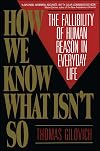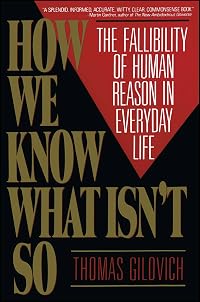
How We Know What Isn't So: The Fallibility of Human Reason in Everyday Life
by Thomas Gilovich
On This Page
Description
Thomas Gilovich offers a wise and readable guide to the fallacy of the obvious in everyday life. When can we trust what we believe--that "teams and players have winning streaks," that "flattery works," or that "the more people who agree, the more likely they are to be right"--and when are such beliefs suspect? Thomas Gilovich offers a guide to the fallacy of the obvious in everyday life. Illustrating his points with examples, and supporting them with the latest research findings, he show more documents the cognitive, social, and motivational processes that distort our thoughts, beliefs, judgments and decisions. In a rapidly changing world, the biases and stereotypes that help us process an overload of complex information inevitably distort what we would like to believe is reality. Awareness of our propensity to make these systematic errors, Gilovich argues, is the first step to more effective analysis and action. show lessTags
Recommendations




Member Reviews
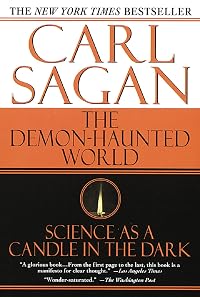
I picked this up after reading The Demon-Haunted World: Science as a Candle in the Dark by Carl Sagan, as he refers to it at some point.
Now, don't get me wrong: this is a very good read, doing exactly what it says on the tin, that is, exposing some of our most common fallacies when assessing evidence and so forging opinions. Personally for instance, I particularly like his insisting that being prejudiced/ wrong is not being irrational or stupid but, merely abiding to what he calls a 'flawed rationality'. I was also really engrossed by the chapters relating to the false consensus effect, as they strongly reminded me of another effect detailed in another book that I had read recently (The Spiral of Silence: Public Opinion - Our Social show more Skin, 2nd Edition, by Elizabet Noelle-Neumann), that of the spiral of silence and how individuals monitor the expression of their own opinions, based on what they believe other people think. The fact that Thomas Gilovich dares exposing how erroneous thinking can lead to dangerous groupthinks and, beyond, catastrophic policies in various fields makes it all the more compelling and relevant.
The thing is, if you are like me, that is, interested in rational thinking, the scientific method, how prejudicial thinking operates, and/ or some of the commonest claptraps when assessing data, then there won't be much to learn here. Even the most engaging parts putting the reader to the test (e.g. a card experiment asking you which cards you would chose in other to confirm/ infirm the veracity of a statement etc.) will feel déjà-vu to those used to this type of literature. Is it bad?
All in all, there is no denying that I enjoyed it. When it comes to re-assert the key features of critical thinking, it will surely feel like barging through an open door with a ram and just so as to state what should be obvious! And yet... And yet, as someone having prejudices of my own (e.g. I dislike the press, and the British press especially) I for one never cease to be amazed by how the medias seem utterly incompetent in basic numeracy when assessing statistics, or, worse, unable to comprehend the necessity to question source before tossing out opinions passed off as facts. Needless to say, then, the parts on how the medias can dangerously serve 'the fallibility of human reason' were right up my street!
Is it ground-breaking? Absolutely not. Do I recommend it, though? You bet I do! We all can be easily mislead. It's good to be reminded so. show less
Now, don't get me wrong: this is a very good read, doing exactly what it says on the tin, that is, exposing some of our most common fallacies when assessing evidence and so forging opinions. Personally for instance, I particularly like his insisting that being prejudiced/ wrong is not being irrational or stupid but, merely abiding to what he calls a 'flawed rationality'. I was also really engrossed by the chapters relating to the false consensus effect, as they strongly reminded me of another effect detailed in another book that I had read recently (The Spiral of Silence: Public Opinion - Our Social show more Skin, 2nd Edition, by Elizabet Noelle-Neumann), that of the spiral of silence and how individuals monitor the expression of their own opinions, based on what they believe other people think. The fact that Thomas Gilovich dares exposing how erroneous thinking can lead to dangerous groupthinks and, beyond, catastrophic policies in various fields makes it all the more compelling and relevant.
The thing is, if you are like me, that is, interested in rational thinking, the scientific method, how prejudicial thinking operates, and/ or some of the commonest claptraps when assessing data, then there won't be much to learn here. Even the most engaging parts putting the reader to the test (e.g. a card experiment asking you which cards you would chose in other to confirm/ infirm the veracity of a statement etc.) will feel déjà-vu to those used to this type of literature. Is it bad?
All in all, there is no denying that I enjoyed it. When it comes to re-assert the key features of critical thinking, it will surely feel like barging through an open door with a ram and just so as to state what should be obvious! And yet... And yet, as someone having prejudices of my own (e.g. I dislike the press, and the British press especially) I for one never cease to be amazed by how the medias seem utterly incompetent in basic numeracy when assessing statistics, or, worse, unable to comprehend the necessity to question source before tossing out opinions passed off as facts. Needless to say, then, the parts on how the medias can dangerously serve 'the fallibility of human reason' were right up my street!
Is it ground-breaking? Absolutely not. Do I recommend it, though? You bet I do! We all can be easily mislead. It's good to be reminded so. show less
I liked the book but I thought it was a bit too shallow and repetitive. You could distill the main arguments down to 25 pages and still include everything that's important. But at least it was a fairly entertaining book.
Great book, opened my mind to how closed the human mind is. it was the last of the four books my friend Mordy Ovits got me as a housewarming gift 5 years ago. I've now asked him to make 4 recommendations on a new topic.
Author Jonah Lehrer has chosen to discuss How We Know What Isn’t So: The Fallibility of Human Reason in Everyday Life by Thomas Gilovich on FiveBooks as one of the top five on his subject - Decision-Making, saying that:
“...This book really invented the genre of science non-fiction. If you want to summarise it, a large part of the book is about positive information bias – the fact that we like to believe that we’re right and so we ignore all sorts of evidence that suggests we might be wrong. We think we’re so objective, but there’s actually nothing objective about the human mind. We have these working beliefs and we seek evidence to confirm beliefs: that, unfortunately, is the best summary of how we seek out evidence. …” show more
The full interview is available here: http://fivebooks.com/interviews/jonah-lehrer-on-decision-making show less
“...This book really invented the genre of science non-fiction. If you want to summarise it, a large part of the book is about positive information bias – the fact that we like to believe that we’re right and so we ignore all sorts of evidence that suggests we might be wrong. We think we’re so objective, but there’s actually nothing objective about the human mind. We have these working beliefs and we seek evidence to confirm beliefs: that, unfortunately, is the best summary of how we seek out evidence. …” show more
The full interview is available here: http://fivebooks.com/interviews/jonah-lehrer-on-decision-making show less
Ratings
Members
- Recently Added By
Lists

Make it Stick's Suggested Books Reading
19 works; 2 members

Atheism, humanism, freethought, &c. — Best nonfiction books in favour of
167 works; 14 members

The Great Courses: Your Deceptive Mind
60 works; 1 member
Author Information

6 Works 1,477 Members
Common Knowledge
- Canonical title
- How We Know What Isn't So: The Fallibility of Human Reason in Everyday Life
- Last words
- (Click to show. Warning: May contain spoilers.)To truly appreciate the complexities of the world and the intricacies of human experience, it is essential to understand how we can be misled by the apparent evidence of everyday experience. This, in turn, requires that we think clearly about our experience, question our assumptions, and challenge what we think we know.
Classifications
- Genres
- Nonfiction, General Nonfiction, Science & Nature, Philosophy
- DDC/MDS
- 153.43 — Philosophy & psychology Psychology Conscious mental processes and intelligence Thought, thinking, reasoning, intuition, value, judgment Problem Solving
- LCC
- BF442 .G55 — Philosophy, Psychology and Religion Psychology Psychology Consciousness. Cognition
- BISAC
Statistics
- Members
- 708
- Popularity
- 40,069
- Reviews
- 4
- Rating
- (3.89)
- Languages
- Chinese, English, Spanish
- Media
- Paper, Ebook
- ISBNs
- 5
- ASINs
- 6