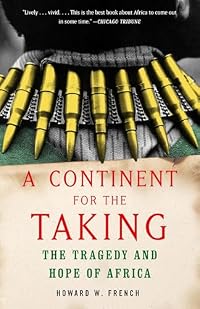
A Continent for the Taking: The Tragedy and Hope of Africa
by Howard W. French
On This Page
Description
"[Howard French] takes us inside Nigeria, Liberia, Mali, and the Congo, examining ... the legacy of colonization in the lives of contemporary Africans"--jacket.Tags
Recommendations















Member Reviews
Howard French's portrayal of Africa is both professional and passionate. He is scholarly and sentimental. There is a deep knowledge about, and an undeniable kinship with, this continent yet French is able to objectively portray it all. He takes the reader through the events of horrific genocide as well as the equally deadly outbreaks of AIDS and Ebola diseases. French skillfully demonstrates how political infrastructures prove to be volatile and fragile yet Africa's deep seeded cultural roots remain unfailing.
For me, this was a hard read. I simply couldn't wrap my brain around the threat of senseless violence everyone, regardless of race, age, caste, or sex, had to endure. When these attacks rained down no one was safe. Survival show more depended on the ability to outwit, outrun, outhide the attacker. show less
For me, this was a hard read. I simply couldn't wrap my brain around the threat of senseless violence everyone, regardless of race, age, caste, or sex, had to endure. When these attacks rained down no one was safe. Survival show more depended on the ability to outwit, outrun, outhide the attacker. show less
Unlike much of the other African travel writing and reportage that I have read, French's book is uncompromisingly fact-laden and dense. There are a few moments when the history that he lived through gathers enough speed around certain imperiled individuals or groups to make the book gripping and fast-paced; but, on average, it requires careful attention that borders on note-taking to keep track of the motivations and backgrounds of the different players in French's account (unless you have already committed the recent history of Central Africa to memory).
The pace of the book is not helped by the random, loosely structured way that it leaps across decades and continents from one chapter to another. It could definitely have used smoother show more transitions and it would have benefited from a more thought out structure; it is really a collection of essays and an opportunity for French to air some of the grievances and experiences that (I imagine) he was not allowed to share with readers of The New York Times, for which he worked.
I also got the sense that because he was granted such unparalleled journalistic access and because he was always aware of representing the New York Times, he didn't engage as much with African people and African culture as authors like Aidan Hartley or Paul Theroux. French seemed, at times, to be above the real situations and distanced from the real people, constantly hopping onto safe transport for a timely exit--and, more importantly, while he remained on the ground, he seemed more likely to spend his time at the hotels that served as the nexus of western reporting or to lounge about with various privileged people who wished to appear in his writings than to fraternize with random, non-influential Africans for the sake of better understanding their culture and ways.
That said, I feel like I understand the last two decades in Central Africa MUCH better than I did before this book, especially as regards the wars in Congo and the appallingly two-faced and negligent foreign policy decisions of the Clinton Administration, which has somehow escaped prominent or consistent blame and accusation for the giant drop kick away from democracy that it managed to offer Africa in the nineties.
Lastly, it was refreshing to encounter those rare moments when French shows his own attitude and frustration, lashing out, for instance at the "Big Man" stereotype used to explain some of Africa's governance failures, "Africa's dictators had been supported for decades by East and West, and were often handpicked by outside powers. their misrule had placed the continent in the deep hole it now found itself in, not some congenital incapacity for modern governance, as decades of shallow analyses about Big Men and ancient tribal animosities' often insinuated." French doesn't share such blunt conclusions very often; but when he does, he has more than proven himself correct in the preceding pages. show less
The pace of the book is not helped by the random, loosely structured way that it leaps across decades and continents from one chapter to another. It could definitely have used smoother show more transitions and it would have benefited from a more thought out structure; it is really a collection of essays and an opportunity for French to air some of the grievances and experiences that (I imagine) he was not allowed to share with readers of The New York Times, for which he worked.
I also got the sense that because he was granted such unparalleled journalistic access and because he was always aware of representing the New York Times, he didn't engage as much with African people and African culture as authors like Aidan Hartley or Paul Theroux. French seemed, at times, to be above the real situations and distanced from the real people, constantly hopping onto safe transport for a timely exit--and, more importantly, while he remained on the ground, he seemed more likely to spend his time at the hotels that served as the nexus of western reporting or to lounge about with various privileged people who wished to appear in his writings than to fraternize with random, non-influential Africans for the sake of better understanding their culture and ways.
That said, I feel like I understand the last two decades in Central Africa MUCH better than I did before this book, especially as regards the wars in Congo and the appallingly two-faced and negligent foreign policy decisions of the Clinton Administration, which has somehow escaped prominent or consistent blame and accusation for the giant drop kick away from democracy that it managed to offer Africa in the nineties.
Lastly, it was refreshing to encounter those rare moments when French shows his own attitude and frustration, lashing out, for instance at the "Big Man" stereotype used to explain some of Africa's governance failures, "Africa's dictators had been supported for decades by East and West, and were often handpicked by outside powers. their misrule had placed the continent in the deep hole it now found itself in, not some congenital incapacity for modern governance, as decades of shallow analyses about Big Men and ancient tribal animosities' often insinuated." French doesn't share such blunt conclusions very often; but when he does, he has more than proven himself correct in the preceding pages. show less
A good review of the chaotic 1990's, but only about central and west Africa. also, there's nothing more in depth as to the root causes of the ongoing cycle of violence beyond "European colonization made us this way". Contrary to the subtitle,there is no indication of hope.
The author seems to think that America should step in at every opportunity, and if it doesn't, it is to blame wholly for any succeeding violence. Also, the author's holier -than-thou attitude got to me a few times (granted, it only showed up a few times), most especially when implying that Doctors Without Borders personnel investigating an Ebola outbreak somehow cared less about a local population than does the author (despite the fact that the doctors were there for show more weeks if not months and the author flew in for a day to snap some photos).
Glad I read it, because I do recognize that I know far too little about Africa and the recent history that impacts modern politics. but if this is the best book out there on modern Africa, it is no wonder that the English speaking world quietly ignores the seeming unsolvable problem of Africa. show less
The author seems to think that America should step in at every opportunity, and if it doesn't, it is to blame wholly for any succeeding violence. Also, the author's holier -than-thou attitude got to me a few times (granted, it only showed up a few times), most especially when implying that Doctors Without Borders personnel investigating an Ebola outbreak somehow cared less about a local population than does the author (despite the fact that the doctors were there for show more weeks if not months and the author flew in for a day to snap some photos).
Glad I read it, because I do recognize that I know far too little about Africa and the recent history that impacts modern politics. but if this is the best book out there on modern Africa, it is no wonder that the English speaking world quietly ignores the seeming unsolvable problem of Africa. show less
Interesting reportage in the autobiographical parts but the rest is just a random jumble of inarticulate complaints against the west. The title is misleading, I was expecting some analysis of economical exploitation. The hope part is completely absent - all the book shows is how hopeless the continent's situation is, with no way out.
If you're interested I can recommend "The Looting Machine" by Tom Burgis which contains real journalism. This book is just not worth your time.
If you're interested I can recommend "The Looting Machine" by Tom Burgis which contains real journalism. This book is just not worth your time.
This book mainly contains the author's eyewitness accounts of tumultuous events in Central and Western Africa when he was the NY Times Bureau Chief for West Africa, stationed in Abidjan in the Ivory Coast. If you think back to the horrors of the Hutu/Tutsi genocides in Rwanda and Zaire that once made headlines iin 1997, and of General Mobutu as dictator of Zaire, then you are in the right geographic locale and in the right time-frame and tone for this book. The author has mainly a journalist's viewpoint for front-line reporting of conflicts, although he does briefly describe some aspects of indigenous African culture and also provide some historical background of the continuing competition by foreign countries to plunder Africa's show more resources, beginning with the slave trade in about 1520 and continuing through years of colonialism, the Cold War, nascent independence, and recent dictatorial military regimes. Emphasizing events of 1997 might make the book seem somewhat dated, but in reading modern-day headlines of merciless tribal slaughter, stolen elections, and imprisoned opposition leaders, one suspects that perhaps not much has changed since then beyond the particular names and places. Africa is a huge continent, with a long history, and this is a slender book of only 258 pages, so the focus is of necessity somewhat narrower than the title might imply. If one is interested in a more general history of Africa, with broader coverage of the continent, then a more comprehensive (and much larger) book should be found. show less
A NY Times' journalist's musings on the nightmare of war and greed in West Africa.
Members
- Recently Added By
Published Reviews
ThingScore 100
Howard French’s A Continent for the Taking is a rewarding combination of journalism and personal reportage. French, a senior writer for The New York Times, sustains a delicate balance between objective fact and subjective interpretation as he recounts his 25 years of reporting on African history and culture.
added by mikeg2
Author Information

8 Works 1,094 Members
Awards and Honors
Awards
Distinctions
Common Knowledge
- Canonical title
- A Continent for the Taking: The Tragedy and Hope of Africa
- Original publication date
- 2004
- Important places
- Liberia; Nigeria; Zaire; Mali; Sierra Leone; Democratic Republic of the Congo (show all 7); Congo
- Dedication
- To my parents, who taught me to ask, and to Avouka, William and Henry, who understood
Classifications
Statistics
- Members
- 297
- Popularity
- 107,679
- Reviews
- 7
- Rating
- (3.88)
- Languages
- English
- Media
- Paper, Audiobook, Ebook
- ISBNs
- 5
- ASINs
- 2