
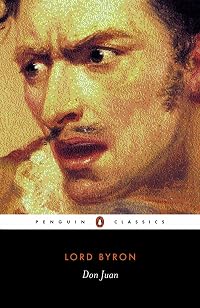
Don Juan
by Lord Byron
On This Page
Description
In his satiric poem Don Juan, Lord Byron refigures the legend as a man easily seduced by women, rather than as a dangerous womanizer. When the first two cantos were anonymously published in 1819, they were criticized for being immoral. They were also immensely popular. Byron only completed 16 cantos, leaving the 17th unwritten when he died in 1824. Don Juan is commonly considered to be his masterpiece..
Tags
Recommendations










Member Recommendations


anonymous user Byron obviously knew his grandfather's Narrative and drew some inspiration from it for the shipwreck episode. Quite apart from that, John Byron's harrowing and haunting tale still makes a fine read.

anonymous user Asimov's annotated Don Juan is unfortunately scarce and expensive. But worth having by any true aficionado of the greatest comic epic in the language. Asimov's annotation is at once more extensive and more accessible than what Byronic scholars have to offer.
Member Reviews
This was tremendous fun to read. Byron's personality infuses the work and he's a likable, open-hearted narrator. It's a picture of England just before the clouds of Victorian prudery turned love from a game to a chore. It also has a strong anti-war subtext that I wasn't expecting. A great read and a real surprise!
For a long time, I somehow placed Byron into that terrible category of "people you read about" - I don't know why, because every time I've looked up quotations from Don Juan I've felt that this is a poem I should read. Probably needless to say that I couldn't tear myself away from it once I did finally get around to reading it, and read the whole thing in one weekend.
There's a story, of sorts, although that gets pushed further and further into the background as we go on; there's sex and violence; there are all your favourite holiday destinations (Spain, Greece, Turkey, English country houses); there are the wonderfully cutting asides about fellow-poets and contemporary politics; there are gloriously random discussions of whatever show more happens to come into the poet's head.
It's all wonderful, but what really makes it work is Byron's amazingly light touch with verse. The ottava rima form ought by rights to sound forced and mechanical in English, and it probably would in anyone else's hands, but Byron seems to be able to make it read as naturally as everyday conversation. Of course, he has to cheat like anything to achieve this, but he knows exactly how far he can bend the rules before the whole thing breaks down, and always draws back just in time. He seems to take great pleasure in pretending to paint himself into a corner and then producing a ludicrously inappropriate or impossible rhyme ("Aristotle/bottle", "Corydon/horrid one", "excel/well/indispensable"). Even a master of atrocious rhymes like W.S. Gilbert ("Plato/potato") couldn't have done any better - in fact, Gilbert clearly lifted a few useful examples direct from Don Juan, e.g. the "monotony/got any" in Iolanthe. And there are some wonderful bits of bathos, like "...that all-softening, overpowering knell, / The tocsin of the soul—the dinner-bell" and some dreadfully barbed jokes "...angling, too, that solitary vice, / Whatever Izaak Walton sings or says". What more could you want? show less
There's a story, of sorts, although that gets pushed further and further into the background as we go on; there's sex and violence; there are all your favourite holiday destinations (Spain, Greece, Turkey, English country houses); there are the wonderfully cutting asides about fellow-poets and contemporary politics; there are gloriously random discussions of whatever show more happens to come into the poet's head.
It's all wonderful, but what really makes it work is Byron's amazingly light touch with verse. The ottava rima form ought by rights to sound forced and mechanical in English, and it probably would in anyone else's hands, but Byron seems to be able to make it read as naturally as everyday conversation. Of course, he has to cheat like anything to achieve this, but he knows exactly how far he can bend the rules before the whole thing breaks down, and always draws back just in time. He seems to take great pleasure in pretending to paint himself into a corner and then producing a ludicrously inappropriate or impossible rhyme ("Aristotle/bottle", "Corydon/horrid one", "excel/well/indispensable"). Even a master of atrocious rhymes like W.S. Gilbert ("Plato/potato") couldn't have done any better - in fact, Gilbert clearly lifted a few useful examples direct from Don Juan, e.g. the "monotony/got any" in Iolanthe. And there are some wonderful bits of bathos, like "...that all-softening, overpowering knell, / The tocsin of the soul—the dinner-bell" and some dreadfully barbed jokes "...angling, too, that solitary vice, / Whatever Izaak Walton sings or says". What more could you want? show less
Bloody great book. I think a lot of people don't realize that as a poet/writer Byron was in a sense closer to 18th century satirists like, say, Swift than he was to his Romantic so-called cohorts ... and yet he's often considered some kind of "arch"-Romantic. Naah. His great talent, I'd say, was a comic one, and it's in Don Juan -- even unfinished as it is -- that this comic genius burns most brightly. It isn't just the funny-as-hell "Hudibrastic" rhymes he often employs, it's ... oh, hell, he was just such a funny damned bastard. Mean, spiteful, but funny.
"Try and find something in here I haven't put my penis in. It's not easy!"
Screw (not all the time, but at this moment I am lionizing Byron, so screw) all the other Romantics with their philosophies and sensibilities. Byron is not even a poet in the hyperdense, words-on-paper-privileging sense that we are used to these days--he's a raconteur, and as such his poetry is a lot more capacious, more flowy, more conducive to being read out loud, more expressive of the medium's oral, social past. "Wedlock and padlock". Keats killed by one review. English ennui. He's not only a raconteur, he's full to bursting of upper-class bons mots. And in that sense, we get the cute reversal of Don Juan the ingenue, not lusting but being lusted, but we also show more get Byron playing the traditional Don Juan role, rolling and rocking and rollicking the story out with a leer. Putting his penis in it, shall we say. And think about how fast that changed from, say, Mozart's Don Giovanni, the degenerate genius of Joseph II's court rolling out a demonic hubris play. In that sense, Don Juan is Exhibit A for the case of Byron as the first modern.
(Penis!) show less
Screw (not all the time, but at this moment I am lionizing Byron, so screw) all the other Romantics with their philosophies and sensibilities. Byron is not even a poet in the hyperdense, words-on-paper-privileging sense that we are used to these days--he's a raconteur, and as such his poetry is a lot more capacious, more flowy, more conducive to being read out loud, more expressive of the medium's oral, social past. "Wedlock and padlock". Keats killed by one review. English ennui. He's not only a raconteur, he's full to bursting of upper-class bons mots. And in that sense, we get the cute reversal of Don Juan the ingenue, not lusting but being lusted, but we also show more get Byron playing the traditional Don Juan role, rolling and rocking and rollicking the story out with a leer. Putting his penis in it, shall we say. And think about how fast that changed from, say, Mozart's Don Giovanni, the degenerate genius of Joseph II's court rolling out a demonic hubris play. In that sense, Don Juan is Exhibit A for the case of Byron as the first modern.
(Penis!) show less
It's been said (I can't remember by whom) that a great book should be read once in youth, once in middle age, and once in old age, just as a great building should viewed at dawn, in daylight, and at dusk.
I first read Byron's Don Juan when I was 25 years old. It was a Penguin edition, and I remember being very swept away by Byron's sexually-charged romance. I had always thought of 19th century poets as being very, well, Victorian. "We shall talk about love but it must be chaste, innocent love. No sex please; we're Victorian". Byron had no such prudish streak. Don Juan is filled with passion and love in equal measure. It has a sensuality that would have horrified Byron's contemporaries, but which shows a profound respect for love, sex, show more and women that was unheard of during his own era.
Now, as I'm closer to middle age then youth, I'm looking forward to revisiting Byron's Don and see if any of my perceptions have changed. show less
I first read Byron's Don Juan when I was 25 years old. It was a Penguin edition, and I remember being very swept away by Byron's sexually-charged romance. I had always thought of 19th century poets as being very, well, Victorian. "We shall talk about love but it must be chaste, innocent love. No sex please; we're Victorian". Byron had no such prudish streak. Don Juan is filled with passion and love in equal measure. It has a sensuality that would have horrified Byron's contemporaries, but which shows a profound respect for love, sex, show more and women that was unheard of during his own era.
Now, as I'm closer to middle age then youth, I'm looking forward to revisiting Byron's Don and see if any of my perceptions have changed. show less
So much better than I remembered from college. The rhymes, humor, and slights. Life may certainly be not worth a potato when you are looking for a rhyme for Cato. A fun novel length poem
A very modern and readable epic. Though some (maybe... 5%) takes a pretty hardcore reader to appreciate, it was easy for even a big noob like me to have a lot of fun.
One of the finest long poems in English.
One of the finest long poems in English.
Members
- Recently Added By
Published Reviews
ThingScore 100
In spite of its romantic trappings Don Juan is as "true" as anything by Maupassant or Chekhov or Somerset Maugham, and the reason is Byron's infallible sense, as his style matured, for the immediacy of a situation and of those taking part in it. In the midst of Eastern local color, which could be as vapid as Lalla Rookh, the oriental tales in verse by his friend Thomas Moore, he has a show more Shakespearean sureness for the touch that makes all live...
Wherever Juan goes, even into the kitchen where he sees "cooks in motion with their clean arms bare," his creator seizes on the vital impression. Though Byron in fact corrected lavishly, and had second or third thoughts like any other writer, it remains true of him, as he said, that when composing he was like a tiger, which if it misses its first spring goes growling back to the jungle. show less
Wherever Juan goes, even into the kitchen where he sees "cooks in motion with their clean arms bare," his creator seizes on the vital impression. Though Byron in fact corrected lavishly, and had second or third thoughts like any other writer, it remains true of him, as he said, that when composing he was like a tiger, which if it misses its first spring goes growling back to the jungle. show less
added by SnootyBaronet
Lists

Narrative verse for pleasure
75 works; 8 members

Western World's Greatest Books - Project Gutenberg
295 works; 15 members

Harold Bloom - The Western Canon: C. The Democratic Age
336 works; 15 members

The Works of Lord Byron
46 works; 1 member

A Reading List
100 works; 3 members

How to Read a Book's Recommended Reading List
309 works; 10 members

Greatest Books, allegedly
484 works; 9 members

Books and authors mentioned by Le Clézio in his Nobel Prize speech
87 works; 3 members

Recommended Reading : 600 Classics Reviewed, Editors of Salem Press, 2015
634 works; 6 members

Works Cited in The Life and Death of Democracy by John Keane
278 works; 1 member

el
1,139 works; 1 member
Author Information

843+ Works 12,148 Members
English poet and dramatist George Gordon, Lord Byron was born January 22, 1788, in London. The boy was sent to school in Aberdeen, Scotland, until the age of ten, then to Harrow, and eventually to Cambridge, where he remained form 1805 to 1808. A congenital lameness rankled in the spirit of a high-spirited Byron. As a result, he tried to excel in show more every thing he did. It was during his Cambridge days that Byron's first poems were published, the Hours of Idleness (1807). The poems were criticized unfavorably. Soon after Byron took the grand tour of the Continent and returned to tell of it in the first two cantos of Childe Harold (1812). Instantly entertained by the descriptions of Spain, Portugal, Albania, and Greece in the first publication, and later travels in Belgium, Germany, Switzerland, and Italy, the public savored Byron's passionate, saucy, and brilliant writing. Byron published the last of Childe Harold, Canto IV, in 1818. The work created and established Byron's immense popularity, his reputation as a poet and his public persona as a brilliant but moody romantic hero, of which he could never rid himself. Some of Byron's lasting works include The Corsair, Lara, Hebrew Melodies, She Walks In Beauty, and the drama Manfred. In 1819 he published the first canto of Don Juan, destined to become his greatest work. Similar to Childe Harold, this epic recounts the exotic and titillating adventures of a young Byronica hero, giving voice to Byron's social and moral criticisms of the age. Criticized as immoral, Byron defended Don Juan fiercely because it was true-the virtues the reader doesn't see in Don Juan are not there precisely because they are so rarely exhibited in life. Nevertheless, the poem is humorous, rollicking, thoughtful, and entertaining, an enduring masterpiece of English literature. Byron died of fever in Greece in 1824, attempting to finance and lead the Byron Brigade of Greek freedom fighters against the Turks. (Bowker Author Biography) show less
Some Editions
Awards and Honors
Notable Lists
Series
Belongs to Publisher Series
Riverside Editions (B40)
Clube de Literatura Clássica (CLC) (42 [October 2023])
Perpetua reeks (61)
Doubleday Dolphin (C64)
Modern Library (24.3)
Penguin Poets (D216)
Work Relationships
Is contained in
Contains
Has the adaptation
Is expanded in
Has as a reference guide/companion
Has as a study
Has as a commentary on the text
Has as a concordance
Has as a student's study guide
Common Knowledge
- Canonical title
- Don Juan
- Original title
- Don Juan
- Original publication date
- 1826
- People/Characters
- Don Juan; Donna Inez; Haidee; Donna Julia; Don Alfonso; Don Jose (show all 16); Gulbeyaz; Lolah; Dudu; Katinka; Lady Adeline Amundeville; Aurora Raby; Catherine the Great; Baba; Lambro; Don Jose
- Important places
- Seville, Andalusia, Spain; Russia; Turkey; Greece; England, UK
- Dedication
- Bob Southey!
- First words
- I want a hero: an uncommon want, when every year and month sends forth a new one, Till, after cloying the gazetts with cant, The age discovers he is not the true one; Of such as these I should not care to vaunt, I'll therefor... (show all)e take our ancient frien Don Juan--We all have seen him, in the pantomime, Sent to the devil somewhat ere his time.
- Quotations
- But--Oh! ye lords of ladies intellectual, Inform us truly, have they not hen-peck'd you all?
What are the hopes of man? Old Egypt's King Cheops erected the first pyramid And largest, thinking it was just the thing To keep his memory whole, and mummy hid; But somebody or other rummaging, Burglariously broke his coffin... (show all)'s lid: Let not a monument give you or me hopes, Since not a pinch of dust remains of Cheops.
There's not a sea the passenger e'er pukes in, Turns up more dangerous breakers than the Euxine.
A better cavalier ne'er mounted horse, Or, being mounted, e'er got down again. - Last words
- (Click to show. Warning: May contain spoilers.)Her Grace, too, had sort of air rebuked--Seem'd pale and shiver'd, as if she had kept A vigil, or dreamt rather more than slept.
- Original language
- English
Classifications
Statistics
- Members
- 1,865
- Popularity
- 11,532
- Reviews
- 21
- Rating
- (3.88)
- Languages
- 11 — Catalan, Chinese, Czech, Dutch, English, French, German, Polish, Spanish, Swedish, Turkish
- Media
- Paper, Audiobook, Ebook
- ISBNs
- 120
- UPCs
- 1
- ASINs
- 56