On This Page
Description
"When his sexy young wife fails to home one night, Jonas Milk tells his inquisitive neighbours she is visiting a friend. But his innocent attempt to protect Gina's reputation provokes hostility and suspicion among the residents of the Vieux-Marche - who know very well she has been having flagrant affairs throughout her marriage to the quiet little bookseller. Soon Jonas's small lie leads him into a nightmare of police inquiries and painful discoveries . . ."--Publisher.Tags
Recommendations






















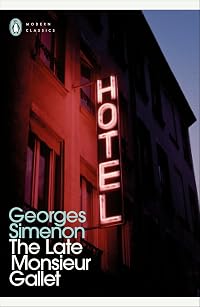


Member Recommendations


Member Reviews
Jonas had always thought of them as friends, but this time when his young wife disappears, the villagers turn on him. His background is that he is a Russian-Jew, whose family fled the Revolution, and he had almost forgotten that and thought they had too. But when young Gina leaves him they remember everything that makes him different and he becomes an outsider.
This is a sad story for there is no way back for Jonas as Simenon explores his final path.
I read this to discuss with my U3A Crime Fiction Reading Group. Our focus this month is Georges Simenon.
This is a sad story for there is no way back for Jonas as Simenon explores his final path.
I read this to discuss with my U3A Crime Fiction Reading Group. Our focus this month is Georges Simenon.
Perfect little book. Read as ILL in very bad condition from Tulane. Man came from archangel (Russia) in childhood, but settled in a town in France. Becomes a bookseller / owner on a market square and longs to fit in with all his town colleagues- the butcher, the cafe, etc. They come to accept him (or seem to) and he finally comes to marry the rather free loving daughter of the grocer (Gina). She is much younger (42 to 20) but he is made to feel he'd be helping her out because of her iffy reputation. She continues (in a slightly reduced volume) her easy way with men and everyone in town knows it. He suffers, but does not upbraid her (because - after all, he thinks to himself- he is so much older). Finally she leaves one night and does show more not come back. He expects she'll be back when she has done with her fellow, but this time she has taken some valuable stamps that he had and also the neighbors become immediately concerned. This is different from before making us thing that they all knew where and what she was doing on other occasions, but this time they don't. (creepy). He lies about her whereabouts (she went to see a friend) just to reduce the embarrassing chatter about her likely destination (with another man). He is soon found out in the lied, and now it is looking bad- she has "disappeared" and he lied about it has no good alibi- he must have killed her! His friends / neighbors in town turn cold towards him ... and he feels his outsiderness that was always just below the surface. This is what the book is about ... that they could never accept him- being an emigre and even ... it seems ... Jewish! non practicing and converted catholic (to marry Gina, but still... at the end of the day- a Jew! They don't say anything to him- that would be too bald, to obvious- this is Simenon- this is real. you just feel it from every eye and the way people walk by his shop and i really do feel it. Such empathy for this man. Soon, the police are involved and it appears as though things are heading for the ironic sad conclusion that he'll be charged with her disappearance. It isn't the way it actually ends... it ends .... worse- yes, much worse than that. Such a beautiful, sad little book. Among his best and that is saying a lot. show less
To be quite honest, I'm not entirely sure of what I thought about this book. I feel like I liked it, but at the same time, something was missing and so I didn't LOVE it. Now, if only I could figure out what that was...
The basic plot is very simple: Jonas Milk, a shy Jewish librarian of Russian origin living in France, wakes up one morning to find that his (much younger) wife has disappeared. Since she had many affairs, and had already disappeared in the past with one of her lovers, he doesn't think much of it and just waits for her to come back. But when his neighbours and her family start asking questions about where she is, he lies, saying she went to visit a friend in a nearby town. What he didn't anticipate is that everyone would show more start suspecting him of having killed her. The whole book essentially explores this situation, starting from the moment Jonas tells this little lie for the first time, and following the evolution of the situation.
Not a lot actually happens throughout the story, as we mostly follow Jonas as he tries to continue leading a normal life, while wondering where his wife might be and why everyone around him is suddenly treating him differently. Of course, that is exactly the point of this book, since it's not a mystery/thriller, but feels more like a character study than anything else. What I found really interesting is that the story is told entirely from Jonas' POV, so we know exactly what he is thinking and feeling at any point. But that's all we ever know, as there is no objective narrator, and no other POV to compare it to. It was fascinating to follow Jonas as he starts to come to terms with reality, and it was heartbreaking to witness first-hand his pain as he realises that the people he thought were his friends and among whom he grew up can abandon him so quickly.
And, for me, that was the most important and beautiful part of the book: the underlying theme of acceptance of diversity that ran throughout. Even though Jonas has lived within the same community since he was a child, he has never truly been accepted by the people. Those he believes to be his friends, have actually never stopped seeing him as a foreigner, as "the little man from Archangel" or the "Russian librarian". In this sense, the book sends a really powerful message, by showing us exactly what consequences this type of behaviour can have on the people who experience it,as Jonas eventually crumbles under the weight of his neighbours' judgment and decides to take his life, even though he knows he did not kill his wife.
Even though the story was really intense and thought-provoking, it still had something that didn't quite do it for me, although I really could not point out one single thing and say: "That's it! That's the reason I couldn't like this book quite how much I wanted to!" Maybe it was the writing style, maybe it was all the introspection, maybe it was the fact that I had SO MANY questions that were never answered. I just don't know. What I do know is that it took me a very long time to read this book, considering how short it is (standing at less than 200 pages), and I was never fully involved in the story, no matter how much I tried to engage with it. It is definitely worth reading though, particularly if you are looking for a book that will make you really think about acceptance and diversity, and the prejudices that sometimes we can never get rid of. show less
The basic plot is very simple: Jonas Milk, a shy Jewish librarian of Russian origin living in France, wakes up one morning to find that his (much younger) wife has disappeared. Since she had many affairs, and had already disappeared in the past with one of her lovers, he doesn't think much of it and just waits for her to come back. But when his neighbours and her family start asking questions about where she is, he lies, saying she went to visit a friend in a nearby town. What he didn't anticipate is that everyone would show more start suspecting him of having killed her. The whole book essentially explores this situation, starting from the moment Jonas tells this little lie for the first time, and following the evolution of the situation.
Not a lot actually happens throughout the story, as we mostly follow Jonas as he tries to continue leading a normal life, while wondering where his wife might be and why everyone around him is suddenly treating him differently. Of course, that is exactly the point of this book, since it's not a mystery/thriller, but feels more like a character study than anything else. What I found really interesting is that the story is told entirely from Jonas' POV, so we know exactly what he is thinking and feeling at any point. But that's all we ever know, as there is no objective narrator, and no other POV to compare it to. It was fascinating to follow Jonas as he starts to come to terms with reality, and it was heartbreaking to witness first-hand his pain as he realises that the people he thought were his friends and among whom he grew up can abandon him so quickly.
And, for me, that was the most important and beautiful part of the book: the underlying theme of acceptance of diversity that ran throughout. Even though Jonas has lived within the same community since he was a child, he has never truly been accepted by the people. Those he believes to be his friends, have actually never stopped seeing him as a foreigner, as "the little man from Archangel" or the "Russian librarian". In this sense, the book sends a really powerful message, by showing us exactly what consequences this type of behaviour can have on the people who experience it,
Even though the story was really intense and thought-provoking, it still had something that didn't quite do it for me, although I really could not point out one single thing and say: "That's it! That's the reason I couldn't like this book quite how much I wanted to!" Maybe it was the writing style, maybe it was all the introspection, maybe it was the fact that I had SO MANY questions that were never answered. I just don't know. What I do know is that it took me a very long time to read this book, considering how short it is (standing at less than 200 pages), and I was never fully involved in the story, no matter how much I tried to engage with it. It is definitely worth reading though, particularly if you are looking for a book that will make you really think about acceptance and diversity, and the prejudices that sometimes we can never get rid of. show less
Georges Simenon's The Man from Archangel is a novel of ordinary circumstances become extraordinary. The eponymous protagonist, one M. Milk, is a dull little bookstore proprietor who almost inexplicably decides to marry the town slut. And then one day she disappears, and guess who comes under immediate suspicion?
M. Milk's plight is actually a deep exploration of what it means to be an individual human being, and a part of a community -- or not. This is a moving and disturbing work, and should be more read.
M. Milk's plight is actually a deep exploration of what it means to be an individual human being, and a part of a community -- or not. This is a moving and disturbing work, and should be more read.
Beautiful little gem of a book. It's more of a character study than a novel, though the way Simenon extracts plot through flashback is masterful. The characters (particularly the two principals) really shine too. Essentially, a quiet bookseller's life in a small French town is turned upside down when his much younger wife disappears.
Incidentally, I think this was lent to Ellen by Barnaby Richards. Judging from a receipt within, he bought it in Falmouth in August 2003 for 99p. Money well spent.
Incidentally, I think this was lent to Ellen by Barnaby Richards. Judging from a receipt within, he bought it in Falmouth in August 2003 for 99p. Money well spent.
Quanta tristezza in questo romanzo, e quanta delicatezza nel descrivere un uomo mite e introverso, fondamentalmente solo.
Tutti siamo Jonas Milk, o almeno una volta nella vita lo siamo stati.
Simenon immenso, come sempre; ma qui lo è di più ancora
Simenon immenso, come sempre; ma qui lo è di più ancora
Members
- Recently Added By
Lists

Reading LIst
648 works; 1 member

Take Four Books
130 works; 1 member
Author Information

1,331+ Works 63,057 Members
The prolific Belgian-born writer Georges Simenon produced hundreds of fictional works under his own name and 17 pseudonyms, in addition to more than 70 books about Inspector Maigret, long "the favorite sleuth of highbrow detective-story readers" (SR). More than 50 "Simenons" have been made into films. In addition to his mystery stories, he wrote show more what he called "hard" books, the serious psychological novels numbering well over 100. The autobiographical Pedigree, set in his native town of Liege, is perhaps his finest work. The publication of Simenon's intimate memoirs also attracted considerable attention. Simenon himself once said that he would never write a "great novel." Yet Gide called him "a great novelist, perhaps the greatest and truest novelist we have in French literature today," and Thornton Wilder (see Vol. 1) found that Simenon's narrative gift extends "to the tips of his fingers." The following are some of Simenon's novels, exclusive of the Maigret detective stories, that are in print. (Bowker Author Biography) Georges Simenon was born on February 13, 1903 in Liege, Belgium. He wrote more than 200 fiction works under 16 different pseudonyms. His first book, The Case of Peter the Lent led to 80 more of the like including the main character, Inspector Maigret. He published over 400 books that were translated into 50 different languages and sold by the millions. He also wrote psychological novels, including The Man Who Watched the Train Go By. He died on September 4, 1989 in Lausanne. (Bowker Author Biography) show less
Some Editions
Series

Belongs to Publisher Series
Work Relationships
Common Knowledge
- Canonical title
- The Little Man from Archangel
- Original title
- Le Petit homme d’Arkhangelsk
- Original publication date
- 1956
- People/Characters*
- Jonas Milk; Gina Palestri; Angèle Palestri; Louis Palestri; Frédo Palestri; Fernand Le Bouc
- First words*
- Fu un errore mentire. Se ne rese conto nel momento stesso in cui apriva bocca per rispondere a Fernand Le Bouc. E solo per timidezza, per mancanza di disinvoltura, non cambiò le parole che gli salivano alle labbra.
- Last words*
- (Click to show. Warning: May contain spoilers.)Un merlo, sbucato dall'interno della casa, si affacciò sulla porta e volò sulla cima del tiglio, dove aveva il nido.
- Original language*
- Francese
*Some information comes from Common Knowledge in other languages. Click "Edit" for more information.
Classifications
Statistics
- Members
- 273
- Popularity
- 118,570
- Reviews
- 17
- Rating
- (3.86)
- Languages
- 9 — Danish, Dutch, English, Finnish, French, German, Italian, Norwegian (Bokmål), Swedish
- Media
- Paper, Audiobook, Ebook
- ISBNs
- 19
- ASINs
- 8