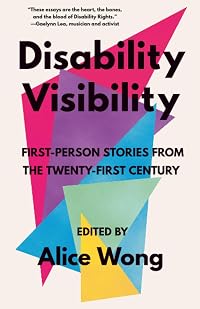
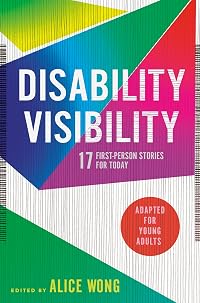
Disability Visibility: First-Person Stories from the Twenty-First Century
by Alice Wong (Editor)
On This Page
Description
"A groundbreaking collection of first-person writing on the joys and challenges of the modern disability experience: Disability Visibility brings together the voices of activists, authors, lawyers, politicians, artists, and everyday people whose daily lives are, in the words of playwright Neil Marcus, "an art . . . an ingenious way to live." According to the last census, one in five people in the United States lives with a disability. Some are visible, some are hidden--but all are show more underrepresented in media and popular culture. Now, just in time for the thirtieth anniversary of the Americans with Disabilities Act, activist Alice Wong brings together an urgent, galvanizing collection of personal essays by contemporary disabled writers. There is Harriet McBryde Johnson's "Unspeakable Conversations," which describes her famous debate with Princeton philosopher Peter Singer over her own personhood. There is columnist s. e. smith's celebratory review of a work of theater by disabled performers. There are original pieces by up-and-coming authors like Keah Brown and Haben Girma. There are blog posts, manifestos, eulogies, and testimonies to Congress. Taken together, this anthology gives a glimpse of the vast richness and complexity of the disabled experience, highlighting the passions, talents, and everyday lives of this community. It invites readers to question their own assumptions and understandings. It celebrates and documents disability culture in the now. It looks to the future and past with hope and love"-- show lessTags
Recommendations


Member Reviews
there's a wide mix of essays here but is a great place to start for learning about disability and the issues that come with it. but i definitely learned more from/resonated with some than others.
in jillian weise's essay, i couldn't believe that insurance can decide on whether or not someone walks enough or too much in order to qualify for another prosthetic: "I'm told by the technician to maintain an average amount of walking on a daily basis. Don't go overboard, but don't be lazy, either. Stay in the middle. The insurance company could pull my data and decide whether I have used my leg enough to justify the next one."
in the antiabortion bill you aren't hearing about by rebecca cokley: "It is hard to be a pro-choice disabled person who show more understands that believing in bodily autonomy means you have to support the idea that other people--your friends, your peers, your siblings--may choose to abort a pregnancy because their child could be like you. Yes, it's hard. But that's why it's a conversation we have to have, because if we don't, decisions about us and our futures get made by others, without us." and "What's equally harmful is that those on the pro-choice side often use disability as a monster under the bed, framing our lives as lacking dignity, independence, or value. Our lives are valuable because they're our lives. Why is this not enough?" and "We also live in a country where Buck v. Bell--the 1927 U.S. Supreme Court case in which the sterilization of people with disabilities was ruled constitutional--has never been overturned."
the end of leah lakshmi piepzna-samarasinha's poem: "There will be an after/Survive for it." show less
in jillian weise's essay, i couldn't believe that insurance can decide on whether or not someone walks enough or too much in order to qualify for another prosthetic: "I'm told by the technician to maintain an average amount of walking on a daily basis. Don't go overboard, but don't be lazy, either. Stay in the middle. The insurance company could pull my data and decide whether I have used my leg enough to justify the next one."
in the antiabortion bill you aren't hearing about by rebecca cokley: "It is hard to be a pro-choice disabled person who show more understands that believing in bodily autonomy means you have to support the idea that other people--your friends, your peers, your siblings--may choose to abort a pregnancy because their child could be like you. Yes, it's hard. But that's why it's a conversation we have to have, because if we don't, decisions about us and our futures get made by others, without us." and "What's equally harmful is that those on the pro-choice side often use disability as a monster under the bed, framing our lives as lacking dignity, independence, or value. Our lives are valuable because they're our lives. Why is this not enough?" and "We also live in a country where Buck v. Bell--the 1927 U.S. Supreme Court case in which the sterilization of people with disabilities was ruled constitutional--has never been overturned."
the end of leah lakshmi piepzna-samarasinha's poem: "There will be an after/Survive for it." show less
This is a vital collection of essays and accounts which make up a cross section of many facets of the disability justice movement in the 21st century. It shows the diversity of the community and includes stories told be everyday people and those on the front lines in the disability justice movement. I respected that it included content warnings at the starts of essays which covered particularly sensitive topics. While I felt some pieces weren’t as fully developed as others, I can’t argue with the inclusion of any of the pieces. It’s an excellent collection and one of the best reads this year.
A wonderful collection of personal stories about disability justice by disabled writers, artists, activists, researchers, people. Here are my notes about some of the ones that struck me the most...
I am embarrassed to admit that I did not know Peter Singer - one of the people who inspired my ethics around veganism - was such an ableist eugenicist. Harriet McBryde Johnson talks about this in the first story in the anthology, her story of how she confronted Singer in the early 2000s.
The Isolation of Being Deaf in Prison by Jeremy Woody as told to Christie Thompson is chilling.
Common Cyborg by Jillian Weise is a mind-bending reflection about technology, AI and disability: "The cyborg is the engineer's dream. The engineer steers and show more manipulates the human to greater performance. As a common cyborg, I subvert that dream." (Note to self to look into Donna Haraway's 'A Cyborg Manifesto,' which Weise critiques because it "promised a cyber-feminist resistance" but instead, tech "has been so effective at erasing disabled women that even now in conversation with many feminists, I am no longer surprised that ability does not figure into their notions of bodies and embodiment.... Our lives are not metaphors."
The emotion of "How to Make a Paper Crane from Rage" by Elsa Sjunneson is palpable: "With each closed door, with each insult, I fold. I crease. I twist. I bend. I make something out of the rage that wells up inside of my chest. It sits somewhere beneath my collarbone; I can feel it sometimes. I live in a world that doesn't want me."
A.H. Reaume's story about how her friend Maddy helped her finish her novel was powerful in its simplicity - all too often the simple, basic ways people care for and support each other are overlooked - not necessarily at the individual level, but at the societal level. They are rendered invisible. I love the way she gives visibility to this.
Incontinence is a Public Health Issue - and We Need to Talk About it by Mari Ramsawakh. Yes!
Six Ways of Looking at Crip Time by Ellen Samuels. Brilliant. I love the way they take something supposedly as simple and straight forward as time and completely redefine it, and make you question all your assumptions about it.
Disability Solidarity: Completing the 'Vision for Black Lives' by Harriet Tubman Collective. Such an instructive piece. Also, it is a reminder that no movement is perfect. To have no heroes.
Leah Lakshmi Piepzna-Samarasinha's poetry and visions are beautiful. I want to read her book about care work.
Stacy Milbern's "On the Ancestral Plan" is part dedication to ancestry and a moving reflection on the power of ancestry. Instructive, too.
Finally, the last piece "The Beauty of Spaces Created for and By Disabled People" by s.e. smith is a concise, powerful, accessible piece about safe spaces and why they matter. show less
I am embarrassed to admit that I did not know Peter Singer - one of the people who inspired my ethics around veganism - was such an ableist eugenicist. Harriet McBryde Johnson talks about this in the first story in the anthology, her story of how she confronted Singer in the early 2000s.
The Isolation of Being Deaf in Prison by Jeremy Woody as told to Christie Thompson is chilling.
Common Cyborg by Jillian Weise is a mind-bending reflection about technology, AI and disability: "The cyborg is the engineer's dream. The engineer steers and show more manipulates the human to greater performance. As a common cyborg, I subvert that dream." (Note to self to look into Donna Haraway's 'A Cyborg Manifesto,' which Weise critiques because it "promised a cyber-feminist resistance" but instead, tech "has been so effective at erasing disabled women that even now in conversation with many feminists, I am no longer surprised that ability does not figure into their notions of bodies and embodiment.... Our lives are not metaphors."
The emotion of "How to Make a Paper Crane from Rage" by Elsa Sjunneson is palpable: "With each closed door, with each insult, I fold. I crease. I twist. I bend. I make something out of the rage that wells up inside of my chest. It sits somewhere beneath my collarbone; I can feel it sometimes. I live in a world that doesn't want me."
A.H. Reaume's story about how her friend Maddy helped her finish her novel was powerful in its simplicity - all too often the simple, basic ways people care for and support each other are overlooked - not necessarily at the individual level, but at the societal level. They are rendered invisible. I love the way she gives visibility to this.
Incontinence is a Public Health Issue - and We Need to Talk About it by Mari Ramsawakh. Yes!
Six Ways of Looking at Crip Time by Ellen Samuels. Brilliant. I love the way they take something supposedly as simple and straight forward as time and completely redefine it, and make you question all your assumptions about it.
Disability Solidarity: Completing the 'Vision for Black Lives' by Harriet Tubman Collective. Such an instructive piece. Also, it is a reminder that no movement is perfect. To have no heroes.
Leah Lakshmi Piepzna-Samarasinha's poetry and visions are beautiful. I want to read her book about care work.
Stacy Milbern's "On the Ancestral Plan" is part dedication to ancestry and a moving reflection on the power of ancestry. Instructive, too.
Finally, the last piece "The Beauty of Spaces Created for and By Disabled People" by s.e. smith is a concise, powerful, accessible piece about safe spaces and why they matter. show less
Thank you @netgalley and Penguin Vintage Books for this ARC of @disability_visibility. What a fantastic anthology! As a person with a chronic illness I am so grateful to this collection of authors. The experiences that these authors recount are, by turn, heart wrenching, relatable, funny, educational and most importantly, deeply human. I was exposed to people whose lives are being lived in the shadows and I was confronted with my own ableism in spite of being disabled myself. We have so far to go towards equality for people with disabilities. I commit to doing the work necessary to amplify the voices of people with disabilities.
I can't say that I enjoyed this book, I didn't take pleasure in the reading of it, when I finished an essay I didn't eagerly reach for the next page and yet despite that I think this is a good book. Reading these essays made me uncomfortable, made me squirm in my seat. It forced me to really think about things that I take for granted and made me aware of issues I hadn't had any knowledge of. I felt foolish at times, why had I never heard of these things (issues and movements within the disabled community) before? Why had I never stopped to consider my assumptions about what someone who is disabled would consider quality of life? To make an effort and do a little research? This book definitely gave me the kick I needed to start thinking show more critically about disability issues, showed me how little I know and gave me a jumping off point to other literature I can use to educate myself. show less
Not an easy book to read, and I appreciated the content warnings, but necessary reading for everyone, disabled or not. These are the kind of stories you don't easily forget, and you shouldn't.
Favorites: "There’s a Mathematical Equation That Proves I’m Ugly", "Radical Visibility: A Disabled Queer Clothing Reform Movement Manifesto", "How to Make a Paper Crane from Rage", "Why My Novel Is Dedicated to My Disabled Friend Maddy", "Six Ways of Looking at Crip Time", "The Fearless Benjamin Lay: Activist, Abolitionist, Dwarf Person", "Love Means Never Having to Say…Anything"
Favorites: "There’s a Mathematical Equation That Proves I’m Ugly", "Radical Visibility: A Disabled Queer Clothing Reform Movement Manifesto", "How to Make a Paper Crane from Rage", "Why My Novel Is Dedicated to My Disabled Friend Maddy", "Six Ways of Looking at Crip Time", "The Fearless Benjamin Lay: Activist, Abolitionist, Dwarf Person", "Love Means Never Having to Say…Anything"
I liked this collection of essays, and especially how they focus on different disabilities and the intersectionality between disability and other marginalizations. I learned a lot from it; I was aware of some of the issues already, but many were things I was not aware of or didn't realize were as bad as they are.
The narration was good, including both the main text read by Alejandra Ospina and the introduction written and read by Alice Wong. It felt like all of the people (who wrote the essays) and marginalizations were treated with care and respect, and the content warnings added to the start of appropriate essays would be helpful to those who needed them.
My only minor complaint with the audio version of the book is that even though show more each new essay was introduced with the title and author's name, they were all narrated by the same person. While Alejandra Ospina was a good narrator, I couldn't get a sense of what the author's intersectionalities were unless they were specifically stated in the essay. I think I wouldn't have had that issue in a print book, since I could have more easily paused to look up the author before continuing. show less
The narration was good, including both the main text read by Alejandra Ospina and the introduction written and read by Alice Wong. It felt like all of the people (who wrote the essays) and marginalizations were treated with care and respect, and the content warnings added to the start of appropriate essays would be helpful to those who needed them.
My only minor complaint with the audio version of the book is that even though show more each new essay was introduced with the title and author's name, they were all narrated by the same person. While Alejandra Ospina was a good narrator, I couldn't get a sense of what the author's intersectionalities were unless they were specifically stated in the essay. I think I wouldn't have had that issue in a print book, since I could have more easily paused to look up the author before continuing. show less
Members
- Recently Added By
Lists

Top Five Books of 2022
736 works; 272 members

Science: Health & Medical
100 works; 1 member

Penguin Random House
458 works; 4 members

Youth: DEI
296 works; 2 members

Neuro Pride Ireland Recommendations
101 works; 1 member

DWI Members Recommendations
25 works; 1 member

Fave books about Ehlers-Danlos syndrome
7 works; 1 member

Featured in Fat Talk by Virginia Sole-Smith
103 works; 1 member

Top Five Books of 2024
795 works; 264 members

Psychology: Abuse, Grief, Self-Help
189 works; 1 member
Author Information

All Editions
Awards and Honors
Awards
Distinctions
Notable Lists
Work Relationships
Common Knowledge
- Original publication date
- 2020
- Epigraph
- Disability is not a brave struggle or "courage in the face of adversity." Disability is an art. It's an ingenious way to live.
—Neil Marcus
Remember, you weren't the one
Who made you ashamed,
But you... (show all) are the one
Who can make you proud.
—Laura Hershey
The word special, as it is applied to disability, too often means "a bit shit."—Stella Young - Dedication
- To my younger self and all the disabled kids today who can't imagine their futures.
The world is ours, and this is for all of us. - Blurbers
- Bell, W. Kamau; Baker, Jennifer; Kim, Christine Sun; Lea, Gaelynn
- Original language
- English
Classifications
- Genres
- General Nonfiction, Nonfiction, Biography & Memoir
- DDC/MDS
- 305.9 — Society, government, & culture Social sciences, sociology & anthropology Social group - Age, Gender, Ethnicity People by occupation and miscellaneous social statuses
- LCC
- HV1552.3 .D57 — Social sciences Social pathology. Social and public welfare. Criminology Social pathology. Social and public welfare. Protection, assistance and relief Special classes People with disabilities
- BISAC
Statistics
- Members
- 924
- Popularity
- 28,944
- Reviews
- 17
- Rating
- (4.25)
- Languages
- English
- Media
- Paper, Audiobook, Ebook
- ISBNs
- 9
- ASINs
- 2