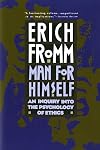
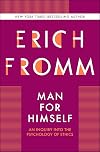
Man for Himself: An Inquiry Into the Psychology of Ethics
by Erich Fromm
On This Page
Description
First published in 1999Tags
Recommendations




















Member Reviews
"Man for Himself" might be a good book, but it is also, in some ways, a limited and dated one. It seems written in the shadow of twentieth-century totalitarianisms, and Fromm's confidence in Freudian ideas about the structure of the subconscious and in psychology's ability to produce real, testable knowledge about the human personality may seem misplaced to modern readers. Also, while it certainly can't be said that Fromm is a communist, his criticisms of the capitalist system left me wondering exactly what sort of economic system might meet his approval. His introduction of the "marketing" orientation as a new twentieth century personality type seems like a product of its time.
Despite all this, "Man for Himself" seems like an honest, show more and occasionally successful, attempt to accommodate psychological insights into older, philosophically-oriented models of human personality. At the same time, Fromm's focus on "productivity" reminds readers that our psychological makeup isn't just a question of the contents of some unseen subconscious but something directly connected with our living conditions and our life choices. His summings up of historical perspectives on various ethical topics are effective, and his contention that self-creation is a constant, ongoing, lifelong process is inspiring. I suspect that readers with a background in philosophy will consider "Man for Himself" as little more than old Aristotle in new bottles, but I'd prefer to think that the way these questions are framed is important, and the author's examination of these questions in a relatively modern context is useful. Fromm is, I think, preaching to a sort of choir: readers who feel that their religious beliefs are an inextricable part of themselves are unlikely to get anything out of this one. But readers who want a fresh perspective on human psychological and ethical structures, or want an introduction to humanistic ethics, could probably do much worse. show less
Despite all this, "Man for Himself" seems like an honest, show more and occasionally successful, attempt to accommodate psychological insights into older, philosophically-oriented models of human personality. At the same time, Fromm's focus on "productivity" reminds readers that our psychological makeup isn't just a question of the contents of some unseen subconscious but something directly connected with our living conditions and our life choices. His summings up of historical perspectives on various ethical topics are effective, and his contention that self-creation is a constant, ongoing, lifelong process is inspiring. I suspect that readers with a background in philosophy will consider "Man for Himself" as little more than old Aristotle in new bottles, but I'd prefer to think that the way these questions are framed is important, and the author's examination of these questions in a relatively modern context is useful. Fromm is, I think, preaching to a sort of choir: readers who feel that their religious beliefs are an inextricable part of themselves are unlikely to get anything out of this one. But readers who want a fresh perspective on human psychological and ethical structures, or want an introduction to humanistic ethics, could probably do much worse. show less
Wise man shares his hopes for humanity rather than describes it as it is. His humanism is religious and beyond the praise of virtues in Greek philosophers. Author complains that psychology wrongly divorces itself from philosophy and ethical guidance. I agree but guidance also needs grounding in reality.
This book has been one my least favourite of Erich Fromm's works : Fromm tries to come up with a humanist approach of ethics in which man taps into his "inner self" , something that is profoundly altruist . In the books he distinguishes different psyches of "hoarding","exploitative","marketing" each replete deep mental neurosis caused by current day hollow lifestyles and the need to move to a rational form inorder to reach ones true potential .
Fromm falls back on his psychoanalytical background to give examples how deep unconscious ulterior motives of domination can be at the bottom of even the most noble intentions ie."the unselfish mother" character , was intriguing .
The book also heavily on existentialist philosohy from Nietzsche , show more Spinoza , Kant to derive this novel approach . All in all I was not enteriely convinced with the concept of Fromm's "productive" man , but then again the task undertaken by the author is monumental and commendable . show less
Fromm falls back on his psychoanalytical background to give examples how deep unconscious ulterior motives of domination can be at the bottom of even the most noble intentions ie."the unselfish mother" character , was intriguing .
The book also heavily on existentialist philosohy from Nietzsche , show more Spinoza , Kant to derive this novel approach . All in all I was not enteriely convinced with the concept of Fromm's "productive" man , but then again the task undertaken by the author is monumental and commendable . show less
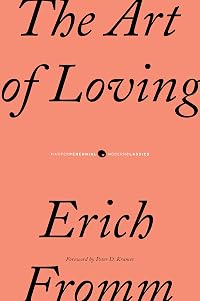
The Art of Loving by Erich Fromm
1/31/22 why I picked up this book. I was interested in reading and I had a few in my shelf.
I personally enjoyed this little book, it covers various concepts of love, (brotherly, eros, familial etc,) the drive for love, the unconditional love given by a mother, the masculine connection also the self love, Love that is developed, facilitated, sexual gratification, drug use seeking pleasure, tracing back to God, how love ought to be developed, the social aspect and developmental aspect.
I rated this at 3 out of 5 stars.
1/31/22 why I picked up this book. I was interested in reading and I had a few in my shelf.
I personally enjoyed this little book, it covers various concepts of love, (brotherly, eros, familial etc,) the drive for love, the unconditional love given by a mother, the masculine connection also the self love, Love that is developed, facilitated, sexual gratification, drug use seeking pleasure, tracing back to God, how love ought to be developed, the social aspect and developmental aspect.
I rated this at 3 out of 5 stars.
1964 edition. I lost my heart/mind to Erich Fromm's books at Stanford. dh
PSIHOLOGIJA
ed. by Ruth Nanda Anshen
Members
- Recently Added By
Lists

1964 College Preparatory Reading List
202 works; 8 members

Tom's Bookstore
346 works; 2 members

Books Cited in Blueprint by Nicholas Christakis
261 works; 1 member
Author Information

182+ Works 18,482 Members
Psychologist and philosopher Erich Fromm was born in Frankfurt, Germany on March 23, 1900. He received a Ph.D in sociology from the University of Heidelberg in 1922 and finished his psychoanalytical training at the Psychoanalytical Institute in Berlin in 1930. He started his own clinical practice and joined the Frankfurt Institute for Social show more Research. In 1934, he moved to New York and became a professor at Columbia University. In 1950, he moved to Mexico City and became a professor at the Universidad Nacional Autónoma de Mexico, where he created a psychoanalytic section at the medical school. He retired from there in 1965 and moved to Muralto, Switzerland in 1974. Throughout his life, Fromm maintained a clinical practice and wrote books. His writings were notable for both their social and political commentary and their philosophical and psychological underpinnings. He became known for linking human personality types with socioeconomic and political structures. His most popular book, The Art of Loving, was first published in 1956 and became an international bestseller. He died on March 18, 1980. (Bowker Author Biography) show less
Series
Belongs to Publisher Series
Work Relationships
Is contained in
Common Knowledge
- Canonical title*
- Är människan ond eller god?
- Original title
- Man for Himself: An Inquiry into the Psychology of Ethics
- Alternate titles
- Man for Himself
- Original publication date
- 1947
- Epigraph
- Be ye lamps unto yourselves.
Be your own reliance.
Hold to the truth within yourselves
as to the only lamp.
BUDDHA
True words always seem paradoxical but no other form of teaching can take ... (show all)its place.
Lao-Tse
Who then are the true philosophers?
Those who are lovers of the vision of truth.
PLATO
My people are destroyed by the lack of knowledge;
because thou hast rejected knowledge
I will also reject thee.
Hosea
If the way which, as I have shown, leads hither seems very difficult, it can nevertheless be found. It must indeed be difficult since it is so seldom discovered; for if salvation lay ready to hand and could be discovered without great labour, how could it be possible that it should be neglected almost by everybody? But all noble things are as difficult as they are rare.
SPINOZA - First words
- Foreword:
This book is in many respects a continuation of Escape
from Freedom, in which I attempted to analyze modern
man's escape from himself and from his freedom; in this book I discuss the problem of ethics, of ... (show all)norms and values leading to the realization of man's self and of his potentialities.
CHAPTER I: The Problem
Surely, I said, knowledge is the food of the soul; and we must take care, my friend, that the Sophist does not deceive us when he praises what he sells, like the dealers wholesale or retail w... (show all)ho sell the food of the body; for they praise indiscriminately all their goods, without knowing what are really beneficial or hurtful: neither do their customers know, with the exception of any trainer or physician who may happen to buy of them. - Last words
- (Click to show. Warning: May contain spoilers.)If I repeat now the question raised in the beginning of this book, whether we have reason to be proud and to be hopeful, the answer is again in the affirmative, but with the one qualification which follows from what we have discussed throughout: neither the good nor the evil outcome is automatic or preordained. The decision rests with man. It rests upon his ability to take himself, his life and happiness seriously; on his willingness to face his and his society's moral problem. It rests upon his courage to be himself and to be for himself.
- Original language
- English
*Some information comes from Common Knowledge in other languages. Click "Edit" for more information.
Classifications
Statistics
- Members
- 875
- Popularity
- 31,095
- Reviews
- 10
- Rating
- (4.03)
- Languages
- 15 — Catalan, Czech, Dutch, English, Finnish, German, Greek, Hungarian, Italian, Polish, Portuguese, Serbian, Spanish, Swedish, Turkish
- Media
- Paper, Audiobook, Ebook
- ISBNs
- 99
- ASINs
- 39