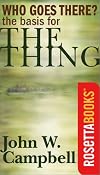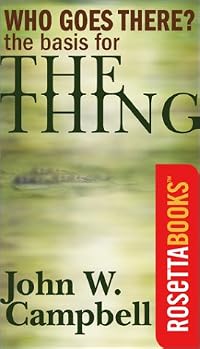
Who Goes There? - novella
by John W. Campbell Jr
On This Page
Description
Who Goes There? is the novella that formed the basis of John Carpenter's film The Thing. John W. Campbell's classic tells of an Antarctic research base that discovers and thaws the ancient, frozen body of a crash-landed alien -- with terrifying results!.Tags
Recommendations











Member Recommendations


Member Reviews
“Three mad, hate-filled eyes blazed up with a living fire, bright as fresh-spilled blood, from a face ringed with a writing, loathsome nest of worms, blue, mobile worms that crawled where hair should grow…”
- from John W. Campbell’s “Who Goes There?”
John W. Campbell’s novella “Who Goes There?” formed the foundation for the thrice-made movie “The Thing”. John Carpenter directed the 1982 film starring Kurt Russell and holds a significant place in my childhood memories as it was the first horror movie I was able to watch all they way through. It’s dark, moody and creepy, and incorporated some realistically disgusting special effects for its day and age. That version was preceded by the 1951 “The Thing From Another show more World” and followed by 2011’s “The Thing”.
The story orbits the staff of an Antarctic research station who’ve recently come across a frozen alien artifact, while the plot traces the psychologically- and culturally-based reactions to such a discovery. One doctor wants to study the creature, while others raise the significant risks if something were to go wrong: “Just because its nature is different, you haven’t any right to say it’s necessarily evil.”
Campbell’s exposition is terrific, as he crafts the landscape and weather to build a moody and desolate atmosphere as a backdrop for the story. Here are a couple of good quotes that exemplify Campbell’s skill at exposition and mood-creation:
“Right now the snow picked up by the mumbling wind fled in level, blinding lines across the face of the buried camp.”
“A sky of thin, whining wind rushing steadily from beyond to another beyond under the licking, curling mantle of the aurora. And off north, the horizon flamed with queer, angry colors of the midnight twilight.”
“Wolf-wind howling in his sleep—winds droning and the evil, unspeakable face of that monster leering up as he’d first seen it through clear, blue ice, with bronze ice-ax buried in its skull.”
The story is considered a seminal creation within the world of science fiction historians. At only about 100 pages, the story is a fun, quick and engaging read. show less
- from John W. Campbell’s “Who Goes There?”
John W. Campbell’s novella “Who Goes There?” formed the foundation for the thrice-made movie “The Thing”. John Carpenter directed the 1982 film starring Kurt Russell and holds a significant place in my childhood memories as it was the first horror movie I was able to watch all they way through. It’s dark, moody and creepy, and incorporated some realistically disgusting special effects for its day and age. That version was preceded by the 1951 “The Thing From Another show more World” and followed by 2011’s “The Thing”.
The story orbits the staff of an Antarctic research station who’ve recently come across a frozen alien artifact, while the plot traces the psychologically- and culturally-based reactions to such a discovery. One doctor wants to study the creature, while others raise the significant risks if something were to go wrong: “Just because its nature is different, you haven’t any right to say it’s necessarily evil.”
Campbell’s exposition is terrific, as he crafts the landscape and weather to build a moody and desolate atmosphere as a backdrop for the story. Here are a couple of good quotes that exemplify Campbell’s skill at exposition and mood-creation:
“Right now the snow picked up by the mumbling wind fled in level, blinding lines across the face of the buried camp.”
“A sky of thin, whining wind rushing steadily from beyond to another beyond under the licking, curling mantle of the aurora. And off north, the horizon flamed with queer, angry colors of the midnight twilight.”
“Wolf-wind howling in his sleep—winds droning and the evil, unspeakable face of that monster leering up as he’d first seen it through clear, blue ice, with bronze ice-ax buried in its skull.”
The story is considered a seminal creation within the world of science fiction historians. At only about 100 pages, the story is a fun, quick and engaging read. show less
This is a novella written by a man who was arguably the greatest editor of science fiction ever. In reading it, you have to consider both the author and the time in which it was written. This is a man who worked with short fiction, for the most part in the pulp magazines of the 1930's and up. It was a time of the "bug-eyed" monster in sci-fi. Every alien was out to destroy mankind and they were all horrendously ugly. By today's cultural standards, this book may seem archaic with most of the characters heroic macho men of great stature and strength. But at the time, that's what the reader expected, the reader being mostly teenage boys. The plot, of necessity, must move along rapidly once it gets going. It's a bullet train, not a local show more commuter. The alien is well thought out and the science behind it is at least somewhat plausible, even today. If you've seen and liked the John Carpenter movie, you'll like this book. If you have not, watch it after reading the book. You'll have a better appreciation of both. show less
I rated this tale so highly not only because of its quality as a sci-fi horror thriller but also for its influence. I wonder how many later stories of humans taken over by alien viruses or suits or pods would have existed without this story. Campbell did a fine job of making it a hard science fiction story, as fine as he could before the DNA molecule was described and genetic engineering began.
The short story from which the film The Thing was adapted. Close to what we see in the film, although with a higher body count and a far more upbeat ending. The short story appears to be more focused on the puzzle of identity that the alien creature affords than the existential horror of the dilemma itself.
This novella is the SF horror story that formed the basis for the various film versions of The Thing (from Outer Space). While it has tense moments, I think it takes too long to get to the point (despite being only 75 pages) and the long opening chapter contains a lot of scientific exposition that didn't grab me. The creature's powers are truly terrifying in their implications, but don't seem entirely consistent throughout. I also thought some of the dialogue was rather odd. Campbell, while a great SF editor, lacked the story-telling power of his most famous associate Isaac Asimov.
A short novella written in 1938, its a closed room mystery set on a research station in Antarctica. It was the basis for the 1951 movie; The Thing from Another World and John Carpenter's The Thing in 1982. That's the movie I remember from the early days of HBO, I'm sure I've seen it at least a half dozen times. As I was reading this story, I couldn't help but see Kurt Russell and Wilfred Brimley in their namesake parts. A little far fetched on the science side, but how could it not, since it was written over 80 years ago. A pretty good October read.
A Defrosted Thing
Review of the Avarang Books kindle edition (May 30, 2023) of the original novella published in Astounding Science Fiction magazine (1938).
Scientists in Antarctica defrost an alien found in a crashed spaceship from "20 million years ago" and discover that the creature is still alive and can transform itself and assume the shape of any other living thing. They seek to identify which of them is the creature in disguise, as they are picked off one by one.
I'll have to admit that I found parts of this quite confusing. I never really understood the blood test business and some of the other scenes make rather inexplicable jump cuts. Perhaps it was the fault of the cheap $1.35 Kindle public domain edition that I grabbed, rather show more than wait to source a more authoritative print version. It was still an interesting early "Alien" precursor.
See cover at https://images-na.ssl-images-amazon.com/images/S/compressed.photo.goodreads.com/...
The cover for the original extended version of "Who Goes There?" discovered and finally published as "Frozen Hell" (2019). It gives an artist's impression of the three-red-eyed monster of the novella. Image sourced from Goodreads.
Trivia and Links
Who Goes There? has been adapted for film three times as:
1. The Thing From Another World (1951) dir. Christian Nyby. You can see the trailer for it here.
2. The Thing (1982) dir. John Carpenter. You can see the trailer for it here.
3. The Thing (2011) dir. Matthijs van Heijningen Jr.. You can see the trailer for it here. show less
Review of the Avarang Books kindle edition (May 30, 2023) of the original novella published in Astounding Science Fiction magazine (1938).
Scientists in Antarctica defrost an alien found in a crashed spaceship from "20 million years ago" and discover that the creature is still alive and can transform itself and assume the shape of any other living thing. They seek to identify which of them is the creature in disguise, as they are picked off one by one.
I'll have to admit that I found parts of this quite confusing. I never really understood the blood test business and some of the other scenes make rather inexplicable jump cuts. Perhaps it was the fault of the cheap $1.35 Kindle public domain edition that I grabbed, rather show more than wait to source a more authoritative print version. It was still an interesting early "Alien" precursor.
See cover at https://images-na.ssl-images-amazon.com/images/S/compressed.photo.goodreads.com/...
The cover for the original extended version of "Who Goes There?" discovered and finally published as "Frozen Hell" (2019). It gives an artist's impression of the three-red-eyed monster of the novella. Image sourced from Goodreads.
Trivia and Links
Who Goes There? has been adapted for film three times as:
1. The Thing From Another World (1951) dir. Christian Nyby. You can see the trailer for it here.
2. The Thing (1982) dir. John Carpenter. You can see the trailer for it here.
3. The Thing (2011) dir. Matthijs van Heijningen Jr.. You can see the trailer for it here. show less
Members
- Recently Added By
Lists

501 Must-Read Books
508 works; 71 members
A Syllabus and Book List for Novice Students of Science Fiction Literature
25 works; 11 members

Books Read By artturnerjr - 2014
34 works; 1 member

Books Read in 2014
2,341 works; 86 members

Books Read in 2017
4,248 works; 129 members

Books Read in 2023
5,547 works; 145 members
Talk Discussions
Past Discussions
THE DEEP ONES: "Who Goes There?" by John W. Campbell in The Weird Tradition (March 2025)
Kickstarter for Letterpress Who Goes There? ends in 3 days in Fine Press Forum (August 2023)
Who Goes There? by John W. Campbell - ANGEL BOMB 2022 in Fine Press Forum (March 2023)
Author Information

738+ Works 9,100 Members
Some Editions
Awards and Honors
Awards
Distinctions
Series
Belongs to Publisher Series
Work Relationships
Is contained in
The Science Fiction Hall of Fame, Volume Two A: The Greatest Science Fiction Novellas of All Time by Ben Bova
The Science Fiction Hall of Fame, Volume I, IIA, IIB, the Greatest Science Fiction Novellas of All Time (Boxed Set, in Slipcase) by Robert Silverberg (indirect)
Who Goes There? The Novella That Formed the Basis of "The Thing" [novella and screen treatment] by John W. Campbell Jr
90 Masterpieces You Must Read (Vol.1): Novels, Poetry, Plays, Short Stories, Essays, Psychology & Philosophy by Various
Has the adaptation
Common Knowledge
- Canonical title
- Who Goes There? - novella
- Original title
- Who Goes There? [novella]
- Alternate titles*
- La Bête d'un autre monde
- Original publication date
- 1938-08
- People/Characters
- Commander Garry; McReady; Blair; Kinner; Dr. Cooper; Van Wall (show all 9); Connant; Barclay; Dutton
- Important places
- Antarctica; Big Magnet, Antarctica; South Polar Plateau, Antarctica
- Important events
- First contact with extraterrestrial lifeforms
- Related movies
- The Thing from Another World (1951 | IMDb); The Thing (1982 | IMDb); The Thing (2011 | IMDb)
- First words
- The place stank.
- Last words
- (Click to show. Warning: May contain spoilers.)Elles venaient d'un monde au soleil bleu.
- Original language
- English (USA) (USA)
- Disambiguation notice
- This is the standalone novella. Please do not combine with any collection of short stories of the same title.
*Some information comes from Common Knowledge in other languages. Click "Edit" for more information.
Classifications
Statistics
- Members
- 208
- Popularity
- 154,797
- Reviews
- 14
- Rating
- (3.84)
- Languages
- 6 — Chinese, English, French, German, Italian, Polish
- Media
- Paper, Audiobook, Ebook
- ISBNs
- 11
- ASINs
- 16