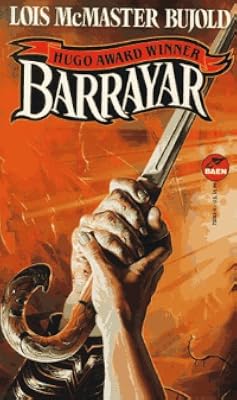
Barrayar
by Lois McMaster Bujold
Vorkosigan: Chronological Order (3), Vorkosigan: Publication Order (8)
On This Page
Description
Political intrigue, culture clash, and romance make a stirring mix in this award-winning follow-up novel to the acclaimed Shards of Honor. In the wake of interplanetary war, former commander Cordelia Naismith has deserted her own planet to marry the leader of the defeated enemy, Aral Vorkosigan. On his home planet of Barrayar, two rival factions are eyeing the recently vacated throne, and Aral, recently appointed Regent of Barrayar by the Emperor on his deathbed, must stand between them. show more Lord and Lady Vorkosigan, Aral and Cordelia struggle to establish stability in a fragile government thrown into confusion by the transition of power and the threat of civil war. When a palace coup endangers the government, their lives, and her unborn son, Cordelia takes action to secure the safety of her new family and new home. show lessTags
Recommendations










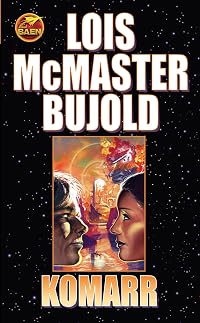





Member Recommendations
reading_fox Both character driven social SF rather than technologically focused.
20
ultimatebookwyrm Although Barrayar is a sci-fi and Darkborn is fantasy, both have great characters, a fast-moving plot, mystery, suspense, action, and phenomenal world-building. Plus a kick-ass Mom who will stop at nothing to retrieve her child.
Member Reviews
My fourth Vorkosigan novel (third in chronological sequence, eighth in publication order) picks up right from the end of the previous one, Shards of Honor. Indeed, Bujold's very interesting afterword to the NESFA edition discusses how originally Shards was going to be longer but she realized she was introducing new complications instead of wrapping up existing ones, so she went backward and found a spot where it could stop, orphaning several thousand words that she'd written. It was another five years or so before she went back to that orphaned material and realized it could form the beginning of a second novel about Cordelia, one about—as the title is very clear about—her new life on the planet Barrayar.
I had actually read Shards show more and Barrayar before; over a decade ago my friend loaned me an omnibus edition of the two. Rereading the review I wrote at the time, it's almost hilariously lukewarm:
The other really interesting tidbit the afterword brought into focus for me was that this was a book about parenting. I just don't think I saw that at age 24, and even if I had, it would not have resonated the way it does as a 38-year-old father of two. Most of Cordelia's emotions and decisions are driven by the fact that she's a parent. This is obviously the case when it comes to Miles, but it's true almost everywhere in the book: the way she thinks about the boy emperor, Gregor, for example, or her ability to figure out what the emperor's mother Kareena is thinking. I definitely liked the book before, but this time through I felt it, there was a real intensity to it. The book is filled with great moments, some of them funny, some of them grim, all of them thoughtful and considered. I won't list them here, but if you've read it, you'll easily bring a number of them to mind.
Science fiction can sometime feel like a young person's game: youthful people doing epic stuff like fighting empires. But Barrayar is science fiction for the middle aged. Yes, there are evil empires, but it's about the struggle to be a good parent in all its myriad forms, the right you keep up every day, not always because you want to, but because you won't be yourself if you give up.
I know there are more Cordelia-focused novels in the saga's "main" sequence, but it's a shame there aren't more of these books about her younger days on Barrayar, because in some ways she's an even more interesting protagonist than Miles. show less
I had actually read Shards show more and Barrayar before; over a decade ago my friend loaned me an omnibus edition of the two. Rereading the review I wrote at the time, it's almost hilariously lukewarm:
It has some adventure narrative tropes I find uncomfortable (the "other" being simultaneously more dangerous and more interesting than the home society), some slightly strange gender politics (the woman must give up her society utterly for the man she loves, who never seriously considers it), and some stuff that's just plain weird (everyone reveres one character who is a rapist), but overall I enjoyed it. It gets off to a rough start, to be honest-- there's a lot of journeying through a dangerous landscape, which I find tedious, and our protagonist Cordelia has a tendency to be rescued by other people a lot. But at the one-third mark, she finally starts making her own decisions, fleeing her home planet in a fantastic sequence, and then traveling to Barrayar, where she marries Aral Vorkosigan and is forced to navigate her way in a strange society. At this point, I was completely absorbed, and I loved all the political maneuvering and civil war stuff, and Cordelia herself shone quite well.On this read, it was pretty obvious to me that the books are interrogating the things I found uncomfortable, and I'm not sure why I didn't know that the first time; these books are all about that contact between cultures and danger of being fascinated by the "other"; the gender politics of Barrayar are continuously scrutinized. And when on Earth was Cordelia ever a victim who needed to be rescued!? What I do think is fair is that I clearly liked Barrayar more than Shards. While Shards is good, I definitely think Bujold got better as a novelist in the interim; Shards is like three linked novellas while Barrayar has a unity of plot and, especially, theme.
The other really interesting tidbit the afterword brought into focus for me was that this was a book about parenting. I just don't think I saw that at age 24, and even if I had, it would not have resonated the way it does as a 38-year-old father of two. Most of Cordelia's emotions and decisions are driven by the fact that she's a parent. This is obviously the case when it comes to Miles, but it's true almost everywhere in the book: the way she thinks about the boy emperor, Gregor, for example, or her ability to figure out what the emperor's mother Kareena is thinking. I definitely liked the book before, but this time through I felt it, there was a real intensity to it. The book is filled with great moments, some of them funny, some of them grim, all of them thoughtful and considered. I won't list them here, but if you've read it, you'll easily bring a number of them to mind.
Science fiction can sometime feel like a young person's game: youthful people doing epic stuff like fighting empires. But Barrayar is science fiction for the middle aged. Yes, there are evil empires, but it's about the struggle to be a good parent in all its myriad forms, the right you keep up every day, not always because you want to, but because you won't be yourself if you give up.
I know there are more Cordelia-focused novels in the saga's "main" sequence, but it's a shame there aren't more of these books about her younger days on Barrayar, because in some ways she's an even more interesting protagonist than Miles. show less
A lot of people think that Barrayar is the superior of the two books chronicling the adventures of Aral and Cordelia Vorkosigan (the other, and first, being Shards of Honor - the two book should not be read out of order). And Barrayar is really good. But it includes a lot of plot elements that do not appeal to me personally, and regardless of the book's objective quality made it less fun for me to read.
For example: I have a really strong, totally irrational phobia about pregnancy. I'd explain but nobody wants to hear about all the ways that fetuses remind me of parasites. Cordelia spends most of this book pregnant, defending her baby's right to live, and just generally being a mama bear. It's well done but...not my thing.
And also: I get show more really grumpy when a character like Cordelia, who's introduced as this pants-wearing, career-first badass, shows up in a second book married, playing second fiddle the husband, and wearing skirts all the time. Admittedly, Cordelia's not a warrior. And in Shards of Honor she spent a fair amount of time as a prisoner of war - not exactly a position of strength, though Cordelia seems to do best when she's got her back up against the wall. But she and Aral were united by their professionalism, their dedication to the highest ideals of their careers.
In Barrayar, she's a sort of sci-fi First Lady and she's restricted, mostly, to the activities of a Barrayaran female. She buys presents, socializes with other powerful women, and gestates. And, yes, that's called assimilation and exactly what she ought to be doing, and yes, she does have a few opportunities to break out the badass, but...I'm just not as riveted by the life of a political wife as I was by the adventures of a scientist spaceship captain.
That being said - the book is deeper and more complex than Shards of Honor. In Barrayar Aral and Cordelia no longer have to worry about obeying orders - Aral is the highest authority. Instead, he and Cordelia falter under the weight of responsibility, and let guilt weaken them. They aren't separated by loyalty to country; they're married, and settled on Barrayar. This time around, Aral's responsibilities take up almost all his time and the hard choices he makes reduce him to a shadow of his former self, while Cordelia's fierce protectiveness of her baby puts her at odds with Aral's family and, in fact, the entire nobility of Barrayar.
If Shards of Honor ultimately led to one horrible decision that nearly broke Aral, Barrayar is the Chinese water torture version, the slow erosion of character version, as messy as Shards was clear.
It's still highly quotable - "You should have fallen in love with a happy man, if you wanted happiness. But no, you had to fall for the breathtaking beauty of pain", for example, or "Cordelia's own soul felt like an exhausted snail, shelled in a glassy numbness." And it's still about good people struggling to do the right thing in a world that smashes everything right and good about a person to a million tiny pieces. In a way, it's the Aaron Sorkin version of sci-fi, with these heroic characters who lead you through the most gruesome situations.
Really, if you read Shards of Honor you'll know whether or not you want to continue with the series. I did, and I think I'll be moving on to read at least a little about Miles Vorkosigan, Aral and Cordelia's son. show less
For example: I have a really strong, totally irrational phobia about pregnancy. I'd explain but nobody wants to hear about all the ways that fetuses remind me of parasites. Cordelia spends most of this book pregnant, defending her baby's right to live, and just generally being a mama bear. It's well done but...not my thing.
And also: I get show more really grumpy when a character like Cordelia, who's introduced as this pants-wearing, career-first badass, shows up in a second book married, playing second fiddle the husband, and wearing skirts all the time. Admittedly, Cordelia's not a warrior. And in Shards of Honor she spent a fair amount of time as a prisoner of war - not exactly a position of strength, though Cordelia seems to do best when she's got her back up against the wall. But she and Aral were united by their professionalism, their dedication to the highest ideals of their careers.
In Barrayar, she's a sort of sci-fi First Lady and she's restricted, mostly, to the activities of a Barrayaran female. She buys presents, socializes with other powerful women, and gestates. And, yes, that's called assimilation and exactly what she ought to be doing, and yes, she does have a few opportunities to break out the badass, but...I'm just not as riveted by the life of a political wife as I was by the adventures of a scientist spaceship captain.
That being said - the book is deeper and more complex than Shards of Honor. In Barrayar Aral and Cordelia no longer have to worry about obeying orders - Aral is the highest authority. Instead, he and Cordelia falter under the weight of responsibility, and let guilt weaken them. They aren't separated by loyalty to country; they're married, and settled on Barrayar. This time around, Aral's responsibilities take up almost all his time and the hard choices he makes reduce him to a shadow of his former self, while Cordelia's fierce protectiveness of her baby puts her at odds with Aral's family and, in fact, the entire nobility of Barrayar.
If Shards of Honor ultimately led to one horrible decision that nearly broke Aral, Barrayar is the Chinese water torture version, the slow erosion of character version, as messy as Shards was clear.
It's still highly quotable - "You should have fallen in love with a happy man, if you wanted happiness. But no, you had to fall for the breathtaking beauty of pain", for example, or "Cordelia's own soul felt like an exhausted snail, shelled in a glassy numbness." And it's still about good people struggling to do the right thing in a world that smashes everything right and good about a person to a million tiny pieces. In a way, it's the Aaron Sorkin version of sci-fi, with these heroic characters who lead you through the most gruesome situations.
Really, if you read Shards of Honor you'll know whether or not you want to continue with the series. I did, and I think I'll be moving on to read at least a little about Miles Vorkosigan, Aral and Cordelia's son. show less
Barrayar picks up right after Shards of Honor, in much the same way that a JATO-powered VW bug picks up after a horsedrawn wagon. Cordelia has one a few months to enjoy her marriage before Aral Vorkosigan becomes Regent of Barrrayar and she's thrust back into the fatal whirl of Barrayaran politics. Aral has to hold the planet together for 15 years, until Prince Gregor comes of age, and Cordelia has to hold Aral together. Meanwhile, she's dealing with medieval culture shock, the confused love-lives of her favorite staffers, and Sergeant Bothari's brittle sanity.
The action kicks off almost immediately with a Soltoxin gas assassination attempt that she and Aral survive by the thinnest of margins, but which grievously maims her unborn show more child. Immediately after, Lord Vondarian launches a military coup against the Vorkosigans, and Cordelia has to flee to the hills with the Child-Emperor until Aral can organize the resistance. And even though this book is over 20 years old, I hesitate to spoil the final third, which has some of the best raiding and most satisfying comeuppances I've read.
I said in my review of Shards of Honor that I didn't buy Cordelia as a lover, but I absolutely believe in her here as a fiercely protective wife and mother, as a clever and capable leader, and above all, as a fount of honor. Barrayar won the Hugo, and is everything that a great sci-fi novel should be.
*****
Updated from August 2014, for the Hugo read-through project.
In the final third, Cordelia takes her personal retainers into the palace on a desperate raid to end the rebellion before the embryonic Miles' uterine replicator tank fails. This is some of the most intense, heart-stopping action that I've encountered, because the personal and political stakes are so high. In the end, Cordelia confronts Vondarian and has Bothari kill him with a sword in the burning palace. It's an incredible moment, one where a very capable person takes a step into the realm of mythic archetypes. It makes me wonder a little bit about what Miles was told growing up. "Yeah, mom and Bothari killed a crown prince and a man who wanted be emperor."
As always, Bujold's talents are in characterization, and there are three major focuses here. Cordelia herself and her journey into motherhood, feels a little like one of those author-insert moments, but I don't mind because Bujold has some genuine humanistic wisdom to share about the responsibility of bringing life into the world. In a lot of ways, Cordelia is what Jubal Harshaw from Stranger in a Strange Land wishes he could be. The second are Kou and Drou, respectively one of Aral's officers maimed by disruptor fire and now trying to rebuild his life in a world that hates cripples, and the Crown Princess's bodyguard, a female commando officer from a society where war is a strictly masculine pursuit. The awkward young-adult romance is both cringe-worthy, and a lot more fun from the outside. Finally, there's Bothari. The psychopathic killer, war criminal and rapist, and mind-wiped for his sins. A man with barely any personality of his own, Bothari becomes what those around him need him to be, and Cordelia needs a hero. It's an interesting look at the kind of limited redemption a monster can achieve. show less
The action kicks off almost immediately with a Soltoxin gas assassination attempt that she and Aral survive by the thinnest of margins, but which grievously maims her unborn show more child. Immediately after, Lord Vondarian launches a military coup against the Vorkosigans, and Cordelia has to flee to the hills with the Child-Emperor until Aral can organize the resistance. And even though this book is over 20 years old, I hesitate to spoil the final third, which has some of the best raiding and most satisfying comeuppances I've read.
I said in my review of Shards of Honor that I didn't buy Cordelia as a lover, but I absolutely believe in her here as a fiercely protective wife and mother, as a clever and capable leader, and above all, as a fount of honor. Barrayar won the Hugo, and is everything that a great sci-fi novel should be.
*****
Updated from August 2014, for the Hugo read-through project.
In the final third, Cordelia takes her personal retainers into the palace on a desperate raid to end the rebellion before the embryonic Miles' uterine replicator tank fails. This is some of the most intense, heart-stopping action that I've encountered, because the personal and political stakes are so high. In the end, Cordelia confronts Vondarian and has Bothari kill him with a sword in the burning palace. It's an incredible moment, one where a very capable person takes a step into the realm of mythic archetypes. It makes me wonder a little bit about what Miles was told growing up. "Yeah, mom and Bothari killed a crown prince and a man who wanted be emperor."
As always, Bujold's talents are in characterization, and there are three major focuses here. Cordelia herself and her journey into motherhood, feels a little like one of those author-insert moments, but I don't mind because Bujold has some genuine humanistic wisdom to share about the responsibility of bringing life into the world. In a lot of ways, Cordelia is what Jubal Harshaw from Stranger in a Strange Land wishes he could be. The second are Kou and Drou, respectively one of Aral's officers maimed by disruptor fire and now trying to rebuild his life in a world that hates cripples, and the Crown Princess's bodyguard, a female commando officer from a society where war is a strictly masculine pursuit. The awkward young-adult romance is both cringe-worthy, and a lot more fun from the outside. Finally, there's Bothari. The psychopathic killer, war criminal and rapist, and mind-wiped for his sins. A man with barely any personality of his own, Bothari becomes what those around him need him to be, and Cordelia needs a hero. It's an interesting look at the kind of limited redemption a monster can achieve. show less
Barrayar
This continues the story of Cordelia, now married to Vorkosigan and living on Barrayar, how the couple are unwillingly caught up in the politics of Barrayar and the tumultous events surrounding the birth of their son Miles, who is the protagonist of the continuing books in the Vorkosigan saga.
Shards of Honour ended with Cordelia on Barryar and Aral retired (not really 'spoiler'; with a whole series ahead, you must have seen that coming).
That retirement is about to end as he takes up the Regency on behalf of 5 year old Emperor Gregor, and Cordelia finds herself not just having to get used to the life of a Vor lady on Barrayar (a far cry from proletarian Beta Colony), but to that of the wife of the Regent. And not just as the show more wife of a Regent, but the wife of an honourable Regent besieged on all sides by threats both physical and political, by causes both frivolous and lethally serious.
As a battle-seasoned Vor lord, Aral handles the empire while Cordelia deals with her pregnancy the old-fashioned Barrayaran way, which involves natural gestation and natural childbirth; barbaric, to her Betan mind, when it can all be done s-fely in vitro.
The two situations collide terrifyingly when the backlash from an attack on Aral affects Cordelia and Miles too and results in many of Miles's future physical liabilities - which form the starting point to other stories in the series.
And while the couple are still dealing with the aftermath and the effects on their baby, the Barrayaran political infighting erupts, with the planets of the Imperium as the prize ...
I love the way this book is written; partly the interaction of the characters, partly the action - when Cordelia gets to utilise her training and skills again - partly the trademark humour woven through the narrative. I like the way so many secondary characters (Droushnakovi for instance) are allowed to develop. Not to mention Bothari's assignation as Miles's bodyguard from the moment of his 'birth', which is significant to Miles's future - but that's another story.
And, oh! Sergeant Bothari. I'm pretty sure that if I came across such a character in real life I would be, at the very least, cautious around them. But Bujold, through Cordelia and even Aral, lets us see that even such a spiritually and mentally scarred creature has his own honour. He seems to be a favourite character of readers of the series; he's certainly one of mine.
The book is full of action, adventure and planetary politics. It also highlights the way families, children and unborn babies can be hostages to fate as they get caught up in a political coup. Although there are tragedies, McMaster Bujold's writing also displays the humour that makes the Miles books more lighthearted.
Beautifully crafted and well paced. A lot of action. A lot of tension. A lot of fun. This is my favourite book of one of my favourite series.
A very well written book - recommended. Read it! show less
This continues the story of Cordelia, now married to Vorkosigan and living on Barrayar, how the couple are unwillingly caught up in the politics of Barrayar and the tumultous events surrounding the birth of their son Miles, who is the protagonist of the continuing books in the Vorkosigan saga.
Shards of Honour ended with Cordelia on Barryar and Aral retired (not really 'spoiler'; with a whole series ahead, you must have seen that coming).
That retirement is about to end as he takes up the Regency on behalf of 5 year old Emperor Gregor, and Cordelia finds herself not just having to get used to the life of a Vor lady on Barrayar (a far cry from proletarian Beta Colony), but to that of the wife of the Regent. And not just as the show more wife of a Regent, but the wife of an honourable Regent besieged on all sides by threats both physical and political, by causes both frivolous and lethally serious.
As a battle-seasoned Vor lord, Aral handles the empire while Cordelia deals with her pregnancy the old-fashioned Barrayaran way, which involves natural gestation and natural childbirth; barbaric, to her Betan mind, when it can all be done s-fely in vitro.
The two situations collide terrifyingly when the backlash from an attack on Aral affects Cordelia and Miles too and results in many of Miles's future physical liabilities - which form the starting point to other stories in the series.
And while the couple are still dealing with the aftermath and the effects on their baby, the Barrayaran political infighting erupts, with the planets of the Imperium as the prize ...
I love the way this book is written; partly the interaction of the characters, partly the action - when Cordelia gets to utilise her training and skills again - partly the trademark humour woven through the narrative. I like the way so many secondary characters (Droushnakovi for instance) are allowed to develop. Not to mention Bothari's assignation as Miles's bodyguard from the moment of his 'birth', which is significant to Miles's future - but that's another story.
And, oh! Sergeant Bothari. I'm pretty sure that if I came across such a character in real life I would be, at the very least, cautious around them. But Bujold, through Cordelia and even Aral, lets us see that even such a spiritually and mentally scarred creature has his own honour. He seems to be a favourite character of readers of the series; he's certainly one of mine.
Well, if she wanted to look dainty, all she had to do was stand next to Sergeant Bothari. He loomed mournfully beside her, all two metres of him. Cordelia considered herself a tall woman, but the top of her head was only level with his shoulder. He had a gargoyle's face, closed, wary, beak-nosed, its lumpiness exaggerated to criminality by his military-burr haircut. Even Count Vorkosigan's elegant livery, dark brown with the symbols of the house embroidered in silver, failed to save Bothari from his astonishing ugliness.
The book is full of action, adventure and planetary politics. It also highlights the way families, children and unborn babies can be hostages to fate as they get caught up in a political coup. Although there are tragedies, McMaster Bujold's writing also displays the humour that makes the Miles books more lighthearted.
Beautifully crafted and well paced. A lot of action. A lot of tension. A lot of fun. This is my favourite book of one of my favourite series.
A very well written book - recommended. Read it! show less
I love this book. I love Cordelia and the way she trips through a new world with different customs. I love the way she's judged and changes things around her when she doesn't really look (or necessarily) understand the broader implications, because she sees something that needs to be done and she does it. I love that she and Aral are not perfect, gorgeous, automatic heroes. And I pretty much love all of the rest of the characters. The plot is fast and crisp, Bujold doesn't waste any time or words. This book is super fun.
After Aral Vorkosigan is named regent for the child emperor of Barrayar, his wife knows they're due for a period of turbulent planetary politics. But Cordelia doesn't anticipate the effects of an assassination attempt on her unborn son -- but then, her enemies don't anticipate Cordelia's nerve and desperation.
Barrayar, the sequel to the quite-good Shards of Honor, is terrific, and Bujold successfully balances the light, snappy comedy with all the angst and death of a military culture struggling against itself. I especially liked Bujold's handling of cliches: they're never part of the straight narrative voice, but they're both ubiquitous and self-consciously mocked in Cordelia's internal monologue. Which, aside from cohering to show more Cordelia's characterization as fast-thinking and self-deprecating, makes perfect sense: cliches are the common currency of our first, unedited thoughts. show less
Barrayar, the sequel to the quite-good Shards of Honor, is terrific, and Bujold successfully balances the light, snappy comedy with all the angst and death of a military culture struggling against itself. I especially liked Bujold's handling of cliches: they're never part of the straight narrative voice, but they're both ubiquitous and self-consciously mocked in Cordelia's internal monologue. Which, aside from cohering to show more Cordelia's characterization as fast-thinking and self-deprecating, makes perfect sense: cliches are the common currency of our first, unedited thoughts. show less
Another unputdownable novel. The thing I really liked about it was that it takes pregnancy and childbirth and biology seriously, unlike many other novels. The clash of Betan and Barrayaran culture continues, as Cordelia observes the patriarchal culture of Barrayar with increasing bafflement. One illustration of the difference is the Betan approach to sex workers, mentioned in passing: very civilized (they all have degrees in psychotherapy and a license from the government).
I liked the unfolding interaction between Drou and Kou, as well — a great illustration of the malfunctioning of patriarchal culture. The relationship between Cordelia and Aral is great too; realistic and very touching.
The plot is fast paced and has many unexpected show more twists and turns. I would like to read it again slowly to pick up on all the nuances. show less
I liked the unfolding interaction between Drou and Kou, as well — a great illustration of the malfunctioning of patriarchal culture. The relationship between Cordelia and Aral is great too; realistic and very touching.
The plot is fast paced and has many unexpected show more twists and turns. I would like to read it again slowly to pick up on all the nuances. show less
Members
- Recently Added By
Lists

Favorite Science Fiction by Women Authors
737 works; 202 members

Hugo Award Winning Novels
63 works; 23 members

Best Science Fiction Novels
816 works; 426 members

NPRs your picks: top 100 Sci-Fi/Fantasy books
297 works; 80 members

Hugo Awards - Best Novel
69 works; 10 members
Broderick and Di Filippo's Science Fiction: The 101 Best Novels 1985-2010
103 works; 7 members

Recommend the 20 best books you've read in the last five years
2,168 works; 606 members

Female Protagonist
1,056 works; 57 members

Best Feminist Science Fiction
188 works; 35 members
Locus Award for Best Novel/SF Novel
53 works; 6 members

Best SciFi and Fantasy Classics
53 works; 6 members

What Makes This Book So Great
102 works; 16 members

Top Five Books of 2018
802 works; 265 members

Books Read in 2013
1,630 works; 51 members

Books Read in 2016
4,666 works; 199 members

Blue Pyramid 1,276 Best Books of All Time
1,248 works; 32 members

Books Read in 2021
5,361 works; 114 members

Books Read in 2023
5,638 works; 145 members

Top Five Books of 2023
767 works; 317 members

Books Read in 2012
816 works; 34 members
Book Worlds We'd Like To Visit
322 works; 158 members

Books Read in 2025
4,128 works; 98 members

The Five Books That Represent Us
391 works; 148 members
Talk Discussions
Past Discussions
Vorkosigan Group Read: Cordelia's Honor in 2014 Category Challenge (January 2015)
Author Information

103+ Works 85,941 Members
Science fiction and fantasy author Lois McMaster Bujold was born in Columbus, Ohio in 1949. After graduating from Ohio State University, she worked as a pharmacy technician at Ohio State University Hospitals. Her first short story was published in Twilight Zone Magazine in 1984 and her first three novels were published in 1986. She received the show more Nebula Award for Falling Free and The Mountains of Mourning and the Hugo Award for The Vor Game, Barrayar, Mirror Dance, The Mountains of Mourning, and Paladin of Souls. She also received the Locus award for Mirror Dance and Paladin of Souls, the Minnesota Book Award for Komarr, the Mythopoeic Award for The Curse of Chalion, and a Romantic Times 2003 Reviewers' Choice Award for Paladin of Souls. She is best known for her series featuring Miles Vorkosigan. She currently lives in Minneapolis, Minnesota. (Bowker Author Biography) show less
Some Editions
Awards and Honors
Awards
Notable Lists
Series


Belongs to Publisher Series
Work Relationships
Common Knowledge
- Canonical title
- Barrayar
- Original title
- Barrayar
- Original publication date
- 1991-10
- People/Characters
- Aral Vorkosigan; Cordelia Naismith Vorkosigan; Piotr Vorkosigan; Sergeant Konstantine Bothari; Kareen Vorbarra; Gregor Vorbarra (show all 21); Simon Illyan; Captain Negri; Vidal Vordarian; Evon Vorhalas; Carl Vorhalas; Ludmilla Droushnakovi; Clement Koudelka; Padma Vorpatril; Alys Vorpatril; Esterhazy; Captain Vaagen; Miles Vorkosigan; Elena Bothari-Jesek (as Elena Bothari); Ivan Vorpatril; Amor Klyeuvi
- Important places
- Barrayar
- Dedication
- For Anne and Paul
- First words
- I am afraid. Cordelia's hand pushed aside the drape in the third floor parlour window of Vorkosigan House.
- Last words
- (Click to show. Warning: May contain spoilers.)Aral gripped her hand as they turned to go up the hill. "I believe he'll soar high, dear Captain."
- Blurbers
- Helfer, Melinda; Alden, John R.
- Original language
- English US
Classifications
Statistics
- Members
- 2,885
- Popularity
- 6,260
- Reviews
- 92
- Rating
- (4.18)
- Languages
- 12 — Czech, Dutch, English, Estonian, French, German, Hungarian, Italian, Polish, Romanian, Russian, Spanish
- Media
- Paper, Audiobook, Ebook
- ISBNs
- 41
- UPCs
- 1
- ASINs
- 19