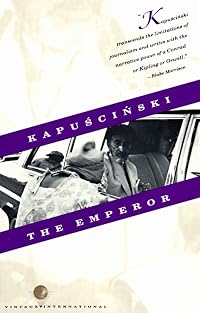
The Emperor: Downfall of an Autocrat
by Ryszard Kapuściński
On This Page
Description
This account of the rise and fall of Ethiopian emperor Haile Selassie is "an unforgettable, fiercely comic, and finally compassionate book" (Salman Rushdie, Man Booker Prize-winning author). After Haile Selassie was deposed in 1974, Ryszard Kapu?ci?ski-Poland's top foreign correspondent-went to Ethiopia to piece together a firsthand account of how the emperor governed his country, and why he finally fell from power. At great risk to himself, Kapu?ci?ski interviewed members of the imperial show more circle who had gone into hiding. The result is this remarkable book, in which Selassie's servants and closest associates share accounts-humorous, frightening, sad, grotesque-of a man living amidst nearly unimaginable pomp and luxury while his people teetered between hunger and starvation. It is a classic portrait of authoritarianism, and a fascinating story of a forty-four-year reign that ended with a coup d'e tat in 1974. show lessTags
Recommendations
















Member Reviews
Great insight into Heile Selassie's realm through the collection of oral histories of surviving members of his personal court. It has a more universal meaning as well about how regimes maintain the acquiscence of the people. As one former servant recounts "a singular misfortune happened to me, my son began to think... and in those days thinking was a painful inconvenience and a troubling deformity". Similarly, it recounts the importance of keeping people permanently hungry on a day to day basis, literally and figuratively, so that they never have time to consider the wider structures and inequalities that oppress them. The servants truly believed in Selassie and his project, throughout human history such figures have dominated as gods show more on earth. show less
What a book, this is an incredible record of a lost court, interviewing many of the remaining courtiers to Haile Sellasie in Ethiopia. The idea this really medieval style court existed until the 1970s is incredible - nothing is written down, backstabbing is rife, and they turn a blind eye to the poverty outside the court walls. Its incredibly interesting and immediate, and the descriptions of the rituals and strange court positions are fascinating.
This is the first book by Polish foreign correspondent Kapuściński of what would have been a trilogy of works about absolute power (Shah of Shahs was published in the 1980s; the third book about Idi Amin is unfinished).
The Emperor recounts a series of interviews Kapuściński conducted with members of Haile Selassie's Ethiopian court after its fall in 1974, interspersed with some observations from Kapuściński. It provides a fascinating insight not only into the absurdities of the regime and the amazing levels of manipulation and misinformation that were required to keep it going, but also into the approaching downfall of the monarchy and the reaction/inaction of the emperor and his courtiers.
I particularly enjoyed the details of the show more Emperor's daily routine - the early morning walks when ministers submitted reports to Selaisse while he fed his lions; the Hour of Assignments when he gave out promotions, prizes and demotions; the Hour of the Cashbox during which subjects would line up to put their case for money to the emperor.
The cult of personality that reigned is also really interesting. The courtiers interviewed continued to call Selaisse 'His Merciful Highness', 'His Benevolent Majesty', 'His August Majesty' and many other extravagant titles after his downfall. The country's constitution stated that the emperor was a direct descendant of Solomon. There is a strong sense from those interviewed of shock that anyone could challenge the authority of a man who tried so hard to help his country.
While this is a work of non-fiction, the extreme and ridiculous aspects of the regime mean that the story of Selaisse's court often reads like a satire of absolute rule. show less
The Emperor recounts a series of interviews Kapuściński conducted with members of Haile Selassie's Ethiopian court after its fall in 1974, interspersed with some observations from Kapuściński. It provides a fascinating insight not only into the absurdities of the regime and the amazing levels of manipulation and misinformation that were required to keep it going, but also into the approaching downfall of the monarchy and the reaction/inaction of the emperor and his courtiers.
I particularly enjoyed the details of the show more Emperor's daily routine - the early morning walks when ministers submitted reports to Selaisse while he fed his lions; the Hour of Assignments when he gave out promotions, prizes and demotions; the Hour of the Cashbox during which subjects would line up to put their case for money to the emperor.
The cult of personality that reigned is also really interesting. The courtiers interviewed continued to call Selaisse 'His Merciful Highness', 'His Benevolent Majesty', 'His August Majesty' and many other extravagant titles after his downfall. The country's constitution stated that the emperor was a direct descendant of Solomon. There is a strong sense from those interviewed of shock that anyone could challenge the authority of a man who tried so hard to help his country.
While this is a work of non-fiction, the extreme and ridiculous aspects of the regime mean that the story of Selaisse's court often reads like a satire of absolute rule. show less
Haile Selassie, the emperor of Ethiopia for more than 40 years, was overthrown by the army in 1974. Ryszard Kapuściński, a Polish journalist, was there, and he wrote about it. It became a book titled Cesarz (The Emperor).
The story is presented as an oral history, in the words of Ethiopians who agreed to speak to the foreign journalist, but were anxious not to be identified:
They caution me again, needlessly: no addresses, no names, don’t say that he’s tall, that he’s short, that he’s skinny, that his forehead this or his hands that. Or that his eyes, or that his legs, or that his knees . . . There’s nobody left to get down on your knees for.
This English translation was published in 1983, after Solidarity had become a show more household word and Poland was actually holding the attention of the U.S. news media. This book even made it into the pages of Time and Newsweek, where reviewers insisted that the author wasn’t just writing about Haile Selassie; he was really taking a subtle swipe at Communism.
Those remarks seemed absurd to me at the time, typical Cold War point scoring. Since then, I've become convinced that Kapuściński probably did have two regimes in mind at once, Ethiopia's and Poland's. The book is not journalism. It's more of a composite portrait of absolute rule. show less
The story is presented as an oral history, in the words of Ethiopians who agreed to speak to the foreign journalist, but were anxious not to be identified:
They caution me again, needlessly: no addresses, no names, don’t say that he’s tall, that he’s short, that he’s skinny, that his forehead this or his hands that. Or that his eyes, or that his legs, or that his knees . . . There’s nobody left to get down on your knees for.
This English translation was published in 1983, after Solidarity had become a show more household word and Poland was actually holding the attention of the U.S. news media. This book even made it into the pages of Time and Newsweek, where reviewers insisted that the author wasn’t just writing about Haile Selassie; he was really taking a subtle swipe at Communism.
Those remarks seemed absurd to me at the time, typical Cold War point scoring. Since then, I've become convinced that Kapuściński probably did have two regimes in mind at once, Ethiopia's and Poland's. The book is not journalism. It's more of a composite portrait of absolute rule. show less
This is a remarkable book. The Emperor is nonfiction, and is an attempt to describe the reign and fall of Ethiopea's last emperor, Haile Selassie, dethroned in 1974. To capture life in the Imperial realm, Kapuschinski interviewed dozens of palace workers from the doorman up to the various ministers, at least those that remained alive after the military coup.
It is difficult to describe this book. The voices of those interviewed treat the Emperor with great reverence. He is the divinely chosen leader. He can do no wrong. When he sets his ministers against one another in intense palace intrigue, it is only right. The imperial machinery is also at work in unexpected ways. Of course, when the Emperor visits other parts of the country, they show more must erect buildings, clothe the poor, instruct them on how to address the Emperor. And the greed of the poor is incomprehensible to these men. They swarm around the car when the Emperor throws alms to them. Invariably they have to be beaten back by the police.
It is strange to read these descriptions, and then it gets worse. The people starving, the granaries full. State money is spent on building airports and major structures. Why spend it on something as ephemoral as feeding the famished? People die every year from hunger. It is natural, not a cause for alarm. ... and all this while hundreds of thousands die of starvation.
The brilliance of this book is that it allows you to enter for a moment into the minds of the corrupt, to see their (il)logic, and to wonder how you can ever change such things. When Selassie was deposed he had somewhere between hundreds of millions and a few billion dollars sequestered in a Swiss Bank account. And yet with so much going wrong still people thought, "What will we do without the Emperor. All appointments, all promotions, all decisions come from him."
It's a bizarre world, and a bit of history I knew nothing about. Merely a snapshot really, and yet telling. It makes me want to learn more about countries with great inequalities. It makes me wonder just how far people wait before a revolution. I mean, hundreds of thousands starving? We started a revolution because we didn't want to have taxes raised after the British beat back the Indians for us! As one of the interviewees said, it's not those who have nothing you have to worry about. They have not the time for anything but bare survival. It's those who have a bit, just enough to whet the appetite, that you have to worry about. What a strange strange world. show less
It is difficult to describe this book. The voices of those interviewed treat the Emperor with great reverence. He is the divinely chosen leader. He can do no wrong. When he sets his ministers against one another in intense palace intrigue, it is only right. The imperial machinery is also at work in unexpected ways. Of course, when the Emperor visits other parts of the country, they show more must erect buildings, clothe the poor, instruct them on how to address the Emperor. And the greed of the poor is incomprehensible to these men. They swarm around the car when the Emperor throws alms to them. Invariably they have to be beaten back by the police.
It is strange to read these descriptions, and then it gets worse. The people starving, the granaries full. State money is spent on building airports and major structures. Why spend it on something as ephemoral as feeding the famished? People die every year from hunger. It is natural, not a cause for alarm. ... and all this while hundreds of thousands die of starvation.
The brilliance of this book is that it allows you to enter for a moment into the minds of the corrupt, to see their (il)logic, and to wonder how you can ever change such things. When Selassie was deposed he had somewhere between hundreds of millions and a few billion dollars sequestered in a Swiss Bank account. And yet with so much going wrong still people thought, "What will we do without the Emperor. All appointments, all promotions, all decisions come from him."
It's a bizarre world, and a bit of history I knew nothing about. Merely a snapshot really, and yet telling. It makes me want to learn more about countries with great inequalities. It makes me wonder just how far people wait before a revolution. I mean, hundreds of thousands starving? We started a revolution because we didn't want to have taxes raised after the British beat back the Indians for us! As one of the interviewees said, it's not those who have nothing you have to worry about. They have not the time for anything but bare survival. It's those who have a bit, just enough to whet the appetite, that you have to worry about. What a strange strange world. show less
«Nadie, lo que se dice nadie, amigo mío, presentía que se acercaba el fin. Aunque tal vez se detectaba que algo flotaba en el ambiente, tal vez algo nos rondara por la cabeza, pero era tan vago, tan confuso que no se podía hablar del presentimiento de algo extraordinario. Y, sin embargo, hacía ya tiempo que el mayordomo deambulaba por palacio apagando un cada vez mayor número de luces, sólo que nuestra vista se fue acostumbrando a ese paulatino apagamiento, y se producía en nosotros un confortable estado de resignación interior ante el hecho de que por lo visto-no visto todo debía ser así: apagado, eclipsado y sumido en la penumbra, en unas sombras tenebrosas y en una nebulosa oscuridad».
Part of Kapuscinski's brillant trilogy on absolute power, The Emperor provides a personal glimpse into the undoing of the strange world of Hallie Selassie. After you read this book you want to stop all the hipsters in their Hallie Selassie t-shirts and question their attire. His conversations with the members of the inner sanctum are particularly engrossing.
Members
- Recently Added By
Lists

New York Public Library's Books of the Century - All
170 works; 14 members

Top Five Books of 2016
795 works; 229 members
Author Information

87+ Works 10,483 Members
Ryszard Kapuscinski was born in Pinsk, a city now in Belarus on March 4, 1932. He received a master's degree in history from the University of Warsaw. He worked for the Communist journal Sztandar Mlodych, The Flag of Youth. He wrote an article describing the misery and despair of steel workers at a new steel plant outside of Krakow that the party show more bosses had extolled as a showpiece of proletarian culture. He was fired and forced into hiding. Later his findings were confirmed by a blue-ribbon task force and he was awarded Poland's Golden Cross of Merit. In 1962, PAP, the Polish news agency, appointed him its only correspondent in the third world. His articles about third world conflicts eventually appeared in a series of books including The Emperor: Downfall of an Autocrat, about the lapsed life of Haile Selassie's imperial court; The Soccer War, which dealt with Latin American conflicts; Another Day of Life, about Angola's civil war; Shah of Shahs, about the rise and fall of Iran's last monarch; and Imperium, an account of his travels through Russia and its neighbors after the collapse of the Soviet Union. He also wrote for The New Yorker, The New York Times Magazine, and Granta. In 1981, the government of General Wojciech Jaruzelski stripped him of his journalistic credentials after he committed himself to the Solidarity trade union movement. He then began working with underground publishers, contributing poems, and supporting the dissident culture. He died January 23, 2007 at the age of 74. (Bowker Author Biography) show less
Some Editions
Awards and Honors
Series
Belongs to Publisher Series
Work Relationships
Is contained in
Has the adaptation
Common Knowledge
- Canonical title
- The Emperor: Downfall of an Autocrat
- Original title
- Cesarz
- Alternate titles*
- Il negus: splendori e miserie di un autocrate
- Original publication date
- 1978
- People/Characters
- Haile Selassie; Ryszard Kapuściński
- Important places
- Addis Ababa, Ethiopia; Africa; Ethiopia
- First words*
- Avonden lang heb ik geluisterd naar mensen die bekend waren geweest met het hof van de Keizer.
- Last words*
- (Click to show. Warning: May contain spoilers.)De twee tanks, die die nacht voor het paleis hadden gestaan en in de loop van de dag door het volk met bloemen waren bestrooid, keerden terug naar hun basis.
- Original language
- Polish
- Disambiguation notice*
- Original title: Cesarz
*Some information comes from Common Knowledge in other languages. Click "Edit" for more information.
Classifications
Statistics
- Members
- 1,202
- Popularity
- 20,669
- Reviews
- 22
- Rating
- (4.11)
- Languages
- 14 — Catalan, Dutch, English, Finnish, French, German, Italian, Norwegian (Nynorsk), Polish, Portuguese, Russian, Slovenian, Spanish, Swedish
- Media
- Paper, Audiobook, Ebook
- ISBNs
- 62
- ASINs
- 8