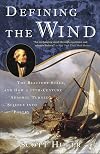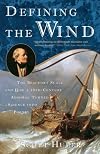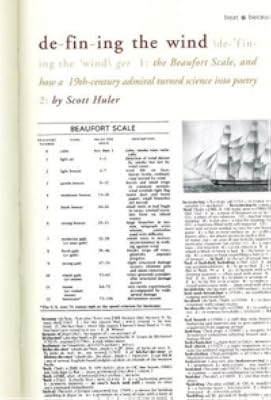
Defining the wind : the Beaufort scale, and how a nineteenth-century admiral turned science into poetry
by Scott Huler
On This Page
Description
Describes how nineteenth-century British admiral Francis Beaufort created the Beaufort Scale, a scientific classification that measures the strength of the wind, utilizing just 110 words to define thirteen gradations of wind.Tags
Recommendations













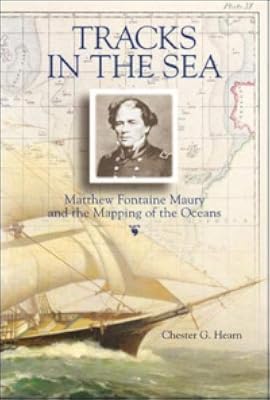

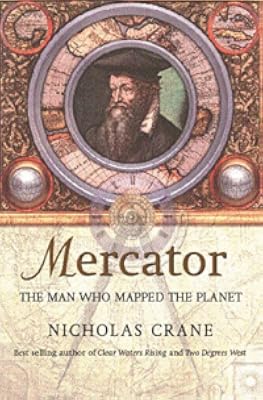


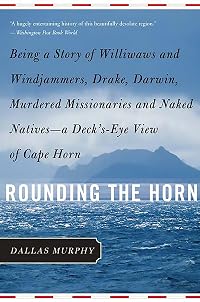

















Member Recommendations
John_Vaughan The defining of the numbers used every day in the Shipping Forecasts.

The Lighthouse Stevensons: The Extraordinary Story of the Building of the Scottish Lighthouses by the Ancestors of Robert Louis Stevenson by Bella Bathurst
harmen Nice history about the first lighthouses.
The Age of Wonder: How the Romantic Generation Discovered the Beauty and Terror of Science by Richard Holmes
harmen More history about the same time, and about the same people, Beaufort dealt with.
Member Reviews
After finding the Beaufort Scale in his dictionary, Huler's is first struck with the poetry intrinsic in the descriptions associated with each level of wind force. This initial charm with the language leads him into a delightful, meandering history of 19th century cartography and natural 'philosophy'.
Scott Huler takes a common wind scale, that we all relearn each year during hurricane season, and weaves an intriguing history about the development of modern meteorology from the necessities of 19th century sailing.Scott tells the story of Francis Beaufort, a fastidious observer and note-taker, who over the course of his 84 year life, goes to sea, teaches himself navigation and cartography, develops a distinctive style or cartography that is still used today, and creates the Beaufort Wind Scale that is a common feature in the nightly weather reports during hurricane season. Along the way, Beaufort gets shipwrecked, shot in battle, becomes Hydrographer to the Admiralty, and an Admiral.
Scott uses Francis Beaufort, who today might be show more diagnosed as having a mild case of OCD (obsessive compulsive disorder), as a vehicle to explore the evolution of naval cartography and meteorology. It is a fascinating story with surprising links to Charles Darwin.
If the book has any weakness, it is the over emphasis on the language of the Beaufort Wind Scale. Scott, a technical writer, knows the importance and beauty of clarity, information delivered in a sparse yet unambiguous style, and he provides insight into why the Beaufort Scale both a scientific and literary gem. Unfortunately, I think that he spends too much time on the topic and it occasionally slows down the otherwise well paced narrative.
I recommend this book to anyone who sails, is interested in weather, or is fascinated with the evolution of modern science.
Defining the Wind has a permanent place in my library. show less
Scott uses Francis Beaufort, who today might be show more diagnosed as having a mild case of OCD (obsessive compulsive disorder), as a vehicle to explore the evolution of naval cartography and meteorology. It is a fascinating story with surprising links to Charles Darwin.
If the book has any weakness, it is the over emphasis on the language of the Beaufort Wind Scale. Scott, a technical writer, knows the importance and beauty of clarity, information delivered in a sparse yet unambiguous style, and he provides insight into why the Beaufort Scale both a scientific and literary gem. Unfortunately, I think that he spends too much time on the topic and it occasionally slows down the otherwise well paced narrative.
I recommend this book to anyone who sails, is interested in weather, or is fascinated with the evolution of modern science.
Defining the Wind has a permanent place in my library. show less
Very thoroughly researched; it seems towards the end a little "I bothered to find this out, I'm putting it in the book whether it's interesting or not, goddamnit," but on the whole an inspiring manifesto for patient, 18th-century style observation of the world. "Nature, properly questioned, never lies."
In 1806, while waiting in port to leave for South America, Sir Francis Beaufort jotted down a brief scale into his journals so that he could quickly record future weather reports. It started at 0 for no breeze and went to 12 for hurricane conditions. It was a simple scale, used by other sailors and natural philosophers for the last 250 years, but he made it his own, and encouraged others to do the same. Scott Huler tells the story of the wind scale from Tycho Brahe through the men who still work on authentic sailing vessels today. The journey is as poetic as the scale itself and warrants a read by anyone from amateur meteorologists to nostalgic seamen. A very good book.
show more target="_top">http://lifelongdewey.wordpress.com/2012/06/30/551-defining-the-wind-by-scott-hul... show less
show more target="_top">http://lifelongdewey.wordpress.com/2012/06/30/551-defining-the-wind-by-scott-hul... show less
A fun read! Huler gets distracted by his journey, but that's always part of the fun.
Again, the best kind of history, a book about a very specific topic and how it changed the world.
Ratings
Members
- Recently Added By
Author Information

6+ Works 665 Members
Scott Huler is the author of six books, including Defining the Wind and No Man's Lands. Widely published in newspapers nationwide, he has won awards for his writing and his work on NPR. He lives in Raleigh, North Carolina.
Common Knowledge
- Canonical title
- Defining the wind : the Beaufort scale, and how a nineteenth-century admiral turned science into poetry
- People/Characters
- Francis Beaufort; John Smeaton; Alexander Dalrymple
- Epigraph
- Nothing I am sure can be more useful than comparing our present ideas with those of old time, tracing back our chains of actions to their primary sources or motions, ascertaining the causes of our successes of failures, in sh... (show all)ort studying the history of our own mind. - Francis Beaufort, Journal, 1805
Remember to get the weather in your god damned book -- weather is very important. - Ernest Hemingway, Letter to John Dos Passos - Dedication
- To Lori
- First words
- In Raleigh, 120 miles inland from the North Carolina coast, we mostly experience hurricanes on TV.
- Last words
- (Click to show. Warning: May contain spoilers.)I wonder what they could call it.
- Blurbers
- Adams, Noah
Classifications
- Genres
- Science & Nature, Nonfiction, History, General Nonfiction, Biography & Memoir
- DDC/MDS
- 551.518 — Natural sciences & mathematics Earth sciences; geology Geology, Hydrology Meteorology Atmosphere, Tornadoes, Hurricanes Atmospheric currents; Winds
- LCC
- QC933 .H85 — Science Physics Physics Meteorology. Climatology
- BISAC
Statistics
- Members
- 324
- Popularity
- 98,122
- Reviews
- 6
- Rating
- (3.78)
- Languages
- English, German
- Media
- Paper, Ebook
- ISBNs
- 7
- ASINs
- 6