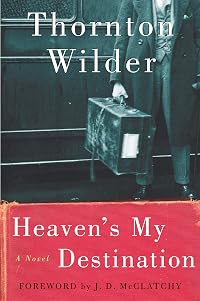
Heaven's My Destination
by Thornton Wilder
On This Page
Description
"If John Steinbeck's mighty Grapes of Wrath is the tragic novel of the Great Depression, then Heaven's My Destination is its comic masterpiece. --J.D. McClatchy A hilarious tale about goodness in a fallen world, Heaven's My Destination introduces George Marvin Brush, one of Thornton Wilder's most memorable characters. Brush, a traveling textbook salesman, is a fervent religious convert who is determined to lead a good life. With sad and sometimes hilarious consequences, his travels take him show more through smoking cars, bawdy houses, banks, and campgrounds from Texas to Illinois--and into the soul of Depression-era America itself. This special edition includes an updated afterword by Wilder's nephew, Tappan Wilder, with illuminating material about the author and book. show lessTags
Recommendations



















Member Recommendations
Member Reviews
George Brush, traveling book salesman and purveyor of morality, is a quiet revolutionary: he’s a pacifist, believing in Gandhi’s concepts of voluntary poverty, fasting, ahimsa (compassion), and doing no harm. He’s also a socialist, saying that everyone ought to be hit by the Depression equally. He gives money to thieves because they need it, believes in the equality of races, and the brotherhood of man. He quotes the Sermon on the Mount, and following Tolstoy, says that Government often commits crimes when punishing crime. “I think the world’s in such a bad way that we’ve all got to start thinking all over again,” he says, “I think all the ideas that are going around now are wrong. I’m trying to begin all over again at show more the beginning.”
On the other hand, he’s also a reactionary: girls shouldn’t be allowed to laugh too loud, move their hands and eyes too much, or smoke and drink. He doesn’t believe in the concept of banks, working on the Sabbath, divorce, or evolution.
Both aspects of his character draw scorn, mockery, and derision from those he comes across. While Brush is pious and stubbornly happy in his convictions, the reaction from others is incredulous and often ends in morally wrong behavior, such as locking him up for withdrawing his money, or beating him because of his views. “Get to be one of the fellas”, they say, “leave other people’s lives alone”, and “Run around with the women. You’re healthy, aintya? Enjoy life, see? You’re going to be dead a long time, believe me.”
What was Wilder saying with this character? The book was popular and controversial when it was published in 1934. Christians saw in Brush Christ-like beliefs and the courage of the early martyrs. Others saw farcical comedy in his naiveté, which could be read as critical of these idealistic and somewhat fundamentalist views. Was it Wilder who is being ambiguous, or are we just reading it that way, possibly because this is a fundamentally ambiguous aspect of the human condition?
Perhaps the most telling line is this interchange:
“’I see,’ said the judge. ‘Your ideas aren’t the same as most people’s, are they?’
‘No,’ said Brush. ‘I didn’t put myself through college for four years and go through a difficult religious conversion in order to have the same ideas as other people have.’”
I think Wilder was simply representing the early phase of life for a thinking person – which is often searching, strong-willed, and idealistic.
As his nephew Tappan Wilder mentions, the first epigraph:
George Brush is my name;
America’s my nation.
Ludington’s my dwelling-place
And Heaven’s my destination.
Which mirrors James Joyce, in ‘Portrait of the Artist as a Young Man’:
Stephen Dedalus is my name.
Ireland is my nation.
Clongowes is my dwelling place
And heaven my expectation.
The second epigraph “Of all forms of genius, goodness has the longest awkward age”, comes from Wilder’s novel ‘The Woman of Andros’, and is also meaningful. Brush is not necessarily right or wrong, he’s simply young, ‘awkward’, and full of paradoxes. He’s also not without faults – with women, with crises of faith, and with thoughts of suicide.
In the end, his views begin evolving, as most people’s do in life. He meets Burkin, a more intelligent man, who tells him somewhat harshly “You’ve got the gaseous ideas of a sick girl. It has nothing to do with life. You live in a foggy, unreal, narcotic dream.” Wilder describes it further: “Burkin plunged into primitive man and the jungle; he came down through the nature myths; he hung the earth in astronomical time. He then exposed the pretensions of subjective religious experience; the absurdity of conflicting prayers, man’s egotistic terror before extinction. At last he said: ‘If you’d read more I could show you the absurdity of the scholastic proofs of the existence of God and I could show you how the dependency complex begins.”
It’s the beginning of the disillusionment of the ideal. Brush has deeper qualms about his faith, and puts a student of evolution into college. One could read it as a sign of ‘reverse conversion’, or a continuation of his almost naïve open-mindedness. While the ending of the novel feels a bit forced, which I found later that Wilder later regretted, one gets the sense that as Brush matures, he will keep some elements of his idealism, and remain a paradox to those around him. show less
On the other hand, he’s also a reactionary: girls shouldn’t be allowed to laugh too loud, move their hands and eyes too much, or smoke and drink. He doesn’t believe in the concept of banks, working on the Sabbath, divorce, or evolution.
Both aspects of his character draw scorn, mockery, and derision from those he comes across. While Brush is pious and stubbornly happy in his convictions, the reaction from others is incredulous and often ends in morally wrong behavior, such as locking him up for withdrawing his money, or beating him because of his views. “Get to be one of the fellas”, they say, “leave other people’s lives alone”, and “Run around with the women. You’re healthy, aintya? Enjoy life, see? You’re going to be dead a long time, believe me.”
What was Wilder saying with this character? The book was popular and controversial when it was published in 1934. Christians saw in Brush Christ-like beliefs and the courage of the early martyrs. Others saw farcical comedy in his naiveté, which could be read as critical of these idealistic and somewhat fundamentalist views. Was it Wilder who is being ambiguous, or are we just reading it that way, possibly because this is a fundamentally ambiguous aspect of the human condition?
Perhaps the most telling line is this interchange:
“’I see,’ said the judge. ‘Your ideas aren’t the same as most people’s, are they?’
‘No,’ said Brush. ‘I didn’t put myself through college for four years and go through a difficult religious conversion in order to have the same ideas as other people have.’”
I think Wilder was simply representing the early phase of life for a thinking person – which is often searching, strong-willed, and idealistic.
As his nephew Tappan Wilder mentions, the first epigraph:
George Brush is my name;
America’s my nation.
Ludington’s my dwelling-place
And Heaven’s my destination.
Which mirrors James Joyce, in ‘Portrait of the Artist as a Young Man’:
Stephen Dedalus is my name.
Ireland is my nation.
Clongowes is my dwelling place
And heaven my expectation.
The second epigraph “Of all forms of genius, goodness has the longest awkward age”, comes from Wilder’s novel ‘The Woman of Andros’, and is also meaningful. Brush is not necessarily right or wrong, he’s simply young, ‘awkward’, and full of paradoxes. He’s also not without faults – with women, with crises of faith, and with thoughts of suicide.
In the end, his views begin evolving, as most people’s do in life. He meets Burkin, a more intelligent man, who tells him somewhat harshly “You’ve got the gaseous ideas of a sick girl. It has nothing to do with life. You live in a foggy, unreal, narcotic dream.” Wilder describes it further: “Burkin plunged into primitive man and the jungle; he came down through the nature myths; he hung the earth in astronomical time. He then exposed the pretensions of subjective religious experience; the absurdity of conflicting prayers, man’s egotistic terror before extinction. At last he said: ‘If you’d read more I could show you the absurdity of the scholastic proofs of the existence of God and I could show you how the dependency complex begins.”
It’s the beginning of the disillusionment of the ideal. Brush has deeper qualms about his faith, and puts a student of evolution into college. One could read it as a sign of ‘reverse conversion’, or a continuation of his almost naïve open-mindedness. While the ending of the novel feels a bit forced, which I found later that Wilder later regretted, one gets the sense that as Brush matures, he will keep some elements of his idealism, and remain a paradox to those around him. show less
An informed and realistic look at the struggles of the depression era, Heaven's My Destination is a comic picaresque tale that defies categorization. It was Wilder's fourth novel and second after the wildly popular The Bridge of San Luis Rey. The hero of the story, George Brush, is an other-worldly figure whose single-minded pursuit of a philosophy that seems like pure hokum, but through his earnest devotion to its strange principles somehow seems to make sense--in an odd way. He needs a certain strength of character to persevere in this earnest pursuit because almost all the people he meets are married to a common sense that either rejects his entreaties or runs away from him in fear and misunderstanding.
The events in this very show more episodic novel are the epitome of what has come to be called quixotic, named after the pursuits of Cervantes' Don Quixote and his humble partner Sancho Panza. They said that Quixote suffered from a sort of madness and that might be an apt explanation for the strange behavior of George Brush. It is likely that Wilder drew on his short stint teaching at the University of Chicago where he taught Cervantes among others. His lectures were popular and they apparently provided him with ideas for future writing. The picaresque hero he created was a wandering man in search of home and family. More than once he says that he believes he should put down roots and have "founded an American home". He says to an acquaintance, "You know what I think is the greatest thing in the world? It's when a man, I mean an American, sits down to Sunday dinner with his wife and six children around him" (pp 22-23) He aspires to "settle down and found an American home." When he tries to persuade a young woman to marry him and share "a fine American home", he enlists the help of his prospective sister-in-law to convince Roberta, the reluctant bride. "Will you go and ask her to come here?" George pleads. "And, Lottie, listen: we'll have a nice home somewhere and you can come in all the time for Sunday dinner, and the whole family can come in from the farm, too. We'll have some fine times, you'll see."(p 170)
He values his home above his job, just one of his notions and one of those that is more understandable than most of them are. More often he is pursuing windmills with ideas like the notion in the opening episode of the novel that banks are built on fear and everyone should take their money out of banks. While in a small town selling books door-to-door he suddenly has an epiphany: he must remove his money from the local bank and he immediately goes to the bank to do this. But he also lectures the Bank manager on the evils of banking and the fears upon which it is based. By the end of the chapter he is being escorted out of town while people are lining up for a good old-fashioned run on the local bank. It is the first of several incidents that mix his strange philosophy with the realities of depression-era America. Often the humor is tinged with a sadness that makes you wonder how poor George can maintain his earnest and naive sincerity in the face of a real world that just does not get it.
The book is an anomaly in my reading experience and certainly an anomaly among American novels written during the Depression. Wilder's realism portrays the struggles of the era, but it is a portrayal that is colored by shadings of farce and high comedy that provide a depth of humor missing too often when considering this era. While George Brush is rigid and puritanical in his thinking he is also sincere and earnest. His straightforward approach upsets the powers that be including evangelists, priests, and local leaders; he finds himself seduced, persecuted, misunderstood, arrested, married, and converted. It is clear, however, that whatever else he may be, George Brush is a sincere man who believes that what he is doing is right, no matter what the cost. For him, he believes, things will work out in the end. The result is a delightful journey, both picaresque and picturesque, of an American dreamer searching for a home in his and our great country. show less
The events in this very show more episodic novel are the epitome of what has come to be called quixotic, named after the pursuits of Cervantes' Don Quixote and his humble partner Sancho Panza. They said that Quixote suffered from a sort of madness and that might be an apt explanation for the strange behavior of George Brush. It is likely that Wilder drew on his short stint teaching at the University of Chicago where he taught Cervantes among others. His lectures were popular and they apparently provided him with ideas for future writing. The picaresque hero he created was a wandering man in search of home and family. More than once he says that he believes he should put down roots and have "founded an American home". He says to an acquaintance, "You know what I think is the greatest thing in the world? It's when a man, I mean an American, sits down to Sunday dinner with his wife and six children around him" (pp 22-23) He aspires to "settle down and found an American home." When he tries to persuade a young woman to marry him and share "a fine American home", he enlists the help of his prospective sister-in-law to convince Roberta, the reluctant bride. "Will you go and ask her to come here?" George pleads. "And, Lottie, listen: we'll have a nice home somewhere and you can come in all the time for Sunday dinner, and the whole family can come in from the farm, too. We'll have some fine times, you'll see."(p 170)
He values his home above his job, just one of his notions and one of those that is more understandable than most of them are. More often he is pursuing windmills with ideas like the notion in the opening episode of the novel that banks are built on fear and everyone should take their money out of banks. While in a small town selling books door-to-door he suddenly has an epiphany: he must remove his money from the local bank and he immediately goes to the bank to do this. But he also lectures the Bank manager on the evils of banking and the fears upon which it is based. By the end of the chapter he is being escorted out of town while people are lining up for a good old-fashioned run on the local bank. It is the first of several incidents that mix his strange philosophy with the realities of depression-era America. Often the humor is tinged with a sadness that makes you wonder how poor George can maintain his earnest and naive sincerity in the face of a real world that just does not get it.
The book is an anomaly in my reading experience and certainly an anomaly among American novels written during the Depression. Wilder's realism portrays the struggles of the era, but it is a portrayal that is colored by shadings of farce and high comedy that provide a depth of humor missing too often when considering this era. While George Brush is rigid and puritanical in his thinking he is also sincere and earnest. His straightforward approach upsets the powers that be including evangelists, priests, and local leaders; he finds himself seduced, persecuted, misunderstood, arrested, married, and converted. It is clear, however, that whatever else he may be, George Brush is a sincere man who believes that what he is doing is right, no matter what the cost. For him, he believes, things will work out in the end. The result is a delightful journey, both picaresque and picturesque, of an American dreamer searching for a home in his and our great country. show less
1935. Charming book about a traveling text-book salesman during the depression. George Brush is a scrupulous Christian evangelist determined to spread the good word throughout his travels. Hilarious scene where his supposed friends take him to a brothel for dinner. He has a serious crisis of faith towards the end.
Ratings
Members
- Recently Added By
Lists

Best Books of 1926-1935
403 works; 10 members

Publisher's Weekly Bestsellers Part I - 1895-1939
399 works; 8 members
Author Information

112+ Works 18,642 Members
One of the most honored and versatile of modern writers, Thornton Wilder combined a career as a successful novelist with work for the theater that made him one of this century's outstanding dramatists. It was an early short novel, however, that first brought him fame. The Bridge of San Luis Rey (1927), a bestseller that won the Pulitzer Prize in show more 1927, is the story of a group of assorted people who happen to be on a bridge in Peru when it collapses. Ingeniously constructed and rich in its philosophical implications about fate and synchronicity, Wilder's book would seem to be the first well-known example of a formula that has become a cliche in popular literature. His attraction to classical themes is manifested in The Woman of Andros (1930), a tragedy about young love in pre-Christian Greece, and The Ides of March (1948), set in the time of Julius Caesar and told in letters and documents covering a long span of years. Heaven's My Destination (1934), is a seriocomic and picaresque story about a young book salesman traveling through the Midwest during the early years of the Great Depression.Theophilus North (1973), Wilder's last novel, disappointed many reviewers, but it provided its author with opportunities to offer some wry observations on the life of the idle rich in Newport during the summer of 1926 and to ponder in the story of his alter ego what might have happened if Wilder had stayed home, so to speak, instead of becoming Thornton Wilder. As a serious writer of fiction, Wilder's main claim rests on The Eighth Day (1967), an intellectual thriller, which the N.Y. Times called "the most substantial fiction of his career." It won the National Book Award for fiction in 1968. (Bowker Author Biography) show less
Some Editions
Awards and Honors
Distinctions
Series
Belongs to Publisher Series
Work Relationships
Is contained in
Has as a student's study guide
Common Knowledge
- Canonical title
- Heaven's My Destination
- Original title
- Heaven's My Destination
- Original publication date
- 1935
- Original language*
- Englisch
*Some information comes from Common Knowledge in other languages. Click "Edit" for more information.
Classifications
Statistics
- Members
- 226
- Popularity
- 145,086
- Reviews
- 3
- Rating
- (3.72)
- Languages
- 8 — Danish, Dutch, English, French, German, Hungarian, Italian, Swedish
- Media
- Paper, Audiobook, Ebook
- ISBNs
- 14
- ASINs
- 19