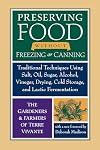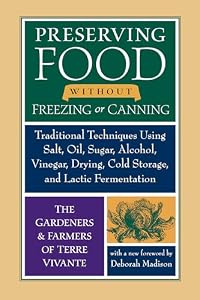
Preserving Food without Freezing or Canning: Traditional Techniques Using Salt, Oil, Sugar, Alcohol, Vinegar, Drying, Cold Storage, and Lactic Fermentation
by The Gardeners and Farmers of Centre Terre Vivante
On This Page
Description
More than 250 easy and enjoyable recipes!"The methods here [will] inspire us with their resourcefulness, their promise of goodness, and with the idea that we can eat well year around."—Deborah Madison
Over 100,00 copies sold!
Typical books about preserving garden produce nearly always assume that modern "kitchen gardeners" will boil or freeze their vegetables and fruits. Yet here is a book that goes back celebrating traditional but little-known French techniques for storing and preserving show more edibles in ways that maximize flavor and nutrition.
Translated into English, and with a new foreword by Deborah Madison, this book deliberately ignores freezing and high-temperature canning in favor of methods that are superior because they are less costly and more energy-efficient.
Inside, you'll learn how to:
Preserving Food Without Freezing or Canning offers more than 250 easy and enjoyable recipes featuring locally grown and minimally refined ingredients.
An essential guide for those who seek healthy food for a healthy world.
. show less
Tags
Recommendations





Member Reviews
Terre Vivante, stated author on title page, is the name of a collective or cooperative which published a magazine. These recipes are readers' contributions requested by the editors; in publishing the book, they deliberately omitted all recipes involving freezing or canning, although some of the foods (eg jams) could be canned. Definitely old school preserving methods here -- and the contributors of each method note their location, most being French but some in Belgium, Germany, or elsewhere, which is of interest in knowing where the techniques originate. Great reference book. Worth reading with close attention.
A collection of personal recipes and traditional food preservation methods. The book is not only a collection of methods and techniques, but a book of traditional food lore.
The introductory pages discuss the need and utility of preserving the lore of food preservation; a distinction between traditional and modern methods; and the story of how this book came to be written.
Following an introduction on preservation, the cautions, and general ideas behind the methods; each chapter begins with a short description of the general method under consideration-along with cautions. The rest of each chapter consists of recipes and lore about specific foods preserved in the method under discussion.
The chapters cover: types of and uses of root show more cellars; drying foods; lactic fermentation; preservation in oil; salt (and salt brining); sugar; preserves; sweet-and-sour preserves; and the use of ethanol for food preservation.
The closing chapter is a chart about how to choose the best method for a particular food.
The book has nice illustrations and great layout. It is well supplemented with a thorough index to make any recipe immediately available. show less
The introductory pages discuss the need and utility of preserving the lore of food preservation; a distinction between traditional and modern methods; and the story of how this book came to be written.
Following an introduction on preservation, the cautions, and general ideas behind the methods; each chapter begins with a short description of the general method under consideration-along with cautions. The rest of each chapter consists of recipes and lore about specific foods preserved in the method under discussion.
The chapters cover: types of and uses of root show more cellars; drying foods; lactic fermentation; preservation in oil; salt (and salt brining); sugar; preserves; sweet-and-sour preserves; and the use of ethanol for food preservation.
The closing chapter is a chart about how to choose the best method for a particular food.
The book has nice illustrations and great layout. It is well supplemented with a thorough index to make any recipe immediately available. show less
This book is amazing, it has traditional recipes for preserving foods ranging from root cellaring to preservation in oil. A gem.
A brilliant food preservation resource!
Ratings
Members
- Recently Added By
Lists

Chelsea Green Publishing
17 works; 2 members
Author Information

4 Works 441 Members
Some Editions
Common Knowledge
- Canonical title
- Preserving Food without Freezing or Canning: Traditional Techniques Using Salt, Oil, Sugar, Alcohol, Vinegar, Drying, Cold Storage, and Lactic Fermentation
- Original publication date
- 1999
- First words
- I live on a dirt lane in a small, historic New Mexican village.
- Last words
- (Click to show. Warning: May contain spoilers.)Eat the cherries within two years, but be careful: This is not a dessert!
Classifications
Statistics
- Members
- 433
- Popularity
- 70,742
- Reviews
- 4
- Rating
- (4.27)
- Languages
- English
- Media
- Paper, Ebook
- ISBNs
- 2
- ASINs
- 3