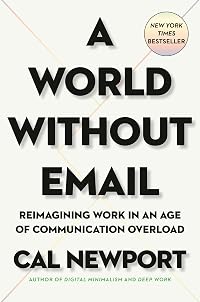
A World Without Email: Reimagining Work in an Age of Communication Overload
by Cal Newport
On This Page
Description
A New York Times and Wall Street Journal bestsellerFrom New York Times bestselling author Cal Newport comes a bold vision for liberating workers from the tyranny of the inbox—and unleashing a new era of productivity.
Modern knowledge workers communicate constantly. Their days are defined by a relentless barrage of incoming messages and back-and-forth digital conversations—a state of constant, anxious chatter in which nobody can disconnect, and so nobody has the cognitive bandwidth to show more perform substantive work. There was a time when tools like email felt cutting edge, but a thorough review of current evidence reveals that the "hyperactive hive mind" workflow they helped create has become a productivity disaster, reducing profitability and perhaps even slowing overall economic growth. Equally worrisome, it makes us miserable. Humans are simply not wired for constant digital communication.
We have become so used to an inbox-driven workday that it's hard to imagine alternatives. But they do exist. Drawing on years of investigative reporting, author and computer science professor Cal Newport makes the case that our current approach to work is broken, then lays out a series of principles and concrete instructions for fixing it. In A World without Email, he argues for a workplace in which clear processes—not haphazard messaging—define how tasks are identified, assigned and reviewed. Each person works on fewer things (but does them better), and aggressive investment in support reduces the ever-increasing burden of administrative tasks. Above all else, important communication is streamlined, and inboxes and chat channels are no longer central to how work unfolds.
The knowledge sector's evolution beyond the hyperactive hive mind is inevitable. The question is not whether a world without email is coming (it is), but whether you'll be ahead of this trend. If you're a CEO seeking a competitive edge, an entrepreneur convinced your productivity could be higher, or an employee exhausted by your inbox, A World Without Email will convince you that the time has come for bold changes, and will walk you through exactly how to make them happen. show less
Tags
Recommendations




Member Reviews
I am always amused by books that never mention the word capitalism and have no intention of critiquing it, yet do just that. 'A World Without Email' is the latest example I've come across. Newport sets out to explain the problems caused by email's domination of the knowledge economy and suggest solutions. He grounds his analysis in a hilariously (to me) neoliberal combination of theories: predominantly technological determinism and evolutionary psychology, with a dash of utilitarianism. The iniquitous tragedy of the commons also gets an airing. In his view, the stress of constantly full inboxes is due to how email was invented and fundamental human social dynamics. What he struggles to explain using these theories is why nearly all show more businesses, indeed employers, oblige their non-manual workers to respond constantly to emails. In his view, this is inefficient as knowledge workers can create more value by focusing on their actual area of expertise, rather than the more general task of sending endless messages.
So why is email ubiquitous? Could it be because capitalism is not actually a system that pursues efficiency or use value, but one that exploits labour and natural resources to exhaustion in pursuit of shareholder returns? Newport wonders why the adoption of email resulted in administrators being downsized and admin tasks piled onto knowledge workers. I think Marx can assist here: capitalism tends towards reducing labour-intensity of production and increasing capital-intensity, both of goods and services. In the 21st century, this manifests as adopting new technology so employees have to work more hours for the same pay, rather than hiring more people. Email overload looks to me like a recent symptom of the same old disease.
Despite not acknowledging that capitalism might be the problem here, Newport does offer interesting insights. The hyperactive hive mind of constant text-based communication is a useful conceptualisation of the weirdness of 21st century knowledge work. This presumption of constant availability and immediate response to communication is very strange, as it actually slows work down and by its nature impedes considered thought. The book suggests avoiding the use of email as much as possible, restricting how often it is checked, and creating more tailored processes and protocols instead. I believe this is also known as 'bureaucracy' and I found Newport's carefully argued support for it fascinating. How I miss [a:David Graeber|29101|David Graeber|https://images.gr-assets.com/authors/1479657149p2/29101.jpg], RIP, whose perspective on this I would love to read. In [b:The Utopia of Rules: On Technology, Stupidity, and the Secret Joys of Bureaucracy|22245334|The Utopia of Rules On Technology, Stupidity, and the Secret Joys of Bureaucracy|David Graeber|https://i.gr-assets.com/images/S/compressed.photo.goodreads.com/books/1417415465l/22245334._SY75_.jpg|41620170], Graeber described bureaucracy as a means of avoiding emotional labour by automating responses without considering individual circumstances. That is indeed what Newport thinks should happen, as the time and attention required to craft individual responses to email is burning employees out. He is proposing to extend the automation principles already predominating in industrial and ill-paid service jobs to better paid knowledge employment.
You really can't win under capitalist employment: either you have so much alleged autonomy that you're overwhelmed by competing demands, or you have virtually none at all. The compromise this book seeks for knowledge workers is setting up rules and processes for predictable repeated tasks, streamlining communication, and maximising time that can be spent concentrating on so-called deep work. I don't disagree with these aims, however I think they're very hard to achieve in most actual workplaces. Project management methods, including those explained in case studies here, have attempted these things for decades while communication has only grown more frenetic. In his conclusion, Newport frames the need to escape the hyperactive hive mind in terms of productivity gains. I think that is just part of what needs to be critiqued, as constant responsiveness must be linked to surveillance capitalism (the best term for our current economic system I've come across so far, thank you [a:Shoshana Zuboff|710768|Shoshana Zuboff|https://images.gr-assets.com/authors/1563298665p2/710768.jpg]).
As the preceding paragraphs might suggest, my reason for reading 'A World Without Email' wasn't actually that I'm struggling with a deluge of email myself. It was mostly my appreciation of Newport's [b:Digital Minimalism: Choosing a Focused Life in a Noisy World|40672036|Digital Minimalism Choosing a Focused Life in a Noisy World|Cal Newport|https://i.gr-assets.com/images/S/compressed.photo.goodreads.com/books/1549433350l/40672036._SY75_.jpg|63988240] and interest in seeing how the principles articulated there would be extended to the world of work. Just as while reading [b:Digital Minimalism: Choosing a Focused Life in a Noisy World|40672036|Digital Minimalism Choosing a Focused Life in a Noisy World|Cal Newport|https://i.gr-assets.com/images/S/compressed.photo.goodreads.com/books/1549433350l/40672036._SY75_.jpg|63988240], I found that I'm already doing several things that Newport suggests out of instinctive antipathy for constant communication. The closest I got to being overwhelmed by emails was in academia, when multitudes of students would send me queries. This was still better than them actually turning up in my office, though, as in most cases my response was, "The information you need is at this link". Even in that job, I didn't feel the obligation of instant response that Newport treats as inherent to the human psyche. Then and now, unless an email specifically states that an urgent response is required I'll get to it when I'm ready, after some thought/procrastination/coffee. Also, I believe in asking closed questions in emails. None of this, "When are you free?" or "Tell me what you think". Instead: "Are you available at 3pm or 4pm on Tuesday?" or "Here is my understanding of the issue. Do you have any changes to suggest?"
Now let me tell you my ultimate lifehack for avoiding excessive quantities of work emails: start a new and specialised job remotely during a pandemic. In video meetings, ensure that you are unmemorable. When none of your colleagues have met you and most don't know who you are, they won't email you. Microsoft Teams messages and emails aren't intrusive if they're only from a few immediate colleagues regarding specific tasks for specific projects. If I may brag for a moment, some mornings I boot up my laptop to find no new emails at all and can go directly to my actual work. I just took a week of holiday and came back to only thirty new messages! As a result I can spend hours on end in what Newport calls 'deep work', hyperfocused on statistics without interruption. It's lovely; so much more intellectually satisfying than admin-plagued academia ever was. I'm not looking forward to the return of office work, which is bound to spoil this peace and quiet.
As a counterpoint to all this, neither of my parents have ever used email in a professional context, so consider it purely as a fun form of personal communication. 'A World Without Email' is aimed at generation X and millennials with degrees working in the Western knowledge economy. It raises some interesting questions about how communications technology has reshaped our experience of work, but only covers a small corner of a much bigger set of interrelated issues. Thus I'd recommend reading it with [b:Digital Minimalism: Choosing a Focused Life in a Noisy World|40672036|Digital Minimalism Choosing a Focused Life in a Noisy World|Cal Newport|https://i.gr-assets.com/images/S/compressed.photo.goodreads.com/books/1549433350l/40672036._SY75_.jpg|63988240], [b:The Age of Surveillance Capitalism: The Fight for a Human Future at the New Frontier of Power|26195941|The Age of Surveillance Capitalism The Fight for a Human Future at the New Frontier of Power|Shoshana Zuboff|https://i.gr-assets.com/images/S/compressed.photo.goodreads.com/books/1521733914l/26195941._SY75_.jpg|46170685], and [b:Capitalism Without Capital: The Rise of the Intangible Economy|34928269|Capitalism Without Capital The Rise of the Intangible Economy|Jonathan Haskel|https://i.gr-assets.com/images/S/compressed.photo.goodreads.com/books/1493303382l/34928269._SY75_.jpg|56192358]. The practical advice for reducing distraction is pontentially useful, depending on your willingness to turn off notifications and not reply immediately to everything. show less
So why is email ubiquitous? Could it be because capitalism is not actually a system that pursues efficiency or use value, but one that exploits labour and natural resources to exhaustion in pursuit of shareholder returns? Newport wonders why the adoption of email resulted in administrators being downsized and admin tasks piled onto knowledge workers. I think Marx can assist here: capitalism tends towards reducing labour-intensity of production and increasing capital-intensity, both of goods and services. In the 21st century, this manifests as adopting new technology so employees have to work more hours for the same pay, rather than hiring more people. Email overload looks to me like a recent symptom of the same old disease.
Despite not acknowledging that capitalism might be the problem here, Newport does offer interesting insights. The hyperactive hive mind of constant text-based communication is a useful conceptualisation of the weirdness of 21st century knowledge work. This presumption of constant availability and immediate response to communication is very strange, as it actually slows work down and by its nature impedes considered thought. The book suggests avoiding the use of email as much as possible, restricting how often it is checked, and creating more tailored processes and protocols instead. I believe this is also known as 'bureaucracy' and I found Newport's carefully argued support for it fascinating. How I miss [a:David Graeber|29101|David Graeber|https://images.gr-assets.com/authors/1479657149p2/29101.jpg], RIP, whose perspective on this I would love to read. In [b:The Utopia of Rules: On Technology, Stupidity, and the Secret Joys of Bureaucracy|22245334|The Utopia of Rules On Technology, Stupidity, and the Secret Joys of Bureaucracy|David Graeber|https://i.gr-assets.com/images/S/compressed.photo.goodreads.com/books/1417415465l/22245334._SY75_.jpg|41620170], Graeber described bureaucracy as a means of avoiding emotional labour by automating responses without considering individual circumstances. That is indeed what Newport thinks should happen, as the time and attention required to craft individual responses to email is burning employees out. He is proposing to extend the automation principles already predominating in industrial and ill-paid service jobs to better paid knowledge employment.
You really can't win under capitalist employment: either you have so much alleged autonomy that you're overwhelmed by competing demands, or you have virtually none at all. The compromise this book seeks for knowledge workers is setting up rules and processes for predictable repeated tasks, streamlining communication, and maximising time that can be spent concentrating on so-called deep work. I don't disagree with these aims, however I think they're very hard to achieve in most actual workplaces. Project management methods, including those explained in case studies here, have attempted these things for decades while communication has only grown more frenetic. In his conclusion, Newport frames the need to escape the hyperactive hive mind in terms of productivity gains. I think that is just part of what needs to be critiqued, as constant responsiveness must be linked to surveillance capitalism (the best term for our current economic system I've come across so far, thank you [a:Shoshana Zuboff|710768|Shoshana Zuboff|https://images.gr-assets.com/authors/1563298665p2/710768.jpg]).
As the preceding paragraphs might suggest, my reason for reading 'A World Without Email' wasn't actually that I'm struggling with a deluge of email myself. It was mostly my appreciation of Newport's [b:Digital Minimalism: Choosing a Focused Life in a Noisy World|40672036|Digital Minimalism Choosing a Focused Life in a Noisy World|Cal Newport|https://i.gr-assets.com/images/S/compressed.photo.goodreads.com/books/1549433350l/40672036._SY75_.jpg|63988240] and interest in seeing how the principles articulated there would be extended to the world of work. Just as while reading [b:Digital Minimalism: Choosing a Focused Life in a Noisy World|40672036|Digital Minimalism Choosing a Focused Life in a Noisy World|Cal Newport|https://i.gr-assets.com/images/S/compressed.photo.goodreads.com/books/1549433350l/40672036._SY75_.jpg|63988240], I found that I'm already doing several things that Newport suggests out of instinctive antipathy for constant communication. The closest I got to being overwhelmed by emails was in academia, when multitudes of students would send me queries. This was still better than them actually turning up in my office, though, as in most cases my response was, "The information you need is at this link". Even in that job, I didn't feel the obligation of instant response that Newport treats as inherent to the human psyche. Then and now, unless an email specifically states that an urgent response is required I'll get to it when I'm ready, after some thought/procrastination/coffee. Also, I believe in asking closed questions in emails. None of this, "When are you free?" or "Tell me what you think". Instead: "Are you available at 3pm or 4pm on Tuesday?" or "Here is my understanding of the issue. Do you have any changes to suggest?"
Now let me tell you my ultimate lifehack for avoiding excessive quantities of work emails: start a new and specialised job remotely during a pandemic. In video meetings, ensure that you are unmemorable. When none of your colleagues have met you and most don't know who you are, they won't email you. Microsoft Teams messages and emails aren't intrusive if they're only from a few immediate colleagues regarding specific tasks for specific projects. If I may brag for a moment, some mornings I boot up my laptop to find no new emails at all and can go directly to my actual work. I just took a week of holiday and came back to only thirty new messages! As a result I can spend hours on end in what Newport calls 'deep work', hyperfocused on statistics without interruption. It's lovely; so much more intellectually satisfying than admin-plagued academia ever was. I'm not looking forward to the return of office work, which is bound to spoil this peace and quiet.
As a counterpoint to all this, neither of my parents have ever used email in a professional context, so consider it purely as a fun form of personal communication. 'A World Without Email' is aimed at generation X and millennials with degrees working in the Western knowledge economy. It raises some interesting questions about how communications technology has reshaped our experience of work, but only covers a small corner of a much bigger set of interrelated issues. Thus I'd recommend reading it with [b:Digital Minimalism: Choosing a Focused Life in a Noisy World|40672036|Digital Minimalism Choosing a Focused Life in a Noisy World|Cal Newport|https://i.gr-assets.com/images/S/compressed.photo.goodreads.com/books/1549433350l/40672036._SY75_.jpg|63988240], [b:The Age of Surveillance Capitalism: The Fight for a Human Future at the New Frontier of Power|26195941|The Age of Surveillance Capitalism The Fight for a Human Future at the New Frontier of Power|Shoshana Zuboff|https://i.gr-assets.com/images/S/compressed.photo.goodreads.com/books/1521733914l/26195941._SY75_.jpg|46170685], and [b:Capitalism Without Capital: The Rise of the Intangible Economy|34928269|Capitalism Without Capital The Rise of the Intangible Economy|Jonathan Haskel|https://i.gr-assets.com/images/S/compressed.photo.goodreads.com/books/1493303382l/34928269._SY75_.jpg|56192358]. The practical advice for reducing distraction is pontentially useful, depending on your willingness to turn off notifications and not reply immediately to everything. show less
Following my recent book clearance, I finally managed to start tackling the backlog of books I want to read and have just finished A World Without Email by Cal Newport. To encourage me to complete this book I decided to ‘read it with my ears’ and switched from paper to the audio book.
I have not read any of Newport’s other books and my interest in this one was triggered by a feeling that I (and others) are drowning in email. I experience many of the problems that are described in the book — a high volume of daily emails, the perception I should reply quickly, even the need to manage the build-up of emails while on holiday. Perhaps in a post-pandemic/working-from-home world communication has become a new metric for productivity. show more What follows are my thoughts and reflections on this book.
Overall I feel there is a much shorter book within this one given the conclusions. I have noticed in many of the ‘self-help’ books I have read that they often provide excessive justification to their recommendations and conclusions using too many repetitive case studies and historical context. I didn’t need to learn about the introduction of stirrups into medieval Europe to understand why email was so widely adopted and so quickly. I don’t feel I needed to learn about the works of Claude Shannon to understand how information is managed within an office environment. As a result of these issues, it felt to me that this book does drag-on a bit and could have been much more focused — more on that below.
It is perhaps unfortunate that this book was released just as the world of work was changing due to the COVID pandemic and, as a result, feels a little dated with references to walking “down the hall” rather than sending emails. It reflects a world before widespread work from home and the consequent need for increased levels of email and messaging communication. The book certainly underlined my own belief that lots of communication is not the same thing as good communication.
The title of the book hints at a revolution but the conclusions; that work should be managed using dedicated project management tools rather than ad-hoc email, that Kanban boards and ‘scrum’ meetings are valuable and that we need to take time to get ‘real’ (aka deep) work done does not feel like a great revelation. I thought the final section of the book spent far too much time on the case studies of the benefits of Extreme Programming), sprints], administrative support to specialists, and other productive workflows.
I work in a ‘technology’ company so perhaps I am not actually the target audience here. Overall I was left disappointed — there was little in this book I could apply to change my life. And if I never hear the phrase “Hyperactive Hive Mind” again it will still be too soon! show less
I have not read any of Newport’s other books and my interest in this one was triggered by a feeling that I (and others) are drowning in email. I experience many of the problems that are described in the book — a high volume of daily emails, the perception I should reply quickly, even the need to manage the build-up of emails while on holiday. Perhaps in a post-pandemic/working-from-home world communication has become a new metric for productivity. show more What follows are my thoughts and reflections on this book.
Overall I feel there is a much shorter book within this one given the conclusions. I have noticed in many of the ‘self-help’ books I have read that they often provide excessive justification to their recommendations and conclusions using too many repetitive case studies and historical context. I didn’t need to learn about the introduction of stirrups into medieval Europe to understand why email was so widely adopted and so quickly. I don’t feel I needed to learn about the works of Claude Shannon to understand how information is managed within an office environment. As a result of these issues, it felt to me that this book does drag-on a bit and could have been much more focused — more on that below.
It is perhaps unfortunate that this book was released just as the world of work was changing due to the COVID pandemic and, as a result, feels a little dated with references to walking “down the hall” rather than sending emails. It reflects a world before widespread work from home and the consequent need for increased levels of email and messaging communication. The book certainly underlined my own belief that lots of communication is not the same thing as good communication.
The title of the book hints at a revolution but the conclusions; that work should be managed using dedicated project management tools rather than ad-hoc email, that Kanban boards and ‘scrum’ meetings are valuable and that we need to take time to get ‘real’ (aka deep) work done does not feel like a great revelation. I thought the final section of the book spent far too much time on the case studies of the benefits of Extreme Programming), sprints], administrative support to specialists, and other productive workflows.
I work in a ‘technology’ company so perhaps I am not actually the target audience here. Overall I was left disappointed — there was little in this book I could apply to change my life. And if I never hear the phrase “Hyperactive Hive Mind” again it will still be too soon! show less
If only! Productivity expert Cal Newport makes a compelling argument against the way we use email now, and anyone who struggles with overflowing inboxes will learn from what he writes. But he doesn’t have much to offer in the way of alternatives, particularly for individuals. The tools he recommends — Trello, Doodle — are well-known and I for one use them. He trashes Slack, and rightly so, and seems pretty dismissive of most instant messaging services — right again. He’s a big fan of face to face meetings (that didn’t work out very well during the pandemic lockdowns). He also thinks some organisations may have rushed things when they sacked all the personal assistants and told managers to look after their own calendars. So, show more no magic bullet then. It looks like email might be around for a while longer. show less
Deep Work was so good and so I was disappointed with this one. Deep Work had a central theme and I feel this one suffers from too many ideas. This is exactly the kind of mishmash I hate in many tech-focused business books talking about this or that technology or process. It reminds me a bit of Timothy Ferris.
That could be me. I've read too many productivity books over the years and I think I'm a bit jaded at this point. I had a hard time focusing on the book.
That could be me. I've read too many productivity books over the years and I think I'm a bit jaded at this point. I had a hard time focusing on the book.
A LOT to chew through in this book. The first part is all about what email has done to the workforce (knowledge workers specifically). The second part is how to get away from email.
I flagged a LOT of pages to go back and process again. Great info and some good framework ideas for companies, teams, etc. looking to move away from the constant hive mind mentality of email.
I flagged a LOT of pages to go back and process again. Great info and some good framework ideas for companies, teams, etc. looking to move away from the constant hive mind mentality of email.
It was surprising that a book published in 2021 is talking about a work-item management tool as old as Trello. Similarly, mentions about Scrum / Kanban as a mechanism to reduce email flow sounded dated too.
I felt a good number of things mentioned in the book was common knowledge, so found it a bit dry and repetitive.
I felt a good number of things mentioned in the book was common knowledge, so found it a bit dry and repetitive.
Not much new compared to his other books
I read Deep Work and Digital Minimalism w Cal Newport before this and enjoyed those much more. This felt less focused, partially because it had more theoretical or organization-level suggestions as opposed to the other two books which focused more on improving my daily work.
I read Deep Work and Digital Minimalism w Cal Newport before this and enjoyed those much more. This felt less focused, partially because it had more theoretical or organization-level suggestions as opposed to the other two books which focused more on improving my daily work.
Members
- Recently Added By
Author Information

29+ Works 10,292 Members
Cal Newport is the author of How to Win at College and How to Become a Straight-A Student. He graduated from Dartmouth College and earned a Ph.D. from MIT. His writing has appeared in national publications, and he is the founder of Study Hacks, the Web's most popular student advice blog.
Awards and Honors
Common Knowledge
- Original publication date
- 2020-03-02
- People/Characters
- Cal Newport
- Dedication
- To Max, Asa, and Josh: May your future not be dominated by inboxes
- First words
- In late 2010, Nish Acharya arrived in Washington, DC, ready to work.
- Last words
- (Click to show. Warning: May contain spoilers.)If you're one of the many millions exhausted by your inbox, hopeful that there must be a better way to do good work in a culture currently obsessed by constant connectivity, then it's time to open your eyes.
- Publisher's editor
- Papadopoulos, Niki
- Original language
- English
Classifications
- Genres
- Business, Nonfiction, Technology, General Nonfiction
- DDC/MDS
- 384.3 — Society, government, & culture Commerce, communications & transportation regulations Communications Computer communication
- LCC
- HE7551 .N495 — Social sciences Transportation and communications Transportation and communications
- BISAC
Statistics
- Members
- 445
- Popularity
- 68,980
- Reviews
- 8
- Rating
- (3.71)
- Languages
- 5 — Dutch, English, German, Portuguese, Spanish
- Media
- Paper, Audiobook, Ebook
- ISBNs
- 13
- ASINs
- 5