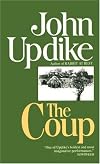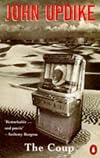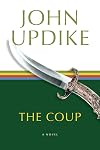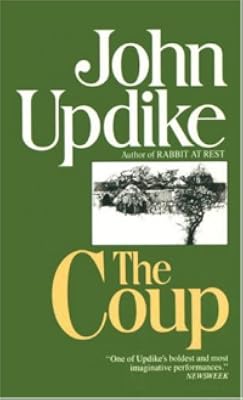
The Coup
by John Updike
On This Page
Description
Updike presents the story of a fictitious modern African state called Kush, narrated tongue-in-cheek by Kush's exiled president, Colonel Felix Ellellou.Tags
Recommendations


















Member Reviews
In honor of John Updike’s passing, I decided to have a go at the one big-name book from his writing prime that I’d never read: The Coup. And I’m certainly glad I did.
Writing in the mid-1970s, Updike breaks away from his typical fascination with skanky suburban housewives, and takes his readers along on a sometimes-bizarre but always lyrical journey to an imaginary African country, seen through the eyes of its erstwhile Islamic Marxist dictator.
Colonel Ellellou, said potentate, is a marvelous satiric creation. Educated in part in Wisconsin, of all places, Ellellou spends much of the novel visiting his four wives and one mistress. One of these wives is a nice white middle-class Midwestern girl who’s swept away by the romance and show more ideological impact of marrying an exotic African student who’s well-connected back in his homeland. Updike's insights into this relationship are particularly tragicomic and poignant.
The best part of the novel follows Ellellou as he goes on a kind of camel-intensive road trip to his country’s deepest and most isolated badlands, where revelation awaits him.
As the story progresses, Updike builds a quite pointed critique of ‘big man’ African dictatorships in the post-colonial era, and of the twin follies of western and Soviet ‘aid’ efforts in Africa.
It's likely that Updike could not even have published this book today. The parts of the book that satirize Islam would likely have left it languishing in a publisher’s limbo. show less
Writing in the mid-1970s, Updike breaks away from his typical fascination with skanky suburban housewives, and takes his readers along on a sometimes-bizarre but always lyrical journey to an imaginary African country, seen through the eyes of its erstwhile Islamic Marxist dictator.
Colonel Ellellou, said potentate, is a marvelous satiric creation. Educated in part in Wisconsin, of all places, Ellellou spends much of the novel visiting his four wives and one mistress. One of these wives is a nice white middle-class Midwestern girl who’s swept away by the romance and show more ideological impact of marrying an exotic African student who’s well-connected back in his homeland. Updike's insights into this relationship are particularly tragicomic and poignant.
The best part of the novel follows Ellellou as he goes on a kind of camel-intensive road trip to his country’s deepest and most isolated badlands, where revelation awaits him.
As the story progresses, Updike builds a quite pointed critique of ‘big man’ African dictatorships in the post-colonial era, and of the twin follies of western and Soviet ‘aid’ efforts in Africa.
It's likely that Updike could not even have published this book today. The parts of the book that satirize Islam would likely have left it languishing in a publisher’s limbo. show less
Colonel Elleloû, leader of the islamic-marxian republic of 'noire', is torm to pieces. Part of his personality is westernized (due to a study in the USA), but another part longs for the old ways, tradition, embodied in the islam, but also his hatred for materialism. Still another part of his personality just cries for his land, dying because of a severe drought. And lets not forget his personal trouble, due to having married four women.
The book plays out a sequence of events starting with the Colonel at the pinnacle of his power, and ending with his exile. In between the colonel travels incognito through his country and makes a spiritual inner journey.
In a way a prophetic book,which shows the difficulties of integrating tradition, show more islam and the modern world, written just before the fall of the Shah and many years before 911. An example: 'When it comes to battle the poor retain a golden weapon: they have little to lose. Their lives are a shabby anteroom in the palace of the afterlife. The Phrophet's vivid Paradise is our atomic bomb.'
I am not a real fan of Updike, mostly because of his style: I find him sometimes difficult to read (complex sentences), but I definitely liked this book. show less
The book plays out a sequence of events starting with the Colonel at the pinnacle of his power, and ending with his exile. In between the colonel travels incognito through his country and makes a spiritual inner journey.
In a way a prophetic book,which shows the difficulties of integrating tradition, show more islam and the modern world, written just before the fall of the Shah and many years before 911. An example: 'When it comes to battle the poor retain a golden weapon: they have little to lose. Their lives are a shabby anteroom in the palace of the afterlife. The Phrophet's vivid Paradise is our atomic bomb.'
I am not a real fan of Updike, mostly because of his style: I find him sometimes difficult to read (complex sentences), but I definitely liked this book. show less
Darkly humorous look at the turmoil of Cold-War Africa. Muslim Marxists in silver Mercedes, Americana, need I go on?
Words, words words. It has technique, but lacks what Bruce Lee, in that first scene of "Enter the Dragon," describes as 'emotional content.' I stopped after the first 50 pages. Maybe I'll come back to it, but I doubt it.
12.29.07
12.29.07
A postcolonial novel par excellence.
Het 1 boek van Updike dat ik niet uitlezen kon...misschien was ik niet in stemming...misschien is dit eerder zwak of matig
Jan 29, 2010Dutch
Ratings
Members
- Recently Added By
Lists

Best Political Fiction
92 works; 12 members

Anthony Burgess 99 Post War Novels
99 works; 7 members
Author Information

342+ Works 53,745 Members
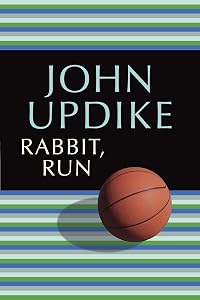
American novelist, poet, and critic John Updike was born in Reading, Pennsylvania on March 18, 1932. He received an A.B. degree from Harvard University, which he attended on a scholarship, in 1954. After graduation, he accepted a one-year fellowship to study painting at the Ruskin School of Drawing and Fine Art in Oxford, England. After returning show more from England in 1955, he worked for two years on the staff of The New Yorker. This marked the beginning of a long relationship with the magazine, during which he has contributed numerous short stories, poems, and book reviews. Although Updike's first published book was a collection of verse, The Carpentered Hen and Other Tame Creatures (1958), his renown as a writer is based on his fiction, beginning with The Poorhouse Fair (1959). During his lifetime, he wrote more than 50 books and primarily focused on middle-class America and their major concerns---marriage, divorce, religion, materialism, and sex. Among his best-known works are the Rabbit tetrology---Rabbit, Run (1960), Rabbit Redux (1971), Rabbit Is Rich (1981), and Rabbit at Rest (1988). Rabbit, Run introduces Harry "Rabbit" Angstrom as a 26-year-old salesman of dime-store gadgets trapped in an unhappy marriage in a dismal Pennsylvania town, looking back wistfully on his days as a high school basketball star. Rabbit Redux takes up the story 10 years later, and Rabbit's relationship with representative figures of the 1960s enables Updike to provide social commentary in a story marked by mellow wisdom and compassion in spite of some shocking jolts. In Rabbit Is Rich, Harry is comfortably middle-aged and complacent, and much of the book seems to satirize the country-club set and the swinging sexual/social life of Rabbit and his friends. Finally, in Rabbit at Rest, Harry arrives at the age where he must confront his mortality. Updike won the Pulitzer Prize for both Rabbit Is Rich and Rabbit at Rest. Updike's other novels range widely in subject and locale, from The Poorhouse Fair, about a home for the aged that seems to be a microcosm for society as a whole, through The Court (1978), about a revolution in Africa, to The Witches of Eastwick (1984), in which Updike tries to write from inside the sensibilities of three witches in contemporary New England. The Centaur (1963) is a subtle, complicated allegorical novel that won Updike the National Book Award in 1964. In addition to his novels, Updike also has written short stories, poems, critical essays, and reviews. Self-Consciousness (1989) is a memoir of his early life, his thoughts on issues such as the Vietnam War, and his attitude toward religion. He was elected to the American Academy of Arts and Letters in 1977. He died of lung cancer on January 27, 2009 at the age of 76. (Bowker Author Biography) John Updike was born in 1932, in Shillington, Pennsylvania. Since 1957 he has lived in Massachusetts. His novels have won the Pulitzer Prize, the National Book Award, the National Book Critics Circle Award, & the Howells Medal. (Publisher Provided) John Updike was born in 1932 and attended Harvard College and the Ruskin School of Drawing and Fine Art in Oxford, England. Form 1955 to 1957 he was a staff member of The New Yorker, which he contributed numerous writings. Updike's art criticism has appeared in publications including Arts and Antiques, The New Republic, The New York Times Book Review, and Realites, among many others. He is the author of such best-selling novels as Rabbit Run and Rabbit is Rich. His many works of fiction, poetry and criticism have been awarded the Pulitzer Prize, the National Book Award, the American Book Award, and the National Book Critics Circle Award. For the past 40 years he has lived in Massachusetts. (Publisher Provided) John Updike is the author of some 50 books, including collections of short stories, poems, & criticism. His novels have won the Pulitzer Prize, the National Book Award, the National Book Critics Circle Award, & the Howells Medal. Born in Shillington, Pennsylvania, in 1932, he has lived in Massachusetts since 1957. (Publisher Provided) show less
Awards and Honors
Awards
Distinctions
Notable Lists
Series
Belongs to Publisher Series
Gallimard, Folio (1590)
Work Relationships
Common Knowledge
- Original title
- The Coup
- Original publication date
- 1978
- Epigraph
- Does there not pass over man a space of time when his life is a blank? --The Koran, sura 76.
- Dedication
- To my Mother
fellow writer & lover of far lands - First words
- My country of Kush, landlocked between the mongrelized, neo-capitalist puppet states of Zanj and Sahel, is small for Africa, though larger than any two nations of Europe.
- Last words
- (Click to show. Warning: May contain spoilers.)No, I should put it more precisely: Colonel Ellelloû is rumored to be working on his memoirs.
- Publisher's editor
- Jones, Judith
- Original language*
- Inglés
*Some information comes from Common Knowledge in other languages. Click "Edit" for more information.
Classifications
Statistics
- Members
- 865
- Popularity
- 31,304
- Reviews
- 6
- Rating
- (3.22)
- Languages
- 10 — Dutch, English, Finnish, French, German, Hungarian, Italian, Norwegian (Bokmål), Russian, Swedish
- Media
- Paper, Audiobook, Ebook
- ISBNs
- 23
- ASINs
- 14