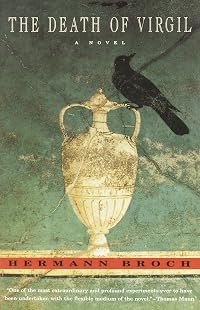
The Death of Virgil
by Hermann Broch
On This Page
Description
It is the reign of the Emperor Augustus, and Publius Vergilius Maro, the poet of the Aeneid and Caesar's enchanter, has been summoned to the palace, where he will shortly die. Out of the last hours of Virgil's life and the final stirrings of his consciousness, the Austrian writer Hermann Broch fashioned one of the great works of twentieth-century modernism, a book that embraces an entire world and renders it with an immediacy that is at once sensual and profound. Begun while Broch was show more imprisoned in a German concentration camp, The Death of Virgil is part historical novel and part prose poem -- and always an intensely musical and immensely evocative meditation on the relation between life and death, the ancient and the modern. show lessTags
Recommendations










Member Recommendations
Member Reviews
Hermann Broch was fifty-one years old in 1937 when he began to write The Death of Virgil. In doing this he was adhering to certain principles that he had outlined in an essay, "Joyce and the Present Age", written in the previous year. In this essay he argued that "the work of art, the "universal work of art" becomes the mirror of the Zeitgeist"; that being the totality of the historic reality of the present age. This totality is reflected in great works of art like Faust and the late works of Beethoven. Reaching his fiftieth year was significant for Broch as a time that would allow him to achieve this sort of significance in his own writing. The work known as The Death of Virgil would be his "great work of art".
With the use of third show more person narrative that often seems like a "stream of consciousness" Hermann Broch is able to put the reader inside the head of Virgil for much of the book. From the opening pages we meet a poet/artist Virgil who is on the edge of life in several different respects. The edge between water and land is explored as Virgil's ship, one among the parade of ships escorting Augustus back to the port of Brundisium in Roman Italy, sails toward land on the first page of the novel.
"as the sunny yet deathly loneliness of the sea changed with the peaceful stir of friendly human activity where the channel, softly enhanced by the proximity of human life and human living, was populated by all sorts of craft". (p 11)
The sunny sea is seen as also deathly in its loneliness. This signals another edge that will be important throughout the novel as Virgil in his illness hovers between life and death. Further there is the personal and historical background with the tension between Virgil and Augustus mirroring that of Athens and Rome. Even though Virgil dearly loved the life of study and thought in Athens he was torn by his memories of home as he arrived in Brundisium:
"lifted up in the breath of the immutable coolness, borne forward to seas so enigmatic and unknown that it was like a homecoming, for wave upon wave of the great planes through which his keel had already furrowed, wave-planes of memory, wave-planes of seas, they had not become transparent, nothing in them had divulged itself to him, only the enigma remained, and filled with the enigma of the past overflowed its shores and reached into the present, so that in the midst of the resinous torch-smoke, in the midst of the brooding city fumes, , , how they all lay behind him, about him, within him, how entirely they were his own," (p 31)
Throughout the beginning of the novel, a section titled "Water--The Arrival", Virgil is filled with doubts. He is nearing the end of his life with a feeling that "it was time itself that called down scorn upon him, the unalterable flood of time with its manifold voices," and he may not be able to escape his fate. But what was that fate and why was it important to him as creator? This is something that he is unsure of even to the point of asking himself why he was writing this book (The Aeneid which is always by his side).
"Nothing availed the poet, he could right no wrongs; he is heeded only if he extols the world, never if he portrays it as it is. Only falsehood wins renown, not understanding! And could one assume that the Aeneid would be vouchsafed another or better influence?" (p 15)
His own Aeneid as quoted epigraphically by Broch suggests that Virgil is "exiled by fate" just as his creation, Aeneas, was. Is that the fate of all poets? Must they be exiled by their fate to become an artist of this world? Perhaps the final three sections of The Death of Virgil will suggest answers to these and other questions. show less
With the use of third show more person narrative that often seems like a "stream of consciousness" Hermann Broch is able to put the reader inside the head of Virgil for much of the book. From the opening pages we meet a poet/artist Virgil who is on the edge of life in several different respects. The edge between water and land is explored as Virgil's ship, one among the parade of ships escorting Augustus back to the port of Brundisium in Roman Italy, sails toward land on the first page of the novel.
"as the sunny yet deathly loneliness of the sea changed with the peaceful stir of friendly human activity where the channel, softly enhanced by the proximity of human life and human living, was populated by all sorts of craft". (p 11)
The sunny sea is seen as also deathly in its loneliness. This signals another edge that will be important throughout the novel as Virgil in his illness hovers between life and death. Further there is the personal and historical background with the tension between Virgil and Augustus mirroring that of Athens and Rome. Even though Virgil dearly loved the life of study and thought in Athens he was torn by his memories of home as he arrived in Brundisium:
"lifted up in the breath of the immutable coolness, borne forward to seas so enigmatic and unknown that it was like a homecoming, for wave upon wave of the great planes through which his keel had already furrowed, wave-planes of memory, wave-planes of seas, they had not become transparent, nothing in them had divulged itself to him, only the enigma remained, and filled with the enigma of the past overflowed its shores and reached into the present, so that in the midst of the resinous torch-smoke, in the midst of the brooding city fumes, , , how they all lay behind him, about him, within him, how entirely they were his own," (p 31)
Throughout the beginning of the novel, a section titled "Water--The Arrival", Virgil is filled with doubts. He is nearing the end of his life with a feeling that "it was time itself that called down scorn upon him, the unalterable flood of time with its manifold voices," and he may not be able to escape his fate. But what was that fate and why was it important to him as creator? This is something that he is unsure of even to the point of asking himself why he was writing this book (The Aeneid which is always by his side).
"Nothing availed the poet, he could right no wrongs; he is heeded only if he extols the world, never if he portrays it as it is. Only falsehood wins renown, not understanding! And could one assume that the Aeneid would be vouchsafed another or better influence?" (p 15)
His own Aeneid as quoted epigraphically by Broch suggests that Virgil is "exiled by fate" just as his creation, Aeneas, was. Is that the fate of all poets? Must they be exiled by their fate to become an artist of this world? Perhaps the final three sections of The Death of Virgil will suggest answers to these and other questions. show less
So why is Virgil upset with his art?
...and this was the very reason why he had never succeeded in depicting real human beings, people who ate and drank, who loved and could be loved, and this was why he was so little able to depict those who went limping and cursing through the streets, unable to picture them in their bestiality and their great need of help, least able to show forth the miracle of humanity with which such bestiality is graced; people meant nothing to him, he considered them as fabulous beings, mimes of beauty in the garments of beauty, and as such he had depicted them, as kings and heroes of fables, as fable-shepherds...
from pp.152-3
Close to the bone and not hard to understand. Among other people, I recommend this book show more for writers with angst. His work has been insincere, his eye for beauty has led him astray, he has been no help to the real human world. He wants to start again but it's too late for that...
I've learnt that the German and this English translation were published simultaneously, and Broch worked closely with Untermeyer. I found the English words amazingly chosen for sound and sense. Or where sense escapes us, yet for sound: there is great artistry in the translation.
For the rest, see my updates. They were spontaneous (that’s the use of these status updates).
Believe me or not, although I’ve read this book in bits and pieces over a year, I can’t wait to start on the second read. Maybe I got about a half of it the first time.
Note to self: I don’t expect I’ll have the brains to peruse this book in the week of my death. But read the last part. It’s only forty pages, it’s less difficult than part two can be; and it talks of death in a way an atheist like me who yet is an optimist by temperament, finds meaningful. It’s Virgil’s inside experience – of a voyage, that cannot help but remind me of the Grey Havens and Frodo’s departure by ship. In mood, moreover – except that we’re not the ones left on the shore (because of course I cry at the Grey Havens. But not here). The farewell voyage goes on into an experience of the animism of the cosmos. Schooled by this I think I can face the extinguishment of self, which I’ve never been known to say before, self-centred as I am. He understands: Where, however, was his own face in this universe?
Is there a Christian presence? Yes, because such is a part of Virgil’s legend. As a non-Christian, I can read those allusions as historical, and ‘the word’ as an answer to, or last thoughts on, his poet’s obsessions and dissatisfactions. Virgil felt on the verge of – what? A new artistic expression, or a salvation through human service? The medievals took him for a herald of Christianity, I believe on the strength of a prophecy of Augustus. There’s enough irony there for this politically-aware novel to use: the writing was begun in a concentration camp and the Nazis were a shadowy presence in part one. Still in this novel, perhaps, if you’re Christian you can see Christianity and if you don’t want to you don’t have to.
Negatives: the conversations on aesthetics, though to be fair Virgil, at his last gasp, finds these fatuous too; and the philosophical poems, which I skimmed or skipped since I cannot do poetry about abstractions.
If you’re curious about this book but daunted, I think you can try out the fourth part on its own, or ahead. It’s of great beauty (look, that’s an understatement, and the translation must be a miracle) and there are no spoilers. You know he’s dead at the end, right? show less
...and this was the very reason why he had never succeeded in depicting real human beings, people who ate and drank, who loved and could be loved, and this was why he was so little able to depict those who went limping and cursing through the streets, unable to picture them in their bestiality and their great need of help, least able to show forth the miracle of humanity with which such bestiality is graced; people meant nothing to him, he considered them as fabulous beings, mimes of beauty in the garments of beauty, and as such he had depicted them, as kings and heroes of fables, as fable-shepherds...
from pp.152-3
Close to the bone and not hard to understand. Among other people, I recommend this book show more for writers with angst. His work has been insincere, his eye for beauty has led him astray, he has been no help to the real human world. He wants to start again but it's too late for that...
I've learnt that the German and this English translation were published simultaneously, and Broch worked closely with Untermeyer. I found the English words amazingly chosen for sound and sense. Or where sense escapes us, yet for sound: there is great artistry in the translation.
For the rest, see my updates. They were spontaneous (that’s the use of these status updates).
Believe me or not, although I’ve read this book in bits and pieces over a year, I can’t wait to start on the second read. Maybe I got about a half of it the first time.
Note to self: I don’t expect I’ll have the brains to peruse this book in the week of my death. But read the last part. It’s only forty pages, it’s less difficult than part two can be; and it talks of death in a way an atheist like me who yet is an optimist by temperament, finds meaningful. It’s Virgil’s inside experience – of a voyage, that cannot help but remind me of the Grey Havens and Frodo’s departure by ship. In mood, moreover – except that we’re not the ones left on the shore (because of course I cry at the Grey Havens. But not here). The farewell voyage goes on into an experience of the animism of the cosmos. Schooled by this I think I can face the extinguishment of self, which I’ve never been known to say before, self-centred as I am. He understands: Where, however, was his own face in this universe?
Is there a Christian presence? Yes, because such is a part of Virgil’s legend. As a non-Christian, I can read those allusions as historical, and ‘the word’ as an answer to, or last thoughts on, his poet’s obsessions and dissatisfactions. Virgil felt on the verge of – what? A new artistic expression, or a salvation through human service? The medievals took him for a herald of Christianity, I believe on the strength of a prophecy of Augustus. There’s enough irony there for this politically-aware novel to use: the writing was begun in a concentration camp and the Nazis were a shadowy presence in part one. Still in this novel, perhaps, if you’re Christian you can see Christianity and if you don’t want to you don’t have to.
Negatives: the conversations on aesthetics, though to be fair Virgil, at his last gasp, finds these fatuous too; and the philosophical poems, which I skimmed or skipped since I cannot do poetry about abstractions.
If you’re curious about this book but daunted, I think you can try out the fourth part on its own, or ahead. It’s of great beauty (look, that’s an understatement, and the translation must be a miracle) and there are no spoilers. You know he’s dead at the end, right? show less
Hermann Broch's The Death of Virgil revolves about the poet's wish to burn his masterpiece, The Aeneid, and creates out of his signified keen senses and heightened perceptions a rich vision, with full actuality, the religious, philosophical and political impulses of the time. The novel should be read as an epic poem in four parts (water, fire, earth, air) that parallel to four movements of a symphony in which the manner of the theme and variations of each successive part serves as some kind of commentary and reiteration on the parts that have preceded it.
The book is arduous in reading, strenuous in contemplating the richly lyrical prose. Woven and sifted throughout are reflections and perceptions of Virgil's febrile yet lucid thoughts show more in such rocking rhythms that illuminate, to the full actuality, the macabre sensation of the drifting journey on which the poet is being carried by the bark of death. Death's signet was graved upon his brow. The epic closely accounts for the last 24 hours of Virgil's life as soon as the near-death poet returns to Rome from Athens. The uninterrupted flow of lyrical speculation begins at the port of Brundisium where the bark docks, lingers in the mental suspension between life and death, between the "no longer alive" and "not yet dead", and ends with the journey to death, to nothingness, to a dimension of non-recollection and stillness.
Truth seems to be the recurring theme. The notion of truth is being illuminated and brought to full elaboration through the repeating insistence of reflections on life, death, memory, knowledge, perception, and philosophy. As the poet approached death, he admits with bitterness and cold sobriety that he has pursued a worthless, wretched literary life. The Aeneid, which is acclaimed by Caesar and to whom it is dedicated, has been a mere indulgence of beauty, self-sufficiently limited to the embellishment of concepts long since conceived, formed, and known, without any novel contribution in it. The truth of artistic inadequacies, lack of perceptions, thirst for superficialities, and egotism yields the decision to mock his works. Despite Caesar's effort to cajole Virgil, the poet comments that he lacks the perception, to which he never takes the first step, and yet nobody has ever attained the knowledge of truth of such perception.
The stream of consciousness technique renders the poet's final hours to the full actuality. In fact, Virgil regards death as the most significant event of his life (perception and knowledge of truth?) and is full of anxiety lest he miss it. His sense of time seems to be warped and each passing second has grown to some immense, throbbing, empty space which is not to be linked. The body and its human qualities are denuded and are stripped to the naked soul with the most naked guilt. For Virgil, death is part of life and the understanding of death enlightens meaning of life. Strong than death and the shackle of time is fate, in which the final secret of time lay hidden. It is for this very secret of time (and death) that the suspense and tension of the book not being thwarted.
The conversations are reproductions of external events and actual dialogues (Aeneid, Georgics, Eclogue, Horace Carmina) and their inclusion into the book's inner monologue (the narrative seems to have proceeded in the third person but soon has discerned that narrative constitutes to an inner monologue made up of Virgil's dreams, reflections, visions, and delusions) gains them an abstract touch. The flow of the book presses on through various tempi according to the degree of Virgil's consciousness. The more headlong the tempo (which usually occurs during Virgil's conversations with his friends, attendants, and Caesar), the shorter the sentence. The slower the tempo becomes, the more complicated the sentence structure (i.e. Part 2 - Fire). Virgil's reflections and musings manifest some interminable, richly lyrical prose that mirrors the dying poet's thoughts and ravings.
The writing also deftly alludes to the religious impulse at the time of Virgil. Talks of the coming of salvation bringer prevail in Virgil's conversations with Caesar, who denies the need of such salvation. In various occasions Virgil forebodes the coming of a savior who will not only live in the perception, but in his being the world will be redeemed to truth, whom will conquer death and bring himself to the sacrifice out of love for men and mankind, transferring himself by his own death into the deed of truth. Virgil's audacious statement signifies the turning point in history, the crisis of the godless era between the no longer antiquity and the net yet of Christianity.
From Broch's own words, nothing is really "reported or perceived" in the book but what "penetrates the invisible web of sensual data, fever visions and speculations." The richness of the writing and its lyrics sharpens the contours of the concrete and brings to full actuality Virgil's musings and memories. It's a strenuous, challenging read that requires undivided concentration. show less
The book is arduous in reading, strenuous in contemplating the richly lyrical prose. Woven and sifted throughout are reflections and perceptions of Virgil's febrile yet lucid thoughts show more in such rocking rhythms that illuminate, to the full actuality, the macabre sensation of the drifting journey on which the poet is being carried by the bark of death. Death's signet was graved upon his brow. The epic closely accounts for the last 24 hours of Virgil's life as soon as the near-death poet returns to Rome from Athens. The uninterrupted flow of lyrical speculation begins at the port of Brundisium where the bark docks, lingers in the mental suspension between life and death, between the "no longer alive" and "not yet dead", and ends with the journey to death, to nothingness, to a dimension of non-recollection and stillness.
Truth seems to be the recurring theme. The notion of truth is being illuminated and brought to full elaboration through the repeating insistence of reflections on life, death, memory, knowledge, perception, and philosophy. As the poet approached death, he admits with bitterness and cold sobriety that he has pursued a worthless, wretched literary life. The Aeneid, which is acclaimed by Caesar and to whom it is dedicated, has been a mere indulgence of beauty, self-sufficiently limited to the embellishment of concepts long since conceived, formed, and known, without any novel contribution in it. The truth of artistic inadequacies, lack of perceptions, thirst for superficialities, and egotism yields the decision to mock his works. Despite Caesar's effort to cajole Virgil, the poet comments that he lacks the perception, to which he never takes the first step, and yet nobody has ever attained the knowledge of truth of such perception.
The stream of consciousness technique renders the poet's final hours to the full actuality. In fact, Virgil regards death as the most significant event of his life (perception and knowledge of truth?) and is full of anxiety lest he miss it. His sense of time seems to be warped and each passing second has grown to some immense, throbbing, empty space which is not to be linked. The body and its human qualities are denuded and are stripped to the naked soul with the most naked guilt. For Virgil, death is part of life and the understanding of death enlightens meaning of life. Strong than death and the shackle of time is fate, in which the final secret of time lay hidden. It is for this very secret of time (and death) that the suspense and tension of the book not being thwarted.
The conversations are reproductions of external events and actual dialogues (Aeneid, Georgics, Eclogue, Horace Carmina) and their inclusion into the book's inner monologue (the narrative seems to have proceeded in the third person but soon has discerned that narrative constitutes to an inner monologue made up of Virgil's dreams, reflections, visions, and delusions) gains them an abstract touch. The flow of the book presses on through various tempi according to the degree of Virgil's consciousness. The more headlong the tempo (which usually occurs during Virgil's conversations with his friends, attendants, and Caesar), the shorter the sentence. The slower the tempo becomes, the more complicated the sentence structure (i.e. Part 2 - Fire). Virgil's reflections and musings manifest some interminable, richly lyrical prose that mirrors the dying poet's thoughts and ravings.
The writing also deftly alludes to the religious impulse at the time of Virgil. Talks of the coming of salvation bringer prevail in Virgil's conversations with Caesar, who denies the need of such salvation. In various occasions Virgil forebodes the coming of a savior who will not only live in the perception, but in his being the world will be redeemed to truth, whom will conquer death and bring himself to the sacrifice out of love for men and mankind, transferring himself by his own death into the deed of truth. Virgil's audacious statement signifies the turning point in history, the crisis of the godless era between the no longer antiquity and the net yet of Christianity.
From Broch's own words, nothing is really "reported or perceived" in the book but what "penetrates the invisible web of sensual data, fever visions and speculations." The richness of the writing and its lyrics sharpens the contours of the concrete and brings to full actuality Virgil's musings and memories. It's a strenuous, challenging read that requires undivided concentration. show less
"La muerte de Virgilio" de Hermann Broch es una novela publicada en 1945, considerada una de las obras más innovadoras del siglo XX. La historia narra las últimas dieciocho horas de vida del poeta Virgilio, quien, enfermo y atormentado, reflexiona sobre su legado y la posibilidad de destruir su obra maestra, La Eneida
Hermann Broch was an Austrian German Jew whose marriage with Franziska von Rothermann, the Catholic daughter of a knighted manufacturer, produced a son. After the age of about 40, and devotion to family and businesses, Hermann turned to a literary and political project, of which The Death of Virgil is one of its prominences. Begun in 1937, continued while imprisoned by Nazis without a trial, and only completed in 1945 after escaping to America with the help of many decent people.
According to literary historians, the greatness of this novel is in part attributed to "the mode in which it is written, for it is actually a single extended monologue in which Virgil's thoughts and visions are systematically elevated from the depths of show more presentiment to a consciously articulated word". [EBSCO bio]
In her Introduction, Hannah Arendt points out that the plot is "dying itself in the sense that it is the story of a man who feels the most significant thing of his life", its end, is approaching. And of course, death promises to visit all of us. It is this universalist theme which Broch rhythmically repeats.
Broch writes in a parallel to the historical, for example, where Virgil despairs of poetry and the legitimacy of authority, and in real life is reported to have sought to destroy the manuscript of the Aeneid. Even here, where Beauty is fitfully and cruelly excluded from expression and our pretended reality, it yet emerges and even satisfies the "vulgar ingratitude of men". show less
According to literary historians, the greatness of this novel is in part attributed to "the mode in which it is written, for it is actually a single extended monologue in which Virgil's thoughts and visions are systematically elevated from the depths of show more presentiment to a consciously articulated word". [EBSCO bio]
In her Introduction, Hannah Arendt points out that the plot is "dying itself in the sense that it is the story of a man who feels the most significant thing of his life", its end, is approaching. And of course, death promises to visit all of us. It is this universalist theme which Broch rhythmically repeats.
Broch writes in a parallel to the historical, for example, where Virgil despairs of poetry and the legitimacy of authority, and in real life is reported to have sought to destroy the manuscript of the Aeneid. Even here, where Beauty is fitfully and cruelly excluded from expression and our pretended reality, it yet emerges and even satisfies the "vulgar ingratitude of men". show less
Gorgeous prose -- I could see everything before me, both real and surreal. I didn't understnd the stream of consciousness, but the narrative concerned Virgil's wanting to burn his ms. of Aeneid and Augustus arguing against it. The last part was Virgil crossing the Styx.
The Roman poet, frustrated from abstruseness and corruption of political and social life, decides in the last hours before his death to burn his masterpiece “Aneid”. Broch wrote this novel, undoubtedly being frustrated from personal situation and political circumstances and tired to death like his protagonist.
Members
- Recently Added By
Lists

The Guardian's 1000 Novels Everyone Must Read
1,005 works; 551 members

1001 Books You Must Read Before You Die
1,448 works; 1,134 members
1940s
221 works; 25 members

German Literature
518 works; 56 members

Philip Ward's Lifetime Reading Plan
592 works; 22 members

Canon de la narrativa universal del siglo XX
254 works; 6 members

Experimental Literature
141 works; 19 members
Most difficult novels
68 works; 27 members

Blue Pyramid 1,276 Best Books of All Time
1,248 works; 32 members

Writers as Characters in Fiction
120 works; 19 members

Books Read in 2016
4,666 works; 199 members
Canon de la narrativa universal del s. XX (cicutadry)
499 works; 3 members
.
396 works; 1 member

Harold Bloom - The Western Canon: D. The Chaotic Age
833 works; 24 members

The 150 Greatest Novels of All Time
150 works; 6 members

My TBR
371 works; 3 members

Fiction with Men's Given Names in the Title
302 works; 11 members

Best of World Literature
435 works; 52 members
Author Information

132+ Works 4,048 Members
Hermann Broch was a novelist, playwright, mathematician, and engineer. He was born in Vienna in 1886; he came to the United States in 1938. The Sleepwalkers (1932) Broch's prose trilogy describes three stages in the disintegration of modern European society. The Death of Virgil (1945), whom Broch considered a prototype of the modern individual, show more depicts the last eighteen hours of the life of Virgil. Broch's vision of the immanence of death will probably be regarded as his most original contribution to human experience. Broch was awarded a Guggenheim Fellowship (1941-42), a membership in the American Institute of Arts and Letters (1942), and a Rockefeller Fellowship for Philosophical and Psychological Research at Princeton (1942-44). Broch died in 1951. (Bowker Author Biography) Hermann Broch was a novelist and playwright. He was born in Vienna on November 1, 1886. Broch studied physics, mathematics, and philosophy at the University of Vienna. Broch's first major work was the trilogy, The Sleepwalkers, which used historical events in the Europe of the late 19th and early 20th centuries to illustrate the decline of European society. His book The Seducer, caused Adolf Hitler to send Broch to a Nazi prison for five months. An international group of artists that included James Joyce arranged for Broch to escape to the United States. Broch's last novel was The Death of Virgil. After its release in 1945, Broch devoted himself to works on political theory and to helping European refugees. Broch died on May 30, 1951. (Bowker Author Biography) show less
Some Editions
Awards and Honors
Notable Lists
Series
Belongs to Publisher Series
Work Relationships
Has as a supplement
Common Knowledge
- Canonical title
- The Death of Virgil
- Original title
- Der Tod des Vergil
- Original publication date
- 1945
- People/Characters
- Virgil; Augustus Caesar; Plotius Tucca; Lucius Varius Rufus; Lysanias
- Important places
- Ancient Rome; Brindisi, Apulia, Italy; Brindisi, Italy
- Important events
- 1st century BCE
- Epigraph*
- ... fato profugus ...
Vergil: Aeneis 1,2
Deutschsprachige Nachdichtung von Wilhelm Hertzberg:
... durch das Geschick landflüchtig ...
... Da iungere dextram,
da, genitor, teque amplexu ne subtrahe nostro.
Sic memorans, largo fletu simul ora rigabat.
Ter conatus ibi collo dare bracchia circum,
ter frustra comprensa manus effugit imago,
Vergil: Aeneis VI, 697-702
Deutschsprachige Nachdichtung von Wilhelm Hertzberg:
... "Oh, reiche die Rechte,
Reiche sie, Vater, mir dar und entzieh dich nicht der Umarmung!"
Sprach's und ein Strom von Tränen benetzt bei den Worten sein Antlitz.
Dreimal versucht' er ihm drauf mit den Armen den Hals zu umschlingen
Dreimal griff er umsonst nach dem Bild, das den Händen entschlüpfte
Ähnlich dem Hauche der Luft, dem geflügelten Traum vergleichbar.
Lo duca ed io per quel cammino ascoso
Etrammo a ritornar nel chiaro mondo;
E, senza cura aver d'alcun riposo,
Salimmo su, ei primo ed io secondo,
Tanto ch'io vidi delle cose belle
Che porta il ciel, p... (show all)er un pertugio tondo;
E quindi uscimmo a riveder le stelle.
Dante: Divina Commedia, Inferno XXXIV, 133-139
Deutschsprachige Nachdichtung von Karl Witte:
Auf so verborgenem Pfad begann mein Führer
Mit mir zur lichten Welt zurückzukehren.
So stiegen, er zuerst und ich ihm folgend,
Wir, ohn' uns Ruh zu gönnen, immer aufwärts,
Bis durch ein rundes Loch ich wieder etwas
Von dem gewahr ward, was den Himmel schmückt;
Dann traten wir hinaus und sahn die Sterne. - Dedication*
- In memoriam Stephen Hudson
- First words*
- Stahlblau und leicht, bewegt von einem leisen, kaum merklichen Gegenwind, waren die Wellen des Adriatischen Meeres dem kaiserlichen Geschwader entgegengeströmt, als dieses, die mählich anrückenden Flachhügel der kalabrisc... (show all)hen Küste zur Linken, dem Hafen Brundisium zusteuerte, und jetzt, da die sonnige, dennoch so todesahnende Einsamkeit der See sich ins friedvoll Freudige menschlicher Tätigkeit wandelte, da die Fluten, sanft überglänzt von der Nähe menschlichen Seins und Hausens, sich mit vielerlei Schiffen bevölkerten, mit solchen, die gleicherweise dem Hafen zustrebten, mit solchen, die aus ihm ausgelaufen waren, jetzt, da die braunsegeligen Fischerboote bereits überall die kleinen Schutzmolen all der vielen Dörfer und Ansiedlungen längs der weißbespülten Ufer verließen, um zum abendlichen Fang auszuziehen, da war das Wasser beinahe spiegelglatt geworden; perlmuttern war darüber die Muschel des Himmels geöffnet, es wurde Abend, und man roch das Holzfeuer der Herdstätten, sooft die Töne des Lebens, ein Hämmern oder ein Ruf von dort hergeweht und herangetragen wurden.
- Original language
- German
- Canonical DDC/MDS
- 838.9923
*Some information comes from Common Knowledge in other languages. Click "Edit" for more information.
Classifications
- Genres
- General Fiction, Fiction and Literature, Historical Fiction
- DDC/MDS
- 838.9923 — Literature & rhetoric German & related literatures German miscellaneous writings 1900- Austria Fiction
- LCC
- PT2603 .R657 .T613 — Language and Literature German, Dutch and Scandinavian literatures German literature Individual authors or works 1860/70-1960
- BISAC
Statistics
- Members
- 1,391
- Popularity
- 17,055
- Reviews
- 16
- Rating
- (4.05)
- Languages
- 19 — Catalan, Czech, Danish, Dutch, English, Estonian, Finnish, French, German, Greek, Italian, Norwegian (Bokmål), Polish, Russian, Serbian, Spanish, Swedish, Turkish, Portuguese (Portugal)
- Media
- Paper, Ebook
- ISBNs
- 43
- ASINs
- 20