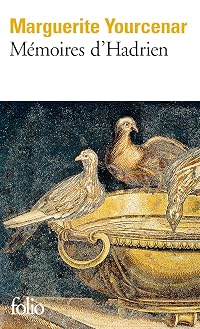
Memoirs of Hadrian
by Marguerite Yourcenar
On This Page
Description
Both an exploration of character and a reflection on the meaning of history, "Memoirs of Hadrian" has received international acclaim since its first publication in France in 1951. In it, Marguerite Yourcenar reimagines the Emperor Hadrian's arduous boyhood, his triumphs and reversals, and finally, as emperor, his gradual reordering of a war-torn world, writing with the imaginative insight of a great writer of the twentieth century while crafting a prose style as elegant and precise as those show more of the Latin stylists of Hadrian's own era. show lessTags
Recommendations





















Member Recommendations

nessreader Literary historical fiction, about the later roman empire, the decline and fall. sumptuously written.
Member Reviews
Trata-se de um dos melhores livros que já li. Essas memórias imaginadas pela autora são mais que um romance histórico, trata-se da própria discussão do que é história, quem define as narrativas que permanecem, quanto tempo essas narrativas podem valer. Mas vai além, se coloca dentro do personagem de uma maneira tão verdadeira que o personagem que era de carne e osso revive perante nossos olhos, sua visão de mundo, sem filtros, e ao mesmo tempo um personagem vivo com a consciência que seu depoimento é escrito e vai para a história e que por isso é uma narrativa seletiva e eventualmente pode não ser perfeita. Incrível. Uma leitura em tantas camadas que é necessário ler novamente para captar tudo.
Whoever recommended this to me: thank you and apologies for forgetting who you are. I found it absolutely beguiling. The emperor Hadrian looks back upon his life at its end, writing to explain himself and instruct his heir. Yourcenar evokes the Roman empire with seemingly effortless grace. Given the beauty of the translation, I wasn’t surprised to find it was done by her ‘great friend’ (possible partner?). The combination of luminous writing and philosophical insight is utterly irresistible. I read certain paragraphs several times to luxuriate in their exquisitely expressed insight - rare behaviour for a speed-reader like me. An example:
It feels appropriate to review such sumptuous writing in a living room heavy with the scent of lilies. Hadrian’s narrative is grounded in sensuous detail, although it explores the abstractions of religious and philosophical thought. As an aging man, he is very aware of his body’s weaknesses and the approach of death. He contemplates his legacy with a magisterial air that could easily have descended into arrogance and pomposity in the hands of a lesser writer:
In an excellent afterword reflecting on the book’s composition, Yourcenar briefly recounts the decades of thought and research that went into the creation of such a vivid narrative voice. This novel is a truly amazing and profound work, not quite like anything I’ve read before. show less
Rome, which I was first to venture to call ‘eternal’, would come to be more and more likeshow more
the mother deities of the cults of Asia, bearer of youths and of harvests, sheltering at her breast both the lions and the hives of bees.
But anything made by man which aspires to eternity must adapt itself to the changing rhythm of nature’s great bodies, to accord with celestial time. Our Rome is no longer the village of the days of Evander, big with a future which has already partly passed by; the plundering Rome of the time of the Republic has performed its role; the mad capital of the first Caesars inclines now to greater sobriety; other Romes will come, whose forms I see but dimly, but whom I shall have helped to mould. When I was visiting ancient cities, sacred but wholly dead, I promised myself to save this Rome of mine from the petrification of a Thebes, a Babylon, or a Tyre. She would no longer be bound by her body of stone, but would compose for herself from the words State, citizenry, and republic a surer immortality.
It feels appropriate to review such sumptuous writing in a living room heavy with the scent of lilies. Hadrian’s narrative is grounded in sensuous detail, although it explores the abstractions of religious and philosophical thought. As an aging man, he is very aware of his body’s weaknesses and the approach of death. He contemplates his legacy with a magisterial air that could easily have descended into arrogance and pomposity in the hands of a lesser writer:
I have sometimes reproached myself for not having taken the precaution of engendering a son, to follow me. But such a vain regret rests on two hypotheses, equally doubtful: first, that a son necessarily continues us, and second, that the strange mixture of good and evil, that mass of minute and odd particularities which make up a person, deserves continuation. I have put my virtues to use as well as I could, and have profited from my vices likewise, but I have no special concern to bequeath myself to anyone. It is not by blood, anyhow, that man’s true continuity is established.
In an excellent afterword reflecting on the book’s composition, Yourcenar briefly recounts the decades of thought and research that went into the creation of such a vivid narrative voice. This novel is a truly amazing and profound work, not quite like anything I’ve read before. show less
My initial review gave this 15 stars, and here is why.
For much of this book I kept asking myself the same question - who am I listening to? Hadrian or Marguerite Yourcenar? Perhaps it is best to read the final chapter of this book first - ‘Reflections On The Composition’, it gives you an insight into not only the women who wrote the book, but the Herculean effort she put into creating it.
Marguerite Yourcenar was not only a writer, but she was also an academic, translator, poet, feminist and literary critic. Born in 1903 into a Franco-Belgium family, after the death of her mother she was home educated by her French father. She was a voracious reader, burying herself in Greek and Latin writers, her favourite author was Virgil.
Memoirs show more of Hadrian took over 30 years to write. Yourcenar originally conceived the idea in 1924 and worked on it for 5 years, before destroying all her work. She resumed the project in-between 1934 -1937, only to abandon it again, with only a single sentence surviving.
"I begin to discern the profile of my death"
But Hadrian would not go away, and she dedicated huge parts of her life trying to understand the man and the world he lived in.
“The rules of the game: learn everything, read everything, inquire into everything…When two texts, or two assertions, or perhaps two ideas, are in contradiction, be ready to reconcile them rather than cancel one by the other; regard them as two different facets, or two successive stages, of the same reality, a reality convincingly human just because it is complex. Strive to read a text of the Second Century with the eyes, soul, and feelings of the Second Century.”
The work was finally published in 1951.
Memoirs of Hadrian is magnificent. Written as an extended letter from Hadrian to his successor, Marcus Aurelius, the novel immediately takes you back to 2nd Century Rome.
Through self-analysis it explores conflict, the turmoil of war, loss, love, failures and regrets. Hadrian’s frankness teaches us about the complexities of leadership, of justice and of law.
"Respect for ancient laws answers what is deepest rooted about piety, but it servers also to pillow the inertia of judges. The oldest codes are a part of that very savagery which they were striving to correct; even the most venerable among them are the product of force. Most of our punitive laws fail, perhaps happily, to reach the greater part of the culprits; our civil laws will never be supple enough to fit the immense and changing diversity of facts"
Hadrian’s admiration for Greek philosophy, art and literature lie at the heart of the book. His romance with Antinous, a Greek youth, and the tragedy of their doomed romance examines the nature of love and exposes Hadrian’s vulnerabilities and weakness. It’s the most passionate part of the novel.
In 1980 Marguerite Yourcenar became the first woman elected to the Academie Francaise, an institution established in 1635 to preserve French literature and language.
Memoirs of Hadrian was one of the finest novels of the last century and an absolute joy to read. I marvel at the genius of Marguerite Yourcenar. She set herself the highest possible standard of achievement, then surpassed it by a distance.
I must thank my reading buddies for this, Debi, Lisa and Mark. They guided me through it with charm and grace and intelligence, I couldn’t have read it without them, not even close. Please read their reviews here:
Lisa - https://www.goodreads.com/review/show/7213943931
Mark - https://www.goodreads.com/review/show/3411581580
Debi - https://www.goodreads.com/review/show/7218544781
I always though that the greatest paragraph to end a novel belonged to Stephen Becker’s A Covenant With Death.
But I was wrong, it is here in Memoirs of Hadrian -
Little soul, gentle and drifting, guest and companion of my body, now you will dwell below in pallid places, stark and bare; there you will abandon your play of yore. But one moment still, let us gaze together on these familiar shores, on these objects which doubtless we shall not see again…Let us try, if we can, to enter death with open eyes…
I’m sticking with 15 stars, if you could deify a book then this would be the one. show less
For much of this book I kept asking myself the same question - who am I listening to? Hadrian or Marguerite Yourcenar? Perhaps it is best to read the final chapter of this book first - ‘Reflections On The Composition’, it gives you an insight into not only the women who wrote the book, but the Herculean effort she put into creating it.
Marguerite Yourcenar was not only a writer, but she was also an academic, translator, poet, feminist and literary critic. Born in 1903 into a Franco-Belgium family, after the death of her mother she was home educated by her French father. She was a voracious reader, burying herself in Greek and Latin writers, her favourite author was Virgil.
Memoirs show more of Hadrian took over 30 years to write. Yourcenar originally conceived the idea in 1924 and worked on it for 5 years, before destroying all her work. She resumed the project in-between 1934 -1937, only to abandon it again, with only a single sentence surviving.
"I begin to discern the profile of my death"
But Hadrian would not go away, and she dedicated huge parts of her life trying to understand the man and the world he lived in.
“The rules of the game: learn everything, read everything, inquire into everything…When two texts, or two assertions, or perhaps two ideas, are in contradiction, be ready to reconcile them rather than cancel one by the other; regard them as two different facets, or two successive stages, of the same reality, a reality convincingly human just because it is complex. Strive to read a text of the Second Century with the eyes, soul, and feelings of the Second Century.”
The work was finally published in 1951.
Memoirs of Hadrian is magnificent. Written as an extended letter from Hadrian to his successor, Marcus Aurelius, the novel immediately takes you back to 2nd Century Rome.
Through self-analysis it explores conflict, the turmoil of war, loss, love, failures and regrets. Hadrian’s frankness teaches us about the complexities of leadership, of justice and of law.
"Respect for ancient laws answers what is deepest rooted about piety, but it servers also to pillow the inertia of judges. The oldest codes are a part of that very savagery which they were striving to correct; even the most venerable among them are the product of force. Most of our punitive laws fail, perhaps happily, to reach the greater part of the culprits; our civil laws will never be supple enough to fit the immense and changing diversity of facts"
Hadrian’s admiration for Greek philosophy, art and literature lie at the heart of the book. His romance with Antinous, a Greek youth, and the tragedy of their doomed romance examines the nature of love and exposes Hadrian’s vulnerabilities and weakness. It’s the most passionate part of the novel.
In 1980 Marguerite Yourcenar became the first woman elected to the Academie Francaise, an institution established in 1635 to preserve French literature and language.
Memoirs of Hadrian was one of the finest novels of the last century and an absolute joy to read. I marvel at the genius of Marguerite Yourcenar. She set herself the highest possible standard of achievement, then surpassed it by a distance.
I must thank my reading buddies for this, Debi, Lisa and Mark. They guided me through it with charm and grace and intelligence, I couldn’t have read it without them, not even close. Please read their reviews here:
Lisa - https://www.goodreads.com/review/show/7213943931
Mark - https://www.goodreads.com/review/show/3411581580
Debi - https://www.goodreads.com/review/show/7218544781
I always though that the greatest paragraph to end a novel belonged to Stephen Becker’s A Covenant With Death.
But I was wrong, it is here in Memoirs of Hadrian -
I’m sticking with 15 stars, if you could deify a book then this would be the one. show less
http://nwhyte.livejournal.com/2351691.html
The book ends up being partly a determinedly detailed and scholarly reconstruction of Hadrian's life, based on the best classical sources (as explained in a decently brief appendix), but partly also a late 1940s reflection on the experiences of conflict and sexuality in the first half of the twentieth century.
It's very good. It's not just a blow-by-blow account of events, it's an attempt to get under the skin of a man who is known only from inscriptions and a few dubiously attributable scraps. Yourcenar finds a credible voice for the aged statesman giving voice to his younger self, and explaining the big decisions that face you as a Roman emperor - the best bits are perhaps the description of show more putting to bed Trajan's legacy of conflict with Persia immediately after he assumed power, and the description of Hadrian's love for the Greek youth Antinous. (His own wife gets barely a mention; Trajan's widow Plotina is rather more visible.) But the whole thing is worth savouring and digesting. Recommended. show less
The book ends up being partly a determinedly detailed and scholarly reconstruction of Hadrian's life, based on the best classical sources (as explained in a decently brief appendix), but partly also a late 1940s reflection on the experiences of conflict and sexuality in the first half of the twentieth century.
It's very good. It's not just a blow-by-blow account of events, it's an attempt to get under the skin of a man who is known only from inscriptions and a few dubiously attributable scraps. Yourcenar finds a credible voice for the aged statesman giving voice to his younger self, and explaining the big decisions that face you as a Roman emperor - the best bits are perhaps the description of show more putting to bed Trajan's legacy of conflict with Persia immediately after he assumed power, and the description of Hadrian's love for the Greek youth Antinous. (His own wife gets barely a mention; Trajan's widow Plotina is rather more visible.) But the whole thing is worth savouring and digesting. Recommended. show less
La novela narra la vida y la muerte del emperador Adriano y está escrita en forma de epístolas que el propio Adriano escribe a su primo y sucesor Marco Aurelio. En sus cartas el emperador hace memoria de sus triunfos, sus éxitos militares y políticos y reflexiona acerca del arte y del amor. Se engloba por tanto dentro de un subgénero dentro de la novela histórica conocido como “falsas memorias”.
Al margen de que el retrato psicológico de Adriano sea en mayor o menor medida invención de la propia autora, la minuciosidad y precisión con que realiza dicho retrato, las reflexiones sobre la vida, la belleza, el arte o la muerte, y el buen hacer con que está escrita convierten a la obra en una de las novelas históricas show more imprescindibles para los amantes del género. La traducción al castellano la realizó con gran maestría Julio Cortázar. show less
Al margen de que el retrato psicológico de Adriano sea en mayor o menor medida invención de la propia autora, la minuciosidad y precisión con que realiza dicho retrato, las reflexiones sobre la vida, la belleza, el arte o la muerte, y el buen hacer con que está escrita convierten a la obra en una de las novelas históricas show more imprescindibles para los amantes del género. La traducción al castellano la realizó con gran maestría Julio Cortázar. show less
Umanità per tutte le stagioni
Non acquisto mai un libro alla volta. Fa parte della mia insicurezza. Non so mai se è il momento giusto di una storia piuttosto che un'altra, o di quella forma letteraria, di quel genere, di quell'autore, di quel tempo. L'ho comprato su commissione, anche se mi ha sempre incuriosito, ma ne ho rimandato nel tempo l'acquisto per una sorta di timore reverenziale che mi suscitava. Per tre anni questo volume ha riposato su di uno scaffale della mia libreria. Quasi come una bottiglia di vino in cantina, l'ho lasciato lì a decantare, ad ambientarsi e ad entrare piano piano nel mio panorama letterario finchè, un giorno, è stato lui a chiamarmi. Si è rivelato il momento giusto. La ricostruzione storica del show more personaggio è interessante e bilanciata. La sua grandezza sta nel consegnarci un uomo raffinato, intelligente, ma pur sempre un uomo, con tutte le sue debolezze ed i suoi tormenti. Per quanto si possa andare indietro nel tempo, la Yourcenar ci mostra in quest'uomo e in queste pagine un'attualità sconvolgente, segno che, per quanto possa evolversi la forma esteriore delle cose, la tensione umana si rivolge sempre verso le medesime inquietudini, verso la disperata ricerca di una felicità per lo più frutto di compromessi più o meno tollerabili. Lucido, poetico, a tratti commovente. Da rileggere in stagioni diverse della vita. show less
Non acquisto mai un libro alla volta. Fa parte della mia insicurezza. Non so mai se è il momento giusto di una storia piuttosto che un'altra, o di quella forma letteraria, di quel genere, di quell'autore, di quel tempo. L'ho comprato su commissione, anche se mi ha sempre incuriosito, ma ne ho rimandato nel tempo l'acquisto per una sorta di timore reverenziale che mi suscitava. Per tre anni questo volume ha riposato su di uno scaffale della mia libreria. Quasi come una bottiglia di vino in cantina, l'ho lasciato lì a decantare, ad ambientarsi e ad entrare piano piano nel mio panorama letterario finchè, un giorno, è stato lui a chiamarmi. Si è rivelato il momento giusto. La ricostruzione storica del show more personaggio è interessante e bilanciata. La sua grandezza sta nel consegnarci un uomo raffinato, intelligente, ma pur sempre un uomo, con tutte le sue debolezze ed i suoi tormenti. Per quanto si possa andare indietro nel tempo, la Yourcenar ci mostra in quest'uomo e in queste pagine un'attualità sconvolgente, segno che, per quanto possa evolversi la forma esteriore delle cose, la tensione umana si rivolge sempre verso le medesime inquietudini, verso la disperata ricerca di una felicità per lo più frutto di compromessi più o meno tollerabili. Lucido, poetico, a tratti commovente. Da rileggere in stagioni diverse della vita. show less
First of all, picking this book up right now - huge mistake. It's the sort of book that calls for reading every sentence twice. Though the kick-ass translation by Julio Cortázar did help with that, my brain has been too scattered lately to treat this book properly. It's a shame, really.
Memoires d'Hadrian is intended as a philosophical reflection on both history and individual human nature. Yourcenar covers just about every major issue you can think of - politics, sexuality and sensuality, mankind's relationship with culture, immortality. Of course, Hadrian comes across as a brilliant, sensible and cultivated man, so much that some of his opinions are suspiciously modern, even prophetic. I know, I know, Hadrian is more a literary device show more than anything else, and that's not the point and I should pretend like I didn't care. The truth is, his meditations are so engrossing in every other respect, I did forgive him - but I had to make an effort not to care.
I was heartbroken over (hardly a spoiler, but oh wellAntinous's suicide. Not because he killed himself, but rather because he did so as a statement, motivated by neglect and by a fear of feeling abandoned and growing old. He both wanted to punish Hadrian and sacrifice himself for him. And Hadrian was smart enough to understand that when it happened, but not smart enough to actually see it coming. How sad it must be, having to live with that knowledge. ).
All in all, a very good read. Probably a masterpiece. I actually feel guilty that I didn't read it properly - then it may have gotten a 5th star. show less
Memoires d'Hadrian is intended as a philosophical reflection on both history and individual human nature. Yourcenar covers just about every major issue you can think of - politics, sexuality and sensuality, mankind's relationship with culture, immortality. Of course, Hadrian comes across as a brilliant, sensible and cultivated man, so much that some of his opinions are suspiciously modern, even prophetic. I know, I know, Hadrian is more a literary device show more than anything else, and that's not the point and I should pretend like I didn't care. The truth is, his meditations are so engrossing in every other respect, I did forgive him - but I had to make an effort not to care.
I was heartbroken over (hardly a spoiler, but oh well
All in all, a very good read. Probably a masterpiece. I actually feel guilty that I didn't read it properly - then it may have gotten a 5th star. show less
Members
- Recently Added By
Published Reviews
'La mayoría de los hombres gusta resumir su vida en una fórmula, a veces jactanciosa o quejumbrosa, casi siempre recriminatoria; el recuerdo les fabrica, complaciente, una existencia explicable y clara. Mi vida tiene contornos menos definidos. Como suele suceder, lo que no fui es quizá lo que más ajustadamente la define: buen soldado pero en modo alguno hombre de guerra; aficionado al show more arte, pero no ese artista que Nerón creyó ser al morir; capaz de cometer crímenes, pero no abrumado por ellos. Pienso a veces que los grandes hombres se caracterizan precisamente por su posición extrema; su heroísmo está en mantenerse en ella toda la vida. Son nuestros polos o nuestros antípodas'. show less
added by Pakoniet
Lists

Fiction Featuring Real People
81 works; 17 members

A Good Read (Radio 4)
287 works; 1 member

.
396 works; 1 member

Slightly Foxed 2
20 works; 1 member
Talk Discussions
Past Discussions
Group Read, June 2017: Memoirs of Hadrian in 1001 Books to read before you die (June 2017)
Author Information

A French novelist, playwright, and essayist born in Belgium, Marguerite Yourcenar was a resident of the United States for many years, living in isolation on a small island off the coast of Maine. Educated at home by wealthy and cultured parents, she had a strong humanistic background, translating the ancient Greek poet Pindar and the poems of the show more modern Greek Constantine Cavafy. She has translated American Negro spirituals and works of Virginia Woolf (see Vol. 1) and Henry James (see Vol. 1). Her novels include Alexis (1929) and Coup de Grace (1939). A collection of poems, Fires, was published in 1936. Yourcenar is particularly known for Hadrian's Memoirs (1951), a philosophical meditation in the form of a fictional autobiography of the second-century Roman emperor. In Germaine Bree's judgment, "With great erudition and great psychological insight, Marguerite Yourcenar constructed a body of work that is a meditation on the destiny of mankind." In 1981, she became the first woman ever elected to the French Academy. (Bowker Author Biography) show less
Some Editions
Awards and Honors
Awards
Notable Lists
Series
Belongs to Publisher Series
dtv grossdruck (25017)
Modern Library Giant (isbn)
Biblioteca Folha (24)
Le livre de poche (0221-0222)
Nuovi Coralli [Einaudi] (189)
Anchor Books (A108)
A tot vent (290)
Penguin Books (1358)
dtv (25017)
Gallimard, Folio (921)
Work Relationships
Is contained in
Inspired
Common Knowledge
- Canonical title
- Memoirs of Hadrian
- Original title
- Mémoires d'Hadrien
- Alternate titles
- Hadrian's memoirs
- Original publication date
- 1951
- People/Characters
- Hadrian; Bar Kokhba (or Simon Bar Kokhba or bar Cochba); Antinous
- Important places
- Roman Empire
- Important events
- Reign of Hadrian (117-08-10 | 138-07-10)
- Epigraph
- Animula vagula, blandula, hospes comesque corporis, quae nunc abibis in loca pallidula, rigida, nudula, nec, ut soles, dabis iocos ... P. Aelius Hadrianus, Imp.
- Dedication*
- /
- First words
- My dear Mark,
Today I went to see my physician Hermogenes, who has just returned to the Villa from a rather long journey in Asia. - Quotations
- I am trusting to this examination of facts to give me some definition of myself, and to judge myself, perhaps, or at the very least to know myself better before I die.
Thus from each art practiced in its time I derive a knowledge which compensates me in part for pleasures lost. I have supposed, and in my better moments think so still, that it would be possible in this manner to participate ... (show all)in the existence of everyone; such sympathy would be one of the least revocable kinds of immortality.
Grammar, with its mixture of logical rule and arbitrary usage, proposes to a young mind a foretaste of what will be offered to him later on by law and ethics, those sciences of human conduct, and by all the systems whereby ma... (show all)n has codified his instinctive experience.
natura deficit, fortuna mutatur, deus omnia cernit - Last words
- (Click to show. Warning: May contain spoilers.)Let us try, if we can, to enter into death with open eyes...
- Publisher's editor*
- Einaudi
- Original language
- French
- Disambiguation notice
- 014001358X 1978 Penguin
0140061711 1982 Penguin
0140087648 1986-1987 Penguin
0140181946 1989 Penguin Classics
0141184965 2000 Penguin Modern Classics
*Some information comes from Common Knowledge in other languages. Click "Edit" for more information.
Classifications
Statistics
- Members
- 3,371
- Popularity
- 5,000
- Reviews
- 81
- Rating
- (4.19)
- Languages
- 21 — Bosnian, Catalan, Danish, Dutch, English, Estonian, Finnish, French, German, Greek, Hebrew, Italian, Norwegian (Bokmål), Portuguese, Romanian, Serbian, Croatian, Slovenian, Spanish, Swedish, Turkish
- Media
- Paper, Audiobook, Ebook
- ISBNs
- 135
- ASINs
- 75