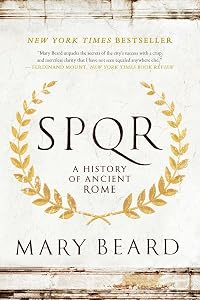
SPQR: A History of Ancient Rome
by Mary Beard
On This Page
Description
Ancient Rome was an imposing city even by modern standards, a sprawling imperial metropolis of more than a million inhabitants, a "mixture of luxury and filth, liberty and exploitation, civic pride and murderous civil war" that served as the seat of power for an empire that spanned from Spain to Syria. Yet how did all this emerge from what was once an insignificant village in central Italy? Classicist Mary Beard narrates the unprecedented rise of a civilization that even two thousand years show more later still shapes many of our most fundamental assumptions about power, citizenship, responsibility, political violence, empire, luxury, and beauty. From the foundational myth of Romulus and Remus to 212 CE -- nearly a thousand years later -- when the emperor Caracalla gave Roman citizenship to every free inhabitant of the empire, S.P.Q.R. (the abbreviation of "The Senate and People of Rome") examines not just how we think of ancient Rome but challenges the comfortable historical perspectives that have existed for centuries by exploring how the Romans thought of themselves: how they challenged the idea of imperial rule, how they responded to terrorism and revolution, and how they invented a new idea of citizenship and nation. Opening the book in 63 BCE with the famous clash between the populist aristocrat Catiline and Cicero, the renowned politician and orator, Beard animates this "terrorist conspiracy," which was aimed at the very heart of the Republic, demonstrating how this singular event would presage the struggle between democracy and autocracy that would come to define much of Rome's subsequent history. Illustrating how a classical democracy yielded to a self-confident and self-critical empire, S.P.Q.R. reintroduces us to famous and familiar characters -- Hannibal, Julius Caesar, Cleopatra, Augustus, and Nero, among others -- while expanding the historical aperture to include those overlooked in traditional histories: the women, the slaves and ex-slaves, conspirators, and those on the losing side of Rome's glorious conquests. show lessTags
Recommendations







Member Recommendations
Member Reviews
This took me two months to read on and off. Loved it. Not traditionally structured and it makes it that much fun and engaging to read. Relevant in our times of chaos. Beard makes it about the people, the institutions and the historian's accounts of the time. With context and a healthy dose of rationality. Makes you want to reach out to your local library and take out Cicero's letters or Suetonius's writings. It's a good feeling to have.
SPQR is one of those big books you see at the library or bookstore (who are we kidding?) and kind of just marvel at. Maybe I'm the only one. Who actually reads those, other than the retired? These felt insurmountable as a young teen, even as I kept impulsively thrift-store buying and storing them. When was I going to read them? Who knows. I guess when I was retired.
It makes some sense though. In our current nonfiction historical tastes, it seems that the Doctoral thesis-cum-book deal or even the bloated Medium-article microhistory is winning out more and more. These tombs seem stodgy as best, potentially dangerous at worst. My University library, of which it carries books for 60,000+ people, had only one complete copy of Edward show more Gibbon's The Decline and Fall of the Roman Empire—and it was in storage. I'm not saying I'm reading it either—I'm just saying it says a lot, no?
This is not that: Beard charts the early, mythic history of Rome to the end of the Roman millennium, around 248 AD. Each chapter (until the last third of the book) is roughly chronological, with welcome revisionist asides that place this book in a refreshingly modern context without being trendy. I've noticed in my constant book-perusing that the field of Classical study has been in a bit of uncomfortable reckoning: no matter how you spin it, there's really nothing less institutional and "ism-y" than the study itself, and a slew of (frankly weird) publications attempting to pretend that isn't the case have come out in recent years. SPQR is far from that—It explores the role of free-women, slaves, and non-citizens without making excuses for the lack of evidence about them, while also constantly reminding the reader of the yarns ancient authors spun for a good story and acknowledging that much of the juiciest bits of these histories are most likely false. Overall, it's a wonderful tone that looks at the Roman ruling elite not as gods or villains, but as political realities tangible to criticisms and praise. To everyone else, it is a wonderfully human look at their lives without being maudlin.
My only real gripe with the book is the lack of structure and depth in anything post-Augustus. Beard structures a 50-page chapter to summarize the next 200 years of Roman political rule and organizes it by Emperors and their rule and then the Senate—which was an understandable distinction given the change of the role of both but nevertheless a bit off after the relative chronology of the previous 400 pages. The weakest point is generally this last third: it's a changing, declining, expanding (whatever you want to call it) state that is obviously difficult to summarize but I still felt rushed through those years to get to the end. Beard fluffs out the ending with chapters regarding a general overview of class, gender, and evidence of expansion/colonial efforts, which I truly appreciated but wish was interspersed with a stronger chronological backbone. I love social history, don't get me wrong, but the great value of big books like these tend to (for me at least) be it's grounding and (perhaps too optimistically) ubiquity of the timeframe it reports of.
Despite all that bitching, this is an almost-addictingly readable history of Rome and I absolutely recommend it. I had a few horribly taught Roman history classes in undergrad while I was studying Classics that turned me off to learning more and this book has somehow given me a better starting point than anything those teachers could muster. Perhaps I should blame myself: I exclusively studied Greek and so tended to stay with their history classes, but for the first time ever I'm actually a bit jealous of the Latin kids of my past. Oh well. I'm sure I'll wake up tomorrow in a cold sweat and remember my poor friends' Livy lamentations of yore, haha. Anyways, I have a lifetime ahead of me so I thank this book for getting me back into this stodgy, dusty, wonderful world of Ancient Rome. show less
It makes some sense though. In our current nonfiction historical tastes, it seems that the Doctoral thesis-cum-book deal or even the bloated Medium-article microhistory is winning out more and more. These tombs seem stodgy as best, potentially dangerous at worst. My University library, of which it carries books for 60,000+ people, had only one complete copy of Edward show more Gibbon's The Decline and Fall of the Roman Empire—and it was in storage. I'm not saying I'm reading it either—I'm just saying it says a lot, no?
This is not that: Beard charts the early, mythic history of Rome to the end of the Roman millennium, around 248 AD. Each chapter (until the last third of the book) is roughly chronological, with welcome revisionist asides that place this book in a refreshingly modern context without being trendy. I've noticed in my constant book-perusing that the field of Classical study has been in a bit of uncomfortable reckoning: no matter how you spin it, there's really nothing less institutional and "ism-y" than the study itself, and a slew of (frankly weird) publications attempting to pretend that isn't the case have come out in recent years. SPQR is far from that—It explores the role of free-women, slaves, and non-citizens without making excuses for the lack of evidence about them, while also constantly reminding the reader of the yarns ancient authors spun for a good story and acknowledging that much of the juiciest bits of these histories are most likely false. Overall, it's a wonderful tone that looks at the Roman ruling elite not as gods or villains, but as political realities tangible to criticisms and praise. To everyone else, it is a wonderfully human look at their lives without being maudlin.
My only real gripe with the book is the lack of structure and depth in anything post-Augustus. Beard structures a 50-page chapter to summarize the next 200 years of Roman political rule and organizes it by Emperors and their rule and then the Senate—which was an understandable distinction given the change of the role of both but nevertheless a bit off after the relative chronology of the previous 400 pages. The weakest point is generally this last third: it's a changing, declining, expanding (whatever you want to call it) state that is obviously difficult to summarize but I still felt rushed through those years to get to the end. Beard fluffs out the ending with chapters regarding a general overview of class, gender, and evidence of expansion/colonial efforts, which I truly appreciated but wish was interspersed with a stronger chronological backbone. I love social history, don't get me wrong, but the great value of big books like these tend to (for me at least) be it's grounding and (perhaps too optimistically) ubiquity of the timeframe it reports of.
Despite all that bitching, this is an almost-addictingly readable history of Rome and I absolutely recommend it. I had a few horribly taught Roman history classes in undergrad while I was studying Classics that turned me off to learning more and this book has somehow given me a better starting point than anything those teachers could muster. Perhaps I should blame myself: I exclusively studied Greek and so tended to stay with their history classes, but for the first time ever I'm actually a bit jealous of the Latin kids of my past. Oh well. I'm sure I'll wake up tomorrow in a cold sweat and remember my poor friends' Livy lamentations of yore, haha. Anyways, I have a lifetime ahead of me so I thank this book for getting me back into this stodgy, dusty, wonderful world of Ancient Rome. show less
I really liked Ms. Beard's engaging writing style that conveys her enthusiasm for her subject. I also liked her awareness that there is more than one side to every story. I also really liked the modern perspective she brought to the subject, which includes a multidisciplinary approach and a focus on "regular folks" as well as the powerful leaders.
I was struck by the fact that many of the problems facing the Roman Empire are still with us today, including debt, inequality of influence and wealth, corruption. Makes me wonder if these are unsolvable problems that will be with us forever.
I was struck by the fact that many of the problems facing the Roman Empire are still with us today, including debt, inequality of influence and wealth, corruption. Makes me wonder if these are unsolvable problems that will be with us forever.
http://nwhyte.livejournal.com/2750319.html
One of my frustrations with Gibbon is that he starts around 100 AD without much explanation of what came before - yet for most students of classics (including me back in my Latin O-Level days) the meaty stuff comes a good century before then, with Cicero, Virgil, Ovid and all those guys. Mary Beard has looked instead at the history of Rome up to 212 AD when Caracalla granted all adults full citizenship, and it's a much more varied story. She starts with the Catiline conspiracy in 63 BC, then loops back to the mythical foundation of the city and the various conflicting accounts thereof, and then slowly progresses forward through the centuries. There is lots of fascinating circumstantial detail; I show more loved this account of an early diplomatic/lobbying mission:
Representatives from the East repeatedly came to Rome in the hope of winning moral support or military intervention. That is a running theme in the historical accounts of the period: there are plenty of envoys reported, for example, in the run-up to Aemilius Paullus’ campaign against Perseus, trying to persuade the Romans to do something about the ambitions of Macedon. But the most vivid picture of how this ‘courting’ worked in practice comes from Teos, a town on the western coast of modern Turkey. It is a mid-second-century BCE inscription recording the attempts made to draw the Romans into a minor dispute, about which nothing else is known, over some land rights between the city of Abdera in northern Greece and a local king, Kotys.
The text is a ‘thank-you letter’ carved on stone, addressed to the town of Teos by the people of Abdera. For the Teans had apparently agreed to send two men to Rome, almost lobbyists in a modern sense, to drum up Roman support for Abdera’s case against the king. The Abderans describe exactly how this pair operated, right down to their regular house calls on key members of the senate. The delegates apparently worked so hard that ‘they wore themselves out physically and mentally, and they met the leading Romans and won them over by paying obeisance to them every day’; and when some of the people they visited appeared to be on Kotys’ side (for he had also sent envoys to Rome), ‘they won their friendship by laying out the facts and paying daily calls at their atria’, that is at the main central hall of their Roman houses.
The silence of our text on the outcome of these approaches hints that things did not go the Abderans’ way. But the snapshot here of rival representatives not merely beating a path to the senate but pressing their case daily on individual senators gives an idea of just how actively and persistently Roman assistance could be sought.
Lots of interesting material about how Rome moved from Republic to Empire, how life was for people at all levels, and a great deal about how our perception of the Romans has changed over the most recent period. A fascinating long read. show less
One of my frustrations with Gibbon is that he starts around 100 AD without much explanation of what came before - yet for most students of classics (including me back in my Latin O-Level days) the meaty stuff comes a good century before then, with Cicero, Virgil, Ovid and all those guys. Mary Beard has looked instead at the history of Rome up to 212 AD when Caracalla granted all adults full citizenship, and it's a much more varied story. She starts with the Catiline conspiracy in 63 BC, then loops back to the mythical foundation of the city and the various conflicting accounts thereof, and then slowly progresses forward through the centuries. There is lots of fascinating circumstantial detail; I show more loved this account of an early diplomatic/lobbying mission:
Representatives from the East repeatedly came to Rome in the hope of winning moral support or military intervention. That is a running theme in the historical accounts of the period: there are plenty of envoys reported, for example, in the run-up to Aemilius Paullus’ campaign against Perseus, trying to persuade the Romans to do something about the ambitions of Macedon. But the most vivid picture of how this ‘courting’ worked in practice comes from Teos, a town on the western coast of modern Turkey. It is a mid-second-century BCE inscription recording the attempts made to draw the Romans into a minor dispute, about which nothing else is known, over some land rights between the city of Abdera in northern Greece and a local king, Kotys.
The text is a ‘thank-you letter’ carved on stone, addressed to the town of Teos by the people of Abdera. For the Teans had apparently agreed to send two men to Rome, almost lobbyists in a modern sense, to drum up Roman support for Abdera’s case against the king. The Abderans describe exactly how this pair operated, right down to their regular house calls on key members of the senate. The delegates apparently worked so hard that ‘they wore themselves out physically and mentally, and they met the leading Romans and won them over by paying obeisance to them every day’; and when some of the people they visited appeared to be on Kotys’ side (for he had also sent envoys to Rome), ‘they won their friendship by laying out the facts and paying daily calls at their atria’, that is at the main central hall of their Roman houses.
The silence of our text on the outcome of these approaches hints that things did not go the Abderans’ way. But the snapshot here of rival representatives not merely beating a path to the senate but pressing their case daily on individual senators gives an idea of just how actively and persistently Roman assistance could be sought.
Lots of interesting material about how Rome moved from Republic to Empire, how life was for people at all levels, and a great deal about how our perception of the Romans has changed over the most recent period. A fascinating long read. show less
Readers who've studied antiquity formally or read secondary sources in the original might not have much reason to read this one, but for everyone else, "SPQR" is highly recommendable. Beard provides a panoramic view of Roman history here, but what makes it so good is the focus she keeps on a few issues that feel vital to her. She digs through ancient Roman history trying to disentangle fact from myth. She describes a historical record that is at once plentiful and full of gaps. And she consistently tries to figure out how the Romans viewed themselves and their empire's project. What she describes is a world that will seem both bizarre and strangely familiar to modern readers -- the same empire that exposed babies at rubbish dumps and show more rescued them for slave labor also seems to have been the foundation of what we think of as "citizenship." She also seems to take aim, as other historians have, I'm sure, at Hollywood's safely European view of Rome: the Rome that Beard describes was constantly expanding its borders and assimilating people, a Greek/Latin agglomeration that involved everyone from Britain to the Black Sea. Beard presents a Rome that was, in many ways, deeply influenced by its military culture, but I rather enjoyed what she revealed about the day-to-day lives of ordinary Romans, and, frankly, I was amazed at how much historians and archeologists have been able to learn about their lives from the bits of smashed statues and variegated junk that they left behind. Beard mentions inscriptions on game boards, and graves, commercial records and private correspondence. One of the best, and most thrilling, aspects of "SPQR" is that the author takes her readers through a historian's reasoning process, showing them how much knowledge can be gleaned from the little that's been left behind and the much that's disappeared along the way. Beard's command of the material she goes over here is impressive, and has the casual yet precise poise that can only really come from a lifetime studying the Romans and their times. I finished this one and told myself that it's time to start reading more history. show less
This took me a lot longer to get through than Tom Holland's Rubicon, and the differences are salutary. The latter was a driving narrative dealing with tumultuous events and larger-than-life characters who actually bestrode the historical stage. SQPR is a far more thoughtful, analytical survey of Roman history from its dim and distant origins to the final flourish of the Augustan emperors. Mary Beard digs into the material, highlighting not only the gaps in the record, but the necessity of reading what is there with a skeptical eye. The relationship between the emperor, the senate and the people is central to her approach, how the idea of citizenship developed, how the idea of Rome was created and backdated. In the latter chapters in show more particular she makes an effort to appraise some sense of everyday life in various levels of Roman society and as usual in these things one is left with sense of how little is known. Still, for all that a great deal is known - through writings and tombs and graffiti and records and archaeological remains, and though not exhaustive, Beard introduces us to a great deal of it.
Well written, discursive, erudite and witty. show less
Well written, discursive, erudite and witty. show less
Very interesting - where books about the Romans normally seem to focus on military matters, technology, and juicy stories about debauched emperors, Beard takes her title literally and concentrates on the relationship between politics and ordinary life, in the process revealing how much less we really know about either than we thought we did. When we look at it closely, despite all we have from texts and achaeology, so much of our knowledge - especially for the early history of Rome - depends on the accounts of classical authors writing long after the event and with their own agendas. If you want the juicy anecdotes, stick to Suetonius and Robert Graves, but if you know them all already, then this book will be a useful sanity check.
Members
- Recently Added By
Published Reviews
ThingScore 96
By the time Beard has finished, she has explored not only archaic, republican, and imperial Rome, but the eastern and western provinces over which it eventually won control. She deploys an immense range of ancient sources, in both Greek and Latin, and an equally wide range of material objects, from pots and coins to inscriptions, sculptures, reliefs, and temples. She moves with ease and show more mastery through archaeology, numismatics, and philology, as well as a mass of written documents on stone and papyrus. show less
added by eereed
"She conveys the thrill of puzzling over texts and events that are bound to be ambiguous, and she complicates received wisdom in the process."
added by bookfitz
You push past this book’s occasional unventilated corner, however, because Ms. Beard is competent and charming company. In “SPQR” she pulls off the difficult feat of deliberating at length on the largest intellectual and moral issues her subject presents (liberty, beauty, citizenship, power) while maintaining an intimate tone.
added by eereed
Lists

Best General History Books
103 works; 23 members

r/History Recommended Reading List
603 works; 12 members

Will Durant's 100 Books: An Update
46 works; 4 members
Non-Fiction Worth Reading
1,025 works; 264 members

Top Five Books of 2017
757 works; 231 members

Top Five Books of 2015
811 works; 241 members

Chronological 2016
33 works; 1 member

Antigua Roma
39 works; 2 members

Fake Top 100 Nonfiction
79 works; 3 members

Chronological 2015
39 works; 1 member

My List
302 works; 1 member

Rome
5 works; 1 member

Books Read in 2026
2,153 works; 70 members

Library Non-Fiction
164 works; 1 member

Vlogbrothers Book Recommendations
307 works; 4 members

Wish List
9 works; 1 member

Club Read's Recommended Nonfiction Written by Women
618 works; 30 members

Huxley's reading log 2016
84 works; 3 members

Library TBR
64 works; 1 member

Maybe This Year? Books to Look Forward To
413 works; 9 members

Books Read in 2020
4,379 works; 124 members

Books Read in 2019
4,052 works; 110 members
The Hive Recommends
62 works; 2 members

Female Author
1,234 works; 66 members

Books Read in 2017
4,249 works; 130 members

Books Read in 2016
4,666 works; 199 members
Author Information

50+ Works 15,375 Members
Some Editions
Awards and Honors
Awards
Distinctions
The Guardian Book of the Day (2015-10-28)
Work Relationships
Is contained in
Has as a reference guide/companion
Common Knowledge
- Canonical title*
- SPQR : een geschiedenis van het Romeinse Rijk
- Original title
- SPQR: A History of Ancient Rome
- Original publication date
- 2015
- People/Characters
- Lucius Sergius Catilina; Marcus Tullius Cicero; Julius Caesar; Marcus Licinius Crassus; Gaius Antonius Hybrida; Gaius Sallustius Crispus (show all 115); Titus Pomponius Atticus; Romulus; Titus Tatius; Publius Ovidius Naso; Decimus Junius Juvenalis; Aeneas; Lucius Tarquinius Superbus; Servius Tullius; Numa Pompilius; Caelius Vivenna; Mastarna; Gaius Plinius Secundus; Lucius Tarquinius Collatinus; Sextus Tarquinius; Marcus Valerius Martialis; Lucius Junius Brutus; Horatius Cocles; Lars Porsenna; Lucius Cornelius Scipio Barbatus; Appius Claudius Caecus; Marcus Furius Camillus; Lucius Quinctius Cincinnatus; Coriolanus; Appius Claudius; Lucius Virginius; Marcus Caedicius; Publius Cornelius Scipio Africanus; Titus Maccis Plautus; Publius Terentius Afer; Publius Cornelius Scipio Aemilianus; Polybius; Pyrrhus, King of Epirus; Hannibal Barca; Quintus Fabius Maximus Verrucosos Cunctator; Antiochus IV Epiphanes (175-164 BC/BCE); Publius Cornelius Scipio Asiaticus; Publius Cornelius Scipio Nasica; Marcus Porcius Cato; Cybele; Hasdrubal Barca; Lucius Mummius Achaicus; Gnaeus Pompeius Magnus; Tiberius Sempronius Gracchus; Lucius Cornelius Sulla; Publius Clodius Pulcher; Gaius Julius Caesar; Publius Cornelius Scipio Nasica Serapio; Gaius Sempronius Gracchus; Lucius Calpurnius Piso Frugi; Lucius Mestrius Plutarchus; Lucius Opimius; Spartacus; Gaius Verres; Publius Gavius; Marcus Junius Brutus; Jugurtha; Gaius Marius; Quintus Caecilius Metellus; Mithridates VI, King of Pontus; Marcus Calpurnius Bibulus; Gaius Asinius Pollio; Titus Annius Milo; Cleopatra VII; Pharnaces; Marcus Antonius; Lucretius (Titus Lucretius Carus, 99?- to 55? BC/BCE); Clodia Tullia; Publius Cornelius Dolabella; Terentia; Publilia; Quintus Tullius Cicero; Pomponia; Marcus Tullius Tiro; Gaius Cassius Longinus; Ptolemy XV Caesarion; Gaius Octavius; Marcus Aemilius Lepidus; Lucius Antonius; Marcus Agrippa; Gaius Suetonius Tranquillus; Lucius Cornelius Balbus; Marcus Egnatius Rufus; Publius Vergilius Maro; Livia Drusilla; Gaius Julius Caesar Augustus Germanicus; Tiberius; Flavius Josephus (37-c.100); Cassius Chaerea; Gnaeus Sentius Saturninus; Claudius I, Emperor of Rome; Publius Cornelius Tacitus; Vespasian; Caesar Publius Aelius Traianus Hadrianus Augustus; Antoninus Pius (138-161); Gaius Plinius Caecilius Secundus; Trajan (Marcus Ulpius, c. 53-117); Marcus Annaeus Lucanus; Lucius Cassius Dio; Helvidius Priscus; Thrasea Paetus; Lucius Annaeus Seneca; Arminius; Publius Quinctilius Varus; Gnaeus Julius Agricola; Pausanias; Titus; Vibia Perpetua; Gaius Julius Zoilus; Caracalla
- Important places
- Ancient Rome
- Important events
- Julius Caesar's conquest of Gaul; Julius Caesar's invasion of Britain; Catilina's Revolt; The Social War; Punic Wars; Conflict of the Orders (show all 7); Assassination of the Gracchi
- Dedication
- This book has been fun and poignant in the making. It was the brainchild of my friend and editor, the much-missed Peter Carson, who sadly died before seeing a word of it. I can only hope that he would not be disappointed in t... (show all)he result ... And thanks go especially to Peter Stothard, who has read and advised, fed and watered me, throughout the process of gestation and writing. If this book were dedicated to anyone, it would be to him. From one Peter to another, thank you both.
- First words
- Ancient Rome is important.
- Last words
- (Click to show. Warning: May contain spoilers.)This book, I hope, is not just A History of Ancient Rome but part of that conversation with its Senate and People: SPQR.
- Blurbers
- Montefiore, Simon Sebag; Edwards, Catharine; Hodgkinson, Thomas; Heather, Peter; Alibhai-Brown, Yasmin; Haynes, Natalie (show all 11); Bartsch, Shadi; Kulikowski, Michael; Appleyard, Bryan; Massie, Alan; Woolf, Greg
- Original language
- English
- Canonical DDC/MDS
- 937
- Canonical LCC
- DG231.B43
*Some information comes from Common Knowledge in other languages. Click "Edit" for more information.
Classifications
- Genres
- History, General Nonfiction, Nonfiction
- DDC/MDS
- 937 — History & geography History of ancient world (to ca. 499) Italian Peninsula to 476 and adjacent territories to 476
- LCC
- DG231 .B43 — History of Europe, Asia, Africa and Oceania City History of Italy Ancient Italy. Rome to 476 History By period Kings and Republic, 753-27 B.C.
- BISAC
Statistics
- Members
- 6,313
- Popularity
- 1,960
- Reviews
- 110
- Rating
- (4.12)
- Languages
- 19 — Catalan, Chinese, Danish, Dutch, English, Estonian, French, German, Greek, Hungarian, Italian, Norwegian, Polish, Romanian, Russian, Spanish, Swedish, Turkish, Portuguese (Portugal)
- Media
- Paper, Audiobook, Ebook
- ISBNs
- 60
- UPCs
- 2
- ASINs
- 26