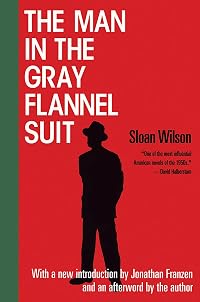
The Man in the Gray Flannel Suit
by Sloan Wilson
On This Page
Description
Universally acclaimed when first published in 1955, "The Man in the Gray Flannel Suit" captured the mood of a generation. Its title, like "Catch-22" and "Fahrenheit 451", has become a part of America's cultural vocabulary. Tom Rath doesn't want anything extraordinary out of life: just a decent home, enough money to support his family, and a career that won't crush his spirit. After returning from World War II, he takes a PR job at a television network. It is inane, dehumanizing work. But show more when a series of personal crises force him to reexamine his priorities-and take responsibility for his past-he is finally moved to carve out an identity for himself. This is Sloan Wilson's searing indictment of a society that had just begun to lose touch with its citizens. "The Man in the Gray Flannel Suit" is a classic of American literature and the basis of the award-winning film starring Gregory Peck. show lessTags
Recommendations

























Member Reviews
Sloan Wilson's novel has provided a misunderstood iconic image from the 1950s. Often mistaken as a symbol for conformity and the rise of the organization man, Wilson's protagonist, Tom Rath, is actually the opposite. He has replaced one uniform, that of an army paratrooper, with another, the gray flannel suit of corporate America. Both are items from wars. The paratrooper fought in World War II against both the Germans and Japanese--and Tom's life itself was in danger. But Tom the executive assistant to the head of a giant broadcasting company is also fighting a war, one where he wants enough money for his family but does not want to surrender his soul to a career that will take him from that family.
That is the essence of the novel. Tom show more is rebelling. So is his wife, Betsy. Neither of them are conformists and could not be further from the cliched imagery of the 1950s and the world of The Adventures of Ozzie and Harriett or Leave It to Beaver. Tom and Betsy are self aware. And the fact is that there were a lot of people who were self aware during that decade. The cliche of a society living within the conformity of rigid social expectations and morality was just that, a cliche. Things, in fact, were changing. Wilson goes at some length to expose these changes through the presence in Tom's memory of Maria, an Italian bar girl he had lived with for some months in 1944 and with whom he had an illegitimate son. At book's end, Tom reveals the situation to Betsy, who, after being devastated, finally agrees with Tom about supporting the child.
Thus are the conventions of puritanical morals struck down. Next up is the image of the career man. Tom is simply unwilling to follow in the footsteps of his boss and sacrifice his family life for a job. He realizes the need for money but not the need to barely see his wife and children, leaving them to become strangers while he spends his time in the office. Instead, he is satisfied working for a charitable trust. His boss recognizes his value and fosters him in the endeavor. In fact, his boss, Ralph Hopkins, is the mirror image of Tom. He is the outward picture of success, worth $5 million. But he is estranged from his wife, never lives at home, his son has died in the war, and his reckless daughter is on the path to ruin due to the lack of adequate parental guidance. Hopkins is the true failure, not Tom.
This novel was a constant point of cultural reference in the 1950s. It became so pervasive that it soon was parodied by comedians and other entertainers. The one I most remember is Stan Freberg's take on the Man in the Gray Flannel Suit as a werewolf. But the book has gradually disappeared from public consciousness, despite a small revival or two every thirty years or so. Today, on the cusp of the third decade of the twenty-first century, it is all but forgotten. For despite all its anger and rebellion, The Man in the Gray Flannel Suit also depicted an America where the path to success was not only possible but likely--even if you didn't always conform. That isn't the case today. That America is gone. And Wilson's novel is like a relic from a time capsule. show less
That is the essence of the novel. Tom show more is rebelling. So is his wife, Betsy. Neither of them are conformists and could not be further from the cliched imagery of the 1950s and the world of The Adventures of Ozzie and Harriett or Leave It to Beaver. Tom and Betsy are self aware. And the fact is that there were a lot of people who were self aware during that decade. The cliche of a society living within the conformity of rigid social expectations and morality was just that, a cliche. Things, in fact, were changing. Wilson goes at some length to expose these changes through the presence in Tom's memory of Maria, an Italian bar girl he had lived with for some months in 1944 and with whom he had an illegitimate son. At book's end, Tom reveals the situation to Betsy, who, after being devastated, finally agrees with Tom about supporting the child.
Thus are the conventions of puritanical morals struck down. Next up is the image of the career man. Tom is simply unwilling to follow in the footsteps of his boss and sacrifice his family life for a job. He realizes the need for money but not the need to barely see his wife and children, leaving them to become strangers while he spends his time in the office. Instead, he is satisfied working for a charitable trust. His boss recognizes his value and fosters him in the endeavor. In fact, his boss, Ralph Hopkins, is the mirror image of Tom. He is the outward picture of success, worth $5 million. But he is estranged from his wife, never lives at home, his son has died in the war, and his reckless daughter is on the path to ruin due to the lack of adequate parental guidance. Hopkins is the true failure, not Tom.
This novel was a constant point of cultural reference in the 1950s. It became so pervasive that it soon was parodied by comedians and other entertainers. The one I most remember is Stan Freberg's take on the Man in the Gray Flannel Suit as a werewolf. But the book has gradually disappeared from public consciousness, despite a small revival or two every thirty years or so. Today, on the cusp of the third decade of the twenty-first century, it is all but forgotten. For despite all its anger and rebellion, The Man in the Gray Flannel Suit also depicted an America where the path to success was not only possible but likely--even if you didn't always conform. That isn't the case today. That America is gone. And Wilson's novel is like a relic from a time capsule. show less
My friend Matt let me borrow this one because I adored the movie (an experience which, in fact, launched an ongoing intense crush on Gregory Peck). I will admit that I found the main character rather insufferable at times in a way I don't remember feeling with the movie--I'm not sure if that's attributable to the fact that I saw the movie several years ago and my memory is somewhat dimmed, if the character was softened somewhat for the movie, or, well, being played by aforementioned total babe Gregory Peck and thus more forgivable! That said, I did still enjoy the book and found its portrayal of both the experience of war and the culture/expectations of the time impressively unvarnished.
Book Circle Reads 158
Title: [THE MAN IN THE GRAY FLANNEL SUIT]
Author: [[SLOAN WILSON]]
Rating: 4* of five
The Publisher Says: Here is the story of Tom and Betsy Rath, a young couple with everthing going for them: three healthy children, a nice home, a steady income. They have every reason to be happy, but for some reason they are not. Like so many young men of the day, Tom finds himself caught up in the corporate rat race - what he encounters there propels him on a voyage of self-discovery that will turn his world inside out.
At once a searing indictment of corporate culture, a story of a young man confronting his past and future with honesty, and a testament to the enduring power of family, The Man in the Gray Flannel Suit is a deeply show more rewarding novel about the importance of taking responsibility for one's own life.
My Review: 1955. That is, if you're math-challenged, 58 years ago, and the year that Simon & Schuster published this book. So Wilson was writing it in, it's safe to say, 1953 (60 years ago). And this is what Wilson said:
Tom Rath has just been to see the overcrowded public school his daughters have to attend because, unlike his own father, he can't afford to put them in a private school. He muses on these thoughts while waiting for a late commuter train into the city, where he will take on a lowly personal assistant's position and, in the process, displace a number of female employees from their physical space.
Sixty years since Wilson was penning these words, and not that much has changed. Now, of course, it could easily be a mom having these platform reveries, because we've been sold the bill of goods that nannies and au pairs are plenty good enough to raise the kids we've had but don't feel like raising even if it means NOT having a home theater, six DVR-equipped TVs, and each kid with an unshared Xbox. If mom's better at business, dad, YOU stay home and raise those people you engendered. Read to them, make them a snack after carpool, help with their homework. Hiring out parenthood sorta makes it pointless, doesn't it?
Ahem.
Me and my rants.
Wilson's book analyzes the sources of Tom's inner discontent as disconnection and materialism. I agree. The alarm bell sounded by this, and by the 1956 movie, went unheeded despite the fact that both were hugely popular and successful in their own spheres. (The movie was as good as the book, for once.)
At every turn, MONEY the getting and spending of, obsesses and defines Tom. His wealthy grandmother is being cared for by a greedy granny-nanny, and the hijinks appertaining thereto are most instructive for today's audience. Tom's boss, the venal and piggish Hopkins, plays out before Tom's increasingly revolted gaze his own probable future of alienated kid (extra probable because his three are TV obsessed brats), estranged wife, and grasping mistress(es). Then things get complicated when a wartime indiscretion with an Italian lass provides a surprise to Tom's unsuspecting wife.
Wilson wrote of his own time. Change the props, update the clothes, and make it about Betsy the wife, and nothing much has changed.
I'm sad about that. So much needless hurt caused in this world from sheer, wasteful greed for MORE when there's more than enough right in front of these hungry-souled people. show less
Title: [THE MAN IN THE GRAY FLANNEL SUIT]
Author: [[SLOAN WILSON]]
Rating: 4* of five
The Publisher Says: Here is the story of Tom and Betsy Rath, a young couple with everthing going for them: three healthy children, a nice home, a steady income. They have every reason to be happy, but for some reason they are not. Like so many young men of the day, Tom finds himself caught up in the corporate rat race - what he encounters there propels him on a voyage of self-discovery that will turn his world inside out.
At once a searing indictment of corporate culture, a story of a young man confronting his past and future with honesty, and a testament to the enduring power of family, The Man in the Gray Flannel Suit is a deeply show more rewarding novel about the importance of taking responsibility for one's own life.
My Review: 1955. That is, if you're math-challenged, 58 years ago, and the year that Simon & Schuster published this book. So Wilson was writing it in, it's safe to say, 1953 (60 years ago). And this is what Wilson said:
Money, I need money, {Tom} thought. If they don't build a new public shcool, I should be able to afford a private school. I should get everything but money out of my head and really do a job for Hopkins. I ought to be at work now....
Money, Tom thought. The housing project could make money, but it depends on re-zoning, and Bernstein says we shouldn't ask for that until they vote on a new school.
A new school, he thought---so much depends on that! ... I should work for a new school, and I should work harder for Hopkins, and I should be making plans for our housing project. Where did I ever get the idea that life is supposed to be anything but work? A man's work should be his pleasure---I shouldn't expect anything more.
Tom Rath has just been to see the overcrowded public school his daughters have to attend because, unlike his own father, he can't afford to put them in a private school. He muses on these thoughts while waiting for a late commuter train into the city, where he will take on a lowly personal assistant's position and, in the process, displace a number of female employees from their physical space.
Sixty years since Wilson was penning these words, and not that much has changed. Now, of course, it could easily be a mom having these platform reveries, because we've been sold the bill of goods that nannies and au pairs are plenty good enough to raise the kids we've had but don't feel like raising even if it means NOT having a home theater, six DVR-equipped TVs, and each kid with an unshared Xbox. If mom's better at business, dad, YOU stay home and raise those people you engendered. Read to them, make them a snack after carpool, help with their homework. Hiring out parenthood sorta makes it pointless, doesn't it?
Ahem.
Me and my rants.
Wilson's book analyzes the sources of Tom's inner discontent as disconnection and materialism. I agree. The alarm bell sounded by this, and by the 1956 movie, went unheeded despite the fact that both were hugely popular and successful in their own spheres. (The movie was as good as the book, for once.)
At every turn, MONEY the getting and spending of, obsesses and defines Tom. His wealthy grandmother is being cared for by a greedy granny-nanny, and the hijinks appertaining thereto are most instructive for today's audience. Tom's boss, the venal and piggish Hopkins, plays out before Tom's increasingly revolted gaze his own probable future of alienated kid (extra probable because his three are TV obsessed brats), estranged wife, and grasping mistress(es). Then things get complicated when a wartime indiscretion with an Italian lass provides a surprise to Tom's unsuspecting wife.
Wilson wrote of his own time. Change the props, update the clothes, and make it about Betsy the wife, and nothing much has changed.
I'm sad about that. So much needless hurt caused in this world from sheer, wasteful greed for MORE when there's more than enough right in front of these hungry-souled people. show less
The Man in the Gray Flannel Suit is the story of an apparently conformist suburban business-man with a secret past, who came to be seen by readers as a representative of American life in the 1950s. Tom Rath is a 30-something veteran of World War II, who, following the end of the war, has returned to his wife Betsy and begun a new life. He has three children and a newly acquired job as personal assistant to the head of United Broadcasting. Everything seems to be going well for him, but this novel, first published in 1955, is actually about his internal struggles and desperation, his intense memories of the war and his unhappiness with the corporate world in which he is trapped.
I discovered this book when it was mentioned on Mad Men and I show more can see many similarities with the story of Don Draper. Like Don, Tom gives nothing away at work – he seems a typical corporate drone in a suit, despite his interesting past – and has a few identity issues. Early in the novel, he is asked to write an autobiography as part of a job application and, tellingly, it’s his refusal to reveal anything beyond the bare facts of his present situation that gets him the job. To say that he leads a double life wouldn’t be quite accurate, as he actually experiences his life as divided into ‘four completely unrelated worlds’:
‘There was the crazy, ghost-ridden world of his grandmother and his dead parents. There was the isolated, best-non-remembered world in which he had been a paratrooper. There was the matter-of-fact, opaque-glass-brick-partitioned world of places like the United Broadcasting Company and the Schanenhauser Foundation. And there was the entirely separate world populated by Betsy and Janey and Barbara and Pete, the only one of the four worlds worth a damn. There must be some way in which the four worlds were related, he thought, but it was easier to think of them as entirely divorced from one another.’
I found the sections of the book describing Tom’s wartime experiences in Italy and the Pacific very vivid and powerful, perhaps intentionally more real-seeming than the descriptions of his home-life in America. There is a distinct lack of connection between Tom’s post-war life, with the suburban drinks parties and his worries over whether he can afford to re-plaster the living room, and the close relationships he experienced during the war, when, the book suggests, time seemed to have a different meaning altogether. Sloan Wilson was himself a veteran of World War II, which I am sure must have contributed to the emotional intensity of those sections of the novel.
Another aspect of the novel I liked very much is the cynical critique of the business world in which Tom works, which results in some black comedy. His boss, Hopkins, is an interesting character, famous for being an extreme workaholic. When his wife asks him to help persuade their rebellious daughter to go to college, she exasperatedly cries, ‘By God, if it will help you, treat her as a business problem!’
Part of Tom’s new job involves helping with Hopkins’ efforts to set up a philanthropic foundation to improve mental health treatment. In a plot development that seemed very modern to me, this is shown to be a completely empty and meaningless endeavour and the subject of more cynicism and humour. Neither Hopkins nor Tom (as his assistant and speech-writer) know anything or could care less about mental health. As Tom says, ‘they’re going to sell mental health the way they sell cigarettes’. Maybe this is slightly ironic considering the state of Tom’s own mental health, his despair and randomly occurring violent impulses. I liked the three thoughts, almost internal catch-phrases, that helped get Tom through parachute jumps in the war and which he also repeats at difficult moments in his current life: ‘It doesn’t really matter’, ‘Here goes nothing’, and ‘It will be interesting to see what happens’. They capture a certain sense of apathy and detachment which is characteristic of Tom.
The Man in the Gray Flannel Suit is an unusual book, since it combines the cynical humour and challenge to society I already mentioned, with a naive optimism, conformity and belief in the perfect 1950s marriage. I preferred the former aspect of the book, partly because the more optimistic side seemed to require that certain characters act in a very convenient and slightly unrealistic way. My copy includes an interesting introduction by Jonathan Franzen, which suggests that the more conformist side of the book hints at the causes of rebellion and change in the 1960s. In the 1960s, the counterculture intellectuals and rebels came to loathe the ‘man in the gray flannel suit’ and see him as an opponent.
Whatever you are more emotionally drawn to as a reader, the novel is an interesting way to find out more about the atmosphere of the 1950s. The novel also provides an insight into the mind of a man who returned home from war and had to reacquaint himself with the ‘casual certainty’ and ‘half-remembered optimism’ of his earlier life. [2011] show less
I discovered this book when it was mentioned on Mad Men and I show more can see many similarities with the story of Don Draper. Like Don, Tom gives nothing away at work – he seems a typical corporate drone in a suit, despite his interesting past – and has a few identity issues. Early in the novel, he is asked to write an autobiography as part of a job application and, tellingly, it’s his refusal to reveal anything beyond the bare facts of his present situation that gets him the job. To say that he leads a double life wouldn’t be quite accurate, as he actually experiences his life as divided into ‘four completely unrelated worlds’:
‘There was the crazy, ghost-ridden world of his grandmother and his dead parents. There was the isolated, best-non-remembered world in which he had been a paratrooper. There was the matter-of-fact, opaque-glass-brick-partitioned world of places like the United Broadcasting Company and the Schanenhauser Foundation. And there was the entirely separate world populated by Betsy and Janey and Barbara and Pete, the only one of the four worlds worth a damn. There must be some way in which the four worlds were related, he thought, but it was easier to think of them as entirely divorced from one another.’
I found the sections of the book describing Tom’s wartime experiences in Italy and the Pacific very vivid and powerful, perhaps intentionally more real-seeming than the descriptions of his home-life in America. There is a distinct lack of connection between Tom’s post-war life, with the suburban drinks parties and his worries over whether he can afford to re-plaster the living room, and the close relationships he experienced during the war, when, the book suggests, time seemed to have a different meaning altogether. Sloan Wilson was himself a veteran of World War II, which I am sure must have contributed to the emotional intensity of those sections of the novel.
Another aspect of the novel I liked very much is the cynical critique of the business world in which Tom works, which results in some black comedy. His boss, Hopkins, is an interesting character, famous for being an extreme workaholic. When his wife asks him to help persuade their rebellious daughter to go to college, she exasperatedly cries, ‘By God, if it will help you, treat her as a business problem!’
Part of Tom’s new job involves helping with Hopkins’ efforts to set up a philanthropic foundation to improve mental health treatment. In a plot development that seemed very modern to me, this is shown to be a completely empty and meaningless endeavour and the subject of more cynicism and humour. Neither Hopkins nor Tom (as his assistant and speech-writer) know anything or could care less about mental health. As Tom says, ‘they’re going to sell mental health the way they sell cigarettes’. Maybe this is slightly ironic considering the state of Tom’s own mental health, his despair and randomly occurring violent impulses. I liked the three thoughts, almost internal catch-phrases, that helped get Tom through parachute jumps in the war and which he also repeats at difficult moments in his current life: ‘It doesn’t really matter’, ‘Here goes nothing’, and ‘It will be interesting to see what happens’. They capture a certain sense of apathy and detachment which is characteristic of Tom.
The Man in the Gray Flannel Suit is an unusual book, since it combines the cynical humour and challenge to society I already mentioned, with a naive optimism, conformity and belief in the perfect 1950s marriage. I preferred the former aspect of the book, partly because the more optimistic side seemed to require that certain characters act in a very convenient and slightly unrealistic way. My copy includes an interesting introduction by Jonathan Franzen, which suggests that the more conformist side of the book hints at the causes of rebellion and change in the 1960s. In the 1960s, the counterculture intellectuals and rebels came to loathe the ‘man in the gray flannel suit’ and see him as an opponent.
Whatever you are more emotionally drawn to as a reader, the novel is an interesting way to find out more about the atmosphere of the 1950s. The novel also provides an insight into the mind of a man who returned home from war and had to reacquaint himself with the ‘casual certainty’ and ‘half-remembered optimism’ of his earlier life. [2011] show less
The first half is great -- you can see why it's heralded as the book to read for a slice of '50's suburban life. But the second half completely falls apart as we sort of lose our protagonist and start following multiple POVs, and the tone sort of changes as well -- the characters rebel against their conformist surroundings, but they do so in such a way that allows them to move up in the world financially and status-wise as well. It's a weird ending: "fight the system", the book seems to say, "so that you can achieve the material ends everyone else wants."
This is the story of Tom Rath and economic survival in the 1950s era. Tom's wife, Betsy and their three children want the good life. Tom is determined to give it to them, even if it means slogging to work doing a job he doesn't completely enjoy. When a new prospect for employment pops up Rath jumps at the chance to move up the ladder but it is not without consequences.
The Man in Gray Flannel epitomizes the proverbial meaning of life in a material world. It is also a study of 1950s conformity and climbing the corporate ladder. You have one man who is a slave to his workaholic lifestyle and is miserable because of it while another man is angry because he can never get ahead. Tom's boss, from the outside, projects an image of ease and calm show more amidst his wealth while Tom encounters roadblocks in every aspect of his life. The new higher paying job is not what he thought it would be. Secrets from his time as a solider in World War II will not stay buried. His wife wants more and more. Even the seemingly straightforward last will and testament of his grandmother's estate doesn't seem to be in his favor.
Confessional: the odd thing is, despite all of Tom's setbacks and struggles, I couldn't entirely feel for him. I felt more for his boss. show less
The Man in Gray Flannel epitomizes the proverbial meaning of life in a material world. It is also a study of 1950s conformity and climbing the corporate ladder. You have one man who is a slave to his workaholic lifestyle and is miserable because of it while another man is angry because he can never get ahead. Tom's boss, from the outside, projects an image of ease and calm show more amidst his wealth while Tom encounters roadblocks in every aspect of his life. The new higher paying job is not what he thought it would be. Secrets from his time as a solider in World War II will not stay buried. His wife wants more and more. Even the seemingly straightforward last will and testament of his grandmother's estate doesn't seem to be in his favor.
Confessional: the odd thing is, despite all of Tom's setbacks and struggles, I couldn't entirely feel for him. I felt more for his boss. show less
Tom Rath is a man who is living a life of lies. Everyday he puts on his grey flannel suit to commute from his Connecticut home to work in New York where he blends in with all of the other men doing the same thing, all wearing their grey flannel suits. And Tom feels the pressure that this conformity brings, the need to get the better job, to be just like the neighbors and like the same things. When Tom gets a new job working for the president of the Universal Broadcasting Corporation, Tom begins to realize how trapped into the conformity around him he is. Tom struggles as he deals with the inheritance of his grandmother's estate, conflicting directions from his bosses, and the specter of a past indiscretion coming back to haunt him and show more ruin the cultivated life of conformity that he has created.
Sloan Wilson's book of 1950's conformity still resonates today. The pressures that Tom faces to fit in, to not step outside the narrow vision of society of what is right and wrong still has a place today. Tom Wrath is an angry man, who is running away from his past, and unwilling to take risks. He sees everything from a class half empty perspective. He is countered by his wife, Betsy, who struggles with the same expectations of conformity, but who is willing to take risks to make their lives better. A lot of the differences between Tom and Betsy come from their experiences during WW2. Tom fought as a paratrooper in Europe and the Pacific, killing 17 men (including his best friend in an accident) and fathering an illegitimate child. These events are things that Tom refuses to talk about; they are part of another life, but they constantly dwell upon Tom's thoughts and shape his view of the world.
Despite being written over 60 years ago, and set in a very different time and place of America, I really enjoyed Wilson's story of Tom and Betsy Rath. Their story resonated with me and I thoroughly enjoyed the character development of both Tom and Betsy. They serve as counter-points to each other, and it is only through being forced to understand each other that they are able to overcome the difficulties that life seems to throw at them. By the end of the book Tom Rath is a very different person, more sure of himself, more at ease with who he is and the events and people that have made him the person he is now. Betsy, while getting less of a character treatment than Tom, also grows as she understands more about who her husband is, and how the war made him a changed man. And while the war changed her some too, the differences are great and she must come to terms with them.
I only have a couple of problems with the book. Wilson writes from an omniscient third-person POV, and in several chapters the reader is forced to head jump from character to character in the scene. This is a bit distracting. I also wish that more time was given to exploring Betsy and her own thought - especially on the critical point when she learns of Tom's infidelity and his illegitimate child born to an Italian woman. Betsy makes a large change in her character, but it mainly happens off stage and we don't see the struggle she goes through to decide to accept Tom and his decision to support the child. Considering we are seeing the thoughts of many other characters not showing us the struggle Betsy is going through felt like a let down.
Overall I recommend The Man in the Grey Flannel Suit. Sloan Wilson's story still has power today to show us how life's events can change and affect a person. It is also a wonderful look at an era of American history that is little covered today. Written in the 1950's, the novel today feels like a well-research historical fiction, and being able to glimpse the world of 60 plus years ago was interesting. The audio production I listened to was narrated by Patrick Lawlor, who does a good job of bringing Tom Rath to life. I had previously heard him narrating a X-Files novel, so at first I could only hear Fox Mulder instead of Tom Rath, but that was more me than Patrick. His characterizations are well done and helped to make the characters stand out. show less
Sloan Wilson's book of 1950's conformity still resonates today. The pressures that Tom faces to fit in, to not step outside the narrow vision of society of what is right and wrong still has a place today. Tom Wrath is an angry man, who is running away from his past, and unwilling to take risks. He sees everything from a class half empty perspective. He is countered by his wife, Betsy, who struggles with the same expectations of conformity, but who is willing to take risks to make their lives better. A lot of the differences between Tom and Betsy come from their experiences during WW2. Tom fought as a paratrooper in Europe and the Pacific, killing 17 men (including his best friend in an accident) and fathering an illegitimate child. These events are things that Tom refuses to talk about; they are part of another life, but they constantly dwell upon Tom's thoughts and shape his view of the world.
Despite being written over 60 years ago, and set in a very different time and place of America, I really enjoyed Wilson's story of Tom and Betsy Rath. Their story resonated with me and I thoroughly enjoyed the character development of both Tom and Betsy. They serve as counter-points to each other, and it is only through being forced to understand each other that they are able to overcome the difficulties that life seems to throw at them. By the end of the book Tom Rath is a very different person, more sure of himself, more at ease with who he is and the events and people that have made him the person he is now. Betsy, while getting less of a character treatment than Tom, also grows as she understands more about who her husband is, and how the war made him a changed man. And while the war changed her some too, the differences are great and she must come to terms with them.
I only have a couple of problems with the book. Wilson writes from an omniscient third-person POV, and in several chapters the reader is forced to head jump from character to character in the scene. This is a bit distracting. I also wish that more time was given to exploring Betsy and her own thought - especially on the critical point when she learns of Tom's infidelity and his illegitimate child born to an Italian woman. Betsy makes a large change in her character, but it mainly happens off stage and we don't see the struggle she goes through to decide to accept Tom and his decision to support the child. Considering we are seeing the thoughts of many other characters not showing us the struggle Betsy is going through felt like a let down.
Overall I recommend The Man in the Grey Flannel Suit. Sloan Wilson's story still has power today to show us how life's events can change and affect a person. It is also a wonderful look at an era of American history that is little covered today. Written in the 1950's, the novel today feels like a well-research historical fiction, and being able to glimpse the world of 60 plus years ago was interesting. The audio production I listened to was narrated by Patrick Lawlor, who does a good job of bringing Tom Rath to life. I had previously heard him narrating a X-Files novel, so at first I could only hear Fox Mulder instead of Tom Rath, but that was more me than Patrick. His characterizations are well done and helped to make the characters stand out. show less
Members
- Recently Added By
Lists

1950s
340 works; 22 members

Publisher's Weekly Bestsellers - Part II - 1940 - 1979
355 works; 6 members

Books To Get From The Library
115 works; 5 members

Canon de la narrativa universal del s. XX (cicutadry)
499 works; 3 members
Author Information

29+ Works 1,366 Members
Some Editions
Awards and Honors
Distinctions
Notable Lists
Work Relationships
Common Knowledge
- Original title
- The Man in the Gray Flannel Suit
- Original publication date
- 1955
- Related movies
- The Man in the Gray Flannel Suit (1956 | IMDb)
- Epigraph
- So I said To the man who knew: "Where are they going? And what do they carry? And why do they hurry so?"
A.F.W. - Dedication
- This book is dedicated by my wife and me to her father, Carl E. Pickhardt
- First words
- By the time they had lived seven years in the little house on Greentree Avenue in Westport, Connecticut, they both detested it.
- Last words
- (Click to show. Warning: May contain spoilers.)Then Tom straightened up and apparently said something to her, for suddenly she smiled radiantly. Bernstein smiled too.
Classifications
Statistics
- Members
- 884
- Popularity
- 30,758
- Reviews
- 27
- Rating
- (3.74)
- Languages
- 10 — Catalan, Danish, Dutch, English, Finnish, French, German, Italian, Spanish, Swedish
- Media
- Paper, Audiobook, Ebook
- ISBNs
- 27
- ASINs
- 28