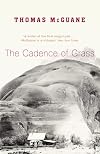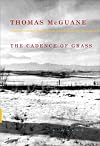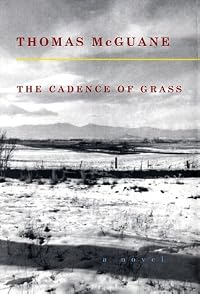
The Cadence of Grass
by Thomas McGuane
On This Page
Description
The daughter of late Whitelaw patriarch Sunny Jim finds herself bound by his will to a marriage with a man she no longer loves as she is drawn to a simpler life as exemplified by the Whitelaw's ranch manager, Bill Champion.Tags
Recommendations









Member Reviews
When “Sunny Jim” Whitelaw, the owner of a Montana bottling plant, dies his family hopes to profit handsomely by selling the plant. Whitelaw was not actually sunny, but more of a dark soul. He leaves the plant in charge of the only family member darker – his son-in-law Paul Crusoe. Paul is the cad of the story. As his estranged wife, Evelyn, says “It’s sad when someone like Paul elects to go on living.”
Paul has spent some time in prison for vehicular homicide, and is still on probation. A sexual relationship with his parole officer results in one of several Paul-induced tragedies. His incarceration has made him not simply observant, but “absolutely awake” “by dint of long effort.” He and Sunny Jim save traded show more betrayals throughout their lives.
Paul’s not the only character, but much of the book revolves around him, even when he’s off the page. McGuane can flat out write, and some of his best prose here is reserved for Evelyn, on her ranch riding horses, tending to cattle, and enjoying it all. There are deftly woven surprises in the book. The story and characters are rich – not always likeable – but readable. show less
Paul has spent some time in prison for vehicular homicide, and is still on probation. A sexual relationship with his parole officer results in one of several Paul-induced tragedies. His incarceration has made him not simply observant, but “absolutely awake” “by dint of long effort.” He and Sunny Jim save traded show more betrayals throughout their lives.
Paul’s not the only character, but much of the book revolves around him, even when he’s off the page. McGuane can flat out write, and some of his best prose here is reserved for Evelyn, on her ranch riding horses, tending to cattle, and enjoying it all. There are deftly woven surprises in the book. The story and characters are rich – not always likeable – but readable. show less
For anyone with a solid familiarity with Thomas McGuane's work, this is a fascinating novel.
Here you have a novel with a female protagonist, written by a man who has often been written off as a male chauvinist pig, whose female characters have always been a major bone of contention with critics. You have a novelist who has continually been accused of rewriting autobiography, writing a novel that clearly has little to do with his own life. And you have the recognizable "McGuane protagonist" -- a man with a tendency to take things too far -- this time cast as anything but sympathetic.
It's almost as if The Cadence of Grass is a conscious attempt on McGuane's part to repudiate his critics. To say, in essence, no, you half-wits, this is show more what I've been trying to say.
Regarding the one-dimensional women of his early novels, McGuane has pointed to a masculine culture that regards women as unfathomable mysteries; how are his male protagonists to view them as fully realized human beings in this context? Despite the reputation he earned in the 1970s, McGuane is not, in fact, a "male chauvinist pig novelist," and in the (nonetheless tomboyish) character of Evelyn he seems determined to shake off that criticism once and for all.
Having repeatedly spoken in interviews about the struggle to write people who are not in any way like himself, McGuane has stepped far outside himself here. He has broken with his conventional close third-person, protagonist-centered viewpoint, using an omniscient narrator for the first time since 92 in the Shade. The result, for a reader familiar with his work, is to force one not only to consider this novel but to reconsider the whole. Have I been making assumptions about his characters, one asks, that have been getting in my way as I read?
McGuane's language is less electrifying here than in his early work, but on the other hand he has achieved his oft-stated goal of not allowing the words to get in the way of what he's trying to say. And there is no doubt that he remains a superb writer; the scenes in this novel that deal with horsemanship are surely examples of his finest prose.
Without a doubt, The Cadence of Grass marks the high point in McGuane's development as a novelist. It may not be his finest novel, but it is certainly his most mature. This is not the best introduction to McGuane for a new reader (go, instead, with 92 in the Shade or Nothing but Blue Skies), but for anyone who has read him extensively, it is possibly his most interesting novel. show less
Here you have a novel with a female protagonist, written by a man who has often been written off as a male chauvinist pig, whose female characters have always been a major bone of contention with critics. You have a novelist who has continually been accused of rewriting autobiography, writing a novel that clearly has little to do with his own life. And you have the recognizable "McGuane protagonist" -- a man with a tendency to take things too far -- this time cast as anything but sympathetic.
It's almost as if The Cadence of Grass is a conscious attempt on McGuane's part to repudiate his critics. To say, in essence, no, you half-wits, this is show more what I've been trying to say.
Regarding the one-dimensional women of his early novels, McGuane has pointed to a masculine culture that regards women as unfathomable mysteries; how are his male protagonists to view them as fully realized human beings in this context? Despite the reputation he earned in the 1970s, McGuane is not, in fact, a "male chauvinist pig novelist," and in the (nonetheless tomboyish) character of Evelyn he seems determined to shake off that criticism once and for all.
Having repeatedly spoken in interviews about the struggle to write people who are not in any way like himself, McGuane has stepped far outside himself here. He has broken with his conventional close third-person, protagonist-centered viewpoint, using an omniscient narrator for the first time since 92 in the Shade. The result, for a reader familiar with his work, is to force one not only to consider this novel but to reconsider the whole. Have I been making assumptions about his characters, one asks, that have been getting in my way as I read?
McGuane's language is less electrifying here than in his early work, but on the other hand he has achieved his oft-stated goal of not allowing the words to get in the way of what he's trying to say. And there is no doubt that he remains a superb writer; the scenes in this novel that deal with horsemanship are surely examples of his finest prose.
Without a doubt, The Cadence of Grass marks the high point in McGuane's development as a novelist. It may not be his finest novel, but it is certainly his most mature. This is not the best introduction to McGuane for a new reader (go, instead, with 92 in the Shade or Nothing but Blue Skies), but for anyone who has read him extensively, it is possibly his most interesting novel. show less
Sunny Jim Whitelaw has passed away, leaving his bottling empire in the hands of his estranged son-in-law Paul with not a red cent going to his family -- unless his eldest daughter Evelyn decides to reconcile with Paul. A reconciliation is the last thing Evelyn wants to do. She would rather stick with the more comfortable rancher's life to which she's more accustomed. Paul would like nothing better so that he can sell off the bottling plant and he'll do whatever can to make sure that happens.
"The Cadence of Grass" reads like any soap opera: lots of snarky, back-and-forth dialogue between characters, deeply buried family secrets coming to light, backstabbing, unfaithfulness, the staling of body organs and a cross-dressing rancher. Even show more with all that, it seemed to lack any real bite, almost as if the characters verbally attacked each other half-heartedly. I didn't enjoy the brief verbal "sparring" matches and couldn't find myself liking any character, preferring instead the scenes of action.
That's where McGuane's story shined. His descriptions of such things as Evelyn and Bill the family's rancher heading into the wilderness to round up some missing heads of cattle before dark settled in, or Evelyn's terrified trek through a snow storm first via car then on foot through the woods, or even Paul and Sunny Jim's trip to Las Vegas resulting in someone losing a kidney, were richly detailed and held my interest. I found those scenes far more interesting than rest of the story.
And, just because it's been bugging me since I finished the book, I didn't see the point of having a cross-dressing rancher, Donald Aadfield. When he appeared as part of the family that rescued Evelyn during the snowstorm, I thought his openness ab out being gay and his interest in ranching -- just as strong as Evelyn's -- would have sparked more interaction between them. But his character disappeared until near the end of the book, for perhaps a page or two with what seemed very little effect on the story, then he disappeared again.
The ending left me confused. I didn't understand why Bill would have gone along with Paul's scheme -- something very out of character for Bill -- traveling up to the cold, icy part of Canada for what I think was a drug run. And I couldn't connect the last five or so pages with the rest of the story. I skimmed those pages because they seemed inconsistent.
Did I enjoy reading the book? Well, I guess that would be a "not really". I did enjoy the descriptive action scenes, but the dialogue and characters never captured my interest enough to recommend it. show less
"The Cadence of Grass" reads like any soap opera: lots of snarky, back-and-forth dialogue between characters, deeply buried family secrets coming to light, backstabbing, unfaithfulness, the staling of body organs and a cross-dressing rancher. Even show more with all that, it seemed to lack any real bite, almost as if the characters verbally attacked each other half-heartedly. I didn't enjoy the brief verbal "sparring" matches and couldn't find myself liking any character, preferring instead the scenes of action.
That's where McGuane's story shined. His descriptions of such things as Evelyn and Bill the family's rancher heading into the wilderness to round up some missing heads of cattle before dark settled in, or Evelyn's terrified trek through a snow storm first via car then on foot through the woods, or even Paul and Sunny Jim's trip to Las Vegas resulting in someone losing a kidney, were richly detailed and held my interest. I found those scenes far more interesting than rest of the story.
And, just because it's been bugging me since I finished the book, I didn't see the point of having a cross-dressing rancher, Donald Aadfield. When he appeared as part of the family that rescued Evelyn during the snowstorm, I thought his openness ab out being gay and his interest in ranching -- just as strong as Evelyn's -- would have sparked more interaction between them. But his character disappeared until near the end of the book, for perhaps a page or two with what seemed very little effect on the story, then he disappeared again.
The ending left me confused. I didn't understand why Bill would have gone along with Paul's scheme -- something very out of character for Bill -- traveling up to the cold, icy part of Canada for what I think was a drug run. And I couldn't connect the last five or so pages with the rest of the story. I skimmed those pages because they seemed inconsistent.
Did I enjoy reading the book? Well, I guess that would be a "not really". I did enjoy the descriptive action scenes, but the dialogue and characters never captured my interest enough to recommend it. show less
Not sure this was the book I expected, but it grew on me. Very slow getting into it; almost gave up on it a few times baffled by the way too odd characters. But, as the book finally gained some traction and the characters settled down, the book turned entertaining -- and I was in enough to see how it turned out for the major characters. Loved the Montana setting. Enjoyable in the end, but not sure the book proves McGuane is "one of the finest writers we have" as the back of the book intones.
Beautiful in the exteme. I do NOT subscibe to the notion that McGuane has less fire in his prose and has, therefore, gotten less interesting. I find this an astonishingly lovely piece of work.
Ratings
Members
- Recently Added By
Author Information

43+ Works 3,792 Members
Thomas McGuane was born in Wyandotte, Michigan on December 11, 1939. He received a B.A. in English from Michigan State University in 1962 and a M.F.A. from Yale University in 1965. His first novel, The Sporting Club, was published in 1969. His other works include Ninety-Two in the Shade, Nothing but Blue Skies, Keep the Change, Panama, and show more Nobody's Angel. His novel, The Bushwhacked Piano, received the Richard and Hinda Rosenthal Award for a Work of Fiction in 1971. He was also co-editor of The Best American Sports Writing. He authored screenplays for Rancho Deluxe (1973), The Missouri Breaks (1976), and 92 in the Shade (1975). (Bowker Author Biography) show less
Common Knowledge
- Epigraph
- A savage place! as holy and enchanted
As e'er beneath a waning moon was haunted
By woman wailing for her demon lover
--"Kubla Khan" - Dedication
- In memory of my sister Marion
- First words
- In most ways, old man Whitelaw's funeral was just another scene in the family's life.
- Last words
- (Click to show. Warning: May contain spoilers.)Well here I am, said Red Wolf, and I followed him into the canyon where the sky was upside down and we could walk straight into the stars.
Classifications
Statistics
- Members
- 238
- Popularity
- 136,161
- Reviews
- 5
- Rating
- (3.30)
- Languages
- English, French
- Media
- Paper, Ebook
- ISBNs
- 9
- ASINs
- 2