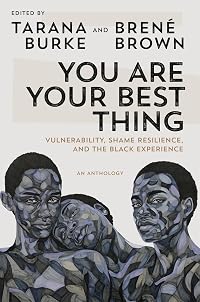
You Are Your Best Thing: Vulnerability, Shame Resilience, and the Black Experience
by Tarana Burke (Editor), Brené Brown (Editor)
On This Page
Description
NEW YORK TIMES BESTSELLER • Tarana Burke and Dr. Brené Brown bring together a dynamic group of Black writers, organizers, artists, academics, and cultural figures to discuss the topics the two have dedicated their lives to understanding and teaching: vulnerability and shame resilience.Contributions by Kiese Laymon, Imani Perry, Laverne Cox, Jason Reynolds, Austin Channing Brown, and more
NAMED ONE OF THE BEST BOOKS OF THE YEAR BY MARIE CLAIRE AND BOOKRIOT
It started as a text show more between two friends.
Tarana Burke, founder of the ‘me too.’ Movement, texted researcher and writer Brené Brown to see if she was free to jump on a call. Brené assumed that Tarana wanted to talk about wallpaper. They had been trading home decorating inspiration boards in their last text conversation so Brené started scrolling to find her latest Pinterest pictures when the phone rang.
But it was immediately clear to Brené that the conversation wasn’t going to be about wallpaper. Tarana’s hello was serious and she hesitated for a bit before saying, “Brené, you know your work affected me so deeply, but as a Black woman, I’ve sometimes had to feel like I have to contort myself to fit into some of your words. The core of it rings so true for me, but the application has been harder.”
Brené replied, “I’m so glad we’re talking about this. It makes sense to me. Especially in terms of vulnerability. How do you take the armor off in a country where you’re not physically or emotionally safe?”
Long pause.
“That’s why I’m calling,” said Tarana. “What do you think about working together on a book about the Black experience with vulnerability and shame resilience?”
There was no hesitation.
Burke and Brown are the perfect pair to usher in this stark, potent collection of essays on Black shame and healing. Along with the anthology contributors, they create a space to recognize and process the trauma of white supremacy, a space to be vulnerable and affirm the fullness of Black love and Black life. show less
Tags
Recommendations











Member Reviews
4 stars: Very Good
From the back cover: It started as a text between two friends.
Tarana Burke, founder of the ‘me too.’ Movement, texted researcher and writer Brené Brown to see if she was free to jump on a call. Brené assumed that Tarana wanted to talk about wallpaper. They had been trading home decorating inspiration boards in their last text conversation so Brené started scrolling to find her latest Pinterest pictures when the phone rang.
But it was immediately clear to Brené that the conversation wasn’t going to be about wallpaper. Tarana’s hello was serious and she hesitated for a bit before saying, “Brené, you know your work affected me so deeply, but as a Black woman, I’ve sometimes had to feel like I have to show more contort myself to fit into some of your words. The core of it rings so true for me, but the application has been harder.”
Brené replied, “I’m so glad we’re talking about this. It makes sense to me. Especially in terms of vulnerability. How do you take the armor off in a country where you’re not physically or emotionally safe?”
Long pause.
“That’s why I’m calling,” said Tarana. “What do you think about working together on a book about the Black experience with vulnerability and shame resilience?”
There was no hesitation.
Burke and Brown are the perfect pair to usher in this stark, potent collection of essays on Black shame and healing. Along with the anthology contributors, they create a space to recognize and process the trauma of white supremacy, a space to be vulnerable and affirm the fullness of Black love and Black life.
--------------------
Edited by Burke and Brown, this collection of essays by African Americans is "a space to recognize and process the trauma of white supremacy, a space to be vulernable and affirm the fullness of Black life and Black possibility." I read this series of essays for Black History Month. Many are very raw and as a white reader, continually made me confront just how deeply insidious and harmful racist structures are in America. This book is explicitly not "for" White readers, rather as Burke says above it is a space for Blacks to be vulnerable and share sides of themselves that they often keep hidden for safety. Having said that, I would encourage anyone to read this, including whites who want to do the hard work of "talking less, listening more." You can do worse than to start listening (reading) here.
--------
"Missing from so much of the scholarship on shame is how the reality of systemic oppression affects a Black woman's ability to be safely vulnerable on a much larger scale than just our personal relationships. We can believe in our inherent worth and value all we want, but moving through a world where our very survival often depends on an acceptance of dehumanization makes healing from trauma complicated."
Shadawn McCants... explains it as "a legacy burden that makes it hard to 'kumbaya' in a world that hates me for the color of my skin, the texture of my hair, the bass in my voice, and the will to want to live the American dream." In white supremacy culture, it's a dog eat dog world, and everybody is fighting for as much privilege as they can possibly get. Vulnerability is seen as weak and for suckers.
We weren't ever taught to grieve, only to be sad and then never speak of the pain again.
When considering what it takes to get to vulnerability with white people, this differs for each individual. Based on my experience and what has been shared with me, there are themes for when we can trust and venture to be vulnerable:
1) Learner mindset - Engaging with someone who is interested in actively learning for the sake of growing and improving can further relationships with white people.
2) Acknowledgement of privilege and inequity- White people who understand and own their privilege and the inequity it can yield are easier to be vulnerable with.
3) Bravery - We can't conclude because a white person is an active learner who acknowledges their privilege and recognizes inequity that they will also be brave enough to take action or use their voice to counter inequity. Seeing a white person who is a learner, who is actively using their status, privilege and knowledge to be present and vocal in countering inequity is powerful. show less
From the back cover: It started as a text between two friends.
Tarana Burke, founder of the ‘me too.’ Movement, texted researcher and writer Brené Brown to see if she was free to jump on a call. Brené assumed that Tarana wanted to talk about wallpaper. They had been trading home decorating inspiration boards in their last text conversation so Brené started scrolling to find her latest Pinterest pictures when the phone rang.
But it was immediately clear to Brené that the conversation wasn’t going to be about wallpaper. Tarana’s hello was serious and she hesitated for a bit before saying, “Brené, you know your work affected me so deeply, but as a Black woman, I’ve sometimes had to feel like I have to show more contort myself to fit into some of your words. The core of it rings so true for me, but the application has been harder.”
Brené replied, “I’m so glad we’re talking about this. It makes sense to me. Especially in terms of vulnerability. How do you take the armor off in a country where you’re not physically or emotionally safe?”
Long pause.
“That’s why I’m calling,” said Tarana. “What do you think about working together on a book about the Black experience with vulnerability and shame resilience?”
There was no hesitation.
Burke and Brown are the perfect pair to usher in this stark, potent collection of essays on Black shame and healing. Along with the anthology contributors, they create a space to recognize and process the trauma of white supremacy, a space to be vulnerable and affirm the fullness of Black love and Black life.
--------------------
Edited by Burke and Brown, this collection of essays by African Americans is "a space to recognize and process the trauma of white supremacy, a space to be vulernable and affirm the fullness of Black life and Black possibility." I read this series of essays for Black History Month. Many are very raw and as a white reader, continually made me confront just how deeply insidious and harmful racist structures are in America. This book is explicitly not "for" White readers, rather as Burke says above it is a space for Blacks to be vulnerable and share sides of themselves that they often keep hidden for safety. Having said that, I would encourage anyone to read this, including whites who want to do the hard work of "talking less, listening more." You can do worse than to start listening (reading) here.
--------
"Missing from so much of the scholarship on shame is how the reality of systemic oppression affects a Black woman's ability to be safely vulnerable on a much larger scale than just our personal relationships. We can believe in our inherent worth and value all we want, but moving through a world where our very survival often depends on an acceptance of dehumanization makes healing from trauma complicated."
Shadawn McCants... explains it as "a legacy burden that makes it hard to 'kumbaya' in a world that hates me for the color of my skin, the texture of my hair, the bass in my voice, and the will to want to live the American dream." In white supremacy culture, it's a dog eat dog world, and everybody is fighting for as much privilege as they can possibly get. Vulnerability is seen as weak and for suckers.
We weren't ever taught to grieve, only to be sad and then never speak of the pain again.
When considering what it takes to get to vulnerability with white people, this differs for each individual. Based on my experience and what has been shared with me, there are themes for when we can trust and venture to be vulnerable:
1) Learner mindset - Engaging with someone who is interested in actively learning for the sake of growing and improving can further relationships with white people.
2) Acknowledgement of privilege and inequity- White people who understand and own their privilege and the inequity it can yield are easier to be vulnerable with.
3) Bravery - We can't conclude because a white person is an active learner who acknowledges their privilege and recognizes inequity that they will also be brave enough to take action or use their voice to counter inequity. Seeing a white person who is a learner, who is actively using their status, privilege and knowledge to be present and vocal in countering inequity is powerful. show less
teen/adult fiction
collected essays (from a range of genders) on the Black experience and social forces resulting in shame (being made to feel less than or unworthy). The editors note that other oppressed groups may experience similar circumstances, though the cultural and physical journey to get there is different.
These won't resonate as much with more privileged people but hopefully if they read it they'll still come away with a better understanding of others' circumstances.
For the target audience (especially Black teens and young adults) I think this will help provide language to process, accept, and deal with mental health issues (anxiety, persistent trauma, shame, depression, etc.)
collected essays (from a range of genders) on the Black experience and social forces resulting in shame (being made to feel less than or unworthy). The editors note that other oppressed groups may experience similar circumstances, though the cultural and physical journey to get there is different.
These won't resonate as much with more privileged people but hopefully if they read it they'll still come away with a better understanding of others' circumstances.
For the target audience (especially Black teens and young adults) I think this will help provide language to process, accept, and deal with mental health issues (anxiety, persistent trauma, shame, depression, etc.)
This was an incredibly rewarding read. The stories in this anthology were so personal and vulnerable and enlightening. I highly recommend it.
Take your time and savor the rich, varied, and vulnerable writing of this essay collection. The beauty and raw honesty will break your heart and enlarge your soul.
Ratings
Members
- Recently Added By
Lists

Top Five Books of 2021
604 works; 181 members

BLM
210 works; 1 member

Patriarchy and white supremacy de-programming
69 works; 1 member
Author Information


Brené Brown was born in San Antonio, Texas on November 18, 1965. She received a Bachelor of Social Work at University of Texas at Austin, a Master of Social Work and Ph.D. from the Graduate College of Social Work at the University of Houston. She is a research professor at the University of Houston Graduate College of Social Work. She is the show more author of I Thought It Was Just Me, The Gifts of Imperfection, and Daring Greatly: How the Courage to Be Vulnerable Transforms the Way We Live, Love, Parent, and Lead. (Bowker Author Biography) show less
All Editions
Some Editions
Awards and Honors
Notable Lists
Classifications
Statistics
- Members
- 325
- Popularity
- 98,112
- Reviews
- 4
- Rating
- (4.28)
- Languages
- English
- Media
- Paper, Audiobook, Ebook
- ISBNs
- 8
- ASINs
- 2