
Marc Lamont Hill
Author of Nobody: Casualties of America's War on the Vulnerable, from Ferguson to Flint and Beyond
About the Author
Marc Lamont Hill was born in Philadelphia, Pennsylvania on December 17, 1978. He is an academic, journalist, and host of BET News, as well as a political commentator. He attended Morehouse College his freshman year, and finished at Temple University, graduating with a B. S. in education and Spanish show more (2000). He received his PhD from the University of Pennsylvania. His work in education includes Professor of Urban Education and American studies at Temple University, Associate Professor of Education at Teachers College, Columbia University, and Distinguished Professor of African American Studies at Morehouse College. His career in journalism includes working for Fox News Channel, CNN, MSNBC, and Court TV. He has worked as a host for Our World with Black Enterprise and HuffPost Live. He is the author of several books, Media, Learning, and Sites of Possibility (New Literacies and Digital Epistemologies); Beats, Rhymes, and Classroom Life: Hip-Hop Pedagogy and the Politics of Identity; The Classroom and The Cell: Conversations on Black Life in America; and his bestseller, Nobody: Casualties of America's War on the Vulnerable, from Ferguson to Flint and Beyond. (Bowker Author Biography) show less
Works by Marc Lamont Hill
Nobody: Casualties of America's War on the Vulnerable, from Ferguson to Flint and Beyond (2016) 311 copies, 4 reviews
Seen and Unseen: Technology, Social Media, and the Fight for Racial Justice (2022) 27 copies, 1 review
Associated Works
You Are Your Best Thing: Vulnerability, Shame Resilience, and the Black Experience (2021) — Contributor — 327 copies, 4 reviews
Tagged
Common Knowledge
- Birthdate
- 1978-12-17
- Gender
- male
- Education
- University of Pennsylvania (Ph.D [with distinction] ∙ Anthropology)
Temple University (BS) - Occupations
- college professor
journalist - Organizations
- Kappa Alpha Psi Fraternity
Morehouse College - Agent
- George Greenfield
- Nationality
- USA
- Birthplace
- Philadelphia, Pennsylvania, USA
- Places of residence
- Philadelphia, Pennsylvania, USA
- Associated Place (for map)
- Philadelphia, Pennsylvania, USA
Members
Reviews
*.5
Of the many books I've read on the subject, this is one of the very worst. It's very well written, which lulls the reader into the false sense that the authors are presenting valid information and ideas, as it all seems so reasonable and well-researched. But underneath the veneer of sensible and rational arguments, lie a deeply deceptive and misleading narrative.
The book starts with a false premise, that Palestinians are treated worse than any group by US foreign policy. As if the US show more hadn't just spent the past two decades bombing the crap out of Iraq and Afghanistan, and it was actually Palestinian prisoners tortured in Abu Ghraib and detained in Guantanamo. As if the US fought tirelessly to secure the rights of other mistreated groups like Kurds in Turkey, or hadn't spent decades wreaking havoc across the globe from Central America to Southeast Asia. Nope, in this worldview it's only the Palestinians that are mistreated.
The authors skillfully employ every debating trick and logical fallacy they can manipulate to make their points. There are too many to list, but their favourite tactic is to take the most extreme quote they could find on a topic, strip away the context, misinterpret even that, then argue against what's left. The lack of context also extends to their describing events, often leading to grossly misleading conclusions. So a police officer shooting a terrorist who had just stabbed someone to death and was on his way to the next victim is presented as Israeli security forces killing a young Palestinian man the day before his wedding. Technically correct, but not particularly helpful in understanding the full situation.
This trend to obfuscate pervades the entire text in the language used. Suicide bombers are described as "guerillas", and guerillas as "activists". "Peaceful" demonstrations retain that label even when they include high powered slingshots, rock throwing, and even petrol bombs.
People interested in a detailed exploration of US policy towards Israel should consider "The Arc of a Covenant" by Walter Russell Mead, which is a lot more thorough. show less
Of the many books I've read on the subject, this is one of the very worst. It's very well written, which lulls the reader into the false sense that the authors are presenting valid information and ideas, as it all seems so reasonable and well-researched. But underneath the veneer of sensible and rational arguments, lie a deeply deceptive and misleading narrative.
The book starts with a false premise, that Palestinians are treated worse than any group by US foreign policy. As if the US show more hadn't just spent the past two decades bombing the crap out of Iraq and Afghanistan, and it was actually Palestinian prisoners tortured in Abu Ghraib and detained in Guantanamo. As if the US fought tirelessly to secure the rights of other mistreated groups like Kurds in Turkey, or hadn't spent decades wreaking havoc across the globe from Central America to Southeast Asia. Nope, in this worldview it's only the Palestinians that are mistreated.
The authors skillfully employ every debating trick and logical fallacy they can manipulate to make their points. There are too many to list, but their favourite tactic is to take the most extreme quote they could find on a topic, strip away the context, misinterpret even that, then argue against what's left. The lack of context also extends to their describing events, often leading to grossly misleading conclusions. So a police officer shooting a terrorist who had just stabbed someone to death and was on his way to the next victim is presented as Israeli security forces killing a young Palestinian man the day before his wedding. Technically correct, but not particularly helpful in understanding the full situation.
This trend to obfuscate pervades the entire text in the language used. Suicide bombers are described as "guerillas", and guerillas as "activists". "Peaceful" demonstrations retain that label even when they include high powered slingshots, rock throwing, and even petrol bombs.
People interested in a detailed exploration of US policy towards Israel should consider "The Arc of a Covenant" by Walter Russell Mead, which is a lot more thorough. show less
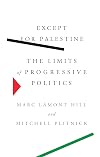
The Palestinians have been refugees for so long, the world has tired of them and pays no attention to their plight. People may be shocked at the treatment of the Rohingya expelled from Burma, or the innumerable escapees from various African horrors, everyone trying desperately to get into Europe, with little or no success. And lately, the Ukrainians have taken top of mind as the latest collection of millions looking to flee a tyrant. The Palestinian problem is an old story, seemingly without show more solution, but is in many ways worse than the others. Marc Lamont Hill and Mitchell Plitnick try to renew the Palestinians' place in our psyche with their book Except For Palestine.
It is a largely straightforward and top-line history of the founding of Israel and the roadkill that has become the fate of the natives, the Palestinians. It breaks neatly into four chapters, which are telling all by themselves. The first wraps and warps the world around Israel's neurotic "right to exist", which does not apply to Palestine. The second follows the global movement of boycotts, which, naturally are antisemitic despite all logic, law and human rights. The boycotts are often uniquely outlawed by one-of-a-kind laws for that reason. The third collects the madness of the Trump era. It was when all progress was ditched in favor of the US embassy moving to Jerusalem and all pretense of the occupied territories ever returning to their owners evaporated in the desert heat. Lastly, the current state of affairs, as bad and worse than it has ever been, with the usual political hypocrisy stalling any kind of solution at all.
At first, in 1948, the Palestinians were shuffled off their properties and gathered in what amounted to refugee camps in their own lands. As time went on, they lost more and more rights - the right to travel in Israel and visit family, the right to work there, the right to any kind of quality of life and the right to negotiate a free and fair conclusion to their plight. Today, they are worse off than ever, and as long as Israel is sitting across the table with the USA behind it, it will never be resolved.
It might be hard to swallow, but the Palestinians have been in a refugee camp called Gaza for 70 years now. Whole generations have come and gone, lived and died there, unable to go anywhere else. They are stateless, without passports, and no one speaks for them, supports them or is allied with them. From tens of thousands in 1948, there are now about two million in Gaza, in what is always in the top three most densely populated places on Earth (11,702 per square mile - compared to less than 300 for the rest of Israel).
Unemployment is 50%. Only 4% of the water is drinkable. Electricity is rationed for four hours a day. Every time they build up the infrastructure, the Israelis smash it. Every time the United Nations passes a resolution condemning Israel for this treatment of innocent bystanders, it simply ignores it. With solid backing from America, they have no fear. The USA has vetoed 44 resolutions calling Israel to let those people go. And many more have never made it to the voting stage because of the foregone conclusion.
The original problem still holds: to Israelis, this is a zero-sum game, the authors say. Any rights the Palestinians have mean less rights for Israelis. So all rights must be taken away from the natives in order for Israelis to be free. Just this year, it downgraded Arabic from its standing as equally important as Hebrew. Those Palestinians not in the camps are second class citizens in their country. They can be removed from their lands at any time, in favor of Israeli settlers. It is as bad as what America did to its indigenous peoples, isolating them and pushing them away. There is an odious correlation between the two. Others compare it to Apartheid. Both are apt and accurate comparisons in their own way.
The book recounts various failures over the decades, each one a setback for the Palestinians, who call the advent of the Israelis the Nakba - the Disaster. Some of them still hold onto the keys to their old homes in the pointless hope they will be allowed to return and pick up where they left off. The trends and events covered include the infighting among political factions of the Palestinians, borne of the frustration of getting absolutely nowhere regardless of who represents them. Whether they represent peace talks or violence, the result is the same - fewer rights for Palestinians.
On the Israeli side, the oft-ruling Likud Party has a plank in its platform strictly against giving the Palestinians their own state. This despite the public mouthings of its leaders claiming to support it (because the USA requires it). This is why it goes precisely nowhere.
It is also redolent of the mouthings by lawmakers regarding nuclear weapons. "Everyone knows" Israel has nuclear weapons, but no one is allowed to say so (though it slips out from time to time) because of an American law forbidding aid to nations harboring nuclear weapons. It often seems the whole country is built on deceit. With Palestinians at the bottom.
Palestinians cling to UN principles, treaties and rules like Human Rights and the Right of Return, which Israel will do everything in its power to prevent, because it might diminish the colonizers as a Jewish nation-state. The Israelis consider peaceful co-existence too much of a gamble and it is out of the question. So what else is there? For Israel it seems to be a matter of keeping everyone caged, shrinking their space and rights, and hoping the world is too weary to care. So far so good.
Taking a small step towards showing their real opinions, the authors discuss the constant bleating by Israel for everyone to acknowledge its right to exist. No other nations do this, even under fire. It is self-obvious, they say, that countries have the right to exist. But insecure Israel is forever demanding that Palestinians formally agree, and keep requiring it over and over as part of every discussion or negotiation. Failure to agree can get the other party branded as antisemitic. The authors label this a set-up and intellectually dishonest. It reminds me of white women breaking down in tears when accused of racism. That too, works.
There is a by now old saying that Capitol Hill is Israeli-Occupied Territory. It was never more the case than when Trump was president. Not only did he move the American embassy to Jerusalem, but he blessed Israel's permanent takeover of the Golan Heights, which belong to Syria. Naturally, the Israelis moved right in. (Not to put too fine a point on it, the Israelis immediately built a suburban community in the Golan Heights, called Ramat Trump - Trump Heights - and the US Ambassador inaugurated it.) For good measure, Trump cancelled food and social services aid to Palestinians while increasing military aid to Israel. Whatever became of the Palestinians, Trump obviously did not care. Then, at the end of his term, Trump's son-in-law published his long-awaited roadmap to peace in the middle east. It basically gave Israel everything it wanted, and gave nothing at all to the Palestinians. The best that can be said about the roadmap is that it has been entirely forgotten. It neatly wrapped up the anarchy of the Trump presidency.
So while Except for Palestine might seem biased, the truth is it has been a linear one-way slide to oblivion. There have been no bright spots, no reversals of fortune, no rights recovered thanks to some enlightened leader. There have been none. It is a constant beating, and the book reflects it well.
David Wineberg show less
It is a largely straightforward and top-line history of the founding of Israel and the roadkill that has become the fate of the natives, the Palestinians. It breaks neatly into four chapters, which are telling all by themselves. The first wraps and warps the world around Israel's neurotic "right to exist", which does not apply to Palestine. The second follows the global movement of boycotts, which, naturally are antisemitic despite all logic, law and human rights. The boycotts are often uniquely outlawed by one-of-a-kind laws for that reason. The third collects the madness of the Trump era. It was when all progress was ditched in favor of the US embassy moving to Jerusalem and all pretense of the occupied territories ever returning to their owners evaporated in the desert heat. Lastly, the current state of affairs, as bad and worse than it has ever been, with the usual political hypocrisy stalling any kind of solution at all.
At first, in 1948, the Palestinians were shuffled off their properties and gathered in what amounted to refugee camps in their own lands. As time went on, they lost more and more rights - the right to travel in Israel and visit family, the right to work there, the right to any kind of quality of life and the right to negotiate a free and fair conclusion to their plight. Today, they are worse off than ever, and as long as Israel is sitting across the table with the USA behind it, it will never be resolved.
It might be hard to swallow, but the Palestinians have been in a refugee camp called Gaza for 70 years now. Whole generations have come and gone, lived and died there, unable to go anywhere else. They are stateless, without passports, and no one speaks for them, supports them or is allied with them. From tens of thousands in 1948, there are now about two million in Gaza, in what is always in the top three most densely populated places on Earth (11,702 per square mile - compared to less than 300 for the rest of Israel).
Unemployment is 50%. Only 4% of the water is drinkable. Electricity is rationed for four hours a day. Every time they build up the infrastructure, the Israelis smash it. Every time the United Nations passes a resolution condemning Israel for this treatment of innocent bystanders, it simply ignores it. With solid backing from America, they have no fear. The USA has vetoed 44 resolutions calling Israel to let those people go. And many more have never made it to the voting stage because of the foregone conclusion.
The original problem still holds: to Israelis, this is a zero-sum game, the authors say. Any rights the Palestinians have mean less rights for Israelis. So all rights must be taken away from the natives in order for Israelis to be free. Just this year, it downgraded Arabic from its standing as equally important as Hebrew. Those Palestinians not in the camps are second class citizens in their country. They can be removed from their lands at any time, in favor of Israeli settlers. It is as bad as what America did to its indigenous peoples, isolating them and pushing them away. There is an odious correlation between the two. Others compare it to Apartheid. Both are apt and accurate comparisons in their own way.
The book recounts various failures over the decades, each one a setback for the Palestinians, who call the advent of the Israelis the Nakba - the Disaster. Some of them still hold onto the keys to their old homes in the pointless hope they will be allowed to return and pick up where they left off. The trends and events covered include the infighting among political factions of the Palestinians, borne of the frustration of getting absolutely nowhere regardless of who represents them. Whether they represent peace talks or violence, the result is the same - fewer rights for Palestinians.
On the Israeli side, the oft-ruling Likud Party has a plank in its platform strictly against giving the Palestinians their own state. This despite the public mouthings of its leaders claiming to support it (because the USA requires it). This is why it goes precisely nowhere.
It is also redolent of the mouthings by lawmakers regarding nuclear weapons. "Everyone knows" Israel has nuclear weapons, but no one is allowed to say so (though it slips out from time to time) because of an American law forbidding aid to nations harboring nuclear weapons. It often seems the whole country is built on deceit. With Palestinians at the bottom.
Palestinians cling to UN principles, treaties and rules like Human Rights and the Right of Return, which Israel will do everything in its power to prevent, because it might diminish the colonizers as a Jewish nation-state. The Israelis consider peaceful co-existence too much of a gamble and it is out of the question. So what else is there? For Israel it seems to be a matter of keeping everyone caged, shrinking their space and rights, and hoping the world is too weary to care. So far so good.
Taking a small step towards showing their real opinions, the authors discuss the constant bleating by Israel for everyone to acknowledge its right to exist. No other nations do this, even under fire. It is self-obvious, they say, that countries have the right to exist. But insecure Israel is forever demanding that Palestinians formally agree, and keep requiring it over and over as part of every discussion or negotiation. Failure to agree can get the other party branded as antisemitic. The authors label this a set-up and intellectually dishonest. It reminds me of white women breaking down in tears when accused of racism. That too, works.
There is a by now old saying that Capitol Hill is Israeli-Occupied Territory. It was never more the case than when Trump was president. Not only did he move the American embassy to Jerusalem, but he blessed Israel's permanent takeover of the Golan Heights, which belong to Syria. Naturally, the Israelis moved right in. (Not to put too fine a point on it, the Israelis immediately built a suburban community in the Golan Heights, called Ramat Trump - Trump Heights - and the US Ambassador inaugurated it.) For good measure, Trump cancelled food and social services aid to Palestinians while increasing military aid to Israel. Whatever became of the Palestinians, Trump obviously did not care. Then, at the end of his term, Trump's son-in-law published his long-awaited roadmap to peace in the middle east. It basically gave Israel everything it wanted, and gave nothing at all to the Palestinians. The best that can be said about the roadmap is that it has been entirely forgotten. It neatly wrapped up the anarchy of the Trump presidency.
So while Except for Palestine might seem biased, the truth is it has been a linear one-way slide to oblivion. There have been no bright spots, no reversals of fortune, no rights recovered thanks to some enlightened leader. There have been none. It is a constant beating, and the book reflects it well.
David Wineberg show less
Nobody: Casualties of America's War on the Vulnerable, from Ferguson to Flint and Beyond by Marc Lamont Hill
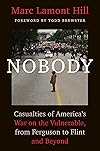
Hill's book is a collection of essays focused on the people whose names have become party of a litany of violence against African-Americans in recent years: Eric Garner, Michael Brown, Sandra Bland, Freddie Gray, Trayvon Martin and others. These people who have been made a Nobody in contemporary America are given their full human dignity in Hill's account of their lives, as well as the incidents that brought their demise and their aftermath. But Hill goes beyond the headlines and uses these show more incidents as a window into the greater societal and political trends that undergird them: "broken windows" policing, plea bargains denying people accused of crimes of their day in court and the incredible power this gives prosecutors, "Stand Your Ground" laws and the arming of America, mass incarceration, and the neoliberal ideal of running the government "like a business" that leads to the exploitation and disasters of places like Flint, Michigan. This is a powerful book and important book and one I highly recommend that everyone concerned about the future of our nation reads.
Favorite Passages:
Favorite Passages:
"The case for broken-windows policing is compelling because it lightly dipped in truth. Yet while there is a correlation between disorder (social and physical) and crime, research shows that this relationship is not causal. Simply put, there is no evidence that disorder directly promotes crime. What the evidence does suggest, however, is that the two are linked to the same larger problem: poverty. High levels of unemployment, lack of social resources, and concentrated areas of low income are all root cause of both high crime and disorder. As such, crime would be more effectively redressed by investing economically in neighborhoods rather than targeting them for heightened arrests." - p. 44show less
"Unfortunately, since modern American society, as with all things in the current neoliberal moment, prioritize privatization and individualism, the very notion of the public has become disposable. As the current criminal-justice process shows, no longer is there a collective interest in affirming the value of the public good, even rhetorically, through the processes of transparency, honesty, or fairness. No longer is there a commitment to monitoring and evaluating public officials, in this case prosecutors, to certify that justice prevails. Instead we have entered a moment in which all things public have been demonized withing out social imagination: public schools, public assistance, public transportation, public housing, public options, and public defenders. In place of a rich democratic conception of "the public" is a market-driven logic that privileges economic efficiency and individual success over collective justice." - p. 78-79
"There is plenty of reason to debate the central premise of privatization - that business always does it better - but we don't have to go there to find this idea objectionable. In the way that privatization separates government responsibilities from democratic accountability, the notion is flawed from its very conception. Businesses are not made function for the public good. The are made to function for the good of profit. There is nothing inherently evil in that. In most cases, the profit motive will almost certainly lead to a more efficient and orderly execution of tasks. But it does not necessarily lead to an equitable execution of tasks; indeed, it quite naturally resists and equitable execution of tasks. Furthermore, bu injecting moneymaking into the relationship between a citizen and the basic services of life - water, roads, electricity, and education - privatization distorts the social contract. People need to know that the decisions of governments are being made with the common good as a priority. Anything else is not government; it is commerce. One only needs to look back at Michigan to see this idea manifested because the crisis in Flint, as Henry Giroux has written, is what happens when the State is 'remade in the image of the corporation.'"
This book was published after Biden was elected and about 2 years before Hamas attacked Israel and Israel declared its intention to do whatever is necessary to destroy Hamas. Therefore the chapter on Gaza is particularly poignant; after reading it, I came to believe that the Hamas attack was probably inevitable as is Israel’s response, which is consistent with its policy of disproportionate retaliation for Palestinian attacks. The book is essentially a plea to progressives in the USA to show more step up, accept responsibility for their complacency when it comes to Palestinians, and their acceptance of related policies and actions which are antithetical to their professed values. Perhaps the current protests and demonstrations are a step in that direction, drawing attention and heightening awareness. It’s situations like this that make me wish I had a magic wand; I do not know what the solution is but I do know that Israel and the USA are far from blameless. show less
Lists
Awards


You May Also Like


Associated Authors
Statistics
- Works
- 8
- Also by
- 1
- Members
- 711
- Popularity
- #35,655
- Rating
- 4.1
- Reviews
- 9
- ISBNs
- 33
- Languages
- 1
- Favorited
- 3