
About the Author
Brené Brown was born in San Antonio, Texas on November 18, 1965. She received a Bachelor of Social Work at University of Texas at Austin, a Master of Social Work and Ph.D. from the Graduate College of Social Work at the University of Houston. She is a research professor at the University of show more Houston Graduate College of Social Work. She is the author of I Thought It Was Just Me, The Gifts of Imperfection, and Daring Greatly: How the Courage to Be Vulnerable Transforms the Way We Live, Love, Parent, and Lead. (Bowker Author Biography) show less
Image credit: Taken by Andrea Scher, owned by Brene Brown. Taken in Manzanita Oregon.
Works by Brené Brown
Daring Greatly: How the Courage to Be Vulnerable Transforms the Way We Live, Love, Parent, and Lead (2012) 5,494 copies, 115 reviews
The Gifts of Imperfection: Let Go of Who You Think You're Supposed to Be and Embrace Who You Are (2010) 5,047 copies, 77 reviews
Atlas of the Heart: Mapping Meaningful Connection and the Language of Human Experience (2021) 2,532 copies, 23 reviews
Braving the Wilderness: The Quest for True Belonging and the Courage to Stand Alone (2017) 2,294 copies, 51 reviews
I Thought It Was Just Me (But It Isn't): Making the Journey From "What Will People Think?" to "I Am Enough." (2007) 1,786 copies, 25 reviews
The Power of Vulnerability: Teachings of Authenticity, Connection, and Courage (2012) 331 copies, 9 reviews
You Are Your Best Thing: Vulnerability, Shame Resilience, and the Black Experience (2021) — Editor; Narrator, some editions — 325 copies, 4 reviews
Strong Ground: The Lessons of Daring Leadership, the Tenacity of Paradox, and the Wisdom of the Human Spirit (2025) 179 copies
Men, Women, and Worthiness: The Experience of Shame and the Power of Being Enough (2012) 81 copies, 1 review
The Gifts of Imperfect Parenting: Raising Children with Courage, Compassion, and Connection (2013) 65 copies, 2 reviews
Associated Works
The Art of Asking: How I Learned to Stop Worrying and Let People Help (2014) — Foreword, some editions — 1,310 copies, 54 reviews
Present Over Perfect: Leaving Behind Frantic for a Simpler, More Soulful Way of Living (2016) — Foreword, some editions — 1,007 copies, 19 reviews
Tagged
Common Knowledge
- Canonical name
- Brown, Brené
- Birthdate
- 1965-11-18
- Gender
- female
- Education
- University of Texas at Austin
University of Houston - Occupations
- research professor
- Organizations
- University of Houston Graduate College of Social Work
- Awards and honors
- Houston Women's Magazine Most Influencial Women (2009)
- Nationality
- USA
- Birthplace
- San Antonio, Texas, USA
- Places of residence
- Houston, Texas, USA
- Associated Place (for map)
- Texas, USA
Members
Reviews
The gifts of imperfection : let go of who you think you're supposed to be and embrace who you are by Brené Brown
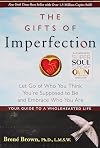
I got about 65% of the way through this one, plus the appendix on methodology, before I gave up.
a) I find it very odd that in a book about embracing imperfection and "who you are," there is so much emphasis on being grateful, joyful, spiritual, etc. What is a person who is naturally somewhat grouchy and devoutly non-spiritual to do? One can only assume that such persons are encouraged to change, to embrace the parts of themselves that are imperfect in other ways.
This is unfortunate. While show more there is nothing wrong with pursuing joy and/or happiness as a central goal of one's existence, there is also nothing wrong with choosing other goals--such as truth, justice, knowledge, etc.--instead, which may or may not be compatible with the values she outlines.
b) There is precious little acknowledgement of the position of relative privilege she is writing from. It is much easier to be (and preach) authentic when one's core self is not so far out of tune with what the culture demands. The worst that will happen to her if she tells a shaming anecdote about herself is that a talk will fall flat. Transgender kids, for instance, risk their lives--literally--when they tell the truth about who they are.
c) If shame had no adaptive value, we would not have evolved to feel it. Yet she writes as if shame were completely disposable, some kind of psychic trash we accidentally picked up over the past several millennia, without any value.
If shame is, as she writes, the fear of the loss of social connection tied to feeling intrinsically wrong or unlovable, it is not impossible to imagine scenarios in which this feeling would have been of very great use. When one's survival is dependent on belonging to a particular social group (family, tribe, etc.) undertaking behaviours that jeopardize that membership, whether or not they're legal, is a dangerous thing to do. (Just ask those transgender kids.) A feeling that keeps us in line, whether that line is defensible or not from a human rights perspective (and I know that in many cases it won't be), could keep someone alive in a pre-industrialized society. Even in an industrialized society.
There is no such thing as an emotion that it is never appropriate or healthy to feel. Negative feelings aren't bad or wrong; they're just uncomfortable. Shame along with the rest. It's just as inappropriate and unhealthy to feel joy when cutting off someone's head as it is to feel shame when accepting the Nobel prize, or actually probably moreso, now that I write it out that way. Every feeling has its healthy and appropriate context, yet she never discusses what it might be, for shame.
d) The research is unconvincing. She tells us about all of these surveys from all of these people who agreed with each other, but readers just have to take her word for it. There's not even quotes from any of the interviews. None of her subjects ever speak for themselves. That's if you accept the qualitative research basis for her work to begin with, which personally I find questionable.
This renders the book a large collection of just-so stories about what emotions mean and how to have more of the good ones and less of the nasty ones. It didn't hold my interest. I got about 60% of the way through and decided to skip to the methodology; the methodology chapter had no more of the details on the actual surveys and interviews that I was hoping for, so that was that. show less
a) I find it very odd that in a book about embracing imperfection and "who you are," there is so much emphasis on being grateful, joyful, spiritual, etc. What is a person who is naturally somewhat grouchy and devoutly non-spiritual to do? One can only assume that such persons are encouraged to change, to embrace the parts of themselves that are imperfect in other ways.
This is unfortunate. While show more there is nothing wrong with pursuing joy and/or happiness as a central goal of one's existence, there is also nothing wrong with choosing other goals--such as truth, justice, knowledge, etc.--instead, which may or may not be compatible with the values she outlines.
b) There is precious little acknowledgement of the position of relative privilege she is writing from. It is much easier to be (and preach) authentic when one's core self is not so far out of tune with what the culture demands. The worst that will happen to her if she tells a shaming anecdote about herself is that a talk will fall flat. Transgender kids, for instance, risk their lives--literally--when they tell the truth about who they are.
c) If shame had no adaptive value, we would not have evolved to feel it. Yet she writes as if shame were completely disposable, some kind of psychic trash we accidentally picked up over the past several millennia, without any value.
If shame is, as she writes, the fear of the loss of social connection tied to feeling intrinsically wrong or unlovable, it is not impossible to imagine scenarios in which this feeling would have been of very great use. When one's survival is dependent on belonging to a particular social group (family, tribe, etc.) undertaking behaviours that jeopardize that membership, whether or not they're legal, is a dangerous thing to do. (Just ask those transgender kids.) A feeling that keeps us in line, whether that line is defensible or not from a human rights perspective (and I know that in many cases it won't be), could keep someone alive in a pre-industrialized society. Even in an industrialized society.
There is no such thing as an emotion that it is never appropriate or healthy to feel. Negative feelings aren't bad or wrong; they're just uncomfortable. Shame along with the rest. It's just as inappropriate and unhealthy to feel joy when cutting off someone's head as it is to feel shame when accepting the Nobel prize, or actually probably moreso, now that I write it out that way. Every feeling has its healthy and appropriate context, yet she never discusses what it might be, for shame.
d) The research is unconvincing. She tells us about all of these surveys from all of these people who agreed with each other, but readers just have to take her word for it. There's not even quotes from any of the interviews. None of her subjects ever speak for themselves. That's if you accept the qualitative research basis for her work to begin with, which personally I find questionable.
This renders the book a large collection of just-so stories about what emotions mean and how to have more of the good ones and less of the nasty ones. It didn't hold my interest. I got about 60% of the way through and decided to skip to the methodology; the methodology chapter had no more of the details on the actual surveys and interviews that I was hoping for, so that was that. show less
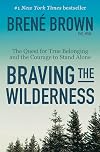
I was surprised by how much this one impacted me. There’s a thin line between self-help books and books they get to the core of a problem to actually solve a bigger social issue. I love the way she encouraged overcoming our differences to find a community instead of highlighting the issues that divide us. She asks readers to be brave by being vulnerable and allowing people to get close to you, while still holding to your own principles.
“I can confidently say that stories of pain and show more courage almost always include two things: praying and cussing. Sometimes at the exact same time.” show less
“I can confidently say that stories of pain and show more courage almost always include two things: praying and cussing. Sometimes at the exact same time.” show less
The Gifts of Imperfect Parenting: Raising Children with Courage, Compassion, and Connection by Brene Brown
I love Brene Brown and find that I connect with her work so deeply. I was excited to listen to this short audio book that was specifically targeted towards parenting. What I loved most about this short audio book is the connection not only to our parenting but also how we were parented because this is such a powerful piece of the puzzle when talking about shame and guilt.
I find that Brown's approachable way of talking about issues makes it very relatable and I always appreciate that about show more her writing style. She has the research but she also can talk to you as a real person and parent.
She covers some important topics including how we influence kids by modeling and through our language. We can't raise kids that are more shame resistant than we are. We can't teach our children what we don't know and do ourselves and I think this is such an important reminder. Leading by example is so powerful.
It is also important to be be vulnerable with our children and share how we deal with things and when there are challenges or disappointments. Taking accountability for your actions is what is important because we all learn and make mistakes as we go.
My favorite part of the book is the part about belonging and unconditional love. I want my children to always feel this sense of belonging as it is such an important foundation for them. show less
I find that Brown's approachable way of talking about issues makes it very relatable and I always appreciate that about show more her writing style. She has the research but she also can talk to you as a real person and parent.
She covers some important topics including how we influence kids by modeling and through our language. We can't raise kids that are more shame resistant than we are. We can't teach our children what we don't know and do ourselves and I think this is such an important reminder. Leading by example is so powerful.
It is also important to be be vulnerable with our children and share how we deal with things and when there are challenges or disappointments. Taking accountability for your actions is what is important because we all learn and make mistakes as we go.
My favorite part of the book is the part about belonging and unconditional love. I want my children to always feel this sense of belonging as it is such an important foundation for them. show less
Daring Greatly: How the Courage to Be Vulnerable Transforms the Way We Live, Love, Parent, and Lead by Brené Brown
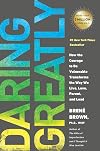
Received this book from Early Reviewers and read the introduction, wasn't moved enough to read further, and just picked it back up over the weekend. After reading into the first two chapters I wondered aloud to my husband why I didn't devour the book when I first picked it up. Read the entire book so quickly the second time around!
Since Brown refers to her TED talk in the book, I was excited to watch it (fan of TEDTalks) but wanted to read her book first.
I am - I think - one of the kinds of show more readers that she refers to in the book that is skeptical that a topic on vulnerability or shame is worth reading an entire book about. Consider me reformed. She makes a strong case for considering vulnerability. One lightbulb went off when she explained how so many of us cite joyful moments as vulnerable ones. She has other helpful insights that I'm planning to use in unexpected ways. I'll be using some of the early chapters in her book in my university classes on peer mentoring.
I think I would have been uncomfortable with the book if it read too much like a self-help book. It doesn't. It is helpful, I have dog-eared tons of pages, but there is intriguing and substantive research to inform her writing.
The thing that I like the best is that she shares her vulnerability in her writing and she writes like a real person... helps that she seems so smart too. show less
Since Brown refers to her TED talk in the book, I was excited to watch it (fan of TEDTalks) but wanted to read her book first.
I am - I think - one of the kinds of show more readers that she refers to in the book that is skeptical that a topic on vulnerability or shame is worth reading an entire book about. Consider me reformed. She makes a strong case for considering vulnerability. One lightbulb went off when she explained how so many of us cite joyful moments as vulnerable ones. She has other helpful insights that I'm planning to use in unexpected ways. I'll be using some of the early chapters in her book in my university classes on peer mentoring.
I think I would have been uncomfortable with the book if it read too much like a self-help book. It doesn't. It is helpful, I have dog-eared tons of pages, but there is intriguing and substantive research to inform her writing.
The thing that I like the best is that she shares her vulnerability in her writing and she writes like a real person... helps that she seems so smart too. show less
 This review was written for LibraryThing Early Reviewers.
Lists
Awards


You May Also Like


Associated Authors
Statistics
- Works
- 30
- Also by
- 2
- Members
- 23,477
- Popularity
- #894
- Rating
- 4.0
- Reviews
- 405
- ISBNs
- 273
- Languages
- 22
- Favorited
- 9

