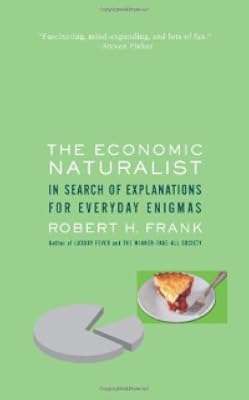
The Economic Naturalist: In Search of Explanations for Everyday Enigmas
by Robert H. Frank
On This Page
Description
The playful guide to how economics explains the simple but profound ideas that govern our world. Why do the keypads on drive-up cash machines have Braille dots? Why are round-trip fares from Orlando to Kansas City higher than those from Kansas City to Orlando? For decades, Robert Frank has been asking his economics students to pose and answer questions like these as a way of learning how economic principles operate in the real world--which they do everywhere, all the time. Once you learn to show more think like an economist, all kinds of puzzling observations start to make sense. This book employs basic economic principles to answer scores of intriguing questions, and, along the way, introduces key ideas such as the cost-benefit principle, the "no cash left on the table" principle, and the law of one price. There is no more delightful and painless way of learning these fundamental principles.--From publisher description. show lessTags
Recommendations





Member Recommendations
Member Reviews
This is a very neat book. I was attracted by the question on the cover: Why is milk sold in rectangular containers, while soft drinks are sold in cylindrical ones? (A: milk needs to be in refrigerated shelves which cost more, and rectangular containers are more space efficient.) There are many more along these lines. Some seem to miss other dimensions, focussing purely on costs/benefits etc, but the process is sound, and it certainly makes you think. Read March 2010.
To sum the author's point: I have a theory of economics, and this theory is what I teach, and here are some observations about people's choices that can lead to interpretations that might kinda support it, if they're true. But let's not bother with experiments or with fact-checking or with actually asking the people making these choices."
Sorry, if economics is the 'dismal science' I expect books about it to be at least a bit scientific. No matter how often the author says "may" or "might be part of the reason" or "could be a factor," I'm not convinced he's not confident of his theories. But what a waste of time to read all these theories that haven't been tested.
"Why are physically attractive people also more intelligent than others, on show more average?" Author suggests several odd ideas, but never mentions general *health* - which I see as predominant in my experience. Kids who are raised with care tend to have both healthier teeth & stronger, straighter bodies & clearer skin, etc. *and* are less likely to have eaten lead paint chips & more likely to have been read aloud to, etc. On average. Now I've not tested my theory either, but it's at least as plausible as his. And that's the thing - he very often leaves out mention of other plausible interpretations of the observations because they wouldn't fit his theory of economics.
" show less
Sorry, if economics is the 'dismal science' I expect books about it to be at least a bit scientific. No matter how often the author says "may" or "might be part of the reason" or "could be a factor," I'm not convinced he's not confident of his theories. But what a waste of time to read all these theories that haven't been tested.
"Why are physically attractive people also more intelligent than others, on show more average?" Author suggests several odd ideas, but never mentions general *health* - which I see as predominant in my experience. Kids who are raised with care tend to have both healthier teeth & stronger, straighter bodies & clearer skin, etc. *and* are less likely to have eaten lead paint chips & more likely to have been read aloud to, etc. On average. Now I've not tested my theory either, but it's at least as plausible as his. And that's the thing - he very often leaves out mention of other plausible interpretations of the observations because they wouldn't fit his theory of economics.
" show less
Robert H Frank presents a collection of reworked student essays on economics applied to real life situations. Each is short, perhaps a page or more, with titles such as 'Why do women endure the discomfort of high heels?' or 'Why did kamikaze pilots wear helmets?'
Good introduction to the way that economists think about some problems. Breaks down many issues in an analytical way, outlining the apparent discrepancy and attempting to explain it. I think it falls down in that it gets repetitive very quickly, and also due to the sometimes speculative nature of the explanations. For example, one question dealing with the varying popularity of text messaging from one country to another resorted to 'national character' as an unsatisfactory show more answer.
Useful for those new to economics, perhaps, but may overextend the applicability of economic concepts in some areas. While such uses are plausible, often they are unnecessary and overcomplicate where a simple common sense answer would suffice. show less
Good introduction to the way that economists think about some problems. Breaks down many issues in an analytical way, outlining the apparent discrepancy and attempting to explain it. I think it falls down in that it gets repetitive very quickly, and also due to the sometimes speculative nature of the explanations. For example, one question dealing with the varying popularity of text messaging from one country to another resorted to 'national character' as an unsatisfactory show more answer.
Useful for those new to economics, perhaps, but may overextend the applicability of economic concepts in some areas. While such uses are plausible, often they are unnecessary and overcomplicate where a simple common sense answer would suffice. show less
Every problem presented has a simple explanation that is only true in an imaginary world that economist live in where markets work perfectly. In fact every single problem presented is much more complicated and the forces behind it are many and interesting but you wouldn't know it from this book. It also picks only problems that work well in markets and avoid any that could show their shortcomings.
About: Questions about everyday life (such as why do women's clothes button from the left and men's clothes button from the right? and why are DVDs sold in bigger packages than CDs, even though the discs themselves are the same size?) are answered using mostly economic theories and realities.
Pros: Very interesting collection of questions answered. I enjoyed thinking about stuff I've never thought about before. Clearly written. Footnotes.
Cons: Some answers are not really answers at all, as answering a question with a theory is not very satisfying. Other questions have obvious answers (i.e. the reason bars give out free salted peanuts is that they make you thirsty, so you'll buy more drinks). These quibbles aside, the book is show more enjoyable.
Grade: B+ show less
Pros: Very interesting collection of questions answered. I enjoyed thinking about stuff I've never thought about before. Clearly written. Footnotes.
Cons: Some answers are not really answers at all, as answering a question with a theory is not very satisfying. Other questions have obvious answers (i.e. the reason bars give out free salted peanuts is that they make you thirsty, so you'll buy more drinks). These quibbles aside, the book is show more enjoyable.
Grade: B+ show less
The Economic Naturalist was okay, but not as good as Freakonomics. He had a great idea, about teaching basic economic concepts with everyday examples - supply and demand, opportunity cost, etc. But it got a little boring and repetitious. It was interesting in the way that he tried to explain everyday things that we don't neccessarily think about in economic terms, like why milk comes in square containers, and soda (pop to me) cans are round?
But he did make the point repeatedly, that maybe his answers weren't the real reasons behind these mysteries just the logical or economic ones - so it made me feel like he hadn't really done any research, like he was just making things up.
Anyway, it wasn't a bad book, but I am glad I got it out of show more the library. show less
But he did make the point repeatedly, that maybe his answers weren't the real reasons behind these mysteries just the logical or economic ones - so it made me feel like he hadn't really done any research, like he was just making things up.
Anyway, it wasn't a bad book, but I am glad I got it out of show more the library. show less
A short series of musings which answers a wide variety of questions from an economic perspective. This certainly wouldn't replace a textbook, but it is a nice way to illustrate the basic principles one would hope to learn in an "Econ 101" college course. The point of this book isn't to teach a series of facts or answers, but to illustrate principles, and it succeeds very well.
Members
- Recently Added By
Author Information

28+ Works 2,482 Members
Robert H. Frank is the H. J. Louis Professor of Management and Professor of Economics, emeritus, at Cornell University's Johnson Graduate School of Management. He has been an Economic View columnist for the New York Times since 2005. His many books include Success and Luck (Princeton). Twitter @econnaturalist
Some Editions
Common Knowledge
- Original publication date
- 2007
- Dedication
- For Thomas C. Schelling
- First words
- Why do the keypad buttons on drive-up cashpoint machines have Braille dots?
- Last words
- (Click to show. Warning: May contain spoilers.)There are rich textures and patterns in everyday experience that become visible to the practised eye of the economic naturalist. Discovering them is an intellectual adventure you can savour for the rest of your days.
- Blurbers
- Solow, Robert; Shiller, Robert J.; de Waal, Frans; Cowen, Tyler; Gilovich, Thomas; Pinker, Steven (show all 7); Strogatz, Steven
Classifications
Statistics
- Members
- 781
- Popularity
- 35,754
- Reviews
- 19
- Rating
- (3.09)
- Languages
- 8 — Dutch, English, French, Italian, Polish, Portuguese (Portugal), Spanish, Turkish
- Media
- Paper, Ebook
- ISBNs
- 18
- ASINs
- 7