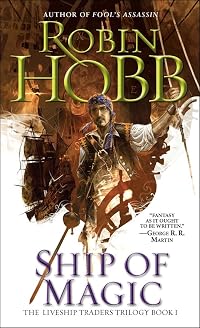
Ship of Magic
by Robin Hobb
The Liveship Traders (1), Realm of the Elderlings (04 (Liveship Traders 01))
On This Page
Description
Bingtown is a hub of exotic trade and home to a merchant nobility famed for its liveships—rare vessels carved from wizardwood, which ripens magically into sentient awareness. The fortunes of one of Bingtown's oldest families rest on the newly awakened liveship Vivacia.For Althea Vestrit, the ship is her rightful legacy unjustly denied her—a legacy she will risk anything to reclaim. For Althea's young nephew Wintrow, wrenched from his religious studies and forced to serve aboard ship, show more Vivacia is a life sentence.
But the fate of the Vestrit family—and the ship—may ultimately lie in the hands of an outsider. The ruthless pirate Kennit seeks a way to seize power over all the denizens of the Pirate Isles...and the first step of his plan requires him to capture his own liveship and bend it to his will.
. show less
Tags
Recommendations


Member Reviews
After the flaws in the Farseer trilogy, I wasn't sure about tackling another huge Hobb saga, but so far I am enjoying it a lot more. The set up of ships, including liveships animated by an intelligence, pirates and the politics of Bingtown, torn between the Old Traders with their secrets and contracts with the mutated Rain Wilders on the one hand and the crass New Traders, given illegal land grants by the corrupt and drugged up satrap of Jamaillia, provides far more interest and conflict, and does not require characters to constantly behave stupidly to make the plot work. Some characters do act stupidly, such as Malta, the spoiled brat, and the odious Kyle, but their behaviour arises from their character flaws - there is far more show more character development in this book than in the Farseer books. There are also the odd sections from the POV of some of the sea serpents who keep attacking ships, especially the slaver ships, which throw dead bodies over the side, and I expect they will turn out to be more important than at first appears. And I can't help wondering if Amber is like the Fool in the Farseer books. Anyway, I am interested to see how things develop in book 2. show less
I’m very apprehensive when it comes to adult fantasy. It’s a genre that takes itself really seriously, and inevitably there are graphic, unnecessary sex scenes. While this is all well and good for people who enjoy that, I personally prefer books that are a little lighter and skip the sex scenes. I mention this, because Ship of Magic is adult fantasy and I was really nervous going in because… you never know.
Here’s the thing, though. Ship of Magic also promised me pirates and I have a weakness for pirates. Give me a story with pirates and I am 150% in to read it. And loves, I was not disappointed.
This novel has the best nautical aesthetic. Most the book takes place aboard one ship or another. There’s your standard wooden ships, show more sure, but there are also ship made of wizard wood that can be “quickened” and come to life and that’s so cool. The source of all peculiar, magical items here is a mysterious place called the Rainwild, a place we hear about but don’t see. What we know about magic and the Rainwild is that they come at a terrible price. So there’s a lot at stake there.
Ship of Magic has a lot of POVs. Most of the POVs come from the Vestrit family, and some POVs are better than others. I loved Althea because of her spirit, and I enjoyed Winthow because of his deep moral dilemmas. Kyle made me so so angry – he was a selfish, sexist pig who constantly made unforgivable choices. So the characters run the gamut. I also really loved the POVs coming from the Liveships – Vivacia and Paragorn are primaries here, but Ophelia enters near the end of the book. I think my favorie part of the characters in general is that you know that we’ve only skimmed the surface and there’s so much more to come.
A book of this length can be a challenge, because the story can drag. Not the case here. Like The Name of the Wind, I found that Ship of Magic flowed so easily that I didn’t realize that I was listening to a 35 hour book. Loves, I finished this in five days, making it seven hours of listening a day, and I breezed through. The pacing is great, and the POVs switch at just the right time to maintain interest. This book has the start of so may journeys, and I want to see where it all goes. Honestly, even the bad POVs? I just want to see justice served upon these horrible individuals. So I’m here for it.
Some last minute standard warnings? There’s a couple of quick, graphic sex scenes. Kyle, as I mentioned, is sexist… Kennit is too, though not to the same extent. There’s also conversations about slavery and keeping women at home “where they belong”. I do want to make it clear – the problematic views are kept by the villains. But they are POVs and the content is there, and it’s worth mentioning.
Honestly, as a whole, I’m so intrigued and impressed. I loved the themes of good and evil, right and wrong, and if it’s worth crossing moral lines to survive. I’m here for the variety of characters and creepy serpents chasing liveships and the storms that threaten to run ships aground and pirate vibes and all of it. Sure, there were moments I didn’t like, but they comprised less than 1% of the novel. I will absolutely be continuing the series, and I’ll most likely check out more of Hobb’s books.
If you like fantasy and pirates you’ve got to add Ship of Magic to your TBR. show less
Here’s the thing, though. Ship of Magic also promised me pirates and I have a weakness for pirates. Give me a story with pirates and I am 150% in to read it. And loves, I was not disappointed.
This novel has the best nautical aesthetic. Most the book takes place aboard one ship or another. There’s your standard wooden ships, show more sure, but there are also ship made of wizard wood that can be “quickened” and come to life and that’s so cool. The source of all peculiar, magical items here is a mysterious place called the Rainwild, a place we hear about but don’t see. What we know about magic and the Rainwild is that they come at a terrible price. So there’s a lot at stake there.
Ship of Magic has a lot of POVs. Most of the POVs come from the Vestrit family, and some POVs are better than others. I loved Althea because of her spirit, and I enjoyed Winthow because of his deep moral dilemmas. Kyle made me so so angry – he was a selfish, sexist pig who constantly made unforgivable choices. So the characters run the gamut. I also really loved the POVs coming from the Liveships – Vivacia and Paragorn are primaries here, but Ophelia enters near the end of the book. I think my favorie part of the characters in general is that you know that we’ve only skimmed the surface and there’s so much more to come.
A book of this length can be a challenge, because the story can drag. Not the case here. Like The Name of the Wind, I found that Ship of Magic flowed so easily that I didn’t realize that I was listening to a 35 hour book. Loves, I finished this in five days, making it seven hours of listening a day, and I breezed through. The pacing is great, and the POVs switch at just the right time to maintain interest. This book has the start of so may journeys, and I want to see where it all goes. Honestly, even the bad POVs? I just want to see justice served upon these horrible individuals. So I’m here for it.
Some last minute standard warnings? There’s a couple of quick, graphic sex scenes. Kyle, as I mentioned, is sexist… Kennit is too, though not to the same extent. There’s also conversations about slavery and keeping women at home “where they belong”. I do want to make it clear – the problematic views are kept by the villains. But they are POVs and the content is there, and it’s worth mentioning.
Honestly, as a whole, I’m so intrigued and impressed. I loved the themes of good and evil, right and wrong, and if it’s worth crossing moral lines to survive. I’m here for the variety of characters and creepy serpents chasing liveships and the storms that threaten to run ships aground and pirate vibes and all of it. Sure, there were moments I didn’t like, but they comprised less than 1% of the novel. I will absolutely be continuing the series, and I’ll most likely check out more of Hobb’s books.
If you like fantasy and pirates you’ve got to add Ship of Magic to your TBR. show less
Despite all the negative reviews I've given Robin Hobb's books in the past, I keep coming back. The only way I can explain it is that, even though I finish every book unhappy and a tad disappointed, I have trouble denying that they are well written (certainly far above the curve for fantasy) and that the plotlines are usually well fleshed out. This book was no exception. Overall thoughts:
PROS:
Strong worldbuilding, story doesn't feel rushed, good characterization, wide array of different, equally interesting plotlines.
CONS:
Formatting! - I don't understand why chapters randomly switch narrators midway through. These should just be new chapters a la GRRM. It's not copying his idea if it's the best way to write third person with multiple show more viewpoints.
Pace - This is both a pro and a con. I love that the story is not rushed, and that all the characters are analyzed in detail so that they are realistic, but sometimes Hobb's books seem to move at a glacial pace. While I'm not sure if this is really a con, or just a personal frustration with her writing, it definitely keeps me from placing her amongst my all time favorite authors
SADISM - Hobb has this insane fascination with her characters being maimed, killed, or writhing in some sort of agony (either emotional or physical). While it is often realistic in the context of her stories, it makes her books overly depressing to read. To be honest, this book was less painful than the books of hers that I'd read previously, because it is not written in the first person (and thus isnt ALL about a single narrator's pain). I still am frustrated by this aspect of her writing, and really wish, just once, one of her characters would actually be happy for a few chapters. show less
PROS:
Strong worldbuilding, story doesn't feel rushed, good characterization, wide array of different, equally interesting plotlines.
CONS:
Formatting! - I don't understand why chapters randomly switch narrators midway through. These should just be new chapters a la GRRM. It's not copying his idea if it's the best way to write third person with multiple show more viewpoints.
Pace - This is both a pro and a con. I love that the story is not rushed, and that all the characters are analyzed in detail so that they are realistic, but sometimes Hobb's books seem to move at a glacial pace. While I'm not sure if this is really a con, or just a personal frustration with her writing, it definitely keeps me from placing her amongst my all time favorite authors
SADISM - Hobb has this insane fascination with her characters being maimed, killed, or writhing in some sort of agony (either emotional or physical). While it is often realistic in the context of her stories, it makes her books overly depressing to read. To be honest, this book was less painful than the books of hers that I'd read previously, because it is not written in the first person (and thus isnt ALL about a single narrator's pain). I still am frustrated by this aspect of her writing, and really wish, just once, one of her characters would actually be happy for a few chapters. show less
It's been a long time since I've read a Robin Hobb book, and I didn't remember much about her style. One thing I did remember is that she likes to torture her characters, and that's definitely true in this book too.Ship of Magic is the first book in a trilogy, which in turn is the second trilogy in a series of four connected trilogies, but it's not connected to the first trilogy and can be read standalone. Despite it being nearly a decade since I read the first trilogy, I never felt lost or that I was missing anything. There are just small references and callbacks.
At its heart this is a pirate novel. It follows several POV characters, but the vast majority of time is spent at sea. I really like pirate fantasy, I think it's an underused show more subgenre and we need more of it, and Hobb is a fantastic writer. This book is long, maybe a little too long, and differently drags a bit in the middle, but it's undoubtedly well-written, smart, witty, and emotional.
The concept of a living ship is a cool one, and the ships being their own characters with distinct personalities definitely adds in some excitement to sailing.
My one complaint with this novel is how poorly she treats some characters. Characters will often make poor decisions act irrational for what seems to be the sole purpose of making their lives harder and driving the plot forward. It's a common criticism I've seen of Hobb.
This is a good novel, but definitely not one that wraps up satisfactorily on its own. Many major plots and subplots are left unresolved and are set up specifically to lead into the next novels. These books are a significant time investment, so be warned if you decide to start this one. show less
At its heart this is a pirate novel. It follows several POV characters, but the vast majority of time is spent at sea. I really like pirate fantasy, I think it's an underused show more subgenre and we need more of it, and Hobb is a fantastic writer. This book is long, maybe a little too long, and differently drags a bit in the middle, but it's undoubtedly well-written, smart, witty, and emotional.
The concept of a living ship is a cool one, and the ships being their own characters with distinct personalities definitely adds in some excitement to sailing.
My one complaint with this novel is how poorly she treats some characters. Characters will often make poor decisions act irrational for what seems to be the sole purpose of making their lives harder and driving the plot forward. It's a common criticism I've seen of Hobb.
This is a good novel, but definitely not one that wraps up satisfactorily on its own. Many major plots and subplots are left unresolved and are set up specifically to lead into the next novels. These books are a significant time investment, so be warned if you decide to start this one. show less
First published at Booking in Heels.
I have actually read Robin Hobb’s first series; the one that starts with Assassin’s Apprentice. It was a while ago and I don’t remember it all that clearly, but I think I was so-so about it. I liked it, but didn’t love it. The Ship of Magic and the Liveship Traders series takes place in the same world but, as far as I can tell, isn’t actually connected in the slightest. I certainly didn’t suffer from having zero recollection of the Farseer trilogy.
There are many different strands and layers to the plot, but the main point focuses on Althea Vestrit and her family’s liveship that has basically just come alive. Three generations of her family have died upon the Vivacia, and so her show more figurehead has now come alive and has a personality, hopes and fears of her own. The problem is that Althea’s brother-in-law has assumed command and won’t let her anywhere near the Vivacia, leading Althea to run off into the world in an attempt to prove herself.
That’s a pretty great plot all in itself, except there is so much more. So many subplots, and characters, and argh. Pirates, politics, mutinies, inheritances… There is such a lot going on and, unusually, I loved them all an equal amount. I never felt irritated when the focus shifted to a different character or subplot, because each one was fascinating in its own way.
I did not love each character equally, however! They are all flawed people who make mistakes and foolish decisions, and some of them I hated. I can only assume this is intentional on the part of the author, as each character is so real to me that they could practically walk off the page. The Ship of Magic is a very character driven story (although it has its fair share of action as well) and it would not have worked without that perfect balance of qualities within the story’s subjects.
What really made The Ship of Magic stand out for is how I was made to personally feel everything that happened. I was alternately outraged, thrilled, sad and disgusted by/with each of the characters and the events that occurred, and those feelings stayed with me long after I put the book down. I caught myself thinking about it in the shower and after I’d turned the light out in bed. It’s a book you carry with you, even when it’s not open in front of you.
It’s 880 pages long, but it flies by. Every second I wasn’t reading The Ship of Magic, I wanted to be. It’s lengthy, complex and somewhat complicated, but it manages to be in-depth without being heavy, and semi-formal without being boring. It is one of the most engrossing books I have ever read.
I’d bought the next book in the Liveship Traders series, The Mad Ship, before I’d even finished this one. It’s 906 pages long, but I’ll definitely be getting to it soon. In case it isn’t crystal clear, I loved this book. show less
I have actually read Robin Hobb’s first series; the one that starts with Assassin’s Apprentice. It was a while ago and I don’t remember it all that clearly, but I think I was so-so about it. I liked it, but didn’t love it. The Ship of Magic and the Liveship Traders series takes place in the same world but, as far as I can tell, isn’t actually connected in the slightest. I certainly didn’t suffer from having zero recollection of the Farseer trilogy.
There are many different strands and layers to the plot, but the main point focuses on Althea Vestrit and her family’s liveship that has basically just come alive. Three generations of her family have died upon the Vivacia, and so her show more figurehead has now come alive and has a personality, hopes and fears of her own. The problem is that Althea’s brother-in-law has assumed command and won’t let her anywhere near the Vivacia, leading Althea to run off into the world in an attempt to prove herself.
That’s a pretty great plot all in itself, except there is so much more. So many subplots, and characters, and argh. Pirates, politics, mutinies, inheritances… There is such a lot going on and, unusually, I loved them all an equal amount. I never felt irritated when the focus shifted to a different character or subplot, because each one was fascinating in its own way.
I did not love each character equally, however! They are all flawed people who make mistakes and foolish decisions, and some of them I hated. I can only assume this is intentional on the part of the author, as each character is so real to me that they could practically walk off the page. The Ship of Magic is a very character driven story (although it has its fair share of action as well) and it would not have worked without that perfect balance of qualities within the story’s subjects.
What really made The Ship of Magic stand out for is how I was made to personally feel everything that happened. I was alternately outraged, thrilled, sad and disgusted by/with each of the characters and the events that occurred, and those feelings stayed with me long after I put the book down. I caught myself thinking about it in the shower and after I’d turned the light out in bed. It’s a book you carry with you, even when it’s not open in front of you.
It’s 880 pages long, but it flies by. Every second I wasn’t reading The Ship of Magic, I wanted to be. It’s lengthy, complex and somewhat complicated, but it manages to be in-depth without being heavy, and semi-formal without being boring. It is one of the most engrossing books I have ever read.
I’d bought the next book in the Liveship Traders series, The Mad Ship, before I’d even finished this one. It’s 906 pages long, but I’ll definitely be getting to it soon. In case it isn’t crystal clear, I loved this book. show less
Complex and rich introduction to a fantasy trilogy focusing on the lie ship Vivacia and the people caught up in her story. Hobb exploits the flaws and blindspots in her characters world views, personalities, and virtues to drive drama from the inside, rather than external factors. Oh the trouble they make for themselves! And there's plenty in the world as it is. Can't wait to read the next one!
Final verdict: a great antidote to A Game of Thrones, with brilliant, complicated characters.
My friend introduced to me to [b:Ship of Magic|45100|Ship of Magic (Liveship Traders, #1)|Robin Hobb|http://ecx.images-amazon.com/images/I/6161dsnKaaL._SL75_.jpg|1476156] because I'd been complaining about annoying stupid characters. She recommended Robin Hobb in general, but Ship of Magic especially, primarily for Althea Vestrit, our primary protagonist.
One thing I want to point out is that I would have never picked this up on my own. Not for the title, not the cover (yes, I'm disproportionately attracted to pretty covers--there's a blog post in there somehow), and not even the cover copy. Although Althea is my middle name. But normally not show more even that.
Thank goodness for my friend, because this book seems to have marked a change in the books I'm reading--after a streak of at best mediocre reading, I'm enjoying it again! (That can't be attributed entirely to this book, but did contribute to the exhilaration of my reading experience.)
Althea Vestrit is the younger daughter of a liveship trader family. In essence, the elite of colonial Bingtown. Liveships are just that: living ships. But you don't just build a ship that's alive, or buy one, it has to be built first of wizard wood, and 'grow': that is to say, quicken. A liveship, though, will only quicken after three of its family members die on-deck, through which they gain knowledge and awareness. And a liveship will only respond to a member of the family, especially once it is alive.
And I haven't even gotten to the story yet. Continued in vaguely topical order:
World building
Robin Hobb has built an incredible, complex world, much of which is gradually revealed throughout the story, naturally and through the characters' perspectives. The world-building is crucial to the story's success, because in many ways, its core theme is the clash of worlds, old and new. There isn't one simple conflict between good and evil or even two families. Bingtown is a colony, only now, they're being settled again by people who don't understand the land and customs--and worse, Bingtown has started following the customs of the mainland, even those that just a generation ago would have been too horrifying to contemplate. Now, the newcomers may not understand the reasons for Bingtown's customs, but the locals won't explain them either (more on that later).
The conflict of cultures is so important. Worldly Jamaillia is decadent, rich, slave-owning. And the slaves can be anyone: the educated call for particularly high prices. Bingtown once had equal relations to men and women: they've borrowed the madonna/whore complex from Jamaillia and now are looking to slavery. But Bingtown has a strange relationship with magic and the people up the river who make it.
Back to Althea. Because she's the natural daughter of the Vestrit's, who own a liveship just one death away from quickening, Althea fully expects to be the next captain. After all, she's been sailing with her father for years, and her older sister is married: settled with children. But as the summary states so baldly, Althea doesn't get Vivacia, her brother in law does.
Ways in which [b:Ship of Magic|45100|Ship of Magic (Liveship Traders, #1)|Robin Hobb|http://ecx.images-amazon.com/images/I/6161dsnKaaL._SL75_.jpg|1476156] exceeds [b:A Game of Thrones|13496|A Game of Thrones (A Song of Ice and Fire, #1)|George R.R. Martin|http://photo.goodreads.com/books/1312430353s/13496.jpg|1466917]:
Plot
Like A Game of Thrones, Ship of Magic has several major plot threads (approximately eight, some embedded in the 'world' arcs), all given roughly equal treatment, and a great many POV characters (at least eight). I wonder if there's something to those numbers. and Martin is praised because he's willing to kill off 'anyone', which just makes me suspect a paucity of decent literature in the fantasy section. Ship of Magic made me care about the characters, even without ever having a POV of their own, and _then_ they died.
Character
Getting into more spoiler-y territory, I loved the conflict between Ronica (Althea's mother) and Kyle (her brother-in-law).Kyle really seems like just your standard sub-boss evil. In most novels ([b:The Name of the Wind|186074|The Name of the Wind (The Kingkiller Chronicle, #1)|Patrick Rothfuss|http://photo.goodreads.com/books/1270352123s/186074.jpg|2502879]), he'd be petty and cruel, and basically the antagonist until the confrontation with the real bad guy happens. In some ways, Kyle is all of those things. But his main threat is in how he threatens, and represents the threat, to the liveship trader way of life. And Ronica loathes him for it. But he's been her son-in-law for 15 years, IIRC, and no one in the family has tried to make him understand these traditions and why things are the way they are in Bingtown. There's a lot of hidden history that's gradually being revealed, but the locals don't discuss it amongst themselves, much less outsiders like Kyle. At least once, the truth has been actively hidden from him. These are cultures clashing because their people (on any side) cannot understand comprehend a way of life different from their own.
Wintrow, Althea's oldest nephew, lived with the priests since infancy, because in Bingtown, it's an honor. Wintrow can't wait to be a priest. But since Kyle captains the Vivacia, he needs a family-member by blood on board, especially now that Vivacia is conscious. Wintrow's struggles: to stay safe, to stay sane--my heart BLED for him.
Btw: Hobb has built an incredible, convincing fictional religion.
Kennit is about as villainous as a villain can be. As I said in a forum: "[he] knows he’s not a good guy, goes around plotting like mad, but is just going after what he wants in any way he can. He knows he’s not a good guy, but doesn’t care: he just wants power. He also goes around going good deeds, but evilly...He’s a pirate freeing slaves because then they’ll voluntarily be his army to help him take over the world. And he’s surrounded by people who are unbearably loyal to him: even his sentient charm fashioned in his image hates him and doesn’t think he deserves what he has."
One thing that Hobb does beautifully that Martin fails entirely, is have a focus to her narrative. Althea's story is central to the unifying thread. All of these characters have very important stories of their own, but Althea's is going to be right in the middle of it all.
Slut Shaming
One note about the characters: sometimes they aren't all good. Or bad. (Unless it's Kennit) They can be whiny, infuriating, annoying, ignorant, just-plain-stupid, and often wrong. For instance, Althea's quest to retake the Vivacia? Well, first she has to learn that she wasn't qualified to captain a vessel on her own, that when she traveled with her father, she was playing at sailoring. So she goes off on her own to learn--and learn she does. Slowly. Which is possibly the best part.
Now that I've been working on this for two hours, I want to touch on a subject I know is important to many of my GR friends--and the reviewers I follow who have no idea who I am: slut shaming.
THERE ISN'T ANY!
First you have Malta, Althea's niece, all of thirteen years old, *IIRC. O Good Lord, Malta. She takes the place of Martin's Sansa: obsessed with boys, rather stupid. Only Malta specifically wants sex. Preferably before babies and marriage, because she doesn't want to end up with an icky husband. Is she too young for this? Hell yes, she's spoiled rotten, doesn't understand how her own society works, and despite her interest, completely ignorant of what said sex would actually mean. Sansa, I just hated, but while I wanted to smack Malta upside the head, I also ached for her. She is so completely unaware of how vulnerable she is--and she does have to work at ignoring it too. Unlike Althea, she retreats from what scares her, what's hard (although Althea has her moments), and Keffria (her mother) and Ronica are only just learning how much they've neglected to teach her.
As for Althea--
Spoilers! Please click carefully, because this section is so important to her character development! It wouldn't ruin the book, but it would color the reading experience.
After Althea goes off to learn sailing while disguised as a boy (explained in text) she sleeps with Brashen (well, okay, it's clear he's a love interest from the cover copy) while both are impaired. She's concussed and they're both drunk and high, I think. He might be concussed too. It turns out, despite being 'upper class' in this society, and their expectations for women, she's had sex before. The first time when she was fourteen under skeevy circumstances. When she goes home to tell her sister, Keffria makes her get a charm to prevent pregnancy and STDs, assuming her sister is easy. It's the betray of trust that Althea has a problem with, she doesn't think of herself that way. In fact, she's NOT damaged by the experience, and she knows it's supposed to be pleasurable, so she seeks it out herself, occasionally. But it's not a flaw of her character that she's sexually active, and while other characters may not like it, it's never a view condoned by the text. Thought you guys might like that.
I should end for now. I can think of so many more things to say! If I can get this under control, I promise to try and make it readable.
I just want to get everyone to read it themselves! It's just that awesome! show less
My friend introduced to me to [b:Ship of Magic|45100|Ship of Magic (Liveship Traders, #1)|Robin Hobb|http://ecx.images-amazon.com/images/I/6161dsnKaaL._SL75_.jpg|1476156] because I'd been complaining about annoying stupid characters. She recommended Robin Hobb in general, but Ship of Magic especially, primarily for Althea Vestrit, our primary protagonist.
One thing I want to point out is that I would have never picked this up on my own. Not for the title, not the cover (yes, I'm disproportionately attracted to pretty covers--there's a blog post in there somehow), and not even the cover copy. Although Althea is my middle name. But normally not show more even that.
Thank goodness for my friend, because this book seems to have marked a change in the books I'm reading--after a streak of at best mediocre reading, I'm enjoying it again! (That can't be attributed entirely to this book, but did contribute to the exhilaration of my reading experience.)
Althea Vestrit is the younger daughter of a liveship trader family. In essence, the elite of colonial Bingtown. Liveships are just that: living ships. But you don't just build a ship that's alive, or buy one, it has to be built first of wizard wood, and 'grow': that is to say, quicken. A liveship, though, will only quicken after three of its family members die on-deck, through which they gain knowledge and awareness. And a liveship will only respond to a member of the family, especially once it is alive.
And I haven't even gotten to the story yet. Continued in vaguely topical order:
World building
Robin Hobb has built an incredible, complex world, much of which is gradually revealed throughout the story, naturally and through the characters' perspectives. The world-building is crucial to the story's success, because in many ways, its core theme is the clash of worlds, old and new. There isn't one simple conflict between good and evil or even two families. Bingtown is a colony, only now, they're being settled again by people who don't understand the land and customs--and worse, Bingtown has started following the customs of the mainland, even those that just a generation ago would have been too horrifying to contemplate. Now, the newcomers may not understand the reasons for Bingtown's customs, but the locals won't explain them either (more on that later).
The conflict of cultures is so important. Worldly Jamaillia is decadent, rich, slave-owning. And the slaves can be anyone: the educated call for particularly high prices. Bingtown once had equal relations to men and women: they've borrowed the madonna/whore complex from Jamaillia and now are looking to slavery. But Bingtown has a strange relationship with magic and the people up the river who make it.
Back to Althea. Because she's the natural daughter of the Vestrit's, who own a liveship just one death away from quickening, Althea fully expects to be the next captain. After all, she's been sailing with her father for years, and her older sister is married: settled with children. But as the summary states so baldly, Althea doesn't get Vivacia, her brother in law does.
Ways in which [b:Ship of Magic|45100|Ship of Magic (Liveship Traders, #1)|Robin Hobb|http://ecx.images-amazon.com/images/I/6161dsnKaaL._SL75_.jpg|1476156] exceeds [b:A Game of Thrones|13496|A Game of Thrones (A Song of Ice and Fire, #1)|George R.R. Martin|http://photo.goodreads.com/books/1312430353s/13496.jpg|1466917]:
*The characters matter. The majority of characters in A Game of Thrones are AT BEST observers, and often not even good at that; all the characters (especially viewpoint characters)in Ship of Magic have agency: they are making things happen, everything they do affects the plot, the story. In A Game of Thrones the plot is happening around the characters--when they could make a difference, they don't, because characters get in the way of the plot. That could work, but only if the reader has a sense that characters caused the plot in the first place. Ship of Magic only takes place because of decisions made generations ago, and how the current people are trying to live around and with those decisions. There is a deep, complicated back story that at no time takes over what's happening now, but only makes it possible. Can I say how much I've missed this?
*A Game of thrones suffered from odd, arbitrary chapter breaks that always followed only one character (ideally, and when Martin didn't abruptly drop into omniscient when he forget what he was doing) and didn't follow the same characters in a row BECAUSE. The chapter breaks and POV changes in Ship of Magic are based on the timeline and pacing. And they don't just skip the big scenes to sum up later.
*The characters in Ship of Magic are so much better. In fact they're so awesome, I'll have to get back to this.
*The women are just as complex as the men! and just as active! and compelling! and have equal textual representation in a sexist world! and there's no creepy, overdone euphemisms for genitalia! and no glorified, underage, fetishized rape scenes! uhhhh....I feel like I shouldn't have to expect such things, but I am comparing it strictly to GoT here.
*This is also a vaguely historically-based world with only rare magic. Only here it's embedded from the beginning, and while not understood and distrusted by the inhabitants of the world, it doesn't follow the pattern of: 100 pages of ambiguity 1 sentence maybe? (x3) 100 pages ambiguity full-on firewalking and suckling dragons!
Plot
Like A Game of Thrones, Ship of Magic has several major plot threads (approximately eight, some embedded in the 'world' arcs), all given roughly equal treatment, and a great many POV characters (at least eight). I wonder if there's something to those numbers. and Martin is praised because he's willing to kill off 'anyone', which just makes me suspect a paucity of decent literature in the fantasy section. Ship of Magic made me care about the characters, even without ever having a POV of their own, and _then_ they died.
Character
Getting into more spoiler-y territory, I loved the conflict between Ronica (Althea's mother) and Kyle (her brother-in-law).Kyle really seems like just your standard sub-boss evil. In most novels ([b:The Name of the Wind|186074|The Name of the Wind (The Kingkiller Chronicle, #1)|Patrick Rothfuss|http://photo.goodreads.com/books/1270352123s/186074.jpg|2502879]), he'd be petty and cruel, and basically the antagonist until the confrontation with the real bad guy happens. In some ways, Kyle is all of those things. But his main threat is in how he threatens, and represents the threat, to the liveship trader way of life. And Ronica loathes him for it. But he's been her son-in-law for 15 years, IIRC, and no one in the family has tried to make him understand these traditions and why things are the way they are in Bingtown. There's a lot of hidden history that's gradually being revealed, but the locals don't discuss it amongst themselves, much less outsiders like Kyle. At least once, the truth has been actively hidden from him. These are cultures clashing because their people (on any side) cannot understand comprehend a way of life different from their own.
Wintrow, Althea's oldest nephew, lived with the priests since infancy, because in Bingtown, it's an honor. Wintrow can't wait to be a priest. But since Kyle captains the Vivacia, he needs a family-member by blood on board, especially now that Vivacia is conscious. Wintrow's struggles: to stay safe, to stay sane--my heart BLED for him.
Btw: Hobb has built an incredible, convincing fictional religion.
Kennit is about as villainous as a villain can be. As I said in a forum: "[he] knows he’s not a good guy, goes around plotting like mad, but is just going after what he wants in any way he can. He knows he’s not a good guy, but doesn’t care: he just wants power. He also goes around going good deeds, but evilly...He’s a pirate freeing slaves because then they’ll voluntarily be his army to help him take over the world. And he’s surrounded by people who are unbearably loyal to him: even his sentient charm fashioned in his image hates him and doesn’t think he deserves what he has."
One thing that Hobb does beautifully that Martin fails entirely, is have a focus to her narrative. Althea's story is central to the unifying thread. All of these characters have very important stories of their own, but Althea's is going to be right in the middle of it all.
Slut Shaming
One note about the characters: sometimes they aren't all good. Or bad. (Unless it's Kennit) They can be whiny, infuriating, annoying, ignorant, just-plain-stupid, and often wrong. For instance, Althea's quest to retake the Vivacia? Well, first she has to learn that she wasn't qualified to captain a vessel on her own, that when she traveled with her father, she was playing at sailoring. So she goes off on her own to learn--and learn she does. Slowly. Which is possibly the best part.
Now that I've been working on this for two hours, I want to touch on a subject I know is important to many of my GR friends--and the reviewers I follow who have no idea who I am: slut shaming.
THERE ISN'T ANY!
First you have Malta, Althea's niece, all of thirteen years old, *IIRC. O Good Lord, Malta. She takes the place of Martin's Sansa: obsessed with boys, rather stupid. Only Malta specifically wants sex. Preferably before babies and marriage, because she doesn't want to end up with an icky husband. Is she too young for this? Hell yes, she's spoiled rotten, doesn't understand how her own society works, and despite her interest, completely ignorant of what said sex would actually mean. Sansa, I just hated, but while I wanted to smack Malta upside the head, I also ached for her. She is so completely unaware of how vulnerable she is--and she does have to work at ignoring it too. Unlike Althea, she retreats from what scares her, what's hard (although Althea has her moments), and Keffria (her mother) and Ronica are only just learning how much they've neglected to teach her.
As for Althea--
Spoilers! Please click carefully, because this section is so important to her character development! It wouldn't ruin the book, but it would color the reading experience.
I should end for now. I can think of so many more things to say! If I can get this under control, I promise to try and make it readable.
I just want to get everyone to read it themselves! It's just that awesome! show less
Members
- Recently Added By
Lists

Best Fantasy Novels
821 works; 361 members

Female Protagonist
1,056 works; 57 members

Epic fantasy by female authors
47 works; 7 members

Sentient ships
20 works; 3 members
Books tagged favorites
390 works; 30 members

Books about pirates
29 works; 10 members

Recommended Speculative Fiction by Women and People of Color
298 works; 45 members
Speculative Fiction to Read
706 works; 32 members
Books Read in 2018
4,360 works; 110 members
Book Worlds We'd Like To Visit
322 works; 158 members

Books Read in 2024
4,727 works; 128 members

Recommended Fantasy Books
77 works; 5 members

Recommend Fantasy Books
100 works; 1 member

What are your favourite books?
121 works; 11 members

Books You Couldn't Finish
202 works; 32 members

Books Read in 2017
4,249 works; 129 members

Unread books
1,063 works; 87 members

Epic Fantasy of the 90s
111 works; 4 members

Literature About Women and Girls
426 works; 40 members
Here There Be Dragons
143 works; 23 members

Books Read in 2025
4,128 works; 98 members
Talk Discussions
Past Discussions
Group read: Ship of Magic by Robin Hobb - The Liveship Trilogy in 75 Books Challenge for 2018 (November 2018)
Author Information

142+ Works 107,576 Members
Robin Hobb was born in California but grew up in Alaska. It was there that she learned to love the forest and the wilderness. She has lived most of her life in the Pacific Northwest and currently resides in Tacoma, Washington. She is the author of five critically acclaimed fantasy series: The Rain Wilds Chronicles (Dragon Keeper, Dragon Haven, show more City of Dragons, Blood of Dragons), The Soldier Son Trilogy, The Tawny Man Trilogy, The Liveship Traders Trilogy, and The Farseer Trilogy. Under the name Megan Lindholm she is the author of The Wizard of the Pigeons, Windsingers, and Cloven Hooves. The Inheritance, a collection of stories, was published under both names. Her short fiction has won the Asimov's Readers' Award and she has been a finalist for both the Nebula and Hugo awards. (Publisher Provided) Margaret Astrid Lindholm Ogden was born in Berkeley, California on March 5, 1952. She writes under the pseudonyms Megan Lindholm and Robin Hobb. She writes fantasy and science fiction under the name Robin Hobb including the Farseer Trilogy, the Liveship Traders Trilogy, the Tawny Man Trilogy, the Soldier Son Trilogy, the Rain Wilds Chronicles, and the Fitz and the Fool Trilogy. Her title, Assassin's Fate, made The New York Times Best Seller List in 2017. (Bowker Author Biography) show less
Some Editions
Awards and Honors
Awards
Series


Work Relationships
Is contained in
Contains
Common Knowledge
- Canonical title
- Ship of Magic
- Original title
- Ship of Magic
- Original publication date
- 1998
- People/Characters
- Brashen Trell; Malta Haven; Amber; Kyle Haven; Althea Vestrit; Ronica Vestrit (show all 8); Wintrow Haven; Kennit
- Important places
- Bingtown; Jamailla City; Pirate Isles
- Dedication
- This one is for
The Devil's Paw
The Totem
The EJ Bruce
The Free Lunch
The Labrador (Scales! Scales!)
The (aptly named) Massacre Bay
The Faithful (Gummi Bea... (show all)rs Ahoy!)
The Entrance Point
The Cape St John
The American Patriot (and Cap'n Wookie)
The Lesbian Warmonger
The Anita J and the Marcy J
The Tarpon
The Capelin
The Dolphin
The (not very) Good News Bay
And even the Chicken Little
But especially for Rain Lady, wherever she may be now. - First words
- Maulkin abruptly heaved himself out of his wallow with a wild thrash that left the atmosphere hanging thick with particles.
- Last words
- (Click to show. Warning: May contain spoilers.)"That we must continue to seek She Who Remembers."
- Original language
- English
- Canonical DDC/MDS
- 813.54
- Canonical LCC
- PS3558.O33636
- Disambiguation notice
- In the french edition, the book was divided in 3 volumes.
Classifications
Statistics
- Members
- 7,107
- Popularity
- 1,667
- Reviews
- 114
- Rating
- (4.07)
- Languages
- 13 — Czech, Dutch, English, Finnish, French, German, Greek, Hungarian, Italian, Polish, Spanish, Swedish, Portuguese (Portugal)
- Media
- Paper, Audiobook, Ebook
- ISBNs
- 45
- UPCs
- 1
- ASINs
- 23