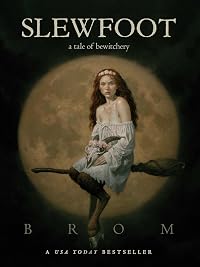
Slewfoot: A Tale of Bewitchery
by Brom
On This Page
Description
"Set in Colonial New England, Slewfoot is a tale of magic and mystery, of triumph and terror as only dark fantasist Brom can tell it. Connecticut, 1666. An ancient spirit awakens in a dark wood. The wildfolk call him Father, slayer, protector. The colonists call him Slewfoot, demon, devil. To Abitha, a recently widowed outcast, alone and vulnerable in her pious village, he is the only one she can turn to for help. Together, they ignite a battle between pagan and Puritan - one that threatens show more to destroy the entire village, leaving nothing but ashes and bloodshed in their wake. "If it is a devil you seek, then it is a devil you shall have!" This terrifying tale of bewitchery features more than two dozen of Brom's haunting paintings, fully immersing readers in this wild and unforgiving world"-- show lessTags
Recommendations

Member Reviews
When Abitha travels overseas to her new home in a Puritan community in Connecticut, she becomes an outcast. The town sees her as an outsider, her husband, Edward, the only real person who accepts her. When he suddenly perishes, Abitha’s entire life seems to crumble around her until she meets a forest spirit she names Samson. Is he a God or a demon? Her salvation or her damnation?
This was such a good book, but it made me so mad. I hated nearly every human character in this book. The men, Wallace in particular, were so infuriating. I rooted so hard for Abitha from the beginning, and it was hard watching her take blow after blow. It seemed like every time things started to go her way, something else would go horribly wrong.
Because of show more that, it took me a little while to finish this story, but I loved the end of the book. This whole story reminded me of that movie The Witch because Abitha was both sassy and strongheaded just like the Thomasin.
This was my first book by Brom, but it definitely won’t be my last. show less
This was such a good book, but it made me so mad. I hated nearly every human character in this book. The men, Wallace in particular, were so infuriating. I rooted so hard for Abitha from the beginning, and it was hard watching her take blow after blow. It seemed like every time things started to go her way, something else would go horribly wrong.
Because of show more that, it took me a little while to finish this story, but I loved the end of the book. This whole story reminded me of that movie The Witch because Abitha was both sassy and strongheaded just like the Thomasin.
This was my first book by Brom, but it definitely won’t be my last. show less
Maybe it was the teen angst. Maybe it was my allergy to Villains Without Nuance. Maybe I'm just getting old.
I don't like this book much. I should...spooky dos in Puritan times? folk horror? Revenge?! yes please...and I think I might have if I hadn't taken against Abitha so very strongly. Adolescents whose sense of themselves as Right and Hard Done By aren't enjoyable companions for an entire book. I felt Abitha's difficulties with Authority were period appropriate...totally bought that she was justifiably angry with the entire male world...but she comes across as a modern woman. Then when Slewfoot-the-character wins her over with no effort? He's an innocent, albeit one with tremendous Powers, and with...um...horns? Literal goatly horns. show more But Abitha just...accepts. It strained me to buy into that.
I'm not insensitive to the appeal of the Other to those trapped in rigid, conformity-enforcing social milieus. But Abitha's ready acceptance of this, um, extremely Other that resembles the goat we meet her losing...and she even calls him "Samson" after the goat...it didn't scan for me with a seventeenth-century woman. Not even one whose upbringing was as peculiar, her mother a root woman and her father a drunken sot, as hers was.
My most favoritest thing is the animate Forest that Slewfoot (he has other names throughout the story, all of which carry their own shades of meaning and of humor) cohabits with, that has re-summoned Slewfoot from a liminal state to deal with Forest's concerns about its future. (I loved Jesus Thunderbird's name for Slewfoot...Hobomok...as it carried so many levels, from a beautiful butterfly to a scary demon via an early American novel about the Noble Savage slur. A quick trip to the internet will give you literal *hours* of perusing pleasure.) Perhaps the most unsettling of Brom's illustrations is the one he made for Creek:
It's perfect, it's unsettlingly Other, and completely relatably familiar all at the same time. What's missing here is the essence of Creek's Wrongness, Otherness...scale...Creek is tiny and looks like that. Sweet dreams!
These being hallmarks of Brom's works, and the source of my relatively high rating for a book I wasn't all the way in sympathy with, so I was rolling along fine until...the torture porn began. Abitha and her mother, women accused of witchcraft, were in for a bad time. I accepted that. But I was revolted by the deeply prurient recounting of the torments meted out to the women, guilty as charged by the lights of the community they lived in though ambiguously so in modern eyes. They transgressed...they paid dearly for it...
"I want to burn them to the ground, All of them. All of it. Their church, their commandments, their covenants, their riles, edicts, and laws, their fields, their homes, and most of all their fucking bonnets and aprons. I want to hollow them out, make them know what it is to lose everything, everything, to lose their very soul!"
Nothing in this life comes for free...the bigger the ask, the bigger the price. There is more truth than you can fully know in the ancient adage, "Be careful what you wish for lest the answer be Yes." show less
I don't like this book much. I should...spooky dos in Puritan times? folk horror? Revenge?! yes please...and I think I might have if I hadn't taken against Abitha so very strongly. Adolescents whose sense of themselves as Right and Hard Done By aren't enjoyable companions for an entire book. I felt Abitha's difficulties with Authority were period appropriate...totally bought that she was justifiably angry with the entire male world...but she comes across as a modern woman. Then when Slewfoot-the-character wins her over with no effort? He's an innocent, albeit one with tremendous Powers, and with...um...horns? Literal goatly horns. show more But Abitha just...accepts. It strained me to buy into that.
I'm not insensitive to the appeal of the Other to those trapped in rigid, conformity-enforcing social milieus. But Abitha's ready acceptance of this, um, extremely Other that resembles the goat we meet her losing...and she even calls him "Samson" after the goat...it didn't scan for me with a seventeenth-century woman. Not even one whose upbringing was as peculiar, her mother a root woman and her father a drunken sot, as hers was.
My most favoritest thing is the animate Forest that Slewfoot (he has other names throughout the story, all of which carry their own shades of meaning and of humor) cohabits with, that has re-summoned Slewfoot from a liminal state to deal with Forest's concerns about its future. (I loved Jesus Thunderbird's name for Slewfoot...Hobomok...as it carried so many levels, from a beautiful butterfly to a scary demon via an early American novel about the Noble Savage slur. A quick trip to the internet will give you literal *hours* of perusing pleasure.) Perhaps the most unsettling of Brom's illustrations is the one he made for Creek:
It's perfect, it's unsettlingly Other, and completely relatably familiar all at the same time. What's missing here is the essence of Creek's Wrongness, Otherness...scale...Creek is tiny and looks like that. Sweet dreams!
These being hallmarks of Brom's works, and the source of my relatively high rating for a book I wasn't all the way in sympathy with, so I was rolling along fine until...the torture porn began. Abitha and her mother, women accused of witchcraft, were in for a bad time. I accepted that. But I was revolted by the deeply prurient recounting of the torments meted out to the women, guilty as charged by the lights of the community they lived in though ambiguously so in modern eyes. They transgressed...they paid dearly for it...
"I want to burn them to the ground, All of them. All of it. Their church, their commandments, their covenants, their riles, edicts, and laws, their fields, their homes, and most of all their fucking bonnets and aprons. I want to hollow them out, make them know what it is to lose everything, everything, to lose their very soul!"
Nothing in this life comes for free...the bigger the ask, the bigger the price. There is more truth than you can fully know in the ancient adage, "Be careful what you wish for lest the answer be Yes." show less
I wasn't expecting this.
Like so many, I was caught quite a while ago by the cover image and the gorgeous interior art of this book. But to be honest, seeing that it takes place 350 years ago, I gave it a pass. Something has to really grab me for me to dive into something historical. It's okay, but it's not something I really love.
But, working in a bookstore, I kinda kept coming back to this book and looking at it. And finally, I had an opportunity to get it at a discounted price so I figured, why not?
So glad I did. I really enjoyed this. If there is anything I didn't quite enjoy about the novel, it was around the the characters of Forest and Sky, etc, constantly pleading with Father. That got a little old, but I do also understand the show more part it played in the overall plot.
But there's a bigger thing that kept going through my mind, especially in the climactic final pages. And that was, "This. THIS is the way you do a new version of CARRIE."
So, here's my thing—and yes, I'm going to take yet another swipe at THE WEIGHT OF BLOOD by Tiffany D. Jackson—which is, we all know there's only a limited number of plots, and I know full well that Stephen King was nowhere near the first to write of a character who's beaten down before unleashing a power they likely shouldn't possess.
But CARRIE is obviously one of the better known ones now. There's an entire generation of people who, when you say that name, immediately picture Sissy Spacek with her crown, and her face covered in pig blood.
There's a right way and a wrong way to take that story and try and make it fresh. Stealing the entire plot, almost beat-for-beat from King, and rewriting it from a POC perspective ain't the way. By all means, DO a retelling, but change it the hell up. This "reimagining" BS ain't the way.
Now, along come Brom with this...and it is a CARRIE story, but it's got some really interesting twists along the way (including a doubling of the CARRIE storyline). But Brom also makes a lot of changes, that both serve the story, while also distancing it from its older sister.
I love what Brom did here. He accomplished a few things.
He gave us a story about female empowerment. He showed us what happens when women are treated like chattel, like possessions. He also manages to paint an interesting—and infuriatingly contemporary—portrait of men who claim to work for god when, in fact, they work and worship the almighty dollar. He got some commentary in there on the true nature of evil...
...and he told a fantastic tale of horror as well.
He got damn near everything right. And he even gave us gorgeous pics to go along with it. show less
Like so many, I was caught quite a while ago by the cover image and the gorgeous interior art of this book. But to be honest, seeing that it takes place 350 years ago, I gave it a pass. Something has to really grab me for me to dive into something historical. It's okay, but it's not something I really love.
But, working in a bookstore, I kinda kept coming back to this book and looking at it. And finally, I had an opportunity to get it at a discounted price so I figured, why not?
So glad I did. I really enjoyed this. If there is anything I didn't quite enjoy about the novel, it was around the the characters of Forest and Sky, etc, constantly pleading with Father. That got a little old, but I do also understand the show more part it played in the overall plot.
But there's a bigger thing that kept going through my mind, especially in the climactic final pages. And that was, "This. THIS is the way you do a new version of CARRIE."
So, here's my thing—and yes, I'm going to take yet another swipe at THE WEIGHT OF BLOOD by Tiffany D. Jackson—which is, we all know there's only a limited number of plots, and I know full well that Stephen King was nowhere near the first to write of a character who's beaten down before unleashing a power they likely shouldn't possess.
But CARRIE is obviously one of the better known ones now. There's an entire generation of people who, when you say that name, immediately picture Sissy Spacek with her crown, and her face covered in pig blood.
There's a right way and a wrong way to take that story and try and make it fresh. Stealing the entire plot, almost beat-for-beat from King, and rewriting it from a POC perspective ain't the way. By all means, DO a retelling, but change it the hell up. This "reimagining" BS ain't the way.
Now, along come Brom with this...and it is a CARRIE story, but it's got some really interesting twists along the way (including a doubling of the CARRIE storyline). But Brom also makes a lot of changes, that both serve the story, while also distancing it from its older sister.
I love what Brom did here. He accomplished a few things.
He gave us a story about female empowerment. He showed us what happens when women are treated like chattel, like possessions. He also manages to paint an interesting—and infuriatingly contemporary—portrait of men who claim to work for god when, in fact, they work and worship the almighty dollar. He got some commentary in there on the true nature of evil...
...and he told a fantastic tale of horror as well.
He got damn near everything right. And he even gave us gorgeous pics to go along with it. show less
Slewfoot was the perfect book for hiding out in the air-conditioning and reading non-stop. Seriously. It's hot, and I was hooked from the first page.
I loved the premise of the book - In the puritanical era of 1600s (1666 I see what you did there...) New England, what if one of the women accused of witchery is actually what she is accused of being? I loved the morality of the book - Why do people consider one religion true over another? What happens when your belief is challenged, and you are forced to confront what you truly are?
With tertiary characters aside, nearly all the characters experience exposure of their genuine selves and real change. None if it is pretty. Most of it is gruesome and emotionally rending.
For people who are show more deeply bothered by violence to animals (as I generally am) -There is a lot, and it is hard. It's life and death in the wilderness. It's not meaningful or meaningless. Good or evil. It just is.
Except for one:
Booka's death was meaningful to Abitha, and it drove her to action. In the end, Booka was Abitha's familiar and her death was the spell that was needed to utterly destroy Sutton.
My thoughts on the violence toward animals came to a sharp focus at the end/epilogue. Humans are animals and we all gotta eat.
One more thing behind the spoiler:
That revenge was so, so sweet.
I can't comment on the art work because I read it on my ancient Kobo. I'm sure that it's lovely. Eventually I'll get around to ordering the hardback of the book. I've got it on my wishlist now. I'll definitely read more of Brom's books now. This one was fantastic. show less
I loved the premise of the book - In the puritanical era of 1600s (1666 I see what you did there...) New England, what if one of the women accused of witchery is actually what she is accused of being? I loved the morality of the book - Why do people consider one religion true over another? What happens when your belief is challenged, and you are forced to confront what you truly are?
With tertiary characters aside, nearly all the characters experience exposure of their genuine selves and real change. None if it is pretty. Most of it is gruesome and emotionally rending.
For people who are show more deeply bothered by violence to animals (as I generally am) -
Except for one:
Booka's death was meaningful to Abitha, and it drove her to action. In the end, Booka was Abitha's familiar and her death was the spell that was needed to utterly destroy Sutton.
My thoughts on the violence toward animals came to a sharp focus at the end/epilogue. Humans are animals and we all gotta eat.
One more thing behind the spoiler:
That revenge was so, so sweet.
I can't comment on the art work because I read it on my ancient Kobo. I'm sure that it's lovely. Eventually I'll get around to ordering the hardback of the book. I've got it on my wishlist now. I'll definitely read more of Brom's books now. This one was fantastic. show less
This is one of those stories that stay with you. For me, it was a book I had to put down, I couldn't read it all in one sitting. But it's also a book that I'm not going to forget tomorrow either. The characters are vivid and the story is so good. It has you questioning, who truly are the bad guys? The creatures that are supposedly "the devil" or the towns people who kill their own who don't fit into a neat little basket.
Abitha is an amazing main character who you are just rooting for the whole time. She's a kick ass strong female who you want to make it. I was nervous along the way that she wasn't. There were many close calls. And the revenge she got on the town and on William in particular in the end just felt so good.
I read a show more library copy of this book but I have it on my list to purchase. The illustrations only made this better! show less
Abitha is an amazing main character who you are just rooting for the whole time. She's a kick ass strong female who you want to make it. I was nervous along the way that she wasn't. There were many close calls. And the revenge she got on the town and on William in particular in the end just felt so good.
I read a show more library copy of this book but I have it on my list to purchase. The illustrations only made this better! show less
An fine, horrifying exploration of how demonization/otherization operates, with the additional insight of how the monsters of society actually tend to be created rather than intrinsically born that way. While the initial, much drier historical drama bits were a bit hard for me to get through since that's not a genre I'm into much, this was made up when Brom got heavier and heavier into his true domain of kicking ass and taking names: Supernatural horror.
I'm serious and not lying at all here. Slewfoot went so off the goddamn rails during the third arc, I ended gobbling it up in one night while cackingly madly at every other scene and going "YES. YES YES." This novel, despite its tedious, cliché "Puritans fucking suck and hate women and show more fun and enjoying life, amirite?" commentary, eventually got into the more insightful themes of how and why they do such things. For example, there's some pretty heartbreaking/enraging scenes where Abitha has to unsuccessfully fend off the people she helped, who repaid her by throwing her under the goddamn bus to save their own shitty skins. And I'd rather not get into what happened to herpoor, poor cat that got accused of being a familiar. It's bad shit.
One thing that made this novel amazing, like most of Brom's other work, is that the third arc is fucking amazing.It's basically a reverse slasher where the final girl (Abitha) raises an incredible amount of hell and spills buckets of blood after being turned into a monster by her "fellow" Puritans. I have yet to read a third arc/conclusion from a Brom work that wasn't incredible, bloody as all hell, depressing, uplifting, yet somehow satisfying. Writing is hard, but making consistently good endings has to be near impossible.
On the other hand, my biggest criticism of Slewfoot is that Abitha doesn't fuck the tall, handsome pseudo-demon she called Samson. That's just teasing bullshit, man. You can't put seeds, no pun intended, like that in a reader's head in one scene, then not nurture those seeds to fruition later on. This is a total betrayal of the unspoken agreement between and (admittedly horny) reader and author. Jokes aside, this is a great modern horror book if you can get past the slow, somewhat tedious start and saddening lack of certain demon-on-human relations. show less
I'm serious and not lying at all here. Slewfoot went so off the goddamn rails during the third arc, I ended gobbling it up in one night while cackingly madly at every other scene and going "YES. YES YES." This novel, despite its tedious, cliché "Puritans fucking suck and hate women and show more fun and enjoying life, amirite?" commentary, eventually got into the more insightful themes of how and why they do such things. For example, there's some pretty heartbreaking/enraging scenes where Abitha has to unsuccessfully fend off the people she helped, who repaid her by throwing her under the goddamn bus to save their own shitty skins. And I'd rather not get into what happened to her
One thing that made this novel amazing, like most of Brom's other work, is that the third arc is fucking amazing.
On the other hand, my biggest criticism of Slewfoot is that Abitha doesn't fuck the tall, handsome pseudo-demon she called Samson. That's just teasing bullshit, man. You can't put seeds, no pun intended, like that in a reader's head in one scene, then not nurture those seeds to fruition later on. This is a total betrayal of the unspoken agreement between and (admittedly horny) reader and author. Jokes aside, this is a great modern horror book if you can get past the slow, somewhat tedious start and saddening lack of certain demon-on-human relations. show less
Series Info/Source: This is a stand alone book. I got a copy of this as a gift for Christmas.
Thoughts: I always love Brom’s books. He is excellent at dark fantasy and does amazing illustrations as well. This book was one of his best ones yet (although both “Plucker” and “The Child Thief” are also favorites of mine).
This story is set in New England in the 1600’s. The story revolves around two characters; Abitha who was sent from London to be a bride for a Puritan man and an ancient spirit who is awakened and confused in the woods surrounding Abitha’s farm. We switch between POV between them and wait for disaster to strike.
This was a fascinating look at Puritan life. You really feel for Abitha and what she goes through. She show more ends up having a delightfully kind, yet somewhat naive husband (Edward). But, as happens in Brom’s books, things quickly start falling into darkness and chaos.
I loved Samson/Slewfoot who is a confused spirit brought back from death. Is he a benevolent nature god or is he a devil? As he tries to reconcile his confusion about his past, which way will things go? Why is he so drawn to Abitha? The whole time you are reading this you are hoping that things will turn out well and knowing that we are heading to disaster.
This is a very creative and engaging read that kept me completely engaged in the story. I was desperate to know how everything would turn out. The ending was satisfying and well done.
My Summary (5/5): Overall this was an excellent book by Brom. I loved the creative blend of ancient forest spirits and Puritan culture. I enjoyed the characters and their struggles. The dark tone that hangs over the story really pushes you to keep reading to find out how everything plays out. I loved the suspense and absolutely couldn’t put this down. Of course, Brom’s artwork is amazing like normal. Definitely recommend this if you are a Brom fan or are looking for a good book of his to start out with. This is definitely one of his stronger books. show less
Thoughts: I always love Brom’s books. He is excellent at dark fantasy and does amazing illustrations as well. This book was one of his best ones yet (although both “Plucker” and “The Child Thief” are also favorites of mine).
This story is set in New England in the 1600’s. The story revolves around two characters; Abitha who was sent from London to be a bride for a Puritan man and an ancient spirit who is awakened and confused in the woods surrounding Abitha’s farm. We switch between POV between them and wait for disaster to strike.
This was a fascinating look at Puritan life. You really feel for Abitha and what she goes through. She show more ends up having a delightfully kind, yet somewhat naive husband (Edward). But, as happens in Brom’s books, things quickly start falling into darkness and chaos.
I loved Samson/Slewfoot who is a confused spirit brought back from death. Is he a benevolent nature god or is he a devil? As he tries to reconcile his confusion about his past, which way will things go? Why is he so drawn to Abitha? The whole time you are reading this you are hoping that things will turn out well and knowing that we are heading to disaster.
This is a very creative and engaging read that kept me completely engaged in the story. I was desperate to know how everything would turn out. The ending was satisfying and well done.
My Summary (5/5): Overall this was an excellent book by Brom. I loved the creative blend of ancient forest spirits and Puritan culture. I enjoyed the characters and their struggles. The dark tone that hangs over the story really pushes you to keep reading to find out how everything plays out. I loved the suspense and absolutely couldn’t put this down. Of course, Brom’s artwork is amazing like normal. Definitely recommend this if you are a Brom fan or are looking for a good book of his to start out with. This is definitely one of his stronger books. show less
Members
- Recently Added By
Lists


Author Information

22+ Works 5,987 Members
Awards and Honors
Notable Lists
Common Knowledge
- Canonical title
- Slewfoot: A Tale of Bewitchery
Classifications
Statistics
- Members
- 1,772
- Popularity
- 12,384
- Reviews
- 53
- Rating
- (4.05)
- Languages
- English, German, Portuguese
- Media
- Paper, Audiobook, Ebook
- ISBNs
- 6
- ASINs
- 2