On This Page
Description
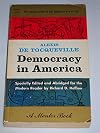
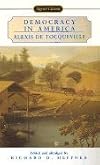
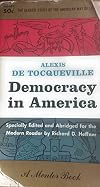
Tocqueville's monumental book is as relevant today as when it was first published in the mid-nineteenth century, and it remains the most comprehensive, penetrating, and astute picture of American life, politics, and morals ever written -- whether by an American or, as in this case, a foreign visitor. This special edition contains the entire two volumes of "Democracy in America," based on the second revised and corrected text of the 1961 French edition, meticulously edited by the show more distinguished Tocqueville scholar J.P. Mayer. show lessTags
Recommendations





























Member Reviews
I started to read this, but didn't finish. My interest in political theory is zero at this stage of my life. I found it interesting to see his thoughts and predictions, and at another stage of my life I could have enjoyed this very much. He gives insights not only on Democracy in America, but also how it worked and developed in other parts of the world up to the time of his writings in 1835. The introduction was very informative as well. For anyone interested in the development of Democracy, this would be a fascinating book because his predictions of its course for the future are insightful.
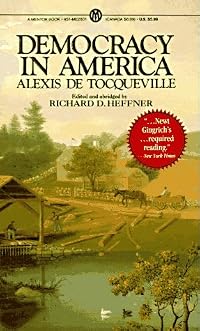
If you want to read about how a pompous, arrogant ass of a Frenchman viewed ‘the Great Experiement’ in Democracy, read this book. Otherwise, skip it. I had to read it in a government class as an undergraduate student (therefore, this image isn’t of the printing that I read, but since the guy has been dead for 150 years, I don’t think much has changed. The intent (I believe) was for us to get some insight as to how America was perceived by Europeans of the age. At that time, we had yet to show our greatness in any way. We were a struggling agrarian society that had gotten our butts kicked recently by the British and were working over the American Indians in order to settle the West.
Of course, a Frenchman is a judge of democracy? show more Yes, they had their revolution in 1789 that started an orgy of blood letting against the noblity (at first) and then (after the realized that they already killed everyone who actually knew how to run a country) each other. Then you get a charismatic military dictator who gives France 15 glorious years in the sun (militarily) while he ran the economy into the ground and pissed off the rest of the continent. Then you get some sort of mismash constitutional monarchy. Yeah good background.
I found the tone annoying and his observations unsurprising. If you are a student of government and the theory thereof, give it a go, otherwise give it a pass. show less
Of course, a Frenchman is a judge of democracy? show more Yes, they had their revolution in 1789 that started an orgy of blood letting against the noblity (at first) and then (after the realized that they already killed everyone who actually knew how to run a country) each other. Then you get a charismatic military dictator who gives France 15 glorious years in the sun (militarily) while he ran the economy into the ground and pissed off the rest of the continent. Then you get some sort of mismash constitutional monarchy. Yeah good background.
I found the tone annoying and his observations unsurprising. If you are a student of government and the theory thereof, give it a go, otherwise give it a pass. show less
Essential addition to any historians bookshelf. Had this one for years and had to replace a worn copy. The man knew our country better than many know her now.
Ratings
Members
- Recently Added By
Author Information

209+ Works 15,710 Members
French writer and politician Alexis de Tocqueville was born in Verneuil to an aristocratic Norman family. He entered the bar in 1825 and became an assistant magistrate at Versailles. In 1831, he was sent to the United States to report on the prison system. This journey produced a book called On the Penitentiary System in the United States (1833), show more as well as a much more significant work called Democracy in America (1835--40), a treatise on American society and its political system. Active in French politics, Tocqueville also wrote Old Regime and the Revolution (1856), in which he argued that the Revolution of 1848 did not constitute a break with the past but merely accelerated a trend toward greater centralization of government. Tocqueville was an observant Catholic, and this has been cited as a reason why many of his insights, rather than being confined to a particular time and place, reach beyond to see a universality in all people everywhere. (Bowker Author Biography) show less
All Editions
Some Editions
Series

Belongs to Publisher Series
Mentor Books (MD161)
Work Relationships
Is an abridged version of
Common Knowledge
- Canonical title
- Democracy in America {abridged}
- Original title
- De la démocratie en Amérique
- Original publication date
- 1956 {thus}
- Important places
- USA
- Quotations
- It would be like the authority of a parent, if, like that authority, its object was to prepare men for manhood; but it seeks, on the contrary, to keep them in perpetual childhood; it is well content that the people should rej... (show all)oice, provided they think of nothing but rejoicing.
After having thus successively taken each member of the community in its powerful grasp, and fashioned him at will, the supreme power then extends its arm over the whole community. It covers the surface of society with a net... (show all)work of small complicated rules, minute and uniform, through which the most original minds and the most energetic characters cannot penetrate, to rise above the crowd. The will of man is not shattered, but softened, bent, and guided; men are seldom forced by it to act, but they are constantly restrained from acting; such a power does not destroy, but it prevents existence; it does not tyrannize, but it compresses, enervates, extinguishes, and stupefies a people, till each nation is reduced to be nothing better than a flock of timid and industrious animals, of which the government is the shepherd. - Original language
- French
- Disambiguation notice
- Please distinguish between Richard Heffner's 1956 abridgement of Alexis de Tocqueville's Democracy in America (1835; 1840) and other editions.
Classifications
- Genres
- Nonfiction, Politics and Government, History, General Nonfiction, Philosophy
- DDC/MDS
- 320.473 — Social sciences Political science Political science (Politics and government) Democracy; Structure and functions of government North America United States
- LCC
- JK216 .T7 — Political Science Political institutions and public administration (United States) Political institutions and public administration United States
- BISAC
Statistics
- Members
- 378
- Popularity
- 82,425
- Reviews
- 3
- Rating
- (3.77)
- Languages
- English
- Media
- Paper
- ISBNs
- 8
- UPCs
- 1
- ASINs
- 7