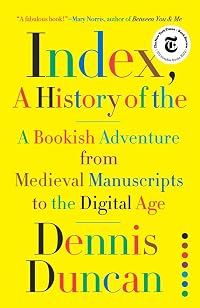
Index, A History of the: A Bookish Adventure from Medieval Manuscripts to the Digital Age
by Dennis Duncan
On This Page
Description
"Most of us give little thought to the back of the book-it's just where you go to look things up. But as Dennis Duncan reveals in this delightful and witty history, hiding in plain sight is an unlikely realm of ambition and obsession, sparring and politicking, pleasure and play. In the pages of the index, we might find Butchers, to be avoided, or Cows that sh-te Fire, or even catch Calvin in his chamber with a Nonne. Here, for the first time, is the secret world of the index: an unsung but show more extraordinary everyday tool, with an illustrious but little-known past. Charting its curious path from the monasteries and universities of thirteenth-century Europe to Silicon Valley in the twenty-first, Duncan uncovers how it has saved heretics from the stake, kept politicians from high office, and made us all into the readers we are today. We follow it through German print shops and Enlightenment coffee houses, novelists' living rooms and university laboratories, encountering emperors and popes, philosophers and prime ministers, poets, librarians and-of course-indexers along the way. Revealing its vast role in our evolving literary and intellectual culture, Duncan shows that, for all our anxieties about the Age of Search, we are all index-rakers at heart-and we have been for eight hundred years"-- show lessTags
Recommendations










Member Reviews
As the subtitle promises, this was a “bookish adventure,” probably of interest mostly to those who are curious about the history of publishing or information science, or books as objects, or who are indexers themselves. In my past life as a publishing freelancer, I dabbled in indexing, and I found this book interesting and entertaining.
I’d never given much thought to how back-of-the-book indexes came to exist, so a lot of the early history was fascinating to me. How much thought have you ever given to the utility and arbitrariness of alphabetical order? Or the origin of page numbers? There were also examples of interesting indexes through history, including visual indexes, satirical indexes, and indexes as literature (which show more motivated me to add Nabakov’s Pale Fire to my reading list).
The index of this book itself is full of easter eggs, inside jokes, and wit. For example, in the text there’s a section about using an index as a satire of the work being indexed: “[A] witty indexer can draw attention to the ludicrousness or inconsistencies in an otherwise innocuous-looking text.” Duncan gives an example of such an index that has entries such as “That Men can’t swallow when they’re dead,” “Dr Lister bit by a Porposs, and how his Finger fell sick thereupon,” “The Head that was a Bag.” The indexer, Paula Clarke Bain (the only indexer I know who has been credited in the book indexed), has made an entry to this page “hoggs that sh-te soap, 152.” Funny, and a brilliant illustration of the concept! As other examples, here are two subheadings under “indexers”:
indexers, life in the old indexer yet, 11
indexers, veneration of [and quite right too], 1
For more indexing humor, among many others, look up “cross-references,” “nuns dance din,” “drudgery, of indexing,” “msiprints” [sic], the subheading for Kinbote, Charles, and of course the final entry.
It is, however, a tragedy that the acknowledgments near the end of the book clearly took up more pages than Bain allowed for in the proof she was indexing, so all the page locators after that are incorrect. What a shame that the publisher didn’t think to correct them, thereby introducing errors into this tour de force of indexing! (On the other hand, who would have expected there to be any entries for the back matter, which, after all, consists of just the indexes?) show less
I’d never given much thought to how back-of-the-book indexes came to exist, so a lot of the early history was fascinating to me. How much thought have you ever given to the utility and arbitrariness of alphabetical order? Or the origin of page numbers? There were also examples of interesting indexes through history, including visual indexes, satirical indexes, and indexes as literature (which show more motivated me to add Nabakov’s Pale Fire to my reading list).
The index of this book itself is full of easter eggs, inside jokes, and wit. For example, in the text there’s a section about using an index as a satire of the work being indexed: “[A] witty indexer can draw attention to the ludicrousness or inconsistencies in an otherwise innocuous-looking text.” Duncan gives an example of such an index that has entries such as “That Men can’t swallow when they’re dead,” “Dr Lister bit by a Porposs, and how his Finger fell sick thereupon,” “The Head that was a Bag.” The indexer, Paula Clarke Bain (the only indexer I know who has been credited in the book indexed), has made an entry to this page “hoggs that sh-te soap, 152.” Funny, and a brilliant illustration of the concept! As other examples, here are two subheadings under “indexers”:
indexers, life in the old indexer yet, 11
indexers, veneration of [and quite right too], 1
For more indexing humor, among many others, look up “cross-references,” “nuns dance din,” “drudgery, of indexing,” “msiprints” [sic], the subheading for Kinbote, Charles, and of course the final entry.
It is, however, a tragedy that the acknowledgments near the end of the book clearly took up more pages than Bain allowed for in the proof she was indexing, so all the page locators after that are incorrect. What a shame that the publisher didn’t think to correct them, thereby introducing errors into this tour de force of indexing! (On the other hand, who would have expected there to be any entries for the back matter, which, after all, consists of just the indexes?) show less
I confess: I picked this book out on title alone. It's clever. And I love books about books and their history - I have a small collection of and about dictionaries, for example - but this topic was a little new for me. And you may be excused for thinking that a book about that end of the book, helpful to browse through when you're looking to research a topic or see where, say, Churchill is mentioned would be dry and dull unless you were an academic or someone who otherwise had a very specific interest in the topic.
If that's your impression, you'd be wrong about this book. Duncan takes the history of the index and not only covers the basics - such as early concordances, adding Bible chapter and verses, page numbers - but also makes the show more personalities of some of the people who argued about (and through!) indexes come alive. This is witty, humorous, and accessible. I grant you it may still be for a very select audience of book lovers, but if you're at all on the fence about it, I urge you to try it and see if you don't come away with an appreciation into what went into creating this particular way we organize information. If you have any doubt on where I came down on it, I'll just say... I even read the index. show less
If that's your impression, you'd be wrong about this book. Duncan takes the history of the index and not only covers the basics - such as early concordances, adding Bible chapter and verses, page numbers - but also makes the show more personalities of some of the people who argued about (and through!) indexes come alive. This is witty, humorous, and accessible. I grant you it may still be for a very select audience of book lovers, but if you're at all on the fence about it, I urge you to try it and see if you don't come away with an appreciation into what went into creating this particular way we organize information. If you have any doubt on where I came down on it, I'll just say... I even read the index. show less
Fascinating! I hadn't ever thought about the fact that it's a separate step from "alphabet" and even "alphabet in specific order" to "sort things alphabetically" - it's just the way things are, now. Tracing the history of how the idea developed, and the structures that grew from that, was fascinating. Duncan is a very good writer, too - looping in texts and people and attitudes of the time, from early medieval to recent past. The index as a concept and a structure is older than that, but it's in early medieval times that there's enough written history and surviving texts to really discuss the matter. Fascinating bits, like the source of the words we use (indices were originally little glued-on tabs that let you tell what was in a scroll show more without unrolling it, for instance). The arguments about the uses of an index, the tricks and insults created through using it, some fascinating poetry and novels and translations... The distinction between a subject index and a concordance, and how that was worked out by various people down the centuries. Early computer indexing, and how that has developed - more for concordance than for subject indexes; the latter need a deeper understanding of the text than computers can manage (yet, anyway). I learned a lot and enjoyed myself. One downer note, right at the end - throughout the book (ebook), there are linked endnotes. Tap the number in the text and it shows you the note from elsewhere in the book. But at the end he presents, with great fanfare, a subject index created by a skilled human indexer. But the numbers are just numbers, no links. They're page numbers for a particular physical edition; if I wanted to go back and read them in the ebook, I'd have to search for each term in the subject index. Awkward, slow, error-prone - it's a very poor example of the utility of a good subject index. So that was a disappointment, at the very end of this large and very interesting book. And apparently my disappointment made me miss some Easter eggs...maybe I'll go back and look at that index. I'll be looking for more by this author. show less
This is mostly a 'word nerd' book - and for those who love books as the physical entities they are, as much as what is contained within. Hence my five star rating! Dennis Duncan has written a thorough and thoroughly engaging history of that essential first search engine. Those who researched anything pre-internet/Google will appreciate the homage he has created. Duncan's humor and wit make this interesting, even fun! to read as he traces the ways humans have tried to order and make sense of information across the ages. There is an explanation of the difference between a concordance and an index (an index being more interesting by far! "There is personality in an index; in a concordance or a search bar, there is not." 264); clever show more anecdotes about an index used as: an intellectual weapon, a stay of execution, a story unto itself, a meta artistic expression, a tool of the devil, figuratively. He crosses over into the history of printing, with a nod to technology and computers, looks at the efficacy of ABC order, the importance of libraries, and takes on the age-old (still raging today) debate about reading a work in its entirety, vs. reading about it through its indicators (table of contents, index)- originally the index was as disdained as Cliffs Notes. Today Google takes the heat for dumbing us down - if you've googled a topic, are you truly conversant and informed? Other topics: who knew the revolutionary importance of page numbers?! I learned the origin of the Reader's Guide to Periodical Literature, still in print today, google be damned. What else is a hashtag but a way to index and search topics? And there is a Society of Indexers - a calling it seems I missed. This book is probably not for everybody - though it could be since Duncan makes it so accessible. But its best for those who care about books, words, and the power within them. A great synopsis quote (among many!) "The professional indexer, learned, vigilant, goes before us, levelling mountains and beating paths so that we, time-poor students at the fingerpost, can arrive swiftly but unruffled at the passage - the quotation, the datum, the knowledge - we need." 260 show less
The title of this book by Dennis Duncan, with its words ordered as they might appear in an index entry, is a hint of the clever and witty writing contained inside. Who knew that the index - that set of pages at the back of (mostly nonfiction) books - had such a long and interesting history? It seems that Dennis Duncan knew.
Duncan, a professor of English at University College London, has an interest in the history of books. His previous book, co-edited with Adam Smyth, was called Book Parts, with chapters focused on all the pieces of a book that aren’t the main text.
Index, A History of the takes a deep dive into just one part of a book, exploring the history of indexes (or indices if you prefer the more latinesque form). Duncan show more tackles the topic with evident fondness and more than a little humor. We ARE talking about indexes, however, so at times the story does get a bit dry. But Gardner does a great job of keeping the reading light and between the narrator and the author even the driest parts don't seem that bad.
The index as we think of it today first sprang forth in the 13th century as an aid to monks and priests in locating specific passages in the Bible. As copies of the bible at that time were only available in manuscript form, each one unique from the next, so indexes themselves could only be specific to one manuscript.
An index entry, after all, has two key pieces to it - the thing you are searching for, and the place in the text where you can find it. But every manuscript of the Bible was unique, with no standard for text size or page numbers, and no agreement as to how many chapters a specific book in the Bible had, or where the breaks between chapters were.
As time went on the index idea spread to books that weren’t the Bible, making page numbering (so indexes would have places for their entries to refer to) an important consideration in the construction of a book.
Duncan also explores how the index came to be used in fiction as well, at least for a time, as well as how authors of fiction began to pen stories and novels that used the index as the form in which to tell their stories.
Later, Duncan brings us into the present day, and explores the relevance of indexes in an age where book contents in digital form can be easily searched. Indexes, the author argues, are not simply providing pointers to individual words in a book. Rather, they are the product of “deep reading” and rely on human knowledge and ability to draw out the important ideas in a written work, and to organize the book’s index in a way that points out the connections in the work to those ideas. In that way then, every index is a record of an individual deep reading of a book.
I listened to the audiobook edition narrated by British narrator Neil Gardner. Gardner did an excellent job. The only distraction was his occasional attempt to render a quote from an American in an American accent. This added an unintentional bit of humor.
It might seem a bit odd to read a book about a “book part” in an audio format. I know I missed a few things from the written edition. First, this book’s own index is said to be “magnificent” (according to the reviewer in the Washington Post), but it is not included in the audio (and likely wouldn’t be appreciated there). And second, there are 40 illustrations in the written book that I didn’t have access to. But I did get a well done reading by Gardner.
This is a microhistory, so by definition it’s a niche book. But, it’s done with enough humor and fondness that I think it might appeal even if you are only marginally interested in the idea at first. Overall it’s a book of interest both to academics and to mere book readers who might want to explore the history and importance of indexes.
RATING: Three Stars ⭐⭐⭐ show less
Duncan, a professor of English at University College London, has an interest in the history of books. His previous book, co-edited with Adam Smyth, was called Book Parts, with chapters focused on all the pieces of a book that aren’t the main text.
Index, A History of the takes a deep dive into just one part of a book, exploring the history of indexes (or indices if you prefer the more latinesque form). Duncan show more tackles the topic with evident fondness and more than a little humor. We ARE talking about indexes, however, so at times the story does get a bit dry. But Gardner does a great job of keeping the reading light and between the narrator and the author even the driest parts don't seem that bad.
The index as we think of it today first sprang forth in the 13th century as an aid to monks and priests in locating specific passages in the Bible. As copies of the bible at that time were only available in manuscript form, each one unique from the next, so indexes themselves could only be specific to one manuscript.
An index entry, after all, has two key pieces to it - the thing you are searching for, and the place in the text where you can find it. But every manuscript of the Bible was unique, with no standard for text size or page numbers, and no agreement as to how many chapters a specific book in the Bible had, or where the breaks between chapters were.
As time went on the index idea spread to books that weren’t the Bible, making page numbering (so indexes would have places for their entries to refer to) an important consideration in the construction of a book.
Duncan also explores how the index came to be used in fiction as well, at least for a time, as well as how authors of fiction began to pen stories and novels that used the index as the form in which to tell their stories.
Later, Duncan brings us into the present day, and explores the relevance of indexes in an age where book contents in digital form can be easily searched. Indexes, the author argues, are not simply providing pointers to individual words in a book. Rather, they are the product of “deep reading” and rely on human knowledge and ability to draw out the important ideas in a written work, and to organize the book’s index in a way that points out the connections in the work to those ideas. In that way then, every index is a record of an individual deep reading of a book.
I listened to the audiobook edition narrated by British narrator Neil Gardner. Gardner did an excellent job. The only distraction was his occasional attempt to render a quote from an American in an American accent. This added an unintentional bit of humor.
It might seem a bit odd to read a book about a “book part” in an audio format. I know I missed a few things from the written edition. First, this book’s own index is said to be “magnificent” (according to the reviewer in the Washington Post), but it is not included in the audio (and likely wouldn’t be appreciated there). And second, there are 40 illustrations in the written book that I didn’t have access to. But I did get a well done reading by Gardner.
This is a microhistory, so by definition it’s a niche book. But, it’s done with enough humor and fondness that I think it might appeal even if you are only marginally interested in the idea at first. Overall it’s a book of interest both to academics and to mere book readers who might want to explore the history and importance of indexes.
RATING: Three Stars ⭐⭐⭐ show less
A lot of fun, like attending a class whose lecturer turns out to be TED talk entertaining, but with a better sense of humor. Best chapter: the story of a period in British history when politico-academic feuds were conducted by republishing an opponent's work with a new, mocking index. Bonus: this book's own index is fun to read, with lots of "easter eggs" (hidden jokes and special features). Recommended to anyone who's ever depended upon an index, or even enjoyed one.
This is a delightful history of the index! The history is largely anecdotal: Duncan focuses a lot on a few specific indexes. Some of them get his attention because they were influential in the history of the book and the organization of knowledge, and some get his attention because they're a lot of fun (there's a whole chapter devoted to the index as a tool of snarky intellectual roasting). There are some topics that are missing, such as the interplay between indexing and standardized spelling (how do you put things in alphabetical order when everybody spells differently?), and the relationship between indexing inside and outside of books (how did the index interact with library catalogues and other information organization systems?). show more The chapter on search engines and how they have changed our access to information also felt slim.... But those are minor criticisms because this is a delightful and interesting book. I thoroughly enjoyed reading the index: it was probably the best part of the book because it is not only full of jokes but also directly illustrates some of the things Duncan discussed in the book. show less
Members
- Recently Added By
Lists

Library TBR
64 works; 1 member

Books Read in 2022
5,168 works; 114 members

Books With the Most Memorable Titles
478 works; 158 members

lynch assignment 2023
6 works; 1 member

Books Read in 2025
4,091 works; 97 members

Books We Discovered On LibraryThing
530 works; 130 members

On Books
70 works; 1 member
Author Information

7+ Works 1,161 Members
All Editions
Some Editions
Awards and Honors
Awards
Distinctions
Notable Lists
Common Knowledge
- Canonical title
- Index, A History of the: A Bookish Adventure from Medieval Manuscripts to the Digital Age
- Original publication date
- 2021-09-02
- Epigraph
- 'I for my part venerate the inventor of Indexes... that unknown laborer in literature who laid open the nerves and arteries of a book.'
Isaac D'Israeli, Literary Miscellanies - Dedication
- For Mia and Molly
- First words
- It is hard to imagine working with books — writing an essay, a lecture, a report, a sermon — without the ability to find what you're looking for, quickly and easily: without, that is, the convenience of a good index.
- Quotations
- [This copy of the Polychronicon, written by the monk Ranulf Higden] was made in 1386.... Its 200-odd leaves, wheaty yellow, darkening to a greasy black around the edges, are mottled with the blemishes of the animals whose ski... (show all)ns they are made from. They have the musty-sweet leather smell that medieval manuscripts do. Like incense, slightly acrid. A scent that sticks on your fingers and gets into your clothes. The parchment is thick, slightly curling, and the leaves crinkle loudly when I turn them. The bottom corners, however, have been worn thin, sometimes almost to translucence, from handling.
- Original language
- English
Classifications
- Genres
- General Nonfiction, Nonfiction, History
- DDC/MDS
- 025.3 — Computer science, information & general works Library & information sciences Administration; Departments Bibliographic analysis and control
- LCC
- Z695.9 .D86 — Bibliography, Library Science and Information Resources Libraries The collections. The books Indexing. Abstracting
- BISAC
Statistics
- Members
- 1,019
- Popularity
- 25,375
- Reviews
- 36
- Rating
- (3.82)
- Languages
- English, German, Italian, Portuguese
- Media
- Paper, Audiobook, Ebook
- ISBNs
- 13
- ASINs
- 3