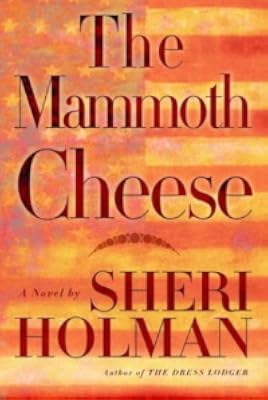
The Mammoth Cheese
by Sheri Holman
On This Page
Description
Celebrating the recent birth of eleven babies born to a local couple after fertility treatments, the citizens of Three Chimneys, Virginia, set out to recreate the making of an original Thomas Jefferson-era, 1,235-pound cheese.Tags
Recommendations





Member Recommendations
Member Reviews
The Mammoth Cheese is full of surprises. I expected a light funny read, but this book is chock full of people with common problems and a few not so common. There are many stories taking place in the novel and they all twine together nicely.
In the small town of Three Chimneys, Virginia, Margaret Prickett is a single mom to 13 year old Polly. Margaret is trying desperately to keep the family dairy farm afloat. Threatened with foreclosure, she puts all her hopes and energy into electing Adams Brooke president. Brooke’s campaign promise of forgiving the debts of all family farms keeps Margaret going through a very challenging year. She tends the farm, makes cheese, raises Polly and works tirelessly on Brooke’s campaign.
Meanwhile, her show more neighbor, Manda Franks, has just given birth to 11 babies. You didn’t misread that. Eleven. The town – and the whole country – have gone into typical media frenzy over the births. The only person seemingly not thrilled by this historical event is Manda (and the nutcases who write threatening letters).
Many other characters and minor stories enter into play. August Vaughn has worked on Margaret’s dairy farm for many years. He’s been in love with her since they were teenagers, but she’s clueless. August still lives with his parents, the Reverend Leland Vaughn and Evelyn, and he travels around the region portraying his hero, Thomas Jefferson.
Some characters are just despicable; Holman may have gone a little overboard with her portrayal of Polly’s father Francis and of Patrick Lewis, the local weatherman-turned-feature reporter. Mr. March, Polly’s history teacher, is the lowest of the low.
There are so many themes running through this book, it could almost make up three or four books – but because Holman weaves it all together so nicely, it didn’t feel overwhelming. Some of the issues include:
--corporate farms vs family farms
--food politics
--coming of age
--the ethics of fertility therapy
--dishonesty in politics
--patriotism
--media responsibility
--strengths and weaknesses of community
--unrequited love
--child sexual abuse
One of the things Holman does so well is depicting setting. I felt damp and dank after reading the description of Leland’s visit to Manda’s after some of the babies come home:
“Manda, could I trouble you for some Tylenol? I have a vicious headache,” said the preacher, wanting to break the depressing spell cast by the wet dogs and the musty food, the unmucked pen and the relentless drizzle. He was getting soaked, and a dull pain was blooming behind his left eye. (snip)This would be the weather in Hell, Pastor Vaughn thought dully. Not an infinite inferno, but one long unsettled day in between seasons, too hot to wear a sweater, too rainy to go without one, a muggy, clammy, oppressive sort of day, when all the world’s sins would stick to a man like dust from the road.
Made me want a shower.
Holman does a great job with her characters (with the exceptions above) and the story, chunky as it could be, really flows. And what is the mammoth cheese? It’s a 1,235 pound block of Margaret’s artisan cheese destined for an unforgettable road trip to Washington D.C. I won’t reveal more – but Holman’s book is not predictable! Recommended. show less
In the small town of Three Chimneys, Virginia, Margaret Prickett is a single mom to 13 year old Polly. Margaret is trying desperately to keep the family dairy farm afloat. Threatened with foreclosure, she puts all her hopes and energy into electing Adams Brooke president. Brooke’s campaign promise of forgiving the debts of all family farms keeps Margaret going through a very challenging year. She tends the farm, makes cheese, raises Polly and works tirelessly on Brooke’s campaign.
Meanwhile, her show more neighbor, Manda Franks, has just given birth to 11 babies. You didn’t misread that. Eleven. The town – and the whole country – have gone into typical media frenzy over the births. The only person seemingly not thrilled by this historical event is Manda (and the nutcases who write threatening letters).
Many other characters and minor stories enter into play. August Vaughn has worked on Margaret’s dairy farm for many years. He’s been in love with her since they were teenagers, but she’s clueless. August still lives with his parents, the Reverend Leland Vaughn and Evelyn, and he travels around the region portraying his hero, Thomas Jefferson.
Some characters are just despicable; Holman may have gone a little overboard with her portrayal of Polly’s father Francis and of Patrick Lewis, the local weatherman-turned-feature reporter. Mr. March, Polly’s history teacher, is the lowest of the low.
There are so many themes running through this book, it could almost make up three or four books – but because Holman weaves it all together so nicely, it didn’t feel overwhelming. Some of the issues include:
--corporate farms vs family farms
--food politics
--coming of age
--the ethics of fertility therapy
--dishonesty in politics
--patriotism
--media responsibility
--strengths and weaknesses of community
--unrequited love
--child sexual abuse
One of the things Holman does so well is depicting setting. I felt damp and dank after reading the description of Leland’s visit to Manda’s after some of the babies come home:
“Manda, could I trouble you for some Tylenol? I have a vicious headache,” said the preacher, wanting to break the depressing spell cast by the wet dogs and the musty food, the unmucked pen and the relentless drizzle. He was getting soaked, and a dull pain was blooming behind his left eye. (snip)This would be the weather in Hell, Pastor Vaughn thought dully. Not an infinite inferno, but one long unsettled day in between seasons, too hot to wear a sweater, too rainy to go without one, a muggy, clammy, oppressive sort of day, when all the world’s sins would stick to a man like dust from the road.
Made me want a shower.
Holman does a great job with her characters (with the exceptions above) and the story, chunky as it could be, really flows. And what is the mammoth cheese? It’s a 1,235 pound block of Margaret’s artisan cheese destined for an unforgettable road trip to Washington D.C. I won’t reveal more – but Holman’s book is not predictable! Recommended. show less
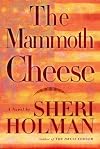
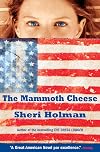
Forget the fact that Sheri Holman's new novel has one of the worst—if not the worst—cover designs ever to curse a dust jacket (behind the title and author's name, there's an American flag sprayed with what looks like powdered cheese dust).
Ignore the fact that its title, The Mammoth Cheese, sounds like a kid's book or a motivational guide for the office-cubicle rat race.
Set all those handicaps aside and enter Holman's world, for what lies between the execrable covers and beneath the silly title is nothing less than superb storytelling, the kind that makes you want to forsake all other obligations of daily life and just keep reading until your eyes feel like sandpaper.
The Mammoth Cheese is a novel that attempts much and succeeds at show more every turn. The plot sprawls and the characters teem, making this a literary version of an epic Cecil B. DeMille movie. Like the legendary film director, Holman never loses sight of her characters, even as they move across a large canvas which in this book include forays into presidential campaigns, dairy farming, teenage rebellion, multiple births, Thomas Jefferson, second chances at love, and the hubris of Episcopalian ministers.
Readers expecting something along the lines of Holman's previous novels—A Stolen Tongue and The Dress Lodger—will be in for a bit of a surprise. While her other books plunged us into the worlds of a 15th-century pilgrimage to Egypt and 19th-century prostitution in England, The Mammoth Cheese is a thoroughly modern tale with folks who could be your friends and neighbors with amplified personalities. Holman applies the same industrious research and care with wordsmithery here as she did when writing about a saint's missing body parts (A Stolen Tongue) or a teenage prostitute trying to survive a cholera plague and bodysnatchers (The Dress Lodger).
On the surface, The Mammoth Cheese's plot is complicated and tangled, but once you're inside the book and humming through the pages, it's apparent that Holman has produced something akin to a Norman Rockwell painting—there's a lot going on within the frame, but one message leaps out like a craggy New England face beaming over a Thanksgiving dinner. For Holman, that point is this: There was still a place in the world for those who did things the right way, the old-fashioned way. As mass media and hyper-technology threaten to swallow the web-wide world, there is still room for the simple pleasures in life—like milking a cow or delivering a 1,200-pound wheel of cheese to the White House. Through it all, America—with all her beauty and blemishes—is touted as a place that's "infinitely perfectible."
As the book opens, Manda Frank has just given birth to eleven babies, the product of a fertility treatment urged on her by the town's overly-ambitious Episcopal priest, Leland Vaughn. The babies range in weight from 2 pounds, 8 ounces, all the way down to the smallest at 16 ounces, “a size, Manda thought, more fitting for a Coke than a baby.âÂ? On hand to congratulate the new, exhausted mother is presidential hopeful Governor Adams Brooke, a candidate who claims to be of the people and for the people. One of the planks in his platform is the Family Matters Act, which promises "an abolition of the estate tax on small farms, but beyond that, a one-time government bailout of farms earning less than $250,000 a year."
That's good news to the good folks of Three Chimneys, VirginiaâÂÂpopulation 781 (792, if you count the just-born Frank Eleven babies). The town has been looking for something to lift it from economic doldrums. Pastor Vaughn's plan for national notoriety includes the record-setting multiple birth and the manufacture of a giant hunk of cheese. The first idea goes sour when the babies start dying even before Manda Frank leaves the hospital. The second publicity stunt is based on an actual event in history when a farmer presented his homemade cheddary gift to President Thomas Jefferson.
Leland comes up with the idea of sending President Brooke a Mammoth Cheese after heâÂÂs elected as a way of thanking him for all he's done for the common man in America, recalling the spirit of the Jeffersonian cheese: "It wasn't about any one farmer. The entire community brought their day's milking. They came together like a family and worked in service of a single ideal. Medicine and science have brought nothing but tragedy to this town. ButâÂÂhistory. History is something Three Chimneys understands."
His son, August, has his doubts about the project. As a history buff who likes to dress up as Jefferson and entertain crowds with his oratories, August knows the truth behind the original cheese:
He could have said that the first Mammoth Cheese became a nationwide jokeâ¦Or that along the way, the cheese generated maggots at its core, and most of it had to be cut away, dumped into the Potomac. Or he might have declared honestly and with great heaviness of heart that this was a country wherein anything was possible, that America loved a large and pointless gesture.
The new Mammoth Cheese is being made by single mother and struggling farmer Margaret Prickett whose teenage daughter Polly is writing her own declaration of independenceâÂÂscorning her motherâÂÂs old-fashioned ideals and dangerously flirting with her history teacher who fills her head with radical politics by day and stalks her by night.
MargaretâÂÂperhaps the most central character in this large castâÂÂearns our sympathy as a woman torn between wanting her daughterâÂÂs love, keeping her dairy farm alive, and holding fast to the simple ways of living (she keeps her TV in a closet and only brings it out on special occasions).
She was raised on homemade jonquil-colored Jersey butter and crumbly sharp Jersey cheese that her great-grandparents had given names like Manassas Gold and Wilderness Cheddar. She had been taught at her grandfather's knee how to preserve calves' stomachs at the dark of the moon and how to tell, almost by smell, the exact greenish moment that curd separates from whey, and if she'd become almost Confucian in her fealty to her ancestors' ways, then so be it. There were some things in life worth preserving.
There are grave lessons to be learned by all these characters and Holman deftly juggles the converging plot lines as the book reaches a climax which in other hands would have strained credulity.
"Jefferson believed in the unlimited potential of our country," Margaret says at one point. Yes, and America is also a place where a writer with Holman's mammoth talent can produce such a fine book as this. show less
Ignore the fact that its title, The Mammoth Cheese, sounds like a kid's book or a motivational guide for the office-cubicle rat race.
Set all those handicaps aside and enter Holman's world, for what lies between the execrable covers and beneath the silly title is nothing less than superb storytelling, the kind that makes you want to forsake all other obligations of daily life and just keep reading until your eyes feel like sandpaper.
The Mammoth Cheese is a novel that attempts much and succeeds at show more every turn. The plot sprawls and the characters teem, making this a literary version of an epic Cecil B. DeMille movie. Like the legendary film director, Holman never loses sight of her characters, even as they move across a large canvas which in this book include forays into presidential campaigns, dairy farming, teenage rebellion, multiple births, Thomas Jefferson, second chances at love, and the hubris of Episcopalian ministers.
Readers expecting something along the lines of Holman's previous novels—A Stolen Tongue and The Dress Lodger—will be in for a bit of a surprise. While her other books plunged us into the worlds of a 15th-century pilgrimage to Egypt and 19th-century prostitution in England, The Mammoth Cheese is a thoroughly modern tale with folks who could be your friends and neighbors with amplified personalities. Holman applies the same industrious research and care with wordsmithery here as she did when writing about a saint's missing body parts (A Stolen Tongue) or a teenage prostitute trying to survive a cholera plague and bodysnatchers (The Dress Lodger).
On the surface, The Mammoth Cheese's plot is complicated and tangled, but once you're inside the book and humming through the pages, it's apparent that Holman has produced something akin to a Norman Rockwell painting—there's a lot going on within the frame, but one message leaps out like a craggy New England face beaming over a Thanksgiving dinner. For Holman, that point is this: There was still a place in the world for those who did things the right way, the old-fashioned way. As mass media and hyper-technology threaten to swallow the web-wide world, there is still room for the simple pleasures in life—like milking a cow or delivering a 1,200-pound wheel of cheese to the White House. Through it all, America—with all her beauty and blemishes—is touted as a place that's "infinitely perfectible."
As the book opens, Manda Frank has just given birth to eleven babies, the product of a fertility treatment urged on her by the town's overly-ambitious Episcopal priest, Leland Vaughn. The babies range in weight from 2 pounds, 8 ounces, all the way down to the smallest at 16 ounces, “a size, Manda thought, more fitting for a Coke than a baby.âÂ? On hand to congratulate the new, exhausted mother is presidential hopeful Governor Adams Brooke, a candidate who claims to be of the people and for the people. One of the planks in his platform is the Family Matters Act, which promises "an abolition of the estate tax on small farms, but beyond that, a one-time government bailout of farms earning less than $250,000 a year."
That's good news to the good folks of Three Chimneys, VirginiaâÂÂpopulation 781 (792, if you count the just-born Frank Eleven babies). The town has been looking for something to lift it from economic doldrums. Pastor Vaughn's plan for national notoriety includes the record-setting multiple birth and the manufacture of a giant hunk of cheese. The first idea goes sour when the babies start dying even before Manda Frank leaves the hospital. The second publicity stunt is based on an actual event in history when a farmer presented his homemade cheddary gift to President Thomas Jefferson.
Leland comes up with the idea of sending President Brooke a Mammoth Cheese after heâÂÂs elected as a way of thanking him for all he's done for the common man in America, recalling the spirit of the Jeffersonian cheese: "It wasn't about any one farmer. The entire community brought their day's milking. They came together like a family and worked in service of a single ideal. Medicine and science have brought nothing but tragedy to this town. ButâÂÂhistory. History is something Three Chimneys understands."
His son, August, has his doubts about the project. As a history buff who likes to dress up as Jefferson and entertain crowds with his oratories, August knows the truth behind the original cheese:
He could have said that the first Mammoth Cheese became a nationwide jokeâ¦Or that along the way, the cheese generated maggots at its core, and most of it had to be cut away, dumped into the Potomac. Or he might have declared honestly and with great heaviness of heart that this was a country wherein anything was possible, that America loved a large and pointless gesture.
The new Mammoth Cheese is being made by single mother and struggling farmer Margaret Prickett whose teenage daughter Polly is writing her own declaration of independenceâÂÂscorning her motherâÂÂs old-fashioned ideals and dangerously flirting with her history teacher who fills her head with radical politics by day and stalks her by night.
MargaretâÂÂperhaps the most central character in this large castâÂÂearns our sympathy as a woman torn between wanting her daughterâÂÂs love, keeping her dairy farm alive, and holding fast to the simple ways of living (she keeps her TV in a closet and only brings it out on special occasions).
She was raised on homemade jonquil-colored Jersey butter and crumbly sharp Jersey cheese that her great-grandparents had given names like Manassas Gold and Wilderness Cheddar. She had been taught at her grandfather's knee how to preserve calves' stomachs at the dark of the moon and how to tell, almost by smell, the exact greenish moment that curd separates from whey, and if she'd become almost Confucian in her fealty to her ancestors' ways, then so be it. There were some things in life worth preserving.
There are grave lessons to be learned by all these characters and Holman deftly juggles the converging plot lines as the book reaches a climax which in other hands would have strained credulity.
"Jefferson believed in the unlimited potential of our country," Margaret says at one point. Yes, and America is also a place where a writer with Holman's mammoth talent can produce such a fine book as this. show less
I was thoroughly entertained by this book, a conglomeration of daily grind, humor, horror - a lot like life. It's a coming-of-age story about eighth grader Polly Marvel in love with her history teacher. It's also a coming-of-age for her mother Margaret, divorced and desperately trying to hold on to her family dairy farm. It is the story of Leland Vaughn, the local Episcopal priest, a most persuasive man who finds himself appalled by the outcomes of his persuasion.
Their lives intertwine with others in their small town as everybody in the novel sees what he has given his life to and learns what is ultimately important.
Their lives intertwine with others in their small town as everybody in the novel sees what he has given his life to and learns what is ultimately important.
The Mammoth Cheese is a good illustration of an ambitious mess being more interesting than a safe success. Say what I will about the somewhat long and meandering narrative, Sheri Holman, at the very least, never bores me!
In the backdrop of rural Three Chimneys, Virginia, Sheri Holman tackles no less than (and in no particular order): politics and media, the value and drawbacks of tradition and community, and the meaning of "rebellion" in everyday contemporary American life. These themes emerge from a many plot threads concerning various residents of the town, involving, at various points: fertility-drug-induced multiple births, Jefferson impersonators, the Civil War legacy of the South, the 'organic' movement, and cows.
Lots of cows. show more This is a good thing, actually, as Holman's got a great sense of place and fitting her characters to their place. I definitely felt like I knew intimately the ins and outs of independent dairy farming and small-town pastor brownnosing and-- and more simply summarized the burdens of living in a community where tradition is so fatalistic. Her many characters are excellently drawn individually (and I note a particular skill with developing insidiously repellant villains), though she struggles somewhat when they interact.
As in The Dress Lodger, Holman's most obvious weakness is the jarring tonal clashes that result when her plot threads finally collide. At these moments of conflict, her authorial voice often slips--here, Margaret's ideals of clean living sometimes become tract rather than commentary-- or the drama of the moment overwhelms logical plot progression (especially noticeable away from the Dickensenian sensibility of Dress Lodger). Yet despite these flaws, the ambition of Holman's undertaking is at times breathlessly exciting, and her patience pace yields moments of real dividends. I'll definitely by following what Holman writes next. show less
In the backdrop of rural Three Chimneys, Virginia, Sheri Holman tackles no less than (and in no particular order): politics and media, the value and drawbacks of tradition and community, and the meaning of "rebellion" in everyday contemporary American life. These themes emerge from a many plot threads concerning various residents of the town, involving, at various points: fertility-drug-induced multiple births, Jefferson impersonators, the Civil War legacy of the South, the 'organic' movement, and cows.
Lots of cows. show more This is a good thing, actually, as Holman's got a great sense of place and fitting her characters to their place. I definitely felt like I knew intimately the ins and outs of independent dairy farming and small-town pastor brownnosing and-- and more simply summarized the burdens of living in a community where tradition is so fatalistic. Her many characters are excellently drawn individually (and I note a particular skill with developing insidiously repellant villains), though she struggles somewhat when they interact.
As in The Dress Lodger, Holman's most obvious weakness is the jarring tonal clashes that result when her plot threads finally collide. At these moments of conflict, her authorial voice often slips--here, Margaret's ideals of clean living sometimes become tract rather than commentary-- or the drama of the moment overwhelms logical plot progression (especially noticeable away from the Dickensenian sensibility of Dress Lodger). Yet despite these flaws, the ambition of Holman's undertaking is at times breathlessly exciting, and her patience pace yields moments of real dividends. I'll definitely by following what Holman writes next. show less
Sheri Holman is a new favorite author. She writes about her characters with great compassion, empathy, and humanity, even the most evil ones.
Sheri Holman is a master at creating memorable characters that will stay with you long after you finish the last page. She portrays even her villains with such humanity and compassion that they are always understandable and even sympathetic.
This is a departure from her previous two historical fiction novels, but she paints the community of Three Chimneys, Virginia, in as much detail and vividness as her historical settings.
Sheri Holman is a master at creating memorable characters that will stay with you long after you finish the last page. She portrays even her villains with such humanity and compassion that they are always understandable and even sympathetic.
This is a departure from her previous two historical fiction novels, but she paints the community of Three Chimneys, Virginia, in as much detail and vividness as her historical settings.
I picked this book up based in the recommendation of a trusted fellow bibliophile. Then it sat on my shelf. For. a. very. long. time. Finally I got kickstarted into gear with the TBR challenge, and commenced reading. To begin with, I loved it. The characters were delightfully eccentric, and the funny details made me smile, and then laugh outloud. Soon though, I began to be dismayed. Things were not going as I hoped. Not only were they not going as I hoped, they were going disastrously wrong. I began to despair. I planned hate mail for my bibliophile friend who had led me so astray to make me read a book that would force me to love it and then end in disaster....
I won't say more because the ending must be experienced, but I will say show more this..Thomas Jefferson and pastor's wives really know how to save the day. show less
I won't say more because the ending must be experienced, but I will say show more this..Thomas Jefferson and pastor's wives really know how to save the day. show less
Normally books about people trying to "find themselves" do not appeal to me. I'm a reader of historical fiction - thus I discovered Rose Tremain through Music & Silence (Excellent) and Restoration (wonderful read). I purchased this book simply because of the author. When I got it and read the covers, I thought "I've been gipped, this isn't what I wanted" - However, after just a few pages, I was pulled in. Mary/Martin's struggle with gender reflects every individual's struggle to become who they think they are meant to be. Gender identity is only a tool here; it is not the focus of the book. The English farm, the repressed family, the country music scene in Nashville are a perfect backdrop for the inner struggles of characters such as show more Mary and Walter. The author paints such a realistic picture: Struggles are hard and probably never ending. The book also demonstrates the importance of the "one person" in someone's life who can make such a difference -- in small and often unknowing ways. I can't say I loved this book, but I can say that I am so glad I read it. The world is filled with Marys and Walters, and there is a bit of them in each of us as well. The perspective this book brings is right on target. Rose Tremain is truly a great writer. show less
Members
- Recently Added By
Lists

Favourite Women's Prize for Fiction, Orange & Bailey's Prize contenders
132 works; 52 members

Five star books
1,755 works; 108 members
Author Information

7+ Works 3,582 Members
Awards and Honors
Awards
Common Knowledge
- Canonical title
- The Mammoth Cheese
- Original publication date
- 2000; 2003
- People/Characters
- Gustine; Margaret Prickett Marvel; Henry Chiver; Polly Marvel; Whilkey; August Vaughn (show all 11); Pink; Leland Vaughn; Audrey; Harvey March; Manda Frank
- Important places
- Sunderland, Tyne and Wear, England, UK; Three Chimneys, Virginia, USA; Washington, D.C., USA
- Epigraph
- Grave: A place where the dead are laid to await the coming of the medical student.
-- Ambrose Bierce, The Devil's Dictionary
...the heart is the beginning of life ... it is the household divinity.
-- William Harvey, The Motion of the Heart and Blood in Animals - Dedication
- For my mother, my best friend.
To my daughter, Elizabeth Hanover Redmond, who allowed me to see it from the other side - First words
- The boys down on the Low Quay know a hundred ways to sell bad fish.
Like a dog unaware it was about to be put down, Manda Frank's cottage sat in the long shade of her new house. - Quotations
- "Maybe disillusionment is the key to growing up..."
- Last words
- (Click to show. Warning: May contain spoilers.)"Nothing without labour."
(Click to show. Warning: May contain spoilers.)Polly had always marveled, along with Margaret, that her country would name such a processed and unnatural product after itself, yet hungry Rose, with a smile as if remembering the funniest of jokes, gleefully ate every individually wrapped, plastic little one of them. - Blurbers
- Atkinson, Kate ; Frazier, Charles ; Shreve, Anita
Classifications
Statistics
- Members
- 477
- Popularity
- 63,639
- Reviews
- 17
- Rating
- (3.49)
- Languages
- Dutch, English, French
- Media
- Paper, Audiobook, Ebook
- ISBNs
- 12
- ASINs
- 5