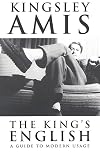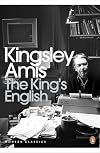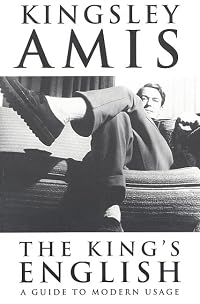
The King's English: A Guide to Modern Usage
by Kingsley Amis
On This Page
Description
With a new introduction by Martin Amis 'A terrific book . . . learned, robust, aggressive, extremely funny' Sebastian Faulks The King's Englishis Kingsley Amis's authoritative and witty guide to the use and abuse of the English language. A scourge of illiteracy and a thorn in the side of pretension, Amis provides indispensable advice about the linguistic blunders and barbarities that lie in wait for us, from danglers, four-letter words to jargon and even Welsh rarebit. If you have ever show more wondered whether it's acceptable to start a sentence with 'and', to boldly split an infinitive, or to cross your sevens in the French style, Amis has the answer - or a trenchant opinion. By turns reflective, acerbic and provocative, The King's Englishis for anyone who cares about how the English language is used. show lessTags
Recommendations



















Member Reviews
As he aged, British author (and he has an opinion on “British”) Kingsley Amis often got described as “irascible” or something similar. In this book on English usage, he doesn’t come across as irascible so much as tired and long-suffering. The title, honoring a classic work on usage by H.W. Fowler, is a pun; Amis’ nickname was “The King”. Amis has no objection to puns, noting that Shakespeare made them and if they’re OK with him they’re OK with Amis.
Not a style manual or grammar or reference, but instead a collection of essays that can be read for pleasure (one is a discussion of the difference between a book of essays that can be read for pleasure and a book of essays which can be read for pleasure).
Among the show more interesting stuff is a derivation of “ain’t”. I remember an elementary school teacher pouncing on me, and anybody else who used “ain’t”, with the triumphant question “Because “ain’t” has an apostrophe it must be a contraction. Of what?”. Amis proposes “Am not I?”, parallel to “isn’t he?”, “aren’t you?” etc. The simple contraction, “amn’t I”, is unpronounceable, leading to “ain’t I”. Take that, Mrs. Jones.
Just with “A” we also have “Americanisms” (Amis generally approves), “alternate” versus “alternative” (Amis notes that it should be “alternative history”, not “alternate history”, but accepts that particular use) and “-athon” (as in “telethon” or “sale-a-thon”; he comments that despite his overall acceptance, some Americanisms should be shot on sight). Lots of other fun stuff with the rest of the alphabet; he’s got some wonderful invective for journalist-speak.
Found in the remainder bin; easily worth the $3.00 paid for it. show less
Not a style manual or grammar or reference, but instead a collection of essays that can be read for pleasure (one is a discussion of the difference between a book of essays that can be read for pleasure and a book of essays which can be read for pleasure).
Among the show more interesting stuff is a derivation of “ain’t”. I remember an elementary school teacher pouncing on me, and anybody else who used “ain’t”, with the triumphant question “Because “ain’t” has an apostrophe it must be a contraction. Of what?”. Amis proposes “Am not I?”, parallel to “isn’t he?”, “aren’t you?” etc. The simple contraction, “amn’t I”, is unpronounceable, leading to “ain’t I”. Take that, Mrs. Jones.
Just with “A” we also have “Americanisms” (Amis generally approves), “alternate” versus “alternative” (Amis notes that it should be “alternative history”, not “alternate history”, but accepts that particular use) and “-athon” (as in “telethon” or “sale-a-thon”; he comments that despite his overall acceptance, some Americanisms should be shot on sight). Lots of other fun stuff with the rest of the alphabet; he’s got some wonderful invective for journalist-speak.
Found in the remainder bin; easily worth the $3.00 paid for it. show less
Not a useful handbook, per se, but Amis' pet peeves collected and arranged in 'alphabetical' order. I put the word alphabetical in scare-quotes because sometimes the choices are rather arbitrary - would the mini-essay differentiating Uninterested and Disinterested belong in D or U?
Many of the things that bother him relate to the difference between British and American English, but he does have both good and bad things to say about both. Many of the other things that bother him are either fads already faded, or fully established by now. And of course I disagree with many of his opinions.
But he's always witty, and each entry is an enlightening read. I'm glad I'm only reading it in odd moments, a few entries at a time, so that I can savor show more it.
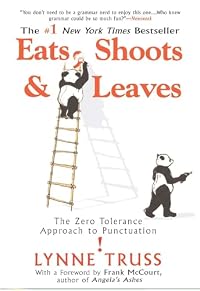
As it happens, this is my first exposure to the author. This book was lauded in the bibliography to [b:Eats, Shoots & Leaves: The Zero Tolerance Approach to Punctuation|8600|Eats, Shoots & Leaves The Zero Tolerance Approach to Punctuation|Lynne Truss|https://d202m5krfqbpi5.cloudfront.net/books/1392135387s/8600.jpg|854886] and that's the only reason I picked it up. Now that I know more about how the man writes, I will see if there's anything else he's done that appeals to me.
---------------
Finally done. The above stands. One addendum - there is a glossary, but it seems incompletely proofread, unclear, and unhelpful. However, the book as a whole is highly recommended to all grammar nerds, novice to advanced. And to writers. And to readers translating from British to American or vice-versa.
Oh, and I'm keeping (!) my copy, and am going to reread (!) it with pen in hand (!) when I need a diversion. The man makes me want to break all the rules about what to do with books I've read.... show less
Many of the things that bother him relate to the difference between British and American English, but he does have both good and bad things to say about both. Many of the other things that bother him are either fads already faded, or fully established by now. And of course I disagree with many of his opinions.
But he's always witty, and each entry is an enlightening read. I'm glad I'm only reading it in odd moments, a few entries at a time, so that I can savor show more it.
As it happens, this is my first exposure to the author. This book was lauded in the bibliography to [b:Eats, Shoots & Leaves: The Zero Tolerance Approach to Punctuation|8600|Eats, Shoots & Leaves The Zero Tolerance Approach to Punctuation|Lynne Truss|https://d202m5krfqbpi5.cloudfront.net/books/1392135387s/8600.jpg|854886] and that's the only reason I picked it up. Now that I know more about how the man writes, I will see if there's anything else he's done that appeals to me.
---------------
Finally done. The above stands. One addendum - there is a glossary, but it seems incompletely proofread, unclear, and unhelpful. However, the book as a whole is highly recommended to all grammar nerds, novice to advanced. And to writers. And to readers translating from British to American or vice-versa.
Oh, and I'm keeping (!) my copy, and am going to reread (!) it with pen in hand (!) when I need a diversion. The man makes me want to break all the rules about what to do with books I've read.... show less
This book was published posthumously. Likely there were no readers left alive who would have been able to be amused by it. However, it is occasionally interesting, and it is always nice to find more authorities who condemn the split-infinitive rule.
In all his work, and throughout his life, the use and abuse of the English language was one of Kingsley Amis's principal concerns. This text conveys his love and knowledge of the subject to new generations of readers and writers.
Ratings
Members
- Recently Added By
Lists

Reading LIst
648 works; 1 member
Author Information

103+ Works 19,630 Members
Kingsley Amis is generally considered one of the "angry young men" of the 1950s. He was born in London in 1922 and educated at the City of London School. He received a degree in English language and literature from St. John's College, Oxford, in 1947. Until 1961 Amis lectured in English at University College, Swansea, and for the following two show more years at Cambridge. In 1947 Amis published his first collection of poems, Bright November. Frame of Mind followed in 1953 and Poems: Fantasy Portraits in 1954. His first novel, Lucky Jim (1954), established his reputation as a writer. He followed with That Uncertain Feeling (1956), and I Like It Here (1958). A longtime James Bond devotee, Amis wrote a James Bond adventure after the death of Ian Fleming in 1964. Amis's study of the famous spy was titled The James Bond Dossier (1965). Amis received the Booker Prize for the Old Devils (1986). Amis's later works include Memoirs (1990), and The King's English, a collection of essays on the craft of writing well. Amis was knighted in 1990. He died in 1995. (Bowker Author Biography) show less
Some Editions
Awards and Honors
Notable Lists
Common Knowledge
- Canonical title
- The King's English: A Guide to Modern Usage
- Alternate titles
- The King's English
Classifications
Statistics
- Members
- 533
- Popularity
- 55,732
- Reviews
- 4
- Rating
- (3.96)
- Languages
- English
- Media
- Paper, Audiobook, Ebook
- ISBNs
- 10
- ASINs
- 4