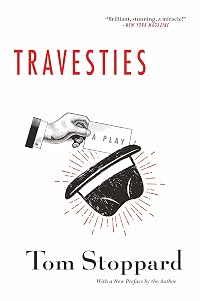
Travesties
by Tom Stoppard
On This Page
Description
"Travesties" was born out of Stoppard's noting that in 1917 three of the twentieth century's most crucial revolutionaries -- James Joyce, the Dadaist founder Tristan Tzara, and Lenin - were all living in Zurich. Also living in Zurich at this time was a British consula official called Henry Carr, a man acquainted with Joyce through the theater and later through a lawsuit concerning a pair of trousers. Taking Carr as his core, Stoppard spins this historical coincidence into a masterful and show more riotously funny play, a speculative portrait of what could have been the meeting of these profoundly influential men in a germinal Europe as seen through the lucid, lurid, faulty, and wholly riveting memory of an aging Henry Carr. show lessTags
Recommendations


















Member Recommendations
Member Reviews
In an alternate world V.I. Lenin, James Joyce, Tristan Tzara, a British consular official named Henry Carr and others get together, argue and discuss politics, kind of.
Joyce calls Tzara “an over-excited little man with a need for self-expression far beyond the scope of your natural gifts.” Carr believes “there was nothing wrong with Lenin except his politics.”
The role of art is a hot topic. Lenin: “Literature must become party literature. Down with non-partisan literature!” The Dadaist Tzara: “The difference between being a man and being a coffee mill is art. But art created patrons and was corrupted.” A librarian named Cicely: “The sole duty and justification for art is social criticism.” And so on.
The language is show more key here. The flow, the word play, the rhyming, the humor, the politics. It’s profound ridiculousness.
Carr: Do you know Gilbert and Sullivan?!
Cicely: I know Gilbert but not Sullivan. show less
Joyce calls Tzara “an over-excited little man with a need for self-expression far beyond the scope of your natural gifts.” Carr believes “there was nothing wrong with Lenin except his politics.”
The role of art is a hot topic. Lenin: “Literature must become party literature. Down with non-partisan literature!” The Dadaist Tzara: “The difference between being a man and being a coffee mill is art. But art created patrons and was corrupted.” A librarian named Cicely: “The sole duty and justification for art is social criticism.” And so on.
The language is show more key here. The flow, the word play, the rhyming, the humor, the politics. It’s profound ridiculousness.
Carr: Do you know Gilbert and Sullivan?!
Cicely: I know Gilbert but not Sullivan. show less
OMG, I had forgotten (or not fully realized) how absolutely hilarious this play is! When I saw it in the theater back in the 1970s, I must have focused on the homage to/parody of The Importance of Being Earnest because the James Joyce bits certainly were over my head then.
Brief description: Henry Carr is recalling his days in the British Consulate in Zurich Switzerland during WW1, when James Joyce, Vladimir Ilyich Ulyanov (Lenin), and Tzara (one of the founders of Dadaism) are all there. These 4 are historical figures who actually were in Zurich in 1917. In a bow to Oscar Wilde, there are also Cecily and Gwendolyn - Cecily works at the library helping Lenin write a book on imperialism while Gwendolyn (Henry's sister) is helping Joyce show more research Homer's Odyssey and the Dublin Street Directory of 1904!! In addition to wickedly funny parodies of Dadaism, Joyce's Ulysses, and Bolshevism, the plot parallels Wilde's with the phony brother and mistaken identities. show less
Brief description: Henry Carr is recalling his days in the British Consulate in Zurich Switzerland during WW1, when James Joyce, Vladimir Ilyich Ulyanov (Lenin), and Tzara (one of the founders of Dadaism) are all there. These 4 are historical figures who actually were in Zurich in 1917. In a bow to Oscar Wilde, there are also Cecily and Gwendolyn - Cecily works at the library helping Lenin write a book on imperialism while Gwendolyn (Henry's sister) is helping Joyce show more research Homer's Odyssey and the Dublin Street Directory of 1904!! In addition to wickedly funny parodies of Dadaism, Joyce's Ulysses, and Bolshevism, the plot parallels Wilde's with the phony brother and mistaken identities. show less
This is a baffling but still quite interesting play about Henry Carr, the British consular officer in Zurich during the First World War, and his encounters with James Joyce, artist Tristan Tzara, and Lenin. It discusses themes of memory (and the unreliability thereof), the meaning of art, class and the viability of revolution, and does this while making use of some interesting narrative devices.
I read this mainly because of a production starring Tom Hollander as Carr and Peter McDonald as Joyce, and it is a good thing they introduced me to it. The play taught me a good deal about the Dadaist movement in particular and had more than a few laugh-out-loud moments. It was also fun to read the play after having seen the trailer on YouTube show more and then figure out the significance of the scenes I'd watched.
Recommended if you like Stoppard, slightly didactic plays, discussion of art, or encounters between several historical figures. show less
I read this mainly because of a production starring Tom Hollander as Carr and Peter McDonald as Joyce, and it is a good thing they introduced me to it. The play taught me a good deal about the Dadaist movement in particular and had more than a few laugh-out-loud moments. It was also fun to read the play after having seen the trailer on YouTube show more and then figure out the significance of the scenes I'd watched.
Recommended if you like Stoppard, slightly didactic plays, discussion of art, or encounters between several historical figures. show less
Stoppard is definitely one of my favorite playwrights. I have probably recommended "Rosencrantz and Guildenstern Are Dead" to everyone I know at least twice. So, I'm finally taking a look at Travesties, which was recommended to me through the Goodreads recommendation system after adding R&G. I can definitely see why it's so well respected.
After noticing that James Joyce, Lenin and Tristan Tzara (founder of Dadaism) were all in Zurich in 1917, Stoppard took advantage of that fact to try to connect them to the rather obscure character of Henry Carr, British Consul. The play is written from the perspective of Carr as an old man looking back on this very interesting moment in history. Of course, memory being rather fleeting and show more uncontrollable, Carr seems to be a little muddled about the exact details, confusing what actually happened with his performance of Algernon ("the other one") in Joyce's staging of Oscar Wilde's "The Importance of Being Earnest."
While the characters discuss the purpose of art and the coming revolution, Carr shadily recollects his part in the events of the day. Stoppard uses his mastery of wit and wordplay to create this beautifully absurd piece of theatrical gold. I'd love to see this performed some day. show less
After noticing that James Joyce, Lenin and Tristan Tzara (founder of Dadaism) were all in Zurich in 1917, Stoppard took advantage of that fact to try to connect them to the rather obscure character of Henry Carr, British Consul. The play is written from the perspective of Carr as an old man looking back on this very interesting moment in history. Of course, memory being rather fleeting and show more uncontrollable, Carr seems to be a little muddled about the exact details, confusing what actually happened with his performance of Algernon ("the other one") in Joyce's staging of Oscar Wilde's "The Importance of Being Earnest."
While the characters discuss the purpose of art and the coming revolution, Carr shadily recollects his part in the events of the day. Stoppard uses his mastery of wit and wordplay to create this beautifully absurd piece of theatrical gold. I'd love to see this performed some day. show less
A masterful fizz of mature 70s Stoppard, this extravagantly brilliant play is, like many of his best works, sketched in the margins of existing literary history. Stoppard noticed, apparently for the first time, that Tristan Tzara, James Joyce and Lenin were all in neutral Zurich at about the same time during the First World War. Travesties imagines how they might have interacted, and it does so with real brio – including one scene written entirely in limericks, another imitating a chapter of Ulysses, and several pastiches of The Importance of Being Earnest (a play that James Joyce was paid to stage for the British Council in 1917).
It had been many years since I last read this or saw it performed, and despite my happy memories of it, I show more had forgotten quite how wonderful it is. The central argument concerns the nature and purpose of art, a subject on which the various characters hold very different views. The fact that these discussions are taking place while thousands are being slaughtered on Europe's battlefields is very much of the essence.
My dear Tristan, to be an artist at all is like living in Switzerland during a world war. To be an artist in Zurich, in 1917, implies a degree of self-absorption that would have glazed over the eyes of Narcissus.
The speaker here is Henry Carr, British consular representative in Zurich, who anchors the play and brings the rest of the cast together. He is suspicious of Tzara's newfangled modern-art sensibilities, despite the Dadaist's attempts to explain himself:
TZARA: Doing the things by which is meant Art is no longer considered the proper concern of the artist. In fact it is frowned upon. Nowadays, an artist is someone who makes art mean the things he does. A man may be an artist by exhibiting his hindquarters. He may be a poet by drawing words out of a hat.
CARR: But that is simply to change the meaning of the word Art.
TZARA: I see I have made myself clear.
I could quote the whole of this scene and not run out of lines I want to share with people. As always with Stoppard, he is unique in the even-handedness of these debates: there is no sense that one character's viewpoint is ‘privileged’ as speaking for the author. Stoppard famously said he became a playwright because it was the only respectable way of disagreeing with himself, and the arguments in Travesties are a good example of this.
Joyce disagrees with Tzara over what art should be, but he makes a passionate case for its importance.
What now of the Trojan War if it had been passed over by the artist's touch? Dust. A forgotten expedition prompted by Greek merchants looking for new markets. A minor redistribution of broken pots.
But Henry Carr, nursing a wound he got in the trenches, is suspicious of this position too. His mistrust of Joyce – which culminates in a lawsuit – is the backdrop for probably the play's most famous line, which closes the first act:
I dreamed about him, dreamed I had him in the witness box, a masterly cross-examination, case practically won, admitted it all, the whole thing, the trousers, everything, and I flung at him – ‘And what did you do in the Great War?’ ‘I wrote Ulysses,’ he said. ‘What did you do?’
Bloody nerve.
All Stoppard's trademarks are here in spades – the verbal pyrotechnics, the deep grounding in literature and history, the love of debate, the willingness to include crowd-pleasing gimmicks and daft jokes (‘Have you ever come across Dada, darling?’ ‘Never, da-da-darling!’), and above all, perhaps, the general questioning of certainty that characterises his oeuvre as a whole. Maybe it's not his very best play – that, I think, is Arcadia – but it might be his most Stoppardian, and it's a masterpiece of condensed thought and wit. show less
It had been many years since I last read this or saw it performed, and despite my happy memories of it, I show more had forgotten quite how wonderful it is. The central argument concerns the nature and purpose of art, a subject on which the various characters hold very different views. The fact that these discussions are taking place while thousands are being slaughtered on Europe's battlefields is very much of the essence.
My dear Tristan, to be an artist at all is like living in Switzerland during a world war. To be an artist in Zurich, in 1917, implies a degree of self-absorption that would have glazed over the eyes of Narcissus.
The speaker here is Henry Carr, British consular representative in Zurich, who anchors the play and brings the rest of the cast together. He is suspicious of Tzara's newfangled modern-art sensibilities, despite the Dadaist's attempts to explain himself:
TZARA: Doing the things by which is meant Art is no longer considered the proper concern of the artist. In fact it is frowned upon. Nowadays, an artist is someone who makes art mean the things he does. A man may be an artist by exhibiting his hindquarters. He may be a poet by drawing words out of a hat.
CARR: But that is simply to change the meaning of the word Art.
TZARA: I see I have made myself clear.
I could quote the whole of this scene and not run out of lines I want to share with people. As always with Stoppard, he is unique in the even-handedness of these debates: there is no sense that one character's viewpoint is ‘privileged’ as speaking for the author. Stoppard famously said he became a playwright because it was the only respectable way of disagreeing with himself, and the arguments in Travesties are a good example of this.
Joyce disagrees with Tzara over what art should be, but he makes a passionate case for its importance.
What now of the Trojan War if it had been passed over by the artist's touch? Dust. A forgotten expedition prompted by Greek merchants looking for new markets. A minor redistribution of broken pots.
But Henry Carr, nursing a wound he got in the trenches, is suspicious of this position too. His mistrust of Joyce – which culminates in a lawsuit – is the backdrop for probably the play's most famous line, which closes the first act:
I dreamed about him, dreamed I had him in the witness box, a masterly cross-examination, case practically won, admitted it all, the whole thing, the trousers, everything, and I flung at him – ‘And what did you do in the Great War?’ ‘I wrote Ulysses,’ he said. ‘What did you do?’
Bloody nerve.
All Stoppard's trademarks are here in spades – the verbal pyrotechnics, the deep grounding in literature and history, the love of debate, the willingness to include crowd-pleasing gimmicks and daft jokes (‘Have you ever come across Dada, darling?’ ‘Never, da-da-darling!’), and above all, perhaps, the general questioning of certainty that characterises his oeuvre as a whole. Maybe it's not his very best play – that, I think, is Arcadia – but it might be his most Stoppardian, and it's a masterpiece of condensed thought and wit. show less
Henry Carr, a onetime employee at the English Consul General in Zurich, and now an old man, pieces together his memories of James Joyce, V.I. Lenin, and Tristan Tzara. But Carr’s memories are untrustworthy: they collide, collude, and corrupt. Scenes repeat, teeter into the absurd, or are structurally infected by memories of other forms including the limerick, the Shakespearean sonnet, and Oscar Wilde’s The Importance of Being Earnest. Thus Travesties is a formally inventive play, setting most scenes in the mind of Carr, and yet owes its success to its comic incorporation of older forms.
This notion of playwright Tom Stoppard borrowing other writer’s forms also appears to have something to do with the theme of the play. Carr opens show more the second scene with a monologue on his encounters with the three famous men, acknowledging that his run-ins with them have also set him in the limelight. But as it turns out, Carr was not even in Zurich at the same time as Lenin and had little to do with Tzara. His real claim to fame is his litigation with Joyce (Joyce won but he carried a grudge) that eventually led the author to take revenge by writing an unflattering parody of Carr in Ulysses. And so as Carr continues to have delusions of grandeur in the play, riding the coattails of famous men, one might make the connection to Stoppard knowingly, ironically doing the same in Travesties. And yet as faulty and lurid as Carr’s memory and Stoppard’s use of form are, they are inventive, technically dazzling, and original. (You could think of Travesties as a forerunner to the screenplays from Charlie Kaufmann.)
That said, I would like to add my sole criticism of the play: one is not moved emotionally by Stoppard but wowed like a child before a magician. show less
This notion of playwright Tom Stoppard borrowing other writer’s forms also appears to have something to do with the theme of the play. Carr opens show more the second scene with a monologue on his encounters with the three famous men, acknowledging that his run-ins with them have also set him in the limelight. But as it turns out, Carr was not even in Zurich at the same time as Lenin and had little to do with Tzara. His real claim to fame is his litigation with Joyce (Joyce won but he carried a grudge) that eventually led the author to take revenge by writing an unflattering parody of Carr in Ulysses. And so as Carr continues to have delusions of grandeur in the play, riding the coattails of famous men, one might make the connection to Stoppard knowingly, ironically doing the same in Travesties. And yet as faulty and lurid as Carr’s memory and Stoppard’s use of form are, they are inventive, technically dazzling, and original. (You could think of Travesties as a forerunner to the screenplays from Charlie Kaufmann.)
That said, I would like to add my sole criticism of the play: one is not moved emotionally by Stoppard but wowed like a child before a magician. show less
I've seen quite a few plays by Stoppard, some wonderful, some riotously funny. The humor of this depends in part on your knowledge of Oscar Wilde's [The Importance of Being Ernest] and of Joyce's [Ulysses] which Stoppard bends to his own purposes.
But it's really a thought experiment wherein James Joyce, Tristan Tzara and the man who would become Lenin are supposedly in Zurich at the same time, just before Lenin travels in a sealed train through Germany to Russia. While the first act weaves in and out of the referenced plays, the second is an extended debate about politics. Naturally, I didn't remember the second act, and will have to read it again before discussing it with my uptown book circle.
It was really nice to revisit this text.
But it's really a thought experiment wherein James Joyce, Tristan Tzara and the man who would become Lenin are supposedly in Zurich at the same time, just before Lenin travels in a sealed train through Germany to Russia. While the first act weaves in and out of the referenced plays, the second is an extended debate about politics. Naturally, I didn't remember the second act, and will have to read it again before discussing it with my uptown book circle.
It was really nice to revisit this text.
Members
- Recently Added By
Lists

Harold Bloom - The Western Canon: D. The Chaotic Age
833 works; 24 members

Favourite Books
1,819 works; 316 members

Books Read in 2016
4,666 works; 199 members

1970s
657 works; 23 members

20th Century Literature
1,161 works; 54 members

Top Five Books of 2020
982 works; 348 members

Every Non-Musical Play Nominated for a Tony Award
64 works; 3 members

Essential/Recognized Stage Plays
115 works; 4 members
My Play Collection
769 works; 3 members
Author Information

113+ Works 23,575 Members
When the National Theatre needed a last-minute substitute for a canceled production of As You Like It, Kenneth Tynan decided to stage Rosencrantz and Guildenstern Are Dead, a work by an unfamiliar author that had received discouraging notices from provincial critics at its Edinburgh Festival debut. Of course, the play, when it opened in April show more 1967, met with universal acclaim. In New York the next year, it was chosen best play by the Drama Critics Circle. In such an unlikely way, Tom Stoppard came to light. Born in Czechoslovakia, a country he left (for Singapore) when he was an infant, he began his literary career as a journalist in Bristol, where play reviewing led to playwriting. After Rosencrantz and Guildenstern, Stoppard's reputation suffered through the production of a number of minor works, whose intellectual preoccupations were shrugged off by reviewers: Enter a Free Man (1968; "an adolescent twinge of a play," N.Y. Times), The Real Inspector Hound (1968; "lightweight," N.Y. Times), and After Magritte. But in the 1970s, the initial enthusiasms aroused by Rosencrantz and Guildenstern were more than vindicated by the production of two full-length plays, Jumpers (1974) and the antiwar play Travesties (1975), whose immense verbal and theatrical inventiveness made them absolute successes on both sides of the Atlantic. Stoppard's method from the start has been to contrive explanations for highly unlikely encounters---of objects (the ironing board, old lady, and bowler hat of After Magritte), characters (Joyce, Lenin, and Tzara in Travesties), and even plays (Hamlet, Rosencrantz and Guildenstern, The Importance of Being Earnest, Travesties, and The Real Thing, 1982). In the 1970s, Tynan called for Stoppard---as a Czech and as an artist---to engage himself politically. But although political subjects have since found their way into pieces from Every Good Boy Deserves Favor (1977) to Squaring the Circle (1985), politics and art seem to have become just two more of the playwright's irreconcilables, which meet, but never join, in the logical frames of his comedy. The presence of political material---such as the Lenin sections that nearly ruin the second part of Travesties---has occasionally strained the structure of the plays. But in The Real Thing Stoppard is comfortable enough with the satire on art and activism to bring a third subject, love, into the mix. Stoppard has acknowledged his Eastern European heritage nonpolitically, in a series of adaptations of plays by Arthur Schnitzler (see Vol. 2), Johann Nestroy, and Ferenc Molnar. (Bowker Author Biography) Tom Stoppard is the author of many plays, including Rosencrantz and Guildenstern Are Dead, Jumpers, Travesties, and The Invention of Love. He lives in London. (Publisher Provided) show less
Awards and Honors
Awards
Notable Lists
Work Relationships
Is contained in
Was inspired by
Has as a supplement
Common Knowledge
- Original title
- Travesties
- Original publication date
- 1974
- People/Characters
- Henry Carr; James Joyce; Vladimir Lenin; Tristan Tzara; Nadezhda Krupskaya
- First words
- The reader of a play whose principle characters include Lenin, James Joyce and Tristan Tzara may not realize that the figure of Henry Carr is likewise taken from history. - Note on Henry Wilfred Carr, 1894-1962 by Tom Stoppar... (show all)d
The play is set in Zurich, in two locations: the drawing room of Henry Carr's apartment ('THE ROOM'), and a section of the Zurich Public Library ('THE LIBRARY'). - ACT ONE
TZARA: Eel ate enormous appletzara / key diary chef's hat he'll learn oomparah! / Ill raced alas whispers kill later nut east, / noon avuncular ill day Clara! - ACT ONE, First Lines - Last words
- (Click to show. Warning: May contain spoilers.)Secondly, if you can't be an artist, you might as well be a revolutionary... I forget the third thing. (BLACKOUT.)
- Original language
- English
Classifications
Statistics
- Members
- 1,091
- Popularity
- 23,395
- Reviews
- 12
- Rating
- (4.11)
- Languages
- English, German
- Media
- Paper, Ebook
- ISBNs
- 12
- ASINs
- 15