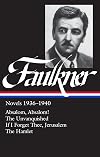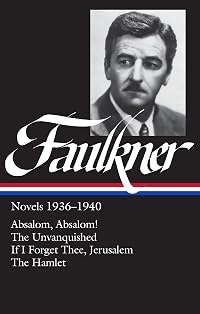
Novels 1936-1940 : Absalom, Absalom! / The Unvanquished / If I Forget Thee, Jerusalem / The Hamlet
by William Faulkner
On This Page
Description
Four novels set in the 1930's explore the tragic and comic aspects of the South.Tags
Recommendations




Member Reviews
Absalom, Absalom!
This is the tragic story of Thomas Sutpen’s attempt to establish a dynasty in the 1830s. He arrives in Jefferson, Yoknapatawpha County, MS as a strange outsider with wild slaves, a mysterious source of seemingly limitless income, and a rigid plan—establish an estate, find a wife, produce a male heir. While Sutpen does accomplish his life’s goals, his unwavering adherence to an ideal brings out the ruin of him and his family. The story of Sutpen and his various il/legitimate children is told primarily through the point of view of Quentin Compson (the same as in The Sound & the Fury). The book, however, is much more than a straightforward narrated life history. Absalom, Absalom! is layered through multiple points show more of view. It is a richly detailed story, but is also complex.
If you are not a fan of Faulkner’s writing style, I would not recommend this book. Other works by him, though still distinctly “Faulkner” in style, are much more accessible. Here Quentin and his roommate Shreve spend a cold winter night at university telling the Sutpen tale to one another. It is obvious that Shreve has heard much of the history before as he interrupts, embellishes, and at times takes over the narrative. The story is not only about Sutpen, but also about Quentin’s experiences in Jefferson, about the ways in which he learned bits and pieces of these events over time from a variety of characters such as Aunt Rosa (Sutpen’s wife’s sister) and his father – who himself is retelling it from Quentin’s grandfather. Other sections were experienced directly by Quentin.
The hearsay third-hand jumbled nature of the transmission is important because the reader experience the plot not as a straightforward narrative, but as a palimpsest of events across nearly a century. The reader learns details in waves; at the beginning of the book, you get the basic idea and then Faulkner builds upon that foundation by adding details or retelling a section through a different character’s point of view. Unfortunately, many characters are unreliable, so as they passed on their story to Quentin or his grandfather, they edited and/or omitted crucial information. “’Your father,’ Shreve said. ‘He seems to have got an awful lot of information awful quick, after having waited forty-five years.’… ‘Grandfather didn’t tell him all of it either, like Sutpen never told Grandfather quite all of it.’” (220).
I could go on for pages about the way the book is written, about foreshadowing (“The day after we—after that night when we—“), and flashbacks, and mind-numbingly long rambling sentences. I will not. However, I do think ultimately, Absalom, Absalom! is worth reading. First, you discover much more about Quentin’s personality and inner turmoil that I think helps clarify his actions in The Sound & The Fury. He is a fascinating character. Second, it is a powerful book about important issues—idealism, blind ambition, doomed Romanticism, and the end of an era. It is also about deep-seated racism, so unwavering that incest is preferred over relationships between people of different color. Finally, it is also about rigid class differences in the South. It is a hard read, but worth the effort. show less
This is the tragic story of Thomas Sutpen’s attempt to establish a dynasty in the 1830s. He arrives in Jefferson, Yoknapatawpha County, MS as a strange outsider with wild slaves, a mysterious source of seemingly limitless income, and a rigid plan—establish an estate, find a wife, produce a male heir. While Sutpen does accomplish his life’s goals, his unwavering adherence to an ideal brings out the ruin of him and his family. The story of Sutpen and his various il/legitimate children is told primarily through the point of view of Quentin Compson (the same as in The Sound & the Fury). The book, however, is much more than a straightforward narrated life history. Absalom, Absalom! is layered through multiple points show more of view. It is a richly detailed story, but is also complex.
If you are not a fan of Faulkner’s writing style, I would not recommend this book. Other works by him, though still distinctly “Faulkner” in style, are much more accessible. Here Quentin and his roommate Shreve spend a cold winter night at university telling the Sutpen tale to one another. It is obvious that Shreve has heard much of the history before as he interrupts, embellishes, and at times takes over the narrative. The story is not only about Sutpen, but also about Quentin’s experiences in Jefferson, about the ways in which he learned bits and pieces of these events over time from a variety of characters such as Aunt Rosa (Sutpen’s wife’s sister) and his father – who himself is retelling it from Quentin’s grandfather. Other sections were experienced directly by Quentin.
The hearsay third-hand jumbled nature of the transmission is important because the reader experience the plot not as a straightforward narrative, but as a palimpsest of events across nearly a century. The reader learns details in waves; at the beginning of the book, you get the basic idea and then Faulkner builds upon that foundation by adding details or retelling a section through a different character’s point of view. Unfortunately, many characters are unreliable, so as they passed on their story to Quentin or his grandfather, they edited and/or omitted crucial information. “’Your father,’ Shreve said. ‘He seems to have got an awful lot of information awful quick, after having waited forty-five years.’… ‘Grandfather didn’t tell him all of it either, like Sutpen never told Grandfather quite all of it.’” (220).
I could go on for pages about the way the book is written, about foreshadowing (“The day after we—after that night when we—“), and flashbacks, and mind-numbingly long rambling sentences. I will not. However, I do think ultimately, Absalom, Absalom! is worth reading. First, you discover much more about Quentin’s personality and inner turmoil that I think helps clarify his actions in The Sound & The Fury. He is a fascinating character. Second, it is a powerful book about important issues—idealism, blind ambition, doomed Romanticism, and the end of an era. It is also about deep-seated racism, so unwavering that incest is preferred over relationships between people of different color. Finally, it is also about rigid class differences in the South. It is a hard read, but worth the effort. show less
The Wild Palms is among the weaker of Faulkner's novels and, of all the episodes of The Unvanquished, only the last shines. Of course, Absalom, Absalom! is a masterpiece and The Hamlet is vivid, funny, and well-paced.
While The Unvanquished began as a collection of short stories that had been published elsewhere, there is enough continuity among the stories for the whole to stand reasonably as a novel, even though the vignettes can be read separately. Perhaps the best story was the final one, An Odor of Verbena, that Faulkner wrote specifically for this novel.
The Civil War is "present time" although the narrator, young Bayard Sartoris, is recalling events that happened many years earlier. His story begins as Colonel Sartoris comes home for a day to warn his family that Yankee soldiers are nearby and to help build a stock pen to hide his animals from the Yankees. A few days later, a Yankee soldier rides onto Sartoris land. The colonel’s show more twelve-year-old son Bayard and his companion Ringo, a slave on the plantation, shoot at the soldier. The boys hide under Granny’s skirts when more soldiers come to search the property for them. Granny denies that any children live on the property, and a colonel orders the rest of the men off the land while eyeing Granny’s skirts. The stories all feature the relationship of Bayard and Ringo, while Granny and Drusilla are also important characters.
Later, advised by Colonel Sartoris, Granny leaves for Memphis because of the dangers of the war. Joby, the Colonel’s servant, drives a wagon carrying Granny, Ringo, Bayard, and a trunk filled with silver that was buried in the yard for safekeeping. During the journey, Yankee soldiers steal their mules and Bayard and Ringo chase them unsuccessfully on a “borrowed” horse. Colonel Sartoris finds the boys and takes them home, capturing a Yankee camp on the way. Joby and Granny also make it back home with the help of “borrowed” horses, and the trunk containing the silver is again buried in the yard. Yankee soldiers come to capture Colonel Sartoris. Granny, Ringo, and Bayard drive six days to Hawkhurst, Alabama, to recover their trunk, their mules, and the runaway slaves. On the journey, they pass hundreds of former slaves who are following the Yankee troops to freedom. At Hawkhurst, Granny’s niece, Drusilla Hawk, joins the group, and the four of them travel to the river, where Yankee soldiers have built a bridge. After crossing, the soldiers hurry to destroy the bridge so the people who have followed them to freedom will be unable cross. The Sartoris wagon gets pushed into the river, and the four travelers make it to the other side, where the Yankee troops are now stationed.
Granny asks to speak with Colonel Dick. She asks for the return of her mules, her trunk, and Loosh and Philadelphy. Colonel Dick gives Granny a written statement from the commanding general dated August 14, 1863, that validates the return of 10 chests, 110 mules, and 110 former slaves who are following the troops. The document allows them to pass safely through any Yankee troops they might encounter and also to petition them for food during the journey home. The story continues with episodes featuring Granny and Drusilla. The differences between the traditions of the Sartorises and other established families and entrepreneurs like Ab Snopes (the Snopes family is explored in detail in the three novels known as The Snopes Trilogy) are highlighted. These and the previous stories also emphasize the tension between the cultures of the established Southerners and marauders, many of whom were Yankees.
About eight years later, Bayard is in his third year studying law in Oxford, Mississippi. Ringo comes to him to report that John Sartoris has been killed by his rival, Ben Redmond. On the forty-mile ride home, Bayard reflects on the last few years: his father’s marriage to Drusilla and the code of violence to which they adhere, his father’s railroad venture with Redmond, their run against each other for political office, his father’s humiliating taunting of Redmond, and his father’s recent decision to turn against killing and meet Redmond unarmed. Bayard knows Drusilla and the men in Jefferson will expect him to avenge his father’s death. Bayard realizes that killing is not a satisfactory solution. Determined neither to kill again nor to be a coward, he goes to Jefferson the next day to meet Redmond unarmed. Redmond shoots twice, intentionally missing Bayard, and leaves town. Bayard returns home and finds that Drusilla has gone to live with her brother but has left behind a sprig of verbena for him.
The Unvanquished provides a view of the Civil War and some of its consequences from the perspective of young Bayard and his extended family. It is a serious assessment of the Southern legend, and a declaration of independence from the past. The characters are deftly portrayed and the stories well-told. show less
The Civil War is "present time" although the narrator, young Bayard Sartoris, is recalling events that happened many years earlier. His story begins as Colonel Sartoris comes home for a day to warn his family that Yankee soldiers are nearby and to help build a stock pen to hide his animals from the Yankees. A few days later, a Yankee soldier rides onto Sartoris land. The colonel’s show more twelve-year-old son Bayard and his companion Ringo, a slave on the plantation, shoot at the soldier. The boys hide under Granny’s skirts when more soldiers come to search the property for them. Granny denies that any children live on the property, and a colonel orders the rest of the men off the land while eyeing Granny’s skirts. The stories all feature the relationship of Bayard and Ringo, while Granny and Drusilla are also important characters.
Later, advised by Colonel Sartoris, Granny leaves for Memphis because of the dangers of the war. Joby, the Colonel’s servant, drives a wagon carrying Granny, Ringo, Bayard, and a trunk filled with silver that was buried in the yard for safekeeping. During the journey, Yankee soldiers steal their mules and Bayard and Ringo chase them unsuccessfully on a “borrowed” horse. Colonel Sartoris finds the boys and takes them home, capturing a Yankee camp on the way. Joby and Granny also make it back home with the help of “borrowed” horses, and the trunk containing the silver is again buried in the yard. Yankee soldiers come to capture Colonel Sartoris. Granny, Ringo, and Bayard drive six days to Hawkhurst, Alabama, to recover their trunk, their mules, and the runaway slaves. On the journey, they pass hundreds of former slaves who are following the Yankee troops to freedom. At Hawkhurst, Granny’s niece, Drusilla Hawk, joins the group, and the four of them travel to the river, where Yankee soldiers have built a bridge. After crossing, the soldiers hurry to destroy the bridge so the people who have followed them to freedom will be unable cross. The Sartoris wagon gets pushed into the river, and the four travelers make it to the other side, where the Yankee troops are now stationed.
Granny asks to speak with Colonel Dick. She asks for the return of her mules, her trunk, and Loosh and Philadelphy. Colonel Dick gives Granny a written statement from the commanding general dated August 14, 1863, that validates the return of 10 chests, 110 mules, and 110 former slaves who are following the troops. The document allows them to pass safely through any Yankee troops they might encounter and also to petition them for food during the journey home. The story continues with episodes featuring Granny and Drusilla. The differences between the traditions of the Sartorises and other established families and entrepreneurs like Ab Snopes (the Snopes family is explored in detail in the three novels known as The Snopes Trilogy) are highlighted. These and the previous stories also emphasize the tension between the cultures of the established Southerners and marauders, many of whom were Yankees.
About eight years later, Bayard is in his third year studying law in Oxford, Mississippi. Ringo comes to him to report that John Sartoris has been killed by his rival, Ben Redmond. On the forty-mile ride home, Bayard reflects on the last few years: his father’s marriage to Drusilla and the code of violence to which they adhere, his father’s railroad venture with Redmond, their run against each other for political office, his father’s humiliating taunting of Redmond, and his father’s recent decision to turn against killing and meet Redmond unarmed. Bayard knows Drusilla and the men in Jefferson will expect him to avenge his father’s death. Bayard realizes that killing is not a satisfactory solution. Determined neither to kill again nor to be a coward, he goes to Jefferson the next day to meet Redmond unarmed. Redmond shoots twice, intentionally missing Bayard, and leaves town. Bayard returns home and finds that Drusilla has gone to live with her brother but has left behind a sprig of verbena for him.
The Unvanquished provides a view of the Civil War and some of its consequences from the perspective of young Bayard and his extended family. It is a serious assessment of the Southern legend, and a declaration of independence from the past. The characters are deftly portrayed and the stories well-told. show less
read all 4...best guess around 2003
"Absalom, Absalom!", "The unvanquished", "If I forget thee, Jerusalem (The wild palms)", "The Hamlet"
Ratings
Members
- Recently Added By
Author Information

467+ Works 99,629 Members
Born in an old Mississippi family, William Faulkner made his home in Oxford, seat of the University of Mississippi. After the fifth grade he went to school only off and on-lived, read, and wrote much as he pleased. In 1918, refusing to enlist with the "Yankees," he joined the Canadian Air Force, and was transferred to the British Royal Air Force. show more After the war he studied a little at the University, did house painting, worked as a night superintendent at a power plant, went to New Orleans and became a friend of Sherwood Anderson, then to Europe and back home to Oxford. By this time he had written two novels. The Sound and the Fury followed in 1929. Financial success came with Sanctuary in 1931, which he assisted in filming. Faulkner 's novels are intense in their character portrayals of disintegrating Southern aristocrats, poor whites, and African Americans. A complex stream-of-consciousness rhetoric often involves Faulkner in lengthy sentences of anguished power. Most of his tales are set in the mythical Yoknapatawpha County, Mississippi, and are characterized by the use of many recurring characters from families of different social levels spanning more than a century. His best subjects are the old, dying South and the newer materialistic South. As I Lay Dying (1930), is a grotesquely tragicomic story about a family of poor southern whites. With Absalom, Absalom! (1936); the difficult parts of his famous short novel "The Bear" (published in Go Down, Moses, 1942); and the allegorical A Fable (1954), a non-Yoknapatawpha novel set in France during World War I; Faulkner returned to an innovative and difficult style that most readers have trouble with. Yet, interspersed among such works are collections of easily read stories originally published in popular magazines. There seems to be a growing sentiment among critics that the Snopes trilogy-The Hamlet (1940), The Town (1957), and The Mansion (1959)-for the most part an example of Faulkner's "moderate" style, could well be among his most important works. Faulkner was awarded the 1949 Nobel Prize for literature "for his powerful and artistically independent contribution to the new American novel," but it would appear now that he also deserved to win that honor for his contribution to world literature. When reporting his death, the Boston Globe quoted Faulkner's having once told an interviewer: "Since man is mortal, the only immortality for him is to leave something behind him that is immortal since it will always move. That is the artist's way of scribbling "Kilroy was here" on the wall of the final and irrevocable oblivion through which he must some day pass." In addition to the Nobel Prize, Faulkner received the Howells Medal of the American Academy of Arts and Letters in 1950, and in 1951 he was given the National Book Award for his Collected Stories Collected Stories. For his novel A Fable he received the National Book Award for the second time, as well as the Pulitzer Prize in 1955. The Reivers (1962) was awarded the Pulitzer Prize in 1963. In 1957 and 1958, he was the University of Virginia's first writer-in-residence, and in January 1959 he accepted an appointment as consultant on contemporary literature to the Alderman Library of that university. Although Faulkner was not without honors in his lifetime and has received world recognition since then, it is surprising to learn that, when Malcolm Cowley edited The Portable Faulkner in 1946, he found that almost all of Faulkner's books were out of print. By arranging selections from the works to form a continuous chronicle, Cowley deserves much of the credit for making readers aware of the way in which Faulkner was creating a fictive world on a scale grander than that of any novelist since Balzac. William Faulkner died in Oxford, Mississippi, in 1962. (Bowker Author Biography) show less
Series
Belongs to Publisher Series
Library of America (048)
Work Relationships
Contains
Common Knowledge
- Canonical title
- Novels 1936-1940 : Absalom, Absalom! / The Unvanquished / If I Forget Thee, Jerusalem / The Hamlet
- Original publication date
- 1990-06-01
- Important places
- Yoknapatawpha County, Mississippi, USA
- Publisher's editor
- Blotner, Joseph; Polk, Noel
- Disambiguation notice
- This is an omnibus unique to the Library of America; therefore, all CK facts apply to this publication only.
Classifications
Statistics
- Members
- 648
- Popularity
- 44,893
- Reviews
- 5
- Rating
- (4.44)
- Languages
- English
- Media
- Paper, Ebook
- ISBNs
- 1
- ASINs
- 2