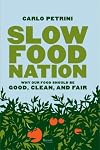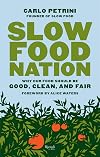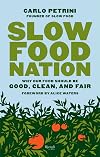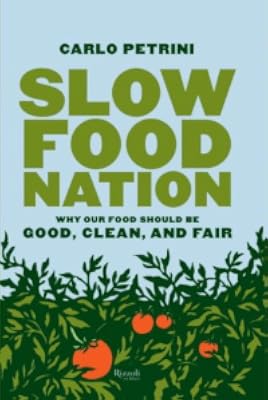
Slow Food Nation: Why Our Food Should Be Good, Clean, And Fair
by Carlo Petrini
On This Page
Description
By now most of us are aware of the threats looming in the food world. The best-selling Fast Food Nation and other recent books have alerted us to such dangers as genetically modified organisms, food-borne diseases, and industrial farming. Now it is time for answers, and Slow Food Nation steps up to the challenge. Here the charismatic leader of the Slow Food movement, Carlo Petrini, outlines many different routes by which we may take back control of our food. The three central principles of show more the Slow Food plan are these: food must be sustainably produced in ways that are sensitive to the environment, those who produce the food must be fairly treated, and the food must be healthful and delicious. In his travels around the world as ambassador for Slow Food, Petrini has witnessed firsthand the many ways that native peoples are feeding themselves without making use of the harmful methods of the industrial complex. He relates the wisdom to be gleaned from local cultures in such varied places as Mongolia, Chiapas, Sri Lanka, and Puglia. Amidst our crisis, it is critical that Americans look for insight from other cultures around the world and begin to build a new and better way of eating in our communities here.. show less
Tags
Recommendations



Member Reviews
This book was written by a founding member of The Slow Food Movement, and it discusses the main philosophies of the movement. Food should be good: Although taste will vary greatly from culture to culture, good also means that it is processed as little as possible. Food should be clean: Using as few pesticides, non-GMO, it should travel as short a distance as possible, and we should strive to save biodiversity in crops and the surrounding environment. Food should be fair: People should be paid a living wage.
The book also discusses the importance of saving/documenting food growing/preserving traditions, as well are redefining the concept of a 'gastronome' from the fat jolly person who only thinks about food, to one who is concerned with show more food being good, clean and fair. It stresses the idea that traditional ideas about agriculture/food preservation can be just as valid as the newer ideas, and we need to preserve these before it is too late.
The book brought up some interesting political points about global intervention in food that really made me think.
When Europe and other countries started banning GMOs, countries like the US found themselves with a huge surplus, especially with GMO corn. What they did was 'dump' it on poorer nations as a charitable donation. Sounds reasonable correct? Only this lead to the many local farmers abandoning their farms as it was no longer financially viable. Which lead to.. you guessed it, more famine the next year. So more food dumps... and fewer farmers again.
A very interesting non-fiction book, recommended to anyone with an interest in ethnography, politics, food, or the environment. show less
The book also discusses the importance of saving/documenting food growing/preserving traditions, as well are redefining the concept of a 'gastronome' from the fat jolly person who only thinks about food, to one who is concerned with show more food being good, clean and fair. It stresses the idea that traditional ideas about agriculture/food preservation can be just as valid as the newer ideas, and we need to preserve these before it is too late.
The book brought up some interesting political points about global intervention in food that really made me think.
When Europe and other countries started banning GMOs, countries like the US found themselves with a huge surplus, especially with GMO corn. What they did was 'dump' it on poorer nations as a charitable donation. Sounds reasonable correct? Only this lead to the many local farmers abandoning their farms as it was no longer financially viable. Which lead to.. you guessed it, more famine the next year. So more food dumps... and fewer farmers again.
A very interesting non-fiction book, recommended to anyone with an interest in ethnography, politics, food, or the environment. show less
The founder of the Slow Food movement lays out the case for why our food should be good, clean and fair, and how it can become so.
I'm not sure whether to blame Petrini or the translator for the diction in this book: the word choice is very academic. (By academic, I mean that there are words like "organoleptic" which strive for precision and instead make the text difficult to absorb and comprehend.) It's an odd tone for a book that's clearly meant to be an argument for a change in the way we perceive some of our daily activities (selecting, buying, preparing and eating food), but it is in keeping with Petrini's eclectic network-building between agro-ecologists, international politicians, rural food producers, celebrity chefs and critics, show more and family matriarchs. There's a little bit of everything in here: quotations from UN reports, emotional stories about individual producers, esoteric cultural criticism, personal anecdote, analysis of world agriculture and economics.
If the occasional "Under the frenetic impulse of technocratic and reductionist thought, we have fallen into the temptation of neglecting the totality of the processes and inter-relations that enable us to eat every day..." kind of sentence puts you off, then I'd skip this book. I kept a dictionary close by, and made it through with only a few eye rolls. show less
I'm not sure whether to blame Petrini or the translator for the diction in this book: the word choice is very academic. (By academic, I mean that there are words like "organoleptic" which strive for precision and instead make the text difficult to absorb and comprehend.) It's an odd tone for a book that's clearly meant to be an argument for a change in the way we perceive some of our daily activities (selecting, buying, preparing and eating food), but it is in keeping with Petrini's eclectic network-building between agro-ecologists, international politicians, rural food producers, celebrity chefs and critics, show more and family matriarchs. There's a little bit of everything in here: quotations from UN reports, emotional stories about individual producers, esoteric cultural criticism, personal anecdote, analysis of world agriculture and economics.
If the occasional "Under the frenetic impulse of technocratic and reductionist thought, we have fallen into the temptation of neglecting the totality of the processes and inter-relations that enable us to eat every day..." kind of sentence puts you off, then I'd skip this book. I kept a dictionary close by, and made it through with only a few eye rolls. show less
Dry as all get out.
Ratings
Members
- Recently Added By
Author Information

22 Works 724 Members
Carlo Petrini is a food writer and the founder and president of the International Slow Food Movement. He lives in Bra, Ital William Mccuaig is a translator living in Toronto
Series
Belongs to Publisher Series
Common Knowledge
- Original title
- Buono, Pulito e Giusto
- Original publication date
- 2005
- People/Characters
- Carlo Petrini; Alice Waters
Classifications
- Genres
- Nonfiction, Food & Cooking, General Nonfiction
- DDC/MDS
- 641.013 — Applied science & technology Home economics & family management Food, Cooking & Recipes / Meals, Picnics standard subdivisions Philosophy and theory [formerly: Epicurism]
- LCC
- TX631 .P47313 — Technology Home economics Home economics Nutrition. Foods and food supply
- BISAC
Statistics
- Members
- 238
- Popularity
- 137,271
- Reviews
- 3
- Rating
- (3.22)
- Languages
- English, Italian, Spanish, Swedish
- Media
- Paper, Ebook
- ISBNs
- 9
- ASINs
- 1