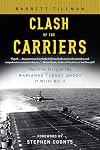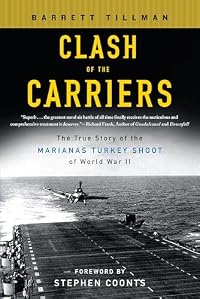
Clash of the Carriers: The True Story of the Marianas Turkey Shoot of World War II
by Barrett Tillman
On This Page
Description
The incredible true story of the most spectacular aircraft carrier battle in history-World War II's Great Marianas Turkey Shoot. In June, 1944, American and Japanese carrier fleets made their way toward one another in the Philippine Sea. Their common objective: the strategically vital Marianas Islands. During two days of brutal combat, the American and Japanese carriers dueled, launching wave after wave of fighters and bombers against one another. By day and night, hundreds of planes filled show more the skies. When it was over, the men of the American Fifth Fleet had claimed more than four hundred aerial combat victories, and three Japanese carriers lay on the bottom of the Pacific Ocean. Here is the true account of those great and terrible days-by those who were there, in the thick of the Battle of the Philippine Sea. Drawing upon numerous interviews with American and Japanese veterans as well as official sources, Clash of the Carriers is an unforgettable testimonial to the bravery of those who fought and those who died in a battle that will never be forgotten. show lessTags
Recommendations






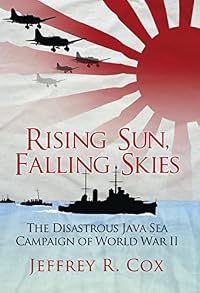
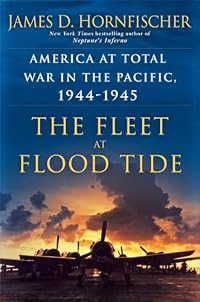


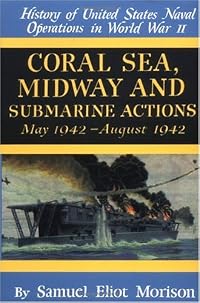
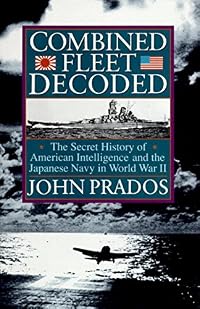





Member Recommendations
Member Reviews
Very well intentioned book on an overlooked World War II battle in the Pacific. The conflict was more massive than the Battle of Midway in ships and men, it was an obliteration of many Japanese aircraft carriers and Japanese naval attack aircraft. It also goes by the name of Battle of Saipan, or the Battle of the Philippine Sea. This book calls it the Battle of the Marianas or the Marianas' Turkey Shoot due to the almost constant shoot downs of Japanese fighter planes and bombers. I found out that the Japanese had take and occupied Guam and were using it as a base for men ad aircraft. I knew the Japanese had taken the Philippines but this battle did not involve those islands. In the Pacific theatre there were three major battles, 1) show more Coral Sea, 2) Midway, 3) Marianas and sometimes a fourth is listed as Leyte Gulf. It was strange to see what was happening. The AMericans were trying to capture an Island called Tinian. It had an airstrip which the Americans were going to use as a base for heavy bombers (B-29 super fortresses) to bomb Japan on command. Once that happened the war would soon be over. That island was where B-29s would attack Hiroshima and Nagasaki to eventually end the war with Japan's total surrender. A very interesting book with perhaps a little too much dry detail of factual numbers of boats and persons who were too numerous to keep track of. Part of the unorthodox methodology is that the author who is competent on military history also like to narrate an exciting adventure story about the US Navy for which he has obvious respect and admiration. He switches back and forth between history and thrilling historical events without transitions which are jarring. I understand them, but they don't always flow well for the reader. A lot of the story covers the Japanese a well. A lot of research went into this but it was a long book which finally rewards to the attentive page turner. Several things are noted in this book. This was the last time aircraft carriers fought aircraft carriers. This was because the US Navy had superior planes and pilots, better resupply ships, the use of effective radar, and finally the lethality of submarines which took out a carrier. There could be no more carrier battles because the Americans had sunk all the Japanese carriers and carrier planes. Aircraft carriers are called that because they house and refuel planes which take off and land on a carrier. Midway is famous because the tide of the war changed miraculously and providentially. After the Battle of the Philippine Sea, Japan could no longer launch offensive attacks anywhere against the Americans. It became a defensive war for Japan to which they refused to surrender, sadly. Good book if a little too ambitious. I learned a lot from this historical overview of the war in the Pacific. show less
I rarely abandon a book, but this one I did. In the 50 pages I managed there was much about every aspect of WW2 carrier warfare except the ostensible subject of the book.
Those first 50 pages are written as though by a bad sportswriter, with lots and lots and lots of facts and figures, connected only by being about WW2 naval operations, but presented in a painfully meandering style. It's as if he took his notes, threw them in the air, and wrote about them in the order he picked them up. Consequently there are lots of non sequiturs, un-referenced statements that seem bogus on their face, and an overall lack of clarity as to what point, exactly, he might be trying to make in any given paragraph/page/section/chapter. It doesn't help that he show more tried never to use the same word twice, or an ordinary one where jargon is available: the text is a mish-mash of four different vocabularies all at once: regular English, official US Navalese, US naval slang, and Japanese. Then there's the editing, which appears to have been performed solely by his word processor's spelling checker.
In an unwonted grant of the benefit of the doubt, I actually gave it two stars because for all I know it gets better after page 50. But if I were you, I wouldn't risk your time on that chance. show less
Those first 50 pages are written as though by a bad sportswriter, with lots and lots and lots of facts and figures, connected only by being about WW2 naval operations, but presented in a painfully meandering style. It's as if he took his notes, threw them in the air, and wrote about them in the order he picked them up. Consequently there are lots of non sequiturs, un-referenced statements that seem bogus on their face, and an overall lack of clarity as to what point, exactly, he might be trying to make in any given paragraph/page/section/chapter. It doesn't help that he show more tried never to use the same word twice, or an ordinary one where jargon is available: the text is a mish-mash of four different vocabularies all at once: regular English, official US Navalese, US naval slang, and Japanese. Then there's the editing, which appears to have been performed solely by his word processor's spelling checker.
In an unwonted grant of the benefit of the doubt, I actually gave it two stars because for all I know it gets better after page 50. But if I were you, I wouldn't risk your time on that chance. show less
While a lot of naval books focus on the 'big' battles of war - Jutland, Midway, The Atlantic - this one is an in-depth study recollecting a US vs. Japan battle in the Philippine Sea in gaining control of the Guam and its island neighbours. The term 'Turkey Shoot' was coined by an airman after one of the dogfights during the week-long fight and is famous for being a totally fought in the air by two battle groups hundreds of miles apart where surface ships never saw sight of each other.
While Midway became the real turning point in the Pacific War for the Americans when Japan lost a lot of its major 'flat tops', Philippine Sea all but sealed the deal as the Japanese, stretched at best, lost not only three more carriers, but somewhere show more close to 75% of its remaining seaborne aircraft, and more importantly experienced pilots.
The recollection is very good in building up to the battle, the planning and sparring from both sides while putting into layman's terms what was happening, and what the risk was to both sides. Calling on interviews from survivors on both sides it is (almost) balanced in its reporting, however it does tend to lean towards the American side i bias, something which is probably easy to do when the author is a Yank, and the Yanks were deemed the victors.
All in all a fascinating read that doesn't bore one with too much jargon and has a good focus on the thoughts and fears of those who dueled in the air. I have read many a book on war and more often than not I have sometimes wondered how the hell the Allies managed to win, what with poor planning, poor execution, and more often than not inter-service distrust. This book almost has you thinking the same thing, but the underlying tone in this is courage, and risk, and the Americans more than had this with near fatal results. Nothing to take away from the Japanese; hopelessly outnumbered and in inferior hardware, but if one chapter sticks out for me, it comes near the end when the American aircrews are left with no choice but to 'come home' in the dark.
Thrilling stuff that makes it hard to put down... show less
While Midway became the real turning point in the Pacific War for the Americans when Japan lost a lot of its major 'flat tops', Philippine Sea all but sealed the deal as the Japanese, stretched at best, lost not only three more carriers, but somewhere show more close to 75% of its remaining seaborne aircraft, and more importantly experienced pilots.
The recollection is very good in building up to the battle, the planning and sparring from both sides while putting into layman's terms what was happening, and what the risk was to both sides. Calling on interviews from survivors on both sides it is (almost) balanced in its reporting, however it does tend to lean towards the American side i bias, something which is probably easy to do when the author is a Yank, and the Yanks were deemed the victors.
All in all a fascinating read that doesn't bore one with too much jargon and has a good focus on the thoughts and fears of those who dueled in the air. I have read many a book on war and more often than not I have sometimes wondered how the hell the Allies managed to win, what with poor planning, poor execution, and more often than not inter-service distrust. This book almost has you thinking the same thing, but the underlying tone in this is courage, and risk, and the Americans more than had this with near fatal results. Nothing to take away from the Japanese; hopelessly outnumbered and in inferior hardware, but if one chapter sticks out for me, it comes near the end when the American aircrews are left with no choice but to 'come home' in the dark.
Thrilling stuff that makes it hard to put down... show less
Fascinating insite into the circumstances and men behind this WW2 battle.
"In June 1944, American and Japanese carrier fleets steamed toward each other, seeking battle in the Philippine Sea." "Their clashing objectives: retaining the vital Marianas for Japan versus seizing the islands for American air bases. When the fleets met, they embarked upon a naval engagement that escalated into the most spectacular aircraft carrier battle in history - a battle that would later become known as the Great Marianas Turkey Shoot." "During two days of brutal combat, the American and Japanese carriers dueled, launching wave after wave of fighters and bombers against one another in an all-out fight for supremacy, By day and night, hundreds of planes filled the skies. When it was over, the exhausted pilots of the American show more Fifth Fleet had claimed more than four hundred aerial c... show less
Ratings
Members
- Recently Added By
Author Information

Barrett Tillman grew up flying and has spent hundreds of hours in historic aircraft. His cockpit perspective gives his writing about aerial warfare an unmatched immediacy. The author of more than forty books, including Enterprise and Whirlwind, he is a familiar television commentator, with credits on the History Channel and National Geographic show more Channel. His work has been cited in dozens of history books and integrated into course work by the Air Force, Navy, and Marine Corps. Tillman lives in Mesa, Arizona, with his wife, Sally. show less
Some Editions
Common Knowledge
- Original title
- Clash of the Carriers: The True Story of the Marianas Turkey Shoot of World War II
- Original publication date
- 2005-11
- Important places
- Mariana Islands; Pacific Ocean; Philippine Sea
- Important events
- World War II (1939 | 1945); World War II, Pacific Theater (1941-12-07 | 1945-09-02); Battle of the Philippine Sea (1944-06-19 | 1944-06-20)
- Related movies
- Midway (1976 | IMDb); Tora! Tora! Tora! (1970 | IMDb)
- Dedication
- For Jig and Ginger and Alex and Kay
- First words
- Foreword: Once upon a time carrier decks were straight, Grummans had tail-wheels, and Pratt & Whtneys had props.
Preface: Marianas: The word conjures different meanings to different audiences.
Prologue: On Tuesday, June 6, 1944, a huge invasion fleet departed its various embarkation areas, formed up, and shaped course for a hostile shore. - Last words
- (Click to show. Warning: May contain spoilers.)Ironically - or perhaps not - the Marianas attract more travelers from Japan than any other nation.
- Blurbers
- Frank, Richard B.; Vraciu, Alexander; Cooper, Jeff; Sakaida, Henry; Polmar, Norman
- Original language
- English
Classifications
Statistics
- Members
- 220
- Popularity
- 147,745
- Reviews
- 5
- Rating
- (3.60)
- Languages
- English
- Media
- Paper, Audiobook, Ebook
- ISBNs
- 5
- ASINs
- 4