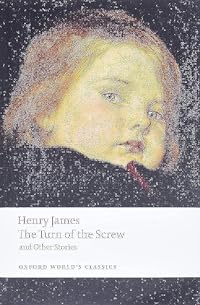
The Turn of the Screw and Other Stories [Oxford World's Classics]
by Henry James
On This Page
Description
Whether viewed as a subtle, self-conscious exploration of the haunted house of Victorian culture, filled with echoes of sexual and social unease, or simply as "the most hopelessly evil story we have ever read," The Turn of the Screw is probably the most famous of ghostly tales and certainly the most eerily equivocal. This new edition includes three rarely reprinted ghost stories from the 1890s, "Sir Edmund Orme," "Owen Wingrave," and "The Friends of the Friends," as well as relevant extracts show more from James's notebooks and journals. show lessTags
Recommendations









Member Reviews
This carefully curated (one might almost say 'over-academic') collection of four Henry James' supernatural stories of the 1890s is well worth reading together rather than singly. What we see is not so much a focus on the supernatural as on the supernatural as coded social commentary.
This is the literature of unease but not an uneasiness about worlds outside our own entering ours (which is the staple of weird fiction) but of the social and psychological worlds within which the 'ghosts' speak to us.
James, whose prose style is exceptionally precise yet often convoluted and not always something that 'flows' but rather which demands attention to get meanings often at the very edge of understanding, has his supernatural express what is hard show more to say directly to a nineteenth century elite audience.
The 'ghosts' (such as they are) are often sublimated feelings or conditions which the author has decided to 'realise' (real-ise) so that the reader will get a frisson from his or her recognition of something on the edge of their own social perception but which is still culturally difficult to state.
'Sir Edmund Orme' treats of guilt at trivialising another's emotion, 'Owen Wingrave' of defiance of enforced social convention where heroism lies in defying the demand to be heroic and 'The Friends of Friends' tells of the dangerous emotion of instinctive desire that breaks social demands.
The ghosts and the supernatural enable the stories to be told elliptically and sometimes tragically. The upper middle class reader does not have to make moral judgements but only experience the unease that would be felt if they were forced to do so in company. James saves their embarrassment,
To uncover the moral problems in these cases, where individual reality comes up against social convention, would require someone to make an existential choice for or against guilty acts and for or against commitment to the self over social expectation. This is not what Victorians wanted to do.
James' realism (his supernatural is embedded in the social conditions of his time) is at its most effective when emotion explodes into direct view - as when the female narrator of 'Friends' suddenly has to breach (irrationally or socially rationally?) the conditions of her assumed future happiness.
When she sees how her intended relates to what appears to be a 'ghost', she feels betrayed. Yet she was the instrument. She can forgive neither him nor herself. They would have been happy together in convention if not for an incident (perhaps as much as Nora and Thorvald in 'A Doll's House').
James captures all the complexity of the human condition and conventional upper middle class sexual relations in this masterful story just as he explores simpler determinations and feelings in 'Orme' and 'Wingrave'. Yet always things must re-stabilise eventually into conventional social reality.
This brings us to the classic 'The Turn of the Screw' which has always had two interpretations - that the narrator is unhinged (perhaps from romantic sexual longing for an ideal) or that there really are two evil figures corrupting two innocent children.
Much ink has been expended on trying to demonstrate one case rather than the other but the operation is futile. The ambiguity strikes me as intentional. The text could be interpreted in either direction. Even an apparently decisive textual point can be made to crumble with determination.
Perhaps the contemporary perception of the story itself being 'evil' lies intuitively in this refusal to not resolve the matter for the reader. After all, hanging in the air is the death of a child which is at the hands of the ghost, of a governess or of neither.
The narrator is unreliable. Every 'fact' is told us by her and her alone. The agreement to the facts of Mrs Grose, the housekeeper, is only the agreement as constantly supplied by the narrator on her terms. Is the manuscript that of a psychotic or a victim of evil that she valiantly stands against?
This irresolution takes us back to the earlier stories where there is in each case a resolution - a happy conclusion, a death and a breach that allows the narrator to progress. But here there is a final shocking event and then a manuscript on which we may not be able to rely.
The unease thus lies in the uncertainty. The framing introduction is important here because the story is regarded as so shocking that the gentlemen seem pleased in retrospect that the ladies had to leave and could not hear its telling. The latter had expected a classic ghost story, not a tale of evil.
As to the reading audience, the shock would have been greater in 1898 than to our jaded palates because it would be difficult to admit the governess was unhinged and possibly complicit in the shocking event. The evil must lie in two lower class servants.
Bear in mind the peculiar status of governesses in Victorian society. Generally poorly qualified, they were often young and inexperienced with child-minding the only way to remain within the comfort of their class yet were no less dependant than a servant. Governesses were ambigiuous creatures.
And this is the other factor in the game. Exactly what evil are we talking about? The nature of the evil is never stated. We never really know what Miles got expelled from school for. It obviously was unmentionable by the headmaster in his letter.
Is there a dark implication of some abuse that got replayed at school since what we seem to be told (if reliable) is not that Miles did something but that he said something unmentionable? If it was unmentionable in the story, you can be sure it would be unmentionable when the story was discussed.
This air of mystery directs itself into the reader's unease - as much at his or her own inner thoughts about the story as at what happens in the story. The 'ghost' (dark thoughts) may be no more than the imaginings within the reader. The story is evil because it brings evil thoughts to mind.
It has to be said that James does get himself into a pickle once or twice in his use of language where things become a little incoherent in exchanges but this occasional incoherence seems to be necessitated by his project which requires that he can never be explicit about the core of the tale.
One incident strikes me as important. The narrator is so shaken by a conversation with Miles (where to be honest he says nothing that could not be reasonably interpreted as just 'growing up') that she cannot enter church for service and runs away.
Why? This is never truly explained. Whereas vampires and ghouls cannot enter a church, Miles and his little sister have no difficulty but our governess does. What might that say about the source of evil here - is she tainted by her thoughts and are the children truly innocent?
Time and time again, we come back to their being only one narrator to retain our faith in the tale. Are any children quite so perfect and unsullied? Is her account of Quint and Miss Jessel truly 'ab initio'? Why do others not see what she sees while she indicates that they sense their reality?
Four remarkable stories that show a most subtle literary genius at work but one who refuses both didacticism and art for art's sake. In these stories, James shows up a mirror to the secret lives of his conventional readers without intending to have them judged.
This particular edition also has a great deal of scholarly background material related to the stories but the academicism of introduction, appendices, notes and variant readings rather misses the point. Even James' own later 'Prefaces' add little. The stories stand in and of themselves. show less
This is the literature of unease but not an uneasiness about worlds outside our own entering ours (which is the staple of weird fiction) but of the social and psychological worlds within which the 'ghosts' speak to us.
James, whose prose style is exceptionally precise yet often convoluted and not always something that 'flows' but rather which demands attention to get meanings often at the very edge of understanding, has his supernatural express what is hard show more to say directly to a nineteenth century elite audience.
The 'ghosts' (such as they are) are often sublimated feelings or conditions which the author has decided to 'realise' (real-ise) so that the reader will get a frisson from his or her recognition of something on the edge of their own social perception but which is still culturally difficult to state.
'Sir Edmund Orme' treats of guilt at trivialising another's emotion, 'Owen Wingrave' of defiance of enforced social convention where heroism lies in defying the demand to be heroic and 'The Friends of Friends' tells of the dangerous emotion of instinctive desire that breaks social demands.
The ghosts and the supernatural enable the stories to be told elliptically and sometimes tragically. The upper middle class reader does not have to make moral judgements but only experience the unease that would be felt if they were forced to do so in company. James saves their embarrassment,
To uncover the moral problems in these cases, where individual reality comes up against social convention, would require someone to make an existential choice for or against guilty acts and for or against commitment to the self over social expectation. This is not what Victorians wanted to do.
James' realism (his supernatural is embedded in the social conditions of his time) is at its most effective when emotion explodes into direct view - as when the female narrator of 'Friends' suddenly has to breach (irrationally or socially rationally?) the conditions of her assumed future happiness.
When she sees how her intended relates to what appears to be a 'ghost', she feels betrayed. Yet she was the instrument. She can forgive neither him nor herself. They would have been happy together in convention if not for an incident (perhaps as much as Nora and Thorvald in 'A Doll's House').
James captures all the complexity of the human condition and conventional upper middle class sexual relations in this masterful story just as he explores simpler determinations and feelings in 'Orme' and 'Wingrave'. Yet always things must re-stabilise eventually into conventional social reality.
This brings us to the classic 'The Turn of the Screw' which has always had two interpretations - that the narrator is unhinged (perhaps from romantic sexual longing for an ideal) or that there really are two evil figures corrupting two innocent children.
Much ink has been expended on trying to demonstrate one case rather than the other but the operation is futile. The ambiguity strikes me as intentional. The text could be interpreted in either direction. Even an apparently decisive textual point can be made to crumble with determination.
Perhaps the contemporary perception of the story itself being 'evil' lies intuitively in this refusal to not resolve the matter for the reader. After all, hanging in the air is the death of a child which is at the hands of the ghost, of a governess or of neither.
The narrator is unreliable. Every 'fact' is told us by her and her alone. The agreement to the facts of Mrs Grose, the housekeeper, is only the agreement as constantly supplied by the narrator on her terms. Is the manuscript that of a psychotic or a victim of evil that she valiantly stands against?
This irresolution takes us back to the earlier stories where there is in each case a resolution - a happy conclusion, a death and a breach that allows the narrator to progress. But here there is a final shocking event and then a manuscript on which we may not be able to rely.
The unease thus lies in the uncertainty. The framing introduction is important here because the story is regarded as so shocking that the gentlemen seem pleased in retrospect that the ladies had to leave and could not hear its telling. The latter had expected a classic ghost story, not a tale of evil.
As to the reading audience, the shock would have been greater in 1898 than to our jaded palates because it would be difficult to admit the governess was unhinged and possibly complicit in the shocking event. The evil must lie in two lower class servants.
Bear in mind the peculiar status of governesses in Victorian society. Generally poorly qualified, they were often young and inexperienced with child-minding the only way to remain within the comfort of their class yet were no less dependant than a servant. Governesses were ambigiuous creatures.
And this is the other factor in the game. Exactly what evil are we talking about? The nature of the evil is never stated. We never really know what Miles got expelled from school for. It obviously was unmentionable by the headmaster in his letter.
Is there a dark implication of some abuse that got replayed at school since what we seem to be told (if reliable) is not that Miles did something but that he said something unmentionable? If it was unmentionable in the story, you can be sure it would be unmentionable when the story was discussed.
This air of mystery directs itself into the reader's unease - as much at his or her own inner thoughts about the story as at what happens in the story. The 'ghost' (dark thoughts) may be no more than the imaginings within the reader. The story is evil because it brings evil thoughts to mind.
It has to be said that James does get himself into a pickle once or twice in his use of language where things become a little incoherent in exchanges but this occasional incoherence seems to be necessitated by his project which requires that he can never be explicit about the core of the tale.
One incident strikes me as important. The narrator is so shaken by a conversation with Miles (where to be honest he says nothing that could not be reasonably interpreted as just 'growing up') that she cannot enter church for service and runs away.
Why? This is never truly explained. Whereas vampires and ghouls cannot enter a church, Miles and his little sister have no difficulty but our governess does. What might that say about the source of evil here - is she tainted by her thoughts and are the children truly innocent?
Time and time again, we come back to their being only one narrator to retain our faith in the tale. Are any children quite so perfect and unsullied? Is her account of Quint and Miss Jessel truly 'ab initio'? Why do others not see what she sees while she indicates that they sense their reality?
Four remarkable stories that show a most subtle literary genius at work but one who refuses both didacticism and art for art's sake. In these stories, James shows up a mirror to the secret lives of his conventional readers without intending to have them judged.
This particular edition also has a great deal of scholarly background material related to the stories but the academicism of introduction, appendices, notes and variant readings rather misses the point. Even James' own later 'Prefaces' add little. The stories stand in and of themselves. show less
The Turn of the Screw was the last story of the four, but I’ll review it up front as the titled work. It’s a novella length story and by far the best in this collection in terms of atmosphere, quality of prose, and level of discomfiture provoked in the reader (in this reader, at least). The children worried me rather a lot; Flora and Miles, so very innocent and cherished for that innocence by their new and devoted governess, who fears for that quality when she realises the former valet to their uncle and their former governess are haunting them. The undercurrent of hysteria, the reticent narration, interspersed with fraught moments of confrontation; make this one of the defining gothic mysteries. The progress in story was a little show more densely hidden at times, but by no means inaccessible; James’ wordiness is an asset to this tale, if anything.
Sir Edmund Orme is interesting if not absolutely creepy, and with characters that one doesn’t mind joining for a ghost hunt. The subtle, almost deferential, figure of Sir Edmund, lingering in the background of the young lady’s life, to the deep consternation of her mother, is one of the more convincing shades in literature, though sadder than horrifying.
While I followed the story with little problem, Owen Wingrave, the second story in the collection, is the one that James’ prose does the least credit. Maybe I was overtired, but I had to reread many paragraphs several times before feeling I had caught the gist and I’m not sure that the end of the story warranted that much effort.
The Friends of Friends was different enough from the rest of the content to intrigue and surprise me; two ‘soulmates’ fall in love secretly, without the benefit of ever having met or communicated, joined by a shared supernatural trait. There’s nothing sinister about this story, but there is an air of near-danger that is quite compelling. show less
Sir Edmund Orme is interesting if not absolutely creepy, and with characters that one doesn’t mind joining for a ghost hunt. The subtle, almost deferential, figure of Sir Edmund, lingering in the background of the young lady’s life, to the deep consternation of her mother, is one of the more convincing shades in literature, though sadder than horrifying.
While I followed the story with little problem, Owen Wingrave, the second story in the collection, is the one that James’ prose does the least credit. Maybe I was overtired, but I had to reread many paragraphs several times before feeling I had caught the gist and I’m not sure that the end of the story warranted that much effort.
The Friends of Friends was different enough from the rest of the content to intrigue and surprise me; two ‘soulmates’ fall in love secretly, without the benefit of ever having met or communicated, joined by a shared supernatural trait. There’s nothing sinister about this story, but there is an air of near-danger that is quite compelling. show less
frankly, i read only The Turn of the Screw. sifting through the stilted Victorian prose was less than fun and i openly skoffed at many of the idiomatic phrasings and vocabulary, finding them to be too massively wordy. however, there were long stretches that i simply did not understand as well. they seemed to contradict themselves. just when i thought the governess was making a positive statement another person would deny it or, worse, agree with it and then the governess would promptly deny it. or so it seemed to me. i found it to be difficult.
once past all that, the story itself was very straight forward and rather simple. i have heard the word "intense" used to describe this story many times but the only intensity seemed to emanate show more from the protagonist and her seemingly abstract machinations and attempted orchestrations to get the children to admit what they were seeing. or what she believed they were seeing.
the disturbing parts were the governess's encounters with the "horrors" that stared at her with a grim ferocity. the story does hint that these visions may be all in her mind and does seem to be some of the reason that she does her utmost to maneuver the children into confession. however, nothing else about the story as it's told was engaging to me. i have been wanting to see a movie or theatre adaptation of this tale for some time now but can never find it.
the afterimages i'm left with are of the "horrors," the deceit of the children, Victorian era household drama, and the hint at delusion. all else is a blur. i would love for this to be re-written into modern prose by someone who understands it fully because i feel like i've missed out on something great. show less
once past all that, the story itself was very straight forward and rather simple. i have heard the word "intense" used to describe this story many times but the only intensity seemed to emanate show more from the protagonist and her seemingly abstract machinations and attempted orchestrations to get the children to admit what they were seeing. or what she believed they were seeing.
the disturbing parts were the governess's encounters with the "horrors" that stared at her with a grim ferocity. the story does hint that these visions may be all in her mind and does seem to be some of the reason that she does her utmost to maneuver the children into confession. however, nothing else about the story as it's told was engaging to me. i have been wanting to see a movie or theatre adaptation of this tale for some time now but can never find it.
the afterimages i'm left with are of the "horrors," the deceit of the children, Victorian era household drama, and the hint at delusion. all else is a blur. i would love for this to be re-written into modern prose by someone who understands it fully because i feel like i've missed out on something great. show less
*multiple copies owned*
Ratings
Members
- Recently Added By
Lists

el
1,139 works; 1 member
Author Information

1,061+ Works 87,953 Members
All Editions
Some Editions
Series
Belongs to Publisher Series
Work Relationships
Common Knowledge
- Canonical title
- The Turn of the Screw and Other Stories [Oxford World's Classics]
- Original publication date
- 1969 (collection) (collection)
- First words
- The Turn of the Screw: The story had held us, round the fire, sufficiently breathless, but except the obvious remark that it was gruesome, as on Christmas eve in an old house a strange tale should essentially be, I remember n... (show all)o comment uttered till somebody happened to note it as the only case he had met in which such a visitation had fallen on a child.
- Last words
- (Click to show. Warning: May contain spoilers.)The poor man's state is almost my consolation; there are really moments when I feel it to be quite my revenge.
- Disambiguation notice
- The Turn of the Screw • Sir Edmund Orme • Owen Wingrave
Classifications
Statistics
- Members
- 615
- Popularity
- 47,454
- Reviews
- 4
- Rating
- (3.69)
- Languages
- English
- Media
- Paper, Ebook
- ISBNs
- 10
- ASINs
- 2