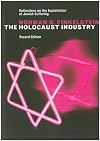
The Holocaust Industry: Reflections on the Exploitation of Jewish Suffering
by Norman G. Finkelstein
On This Page
Description
This iconoclastic study was one of the most widely debated books of 2000. Finkelstein indicts with vigor and honesty those who exploit the tragedy of the Holocaust for their own personal political and financial gain. This new edition includes updated material discussing the initial reception to the book's publication. In a controversial new study, Norman G. Finkelstein moves from an interrogation of the place the Holocaust has come to occupy in American culture to a disturbing examination of show more recent Holocaust compensation agreements. Leaders of America's Jewish community were delighted that Israel was now deemed a major strategic asset and, Finkelstein contends, exploited the Holocaust to enhance this newfound status. Their interpretations of the tragedy are often at variance with historical events and are employed to deflect any criticism of Israel and its supporters. Finkelstein contends that the main danger posed to the memory of Nazism's victims comes not from the distortions of Holocaust deniers but from prominent, self-proclaimed guardians of Holocaust memory. The Holocaust Industry is all the more disturbing and powerful because the issues it deals with are so rarely discussed. show lessTags
Recommendations












































Member Reviews
*1.5
I feel strongly about reading books you know you might not like: I want my options challenged. I decided then to read this highly rated book for some counter-perspective on Israel through the lens of the Holocaust industry, as someone who engages in pre-Holocaust history and literature as much as possible. I spent the last year in college studying this stuff, I’ve written way too many papers, and I have so, so many opinions on post-Holocaust/Holocaust memorial-ism that I could go on about it for hours.
Anyways, If it’s not apparent, I believe in a Jewish homeland. Generally speaking, I like Israel. Despite this, I am not without criticism, but at the end of the day I am an American with no skin in the game, and the country is not show more going anywhere anytime soon. As my Israeli coworkers (and chosen family) like to complain about, “These Americans have no idea what our country is like” (and to make it clear, they said this to both our protestors AND the overeager American Jews supporting our business).
To begin with, the political nature of American Jewry beginning in the first chapter is not dealt with well at all. The author makes very strong, very broad condemnations of their power simply because Finkelstein believes them to be in the wrong. There is no moral framework he supplies to us, and we are supposed to agree. Why? I wanted him to convince me! But he refuses to engage! While there are many valid criticisms of the identity of diasporic American Jewry I can think of (mostly surface-level critiques of its shtetl-philia), Finkelstein’s insistence that its alignment with Israel is the lynchpin of its banality is frankly a gross overstatement. I think at its core, and I’m figuring this out the more I read the various theories, is that Finkelstein views world politics through such a contrarian lens that it ultimately horseshoes into extremism. I don’t think it’s an overstatement to say Finkelstein’s writing enables extremism and antisemitism on both the left and right.
I was almost not shocked then when I learned the author recently supported noted anti-Holocaust author David Irving and even writes about him in this small book. Finkelstein clearly uses his family’s Holocaust tragedy and his parent’s survivor status as a shield to any countercriticism, in the exact way that he is accusing American Jewry of doing when they do not engage with criticisms of Israel.
The only chapter saving this from a straight 1-star rating is chapter 3. In it, Finkelstein finally lays out the crummy underworld of the Holocaust reparations world, and it is indeed, arguably, bad. Despite this genuine critique, the author continues to couch any moral answer to this to the horrible United States government. I want to shake him because I agree, that the US government can definitely suck, but it still is not enough of a reason for Israel to not exist. Finkelstein delights in whataboutism; I felt like I was reading a Fox News teleprompter as he deflected instead onto American ignorance of Native and African American reparations, the murdered non-Jewish groups during the Holocaust, and of course (Finkelstein’s favorite punching bag) the lies of Ellie Wiesel. All of these suck Mr. Finkelstein, this is not a “gotcha!” moment. I will gladly die on the hill of the need to remember the murder of Polish peasants, not only because they are human but because I believe they offer a key to fighting Eastern European anti-semitism. But none of these negate Jewish suffering. And hey, Mr. Finkelstein, guess what? My entire Polish family was murdered by the Soviets. Eat shit.
Ultimately, this book is polemic without giving me a good reason to change any of my opinions. You should have complicated feelings about Israel—but the book does not offer the nuance the subject needs. Finkelstein is a master of laying down a claim with evidence and construing it to the most inane, dangerous conclusions. These conclusions, when extended with the most forgiving evidence, are weak. There are very valid ways to critique the state of Israel without slipping into vague Holocaust denialism. This book does not offer them. show less
I feel strongly about reading books you know you might not like: I want my options challenged. I decided then to read this highly rated book for some counter-perspective on Israel through the lens of the Holocaust industry, as someone who engages in pre-Holocaust history and literature as much as possible. I spent the last year in college studying this stuff, I’ve written way too many papers, and I have so, so many opinions on post-Holocaust/Holocaust memorial-ism that I could go on about it for hours.
Anyways, If it’s not apparent, I believe in a Jewish homeland. Generally speaking, I like Israel. Despite this, I am not without criticism, but at the end of the day I am an American with no skin in the game, and the country is not show more going anywhere anytime soon. As my Israeli coworkers (and chosen family) like to complain about, “These Americans have no idea what our country is like” (and to make it clear, they said this to both our protestors AND the overeager American Jews supporting our business).
To begin with, the political nature of American Jewry beginning in the first chapter is not dealt with well at all. The author makes very strong, very broad condemnations of their power simply because Finkelstein believes them to be in the wrong. There is no moral framework he supplies to us, and we are supposed to agree. Why? I wanted him to convince me! But he refuses to engage! While there are many valid criticisms of the identity of diasporic American Jewry I can think of (mostly surface-level critiques of its shtetl-philia), Finkelstein’s insistence that its alignment with Israel is the lynchpin of its banality is frankly a gross overstatement. I think at its core, and I’m figuring this out the more I read the various theories, is that Finkelstein views world politics through such a contrarian lens that it ultimately horseshoes into extremism. I don’t think it’s an overstatement to say Finkelstein’s writing enables extremism and antisemitism on both the left and right.
I was almost not shocked then when I learned the author recently supported noted anti-Holocaust author David Irving and even writes about him in this small book. Finkelstein clearly uses his family’s Holocaust tragedy and his parent’s survivor status as a shield to any countercriticism, in the exact way that he is accusing American Jewry of doing when they do not engage with criticisms of Israel.
The only chapter saving this from a straight 1-star rating is chapter 3. In it, Finkelstein finally lays out the crummy underworld of the Holocaust reparations world, and it is indeed, arguably, bad. Despite this genuine critique, the author continues to couch any moral answer to this to the horrible United States government. I want to shake him because I agree, that the US government can definitely suck, but it still is not enough of a reason for Israel to not exist. Finkelstein delights in whataboutism; I felt like I was reading a Fox News teleprompter as he deflected instead onto American ignorance of Native and African American reparations, the murdered non-Jewish groups during the Holocaust, and of course (Finkelstein’s favorite punching bag) the lies of Ellie Wiesel. All of these suck Mr. Finkelstein, this is not a “gotcha!” moment. I will gladly die on the hill of the need to remember the murder of Polish peasants, not only because they are human but because I believe they offer a key to fighting Eastern European anti-semitism. But none of these negate Jewish suffering. And hey, Mr. Finkelstein, guess what? My entire Polish family was murdered by the Soviets. Eat shit.
Ultimately, this book is polemic without giving me a good reason to change any of my opinions. You should have complicated feelings about Israel—but the book does not offer the nuance the subject needs. Finkelstein is a master of laying down a claim with evidence and construing it to the most inane, dangerous conclusions. These conclusions, when extended with the most forgiving evidence, are weak. There are very valid ways to critique the state of Israel without slipping into vague Holocaust denialism. This book does not offer them. show less
According to Finkelstein, whose mother survived a Nazi labor camp, elite U.S. Zionist organizations fill their political war chests with money extorted in the name of surviving Holocaust victims. That's the most sensational of his claims, but no less remarkable is his case that these same organizations neither commemorated the Holocaust nor spoke for its victims until the U.S. government formed a strategic alliance with the State of Israel in 1967. The Holocaust, he concludes, has been exploited in the service of the U.S.-Israeli alliance.
Finkelstein has been denounced as a controversialist, but I found that in this book he deals efficiently with his critics. His well-spoken indignation is both engaging and justifiable, given the moral show more depth of his subject. However the book is sure to anger readers whose only moral compass is the query, "Is it good for Israel?" show less
Finkelstein has been denounced as a controversialist, but I found that in this book he deals efficiently with his critics. His well-spoken indignation is both engaging and justifiable, given the moral show more depth of his subject. However the book is sure to anger readers whose only moral compass is the query, "Is it good for Israel?" show less
When I first heard all the controversy surrounding Mr. Finkelstein's book I had to read it myself and find out what all the fuss was about. And the book proved to be a devastating and air-tight argument examining the immoral and corrupt racket that is the Holocaust Industry. I understand that this is a touchy subject, and I can also understand that this book may be upsetting to some who feel that the book could reinforce dangerous and ugly stereotypes, but I don't think it ultimately will. Finkelstein's argument is focused and serious, and he is able to support his claims with first-rate research, providing comprehensive footnotes built into the text. Finkelstein argues that the Holocaust was not a historically unique event, and that show more all who support that claim are attempting to write a blank check to the State of Israel. He examines how the Holocaust and the State of Israel did not figure that greatly into Jewish American life prior to the June 1967 war. Additionally, Finkelstein exposes frauds on the topic, such as Kosinsky with "The Painted Bird," and Wilkomirsky with "Fragments," as well as Holocaust exploiters such as Elie Wiesel. But Finkelstein's most devastating argument is in the section on the Swiss Banks, in which large American Organizations have orchestrated a shakedown on Swiss Banks to turn a profit on Jewish suffering, a disturbing topic. Finkelstein provides careful analysis in dealing with the Swiss Banks, and his findings are difficult to refute. I have to admit, the post-script chapter where he summarizes further developments on the Swiss Banks issue is extremely dense and difficult to follow, but the information is necessary. I'm sure that events will follow in the future with regard to the Banks that will require further examination. As historian Raul Hilberg has said: [the book is good even though incomplete]. This text is a breakthrough of political analysis and a must read for anyone interested in the aftermath of the Holocaust. show less
This is the portuguese translation of the polemical book of Finkelstein about the present day abuses of the holocaust by a number of U.S. jewish organizations. Centering its attention in the connections between the holocaust in one hand, and support for Israel and the extortion of huge financial compensations that rarely reach the actual survivors, in the other hand, this very angry and uncompromizing book, written by a descendent of survivors of Maidanek and Auschwitz, offers a much more radical critique than Novick's, and, unfortunately, is probably not very far from the truth.
A classic!
Adquirido em mar/2008
ספר מרגיז, כתוב רע, מייגע. עם זאת אני חושד שיש אמת בטענה הבסיסית שלו - הארגונים היהודיים מנצלים את שם השואה לרעה ומשתמשים בה כמכשיר סחטנות לצרכים שלהם.
Oct 6, 2011Hebrew
1
Members
- Recently Added By
Lists

Top Five Books of 2020
982 works; 348 members
Author Information

27+ Works 2,424 Members
Norman G. Finkelstein teaches political science at DePaul University.
Common Knowledge
- Canonical title
- The Holocaust Industry: Reflections on the Exploitation of Jewish Suffering
- Original title
- The Holocaust industry . Reflections on the exploitation of Jewish sufferring
- Original publication date
- 2000
- Important events
- Holocaust
- Original language*
- Anglais (Etats-Unis) (Etats-Unis)
*Some information comes from Common Knowledge in other languages. Click "Edit" for more information.
Classifications
- Genres
- History, Nonfiction, General Nonfiction, Religion & Spirituality
- DDC/MDS
- 940.5318 — History & geography History of Europe History of Europe 1918- World War II, 1939-1945 Social, political, economic history; Holocaust Holocaust
- LCC
- D804.3 .F567 — History of Europe, Asia, Africa and Oceania History (General) World War II (1939-1945)
- BISAC
Statistics
- Members
- 962
- Popularity
- 27,288
- Reviews
- 7
- Rating
- (3.82)
- Languages
- 13 — Czech, Danish, Dutch, English, Estonian, French, German, Hungarian, Italian, Polish, Portuguese, Spanish, Swedish
- Media
- Paper, Ebook
- ISBNs
- 29
- UPCs
- 1
- ASINs
- 10